

Second wave is here!
Have you got your surf-board yet!
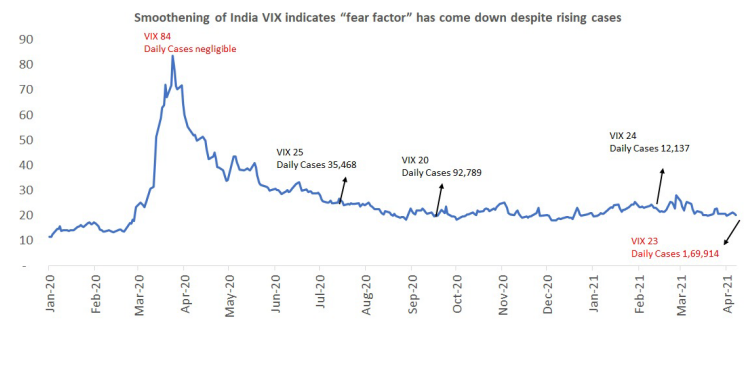
The second COVID wave and its alarming pace has surprised all of us. This is the subject of discussion in all media channels and Whatsapp groups for the last many days including the fact that we could see it rising before it peaks out given recent/ongoing elections in some states & religious gatherings like Kumbh Mela.
While it is true that, India is now in a mini lockdown situation in select states with cases spiking, what is also true is that the mortality rate continues to remain under check in India,
vaccinations are proceeding at a swift pace, on-ground economic indicators are not expected
to deteriorate materially and India Inc is far better prepared this year vs same time last year
when the pandemic struck, given the discovery of medicines/vaccines, some hindsight and
FII/DII/Retail with loads of money on their side.
Mortality rate of last 2months excluding +60 years age population is just 0.15%. Over 70% of India’s vulnerable (+45 years age) population and moderately vulnerable (30-45 years) would
get vaccinated by July’21 and Sep’21 respectively.
CASES RISING IN A HURRY BUT PANIC NOT SET IN
Spike in March & pan India spread takes everyone off guard
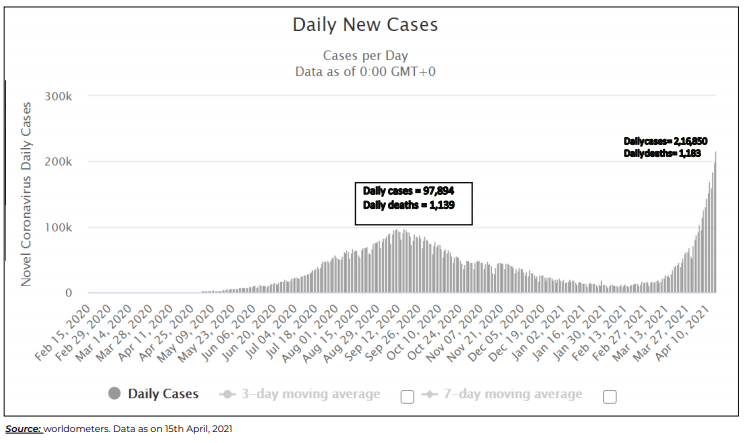
Even as we write this newsletter, India has crossed the 2.17Lakh daily COVID cases (15th April, 2021), an unfortunate milestone. The 2020 peak of daily cases of 97,894 was seen on 17th September. Thereafter cases declined drastically and by February, 2021 things looked to be under control. However, a second wave started soon after, in March, 2021 and India began to scale new peaks every day in April, 2021.
A silver lining – low mortality rate
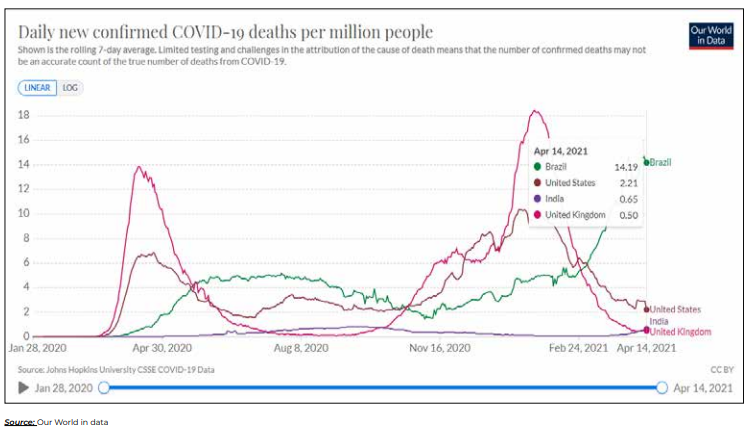
India has reached the (not-so-good) distinction of becoming the country with second highest number of confirmed COVID cases globally, after the USA. However, one very heartening thing is that, India’s death rate remains extremely low; the lowest among Top 10 countries with highest cases and lower than most other countries globally.
Every death is sad and unfortunate and every life precious; however, having a high death rate would have immensely compounded India’s problems. Given the moderate level of healthcare infrastructure that India has, it would have got extremely difficult to manage if death rate would have gone higher.
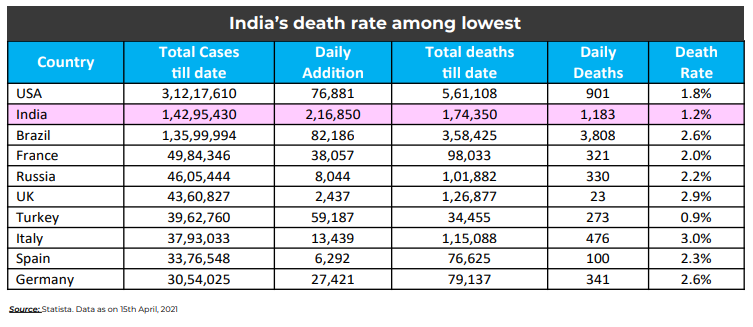
While the mortality rate till date in India is 1.2%, the incremental mortality rate (last 2months) has been only 0.6% and if we exclude the vulnerable population (+60 years age), it slips down to 0.15%.
Maharashtra no longer “Maha” worry
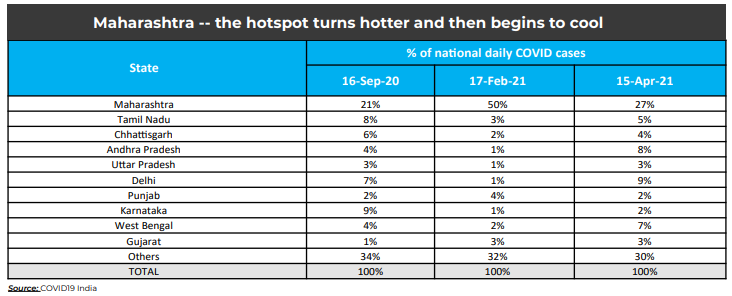
Maharashtra has always been the biggest contributor to India’s daily incremental cases, right from onset of the pandemic. Current wave was dominated by Maharashtra with 50-60% of new cases in Feb/March and approx.
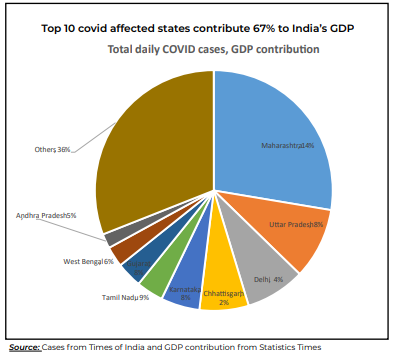
30% cases in April. Maharashtra contributes nearly 14% to India’s GDP and contributes nearly 18% of total GST paid by all Indian states / UTs. Hence, a fulldown lockdown or severe restrictions in Maharashtra would have affected economic growth of India, which doesn’t seem to be case currently.
Though cases have risen, there’s no cause for alarm as yet
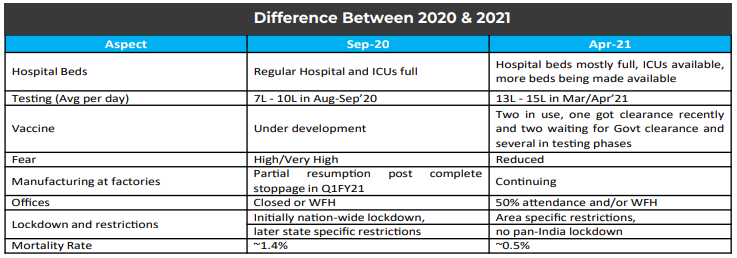
Let us take a look at India’s COVID preparedness in the previous wave and current. Governments (Central and State) have done and continue to do their best to increase India’s COVID preparedness. However, given the expanse of our country and its population, this will continue to be challenging.
OUR OWN SANJEEVANI BOOTI (VACCINE) IS HERE!
India to soon see a flurry of vaccines!
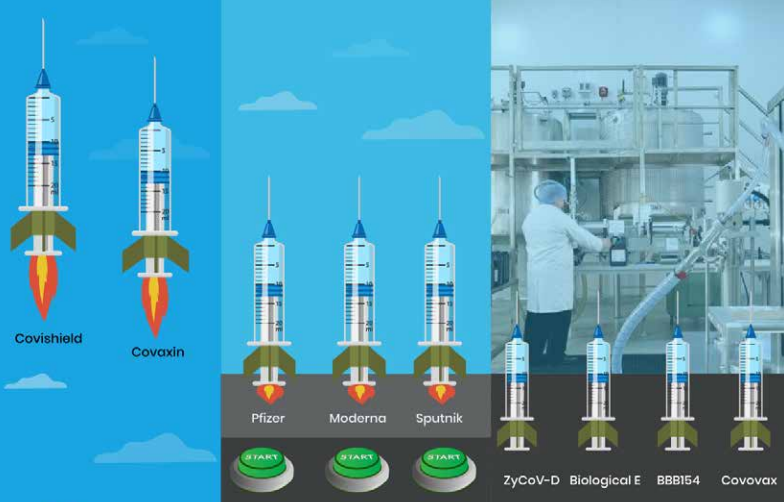
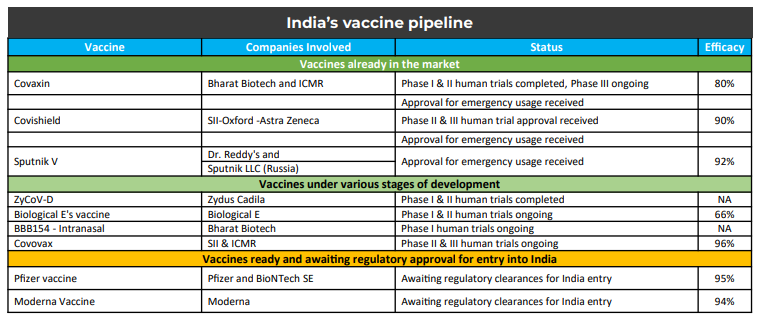
The best bet that countries have (presently) against the COVID-19 pandemic is vaccination. India has two vaccines which are being used in its programs currently – Covaxin (by Bharat Biotech) and Covishield (by Serum Institute of India, Astra Zeneca and Oxford). Pfizer and Moderna have already expressed their preparedness to enter into India, subject to Government approvals. Apart from these, nearly four vaccines are in various stages of trial and development currently. Besides, Sputnik V (Russia) recently received approval and is expected to hit the markets soon.
India’s vaccine manufacturing capacity
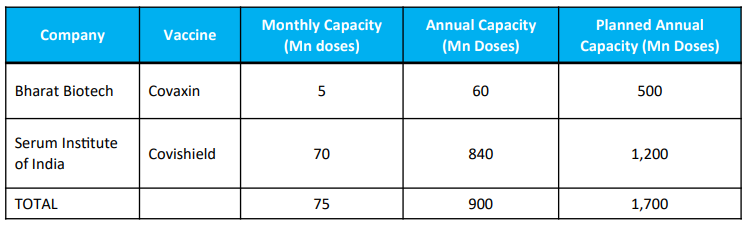
According to Business Today, India’s leading vaccine manufacturers SII, Bharat Biotech, Panacea Biotech, Sanofi’s Shanta Biotech, Biological E, Hester Biosciences and Zydus Cadila, have an installed capacity to manufacture 8.2bn doses of different vaccines per year. However, not all of this is used for COVID vaccine manufacturing. India’s COVID vaccine capacity is as follows:
COVID vaccine makers have approached the Government to provide them with Rs. 900cr support under the Mission COVID Suraksha. According to Government information,
The COVID-19 Vaccine development Mission with end-to-end focus from preclinical development through clinical development and manufacturing and regulatory facilitation for deployment, would consolidate all available and funded resources towards an accelerated product development.
This will help accelerate development of approx. 5-6 vaccine candidates and ensure that these are brought closer to licensure and introduction in market for consideration of regulatory authorities for introduction in public health systems, to combat further spread of COVID infection.
Phase-I of the COVID Suraksha Mission has been allotted Rs.900 Crore for a period of 12 months.
How India stacks up against other countries in vaccination
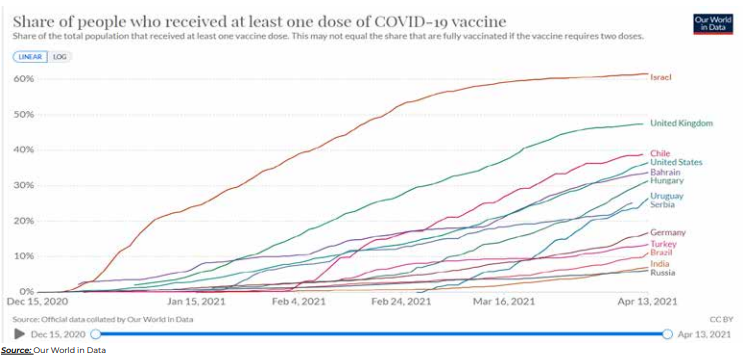
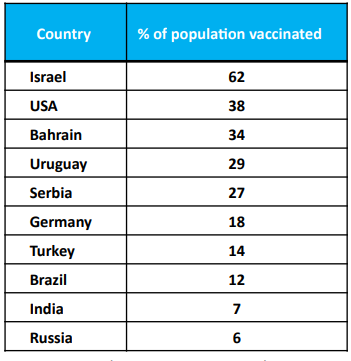
Source: Our World in Data. Data as on 15th April, 2021. Note: Share of the total population that received at least one vaccine dose. This may not equal the share that are fully vaccinated if the vaccine requires two doses.

Source : Britannica
India being a young country; only 25% of the total population is in the 45+ year bracket. However, at 1.34bn total population, this pegs the total people in the 45+ year category at 34cr, a humungous number. The number of people in the 45 – 59 year group, which is the Government’s most targeted group, is 21cr. Hence, there is an urgent need for India to speed up its rate of vaccination.
According to estimates by Hindustan Times (11th April,2021), India is currently on pace to deliver both doses to close to 5cr people by 13th May, 2021, and over 10cr
people by the end of May, 2021 if the country can keep administering an average of 40L doses a day. These timelines could get further reduced as and when new vaccines enter the market, post approval.
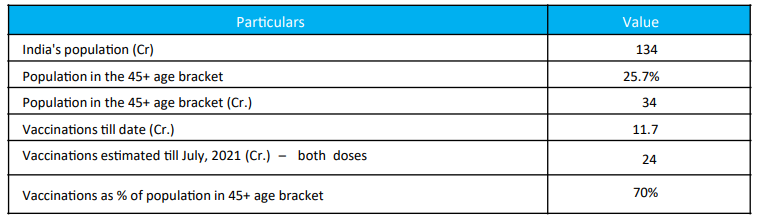
Given all the projections mentioned above, +70% of India’s vulnerable (+45 years age) population would get vaccinated by July, 2021. Similarly basis ramp-up in production and availability of other vaccines, a majority of the moderately vulnerable (30-45 years) should get vaccinated by Sep’21.
ECONOMIC IMPACT
How have India’s policy makers reacted to the second outbreak
The initial reaction of Central Government in 2020 was to impose a nation-wide lockdown. However, given different needs of different states, the Central Government soon gave the authority of imposing restrictions to individual State Governments. Here is a look at the same:
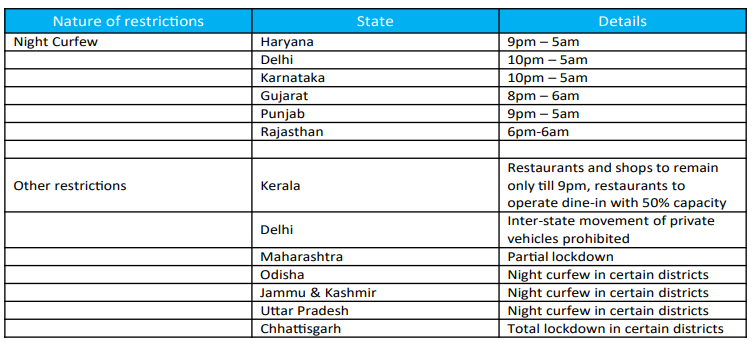
According to experts, India has considerably diluted its restrictions in 2021 compared to 2020. As per the Oxford COVID-19 Government Response Tracker, India’s stringency score was 100/100 in April, 2020 and reduced to ~58 in March, 2021.
Most State Governments have responded in a matured manner to the situation. For example, Maharashtra CM Mr. Uddhav Thackeray has asked the Central Government to provide more vaccines to the state, asked for more oxygen cylinders, has imposed partial restrictions rather than a complete lockdown. Given that Maharashtra is India’s most industrialized state, we feel that the CM’s measures provide a balancing act – don’t choke industries altogether but avoid unnecessary functions.
CM of Delhi has also announced restrictions for the new days, but has allowed essential businesses to run. Exams have been postponed or cancelled so that kids are not exposed to the risk. Lower grades have been promoted to the next grade while crucial exams (Std XII, graduation, post-graduation, etc.) have been postponed.
What do economists have to say?
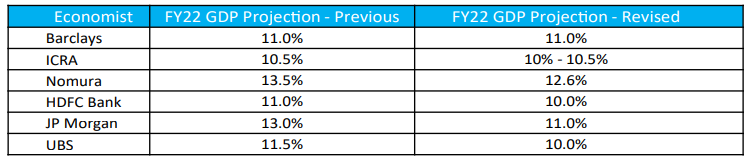
We have tried to present to you the current situation with respect to the pandemic, India’s response to it, Maharashtra’s response, the ongoing vaccination program and vaccine development. All these factors will no doubt have an impact on GDP growth. The second wave has forced economists to lower their FY22 GDP projections for India. However it still has the potential to grow in double digits owing to low base of FY21.
Following is a look at various GDP estimate revisions:
What signals has market been giving over past 5 “Corona quarters”
The following table gives an idea regarding which sectors have been preferred by investors over past five “Corona-affected” quarters:
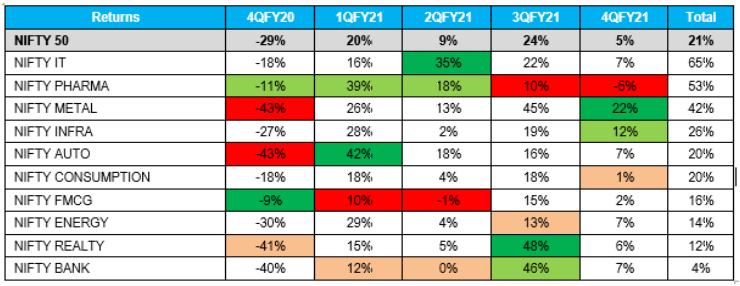
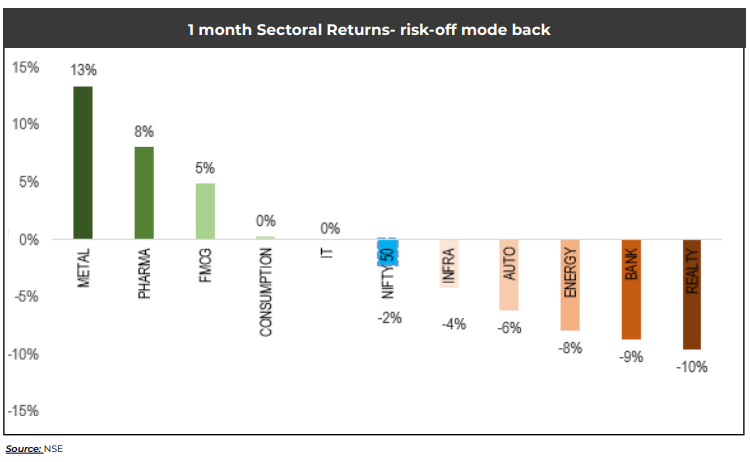
On the whole, investors had turned “risk-off” at the height of the pandemic as seen by the superior performance of Pharma and FMCG at the height of the pandemic in 2020 in Feb-Apr’20. As markets moved higher and recovery was in sight, investors became “risk-on” once again with superior performance from Realty, Infra and Banking. Superior performance of metal index is largely due to global commodity rally.
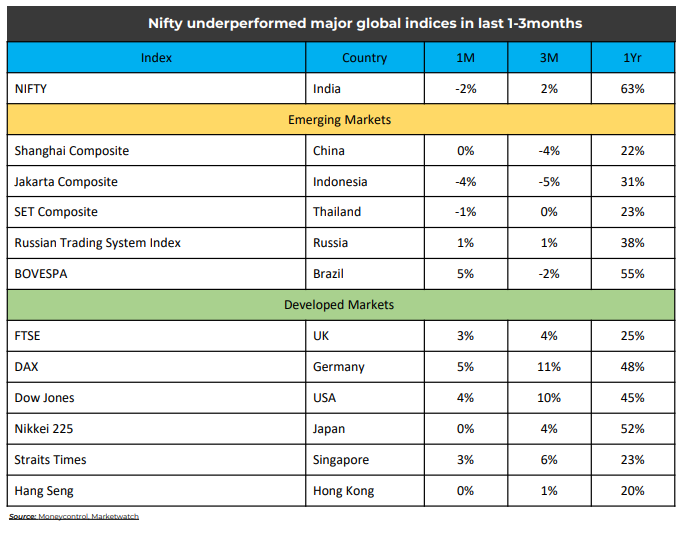
The expectation of daily covid cases peaking out anytime soon, rising share of Indians getting vaccinated, momentum of strong quarterly results continuing in 4QFY21 and continued dovish policy from RBI/monetary support from government are the short term triggers which will bring back the risk-on mode back, thereby arresting Nifty’s recent underperformance vs developed markets.
WHAT’S TRENDING
We thought that you’ve had enough of serious stuff floating around. Hence sharing a collection of some funny quotes that have been doing the rounds on internet and social media. We hope that this would bring a smile on your face.



I’m Archana R. Chettiar, an experienced content creator with
an affinity for writing on personal finance and other financial content. I
love to write on equity investing, retirement, managing money, and more.