Logo
  • About
    • Who we are
    • Video Gallery
    • Media, Award & Accolades
    • Newsletters
    • Life@equentis
    • Our Technology
    • Contact us
  • Businesses
    • Investment Advisory
      • 5 in 5 Strategy
      • MPO
      • Combo
      • Dhanwaan
    • Wealth Management
      • Portfolio Management Services (PMS)
        • Multi-Cap PMS
        • Concentrated Portfolio PMS
      • Alternative Investment Fund (AIF)
        • AIF CAT 1 (Angel Fund)
        • AIF CAT 2 (Growth Fund) Coming Soon
  • Equentis Group
    • Equentis Wealth Advisory Services Ltd.
    • Equentis Investech Ltd
    • Equentis Edutech Ltd
    • Super Smart Magic Productions LLP
  • Market Tools
    • Research Reports
      • JK Cements (PDF)
      • Bharat Electronics Ltd (PDF)
    • Stocks Screener
      • Trending Sector
      • Top Gainers
      • Top Losers
      • 52 Week High
      • 52 Week Low
      • High Growth Stocks
      • High Return Stocks
      • Dividend Stocks
      • Large Cap Stocks
      • Midcap Stocks
      • Smallcap Stocks
      • Low Price-High Volume Stocks
      • Trending Stocks Today
    • IPO
      • Current IPOs
      • Upcoming IPOs
      • Closed IPOs
      • Listed IPOs
      • IPO Performers
    • Financial Calculators
      • Income Tax Calculator
      • Retirement Planning Calculator
      • Asset/Investment Comparison Tool
      • Portfolio Review Calculator
      • CAGR Calculator
      • Budget Buddy Calculator
      • SIP Calculator
      • Reverse CAGR Calculator
      • Stock Average Calculator
      • Return on Investment Calculator
      • Inflation Calculator
      • Compound Interest Calculator
      • Stock Return Calculator
    • Popular Stocks
      • Adani Ports and SEZ
      • Asian Paints
      • Bajaj Finserv Ltd
      • Bharti Airtel
      • ICICI Bank
      • IRFC
      • Suzlon Energy
      • Tata Motors
    • Stock Recommendations
    • Market Guide
  • Pricing
  • Blogs
search
Login
Give a Missed Call
+91 80629 16290
Skip to content
  • Home
  • News
  • Is a Current Account Deficit A...

Is a Current Account Deficit Always a Worry for India?

Is a Current Account Deficit Always a Worry for India?
Picture of Archana Chettiar
  • Archana Chettiar
  • July 11, 2024
4.3
(3)

The term “current account deficit” (CAD) is often used in economic discussions, and in India’s case, it’s a topic of frequent debate. A CAD simply means a country imports more goods and services than it exports. While a deficit can raise concerns about external imbalances, it’s not always negative for a developing economy like India. Let’s first understand what a current account is and why a CAD arises.

Understanding the Current Account

The current account is a part of a country’s balance of payments (BoP), which tracks all its economic transactions with the rest of the world. It’s divided into three main components:

  • Merchandise Trade: It refers to the value of physical goods a country exports and imports.
  • Services Trade: This includes income earned from tourism, IT, and financial services.
  • Net Income from Abroad: This covers interest payments on foreign investments and worker remittances.

A CAD arises when the total value of imports (goods, services, and net income outflow) exceeds the total value of exports (goods, services, and net income inflow).

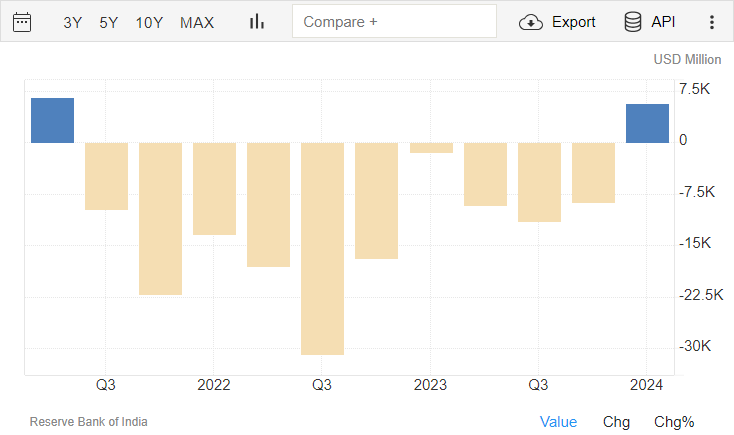
India recorded a current account surplus of $5.7 billion in the quarter ending March 2024. This is a significant shift from the $1.3 billion deficit in the previous quarter and marks the first surplus since June 2021. The surplus was mainly due to an increase in the services account surplus, which grew to $42.7 billion from 39.1 billion, driven by a 4.1% annual growth in services exports. 
AD 4nXdyBuwyvJ 75KuR1JtpuB7PWklM7WJ8sdOPEqQPy3k3h2 XgUf XD2x3Mw0WAZhFwtD sN
Source: Tradingeconomics

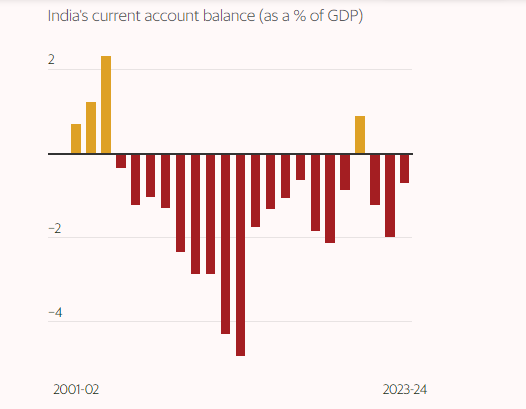
This means more money came into the country than went out, helping India limit its deficit in 2023-24 to $23 billion, or 0.7% of GDP.
AD 4nXcO4YzbM4JAjp RBbIWj JfMwxHDDwLIHEocZ6RXbnMhOix O mAHBtJymr3ZKnpzG4 tspoDP1avN57bJ8XCQdJJUYMb7nyr wCcC2md29Ga 78biOveiVNw13THqVJNQx kh vnFWq3kkUHrCCbHTVKD?key=Ij4iJPD69ofzUXXmkDctMg
Source: Livemint

This deficit is a seven-year low and the second-lowest in two decades, excluding the first pandemic year. India’s situation with the current account deficit (CAD) improved in 2023-24 due to several factors.

Factors For Falling Current Account Deficit

More Investments

There was a significant investment increase, likely due to higher government spending and a booming housing market. It could be because:

  • The government spent more, creating opportunities for companies to supply materials and services for new projects (like building roads).
  • The housing market boomed, leading to increased investment in construction and related services.

Savings on the Rise

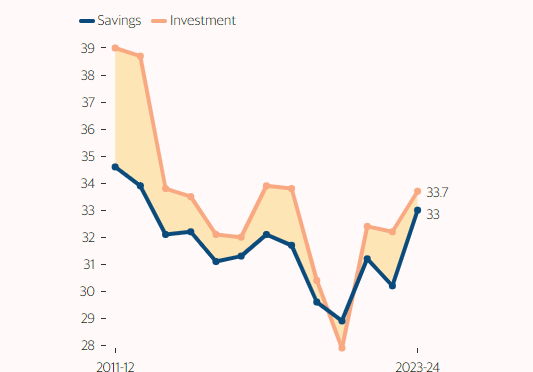
This rise in investments happened alongside a jump in savings. Imagine a household saving more money – India’s savings rate went up. This could be because:

  • People saved a larger portion of their income.
  • Companies earned higher profits and reinvested some of them.

The current Account Deficit Shrinks

Despite the increased imports for investments, India’s CAD decreased. This is because the savings rate went up even more! Think of it as the increase in savings outweighed the extra spending on imports. 

A higher savings rate allows India to invest more, even with a small CAD, which fuels economic growth. So, in this case, the CAD isn’t bad because it’s happening alongside solid savings and investment. It’s like using a credit card responsibly to invest in your future, not just for everyday expenses.

If India keeps a healthy savings rate (33%), even with a small deficit (borrowing 2%), it can still invest a lot (35%). This translates to ₹6 trillion available for building the nation’s future (infrastructure, education, etc.).

Deficits caused by high savings and increased investment can stimulate economic growth.
AD 4nXeQ76sD0 OLiNSWXca6BjdJ4oF5wGG7phHIb0Ubjq R IcehDoIpUc 6Y3 RGKGmQUMdO8qt S0 vSwwYdd62k
Source: Livemint

Let’s delve deeper into what a CAD signifies and explore how it can be beneficial under certain circumstances.

Potential Benefits of a Current Account Deficit for India

A moderate current account deficit can be a sign of a growing economy for several reasons:

  1. Financing Investment: A CAD allows India to access foreign capital. This capital can be used to finance crucial investments in infrastructure, technology, and other areas that boost long-term growth. Foreign direct investment (FDI) brings money, expertise, and technology, contributing to productivity gains.
  2. Competitive Imports: India’s current account deficit can indicate that it is importing essential goods for its development, like machinery and raw materials. These imports can help modernize industries, enhance production capabilities, and make Indian exports more competitive globally.
  3. Consumer Choice and Growth: A CAD allows consumers access to a wider variety of imported goods at potentially lower prices. This can stimulate domestic demand and economic growth.
  4. Currency Appreciation: A large inflow of foreign capital can strengthen the Indian rupee. However, a managed appreciation, where the rupee doesn’t become too strong, can make exports more competitive without hurting import-dependent industries.

The Importance of Management

For a CAD to be beneficial, it needs to be managed responsibly. Here’s why:

  • Sustainability: A large and persistent CAD can pressure the rupee’s value and lead to external vulnerabilities. India must ensure the CAD is financed by sustainable sources like FDI rather than short-term debt.
  • Composition of Imports: The type of imports matters. Focusing on essential goods and capital equipment is preferable to luxury items or excessive gold imports, which strain foreign exchange reserves.
  • Boosting Exports: A long-term strategy should focus on increasing exports to narrow the trade gap. This can be achieved by promoting manufacturing, improving product quality, and diversifying export markets.

India’s Young Population: A Potential Boon, But Challenges Remain

India has a lot of young people entering the workforce – a good thing in theory! This means more people working, which could lead to:

  • Higher Production: More workers can produce more goods and services.
  • Increased Income: With more people working, overall national income could rise.
  • More Savings: Ideally, with more income, people would also save more money.

The Bonus: Women in the Workforce: As families have fewer children, more women are joining the workforce, adding another layer of growth potential. This is called the “demographic dividend.”

The Challenge: Making it Work

Unfortunately, India hasn’t been able to capitalize on this opportunity entirely. Here’s why:

  • Not Enough Jobs: There aren’t enough good jobs for all the young people entering the workforce.
  • Skills Gap: Many workers don’t have the necessary skills for the available jobs.
  • Economic Setbacks: Events like demonetization and the pandemic hurt the economy, making saving harder for people.

The Result: A Funding Gap

Because of these challenges, India might be unable to save enough money to invest in things that could further boost the economy, like infrastructure and education. This could lead to a current account deficit, which means India would need to borrow money from other countries.

India’s Foreign Exchange Outlook

Here’s a breakdown of what’s happening with foreign exchange:

  • India’s government bonds are now included in some essential investment lists, which means more foreign investors are likely to buy them, bringing in more dollars.
  • India’s economy is growing fast, and with elections settled, businesses that were waiting might now invest in India, bringing in more foreign money.
  • If the US lowers interest rates, it could lead to more investment flowing into emerging markets like India.

The Challenge: Balancing the Flow

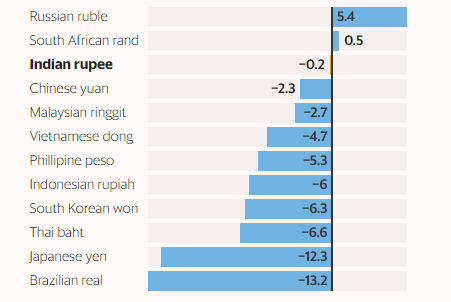
The Indian rupee has already strengthened a bit because of these positive factors. However, there are some things to keep in mind:

  • If the rupee gets too solid, Indian exports become more expensive and less competitive in the global market.
  • A current account deficit (borrowing from other countries) could help balance the inflow of foreign money and prevent the rupee from getting too strong too quickly.

Depreciation (in %) of the exchange rate against the US dollar in the first half of 2024
AD 4nXf2JCwL2ZXfH8YeQGE u1XpdcjHnjdPb9wM4eVJfwrIFRAJ0BqaRk MAYLNJgSMGKLkF oNq2VYU303N5Ai36MPQh6bMRZRFbd7aqm27HfqGV9voRYX7BC2mmwpnHVX3QLN8dtq 9M30epGodK3PrbZ3cw?key=Ij4iJPD69ofzUXXmkDctMg
Source: Livemint

The Quality of Deficits and Surpluses Matters

Whether a country spends more or less than it earns (a deficit or surplus) isn’t always good or bad. What matters is why it’s happening.

Good vs. Bad Deficits

  • Good Deficit: A good deficit is generally okay if a country borrows money to invest in things that will benefit the economy in the future (like building roads or schools).
  • Bad Deficit: Borrowing money to buy things that don’t help the economy grow, like importing too much gold, is not good.

Good vs. Bad Surpluses

  • Good Surplus: If a country saves money because it has many opportunities to invest within the country, that’s great.
  • Bad Surplus: If a country saves money because there’s nowhere good to invest it at home, it’s not ideal.

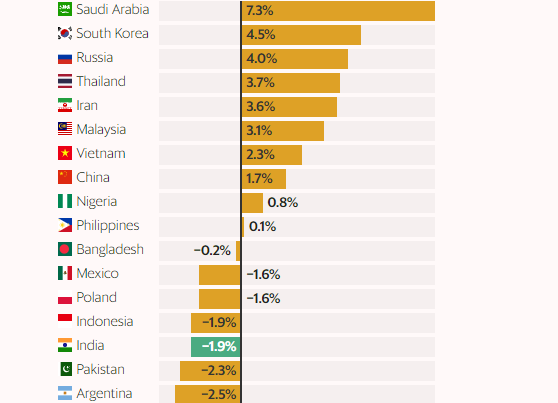
Half of the top 20 emerging markets consistently face current account deficits. In contrast, the surplus countries are either oil-rich (such as Russia and Iran), export-driven (like China, Thailand, and Korea), or emerging export leaders (such as Vietnam).

Average Current Account Balance for Top 16 Emerging Market Economies between 2012 and 2023
AD 4nXdivobee2h9JryIMGLLBsqWK5GGkmX5XEUkYj4BGmSp8h5e0opFt1YxGiczgYNegt1h6p1KtAYqJXtqWPxgp90H7hE6GG5zS2Dexp8ImU
Source: Livemint

A CAD isn’t inherently negative for a developing economy like India. It can be a source of investment, promote industrial growth, and offer consumers a more comprehensive range of goods. However, responsible management is crucial. Focusing on attracting FDI, boosting exports, and ensuring the import of essential goods are vital to reaping the benefits of CAD while mitigating potential risks. Following a balanced approach, India can leverage a moderate CAD to fuel its economic growth journey.

*Disclaimer Note: The securities quoted, if any, are for illustration only and are not recommendatory. This article is for education purposes only and shall not be considered as recommendation or investment advice by Research & Ranking. We will not be liable for any losses that may occur. Investment in securities market are subject to market risks. Read all the related documents carefully before investing. Registration granted by SEBI, membership of BASL, and certification from NISM in no way guarantee the performance of the intermediary or provide any assurance of returns to investors.

FAQs

  1. What is a current account deficit (CAD)?

    A current account deficit occurs when a country imports more goods, services, and capital than it exports. In simpler terms, the government spends more on foreign products and services than it earns from selling its products and services abroad.

  2. Is a current account deficit always bad for India?

    Not necessarily. A moderate CAD can sometimes be beneficial, mainly if used to fund productive infrastructure, technology, or education investments. However, a persistently high CAD can be problematic as it might lead to increased external debt and currency depreciation.

  3. What are the leading causes of India’s current account deficit?

    India’s CAD is primarily influenced by trade imbalance (importing more than exporting), higher oil prices, and gold imports. Income payments like dividends and interest on foreign investments can also contribute to the deficit.

  4. How can India reduce its current account deficit?

    India can address its CAD by boosting exports, promoting import substitution, attracting foreign investments, and controlling gold imports. Additionally, diversifying export markets and improving the economy’s efficiency can help reduce the deficit.

How useful was this post?

Click on a star to rate it!

Average rating 4.3 / 5. Vote count: 3

No votes so far! Be the first to rate this post.

39b1287e4d9721d2c114d0b36394c1b2bf07553038e9ca46d55e2604ae0e95d1?s=150&d=mp&r=g
Archana Chettiar
+ postsBio

I’m Archana R. Chettiar, an experienced content creator with
an affinity for writing on personal finance and other financial content. I
love to write on equity investing, retirement, managing money, and more.

  • Archana Chettiar
    https://www.equentis.com/blog/author/archana/
    Q4 Profit Crashes 99.7% – Star Health’s Expansion Story Faces Reality Check
  • Archana Chettiar
    https://www.equentis.com/blog/author/archana/
    Unlocking Global Wealth: A Beginner’s Guide to Overseas Investments (ODI)
  • Archana Chettiar
    https://www.equentis.com/blog/author/archana/
    Evolution of Overseas Investment Limits for AIFs
  • Archana Chettiar
    https://www.equentis.com/blog/author/archana/
    Gold Climbs ₹68500 in 10 Years. Akshaya Tritiya 2025 Arrives Amid Record Prices

Announcing Stock of the Month!

Grab this opportunity now!

Gandhar Oil Refinery (India) Ltd. IPO – Subscription Status,

Allotment & Other Key Dates

Registered Users

10 lac+

Google Rating

4.6

Related Articles

  • News
  • December 4, 2025

India’s Rupee Slips Past ₹90: What’s Going On

Read more
  • News
  • December 3, 2025

Meesho IPO Day 1 GMP Rises To The Highest Ever, Signals Strong Listing Pop

Read more
  • News
  • December 2, 2025

Big December IPO Lineup Key Details Of Meesho, Aequs Vidya Wires, And Others

Read more
Lenskart shares jump over 5%
  • News
  • December 1, 2025

Lenskart shares jump over 5% today after strong Q2 FY26 results

Read more

Unlock Stock of the Month

T&C*

Popular Blogs

Watch to stay on top of India’s favorite investor community

  • News
  • August 13, 2025

Paytm Share Price Hits 52-Week High After RBI Nod for Payment Aggregator Licence

Read more
  • Fundamental Analysis of Stocks
  • July 11, 2025

Maruti Suzuki Share Price: All You Need to Know

Read more
The Rise of Country Delight
  • Saga
  • June 20, 2025

From Cowsheds to Rs 1,380 Crores: How a Fresh Idea Created the Country Delight Empire

Read more
Asian Paints
  • Saga
  • June 19, 2025

Asian Paints: The Rs 2.2 Trillion Brand That Gave Colour to Every Indian Home

Read more
NSDL’s Upcoming Rs.3,000 Crore IPO Amid Market Slowdown: 4 Key Insights to Know
  • IPO, News
  • March 11, 2025

NSDL’s Upcoming Rs.3,000 Crore IPO Amid Market Slowdown: 4 Key Insights to Know

Read more
शेयर बाजार (Share Bazar) में 90% लोग अपना पैसा गंवा देते हैं। Research and Ranking
  • Hindi
  • February 21, 2025

हैरान करने वाली,लेकिन सच: शेयर बाजार (Share Bazar) में 90% लोग अपना पैसा गंवा देते हैं।

Read more

Stocks Directory

  • ALL
  • A
  • B
  • C
  • D
  • E
  • F
  • G
  • H
  • I
  • J
  • K
  • L
  • M
  • N
  • O
  • P
  • Q
  • R
  • S
  • T
  • U
  • V
  • W
  • X
  • Y
  • Z

Stocks

  • Adani Ports and SEZ
  • Asian Paints
  • Bajaj Finserv Ltd
  • Bharti Airtel
  • ICICI Bank Share Price
  • Mahindra & Mahindra
  • Kotak Mahindra
  • Reliance Industries Limited
  • Titan Company
  • Tata Motors
  • UltraTech Cement
  • Wipro
  • Hero MotoCorp
  • Shree Cement
  • Nestle India
  • Maruti Suzuki
  • HCL Technologies
  • ITC Limited
  • IRFC
  • Suzlon Energy
  • Adani Green
  • Tata Power
  • Yes Bank
  • IRCTC
  • Adani Wilmar
  • Tata Steel
  • Visa Steel
  • Oil India
  • BPCL
  • Affle India
  • Adani Power
  • Happiest Minds Technologies
  • Punjab & Sind National Bank
  • Canara Bank
  • CDSL
  • Trident
  • Urja Global
  • SAIL
  • Stocks Screener

Sectors

  • Agriculture
  • Airlines
  • Automobile Two & Three Wheelers
  • Bank - Private
  • Bank - Public
  • BPO/ITeS
  • Cement & Construction Materials
  • Chemicals
  • Cigarettes/Tobacco
  • Consumer Food
  • Defence
  • Diamond & Jewellery
  • e-Commerce
  • Educational Institutions
  • Engineering
  • Fertilizers
  • Fintech
  • Insurance
  • IT - Software
  • Leather
  • Oil Exploration
  • Paints
  • Pharmaceuticals & Drugs
  • Petrochemicals
  • Port
  • Printing & Stationery
  • Refineries
  • Restaurants
  • Shipping
  • Steel & Iron Products
  • Sugar
  • Tea/Coffee
  • Telecom-Infrastructure
  • Textile
  • Trading
  • Travel Services
  • Tyres & Allied
  • Watches & Accessories
  • Wood & Wood Products
  • Sector Screener

Tools

  • Income Tax Calculator
  • Retirement Planning Calculator
  • Asset/Investment Comparison Tool
  • Portfolio Review Calculator
  • CAGR Calculator
  • Budget Buddy Calculator
  • SIP Calculator
  • Reverse CAGR Calculator
  • Stock Average Calculator
  • Return on Investment Calculator
  • Inflation Calculator
  • Compound Interest Calculator
  • Stock Return Calculator

IPO Guide

  • Current IPOs
  • Upcoming IPOs
  • Closed IPOs
  • Listed IPOs
  • IPO Performers
  • Winning the IPO game
  • IPO Full Form
  • What are IPOs
  • IPO Allotment Process
  • How to Buy IPO
  • Pre-IPO Investing in India
  • IPO Mistakes to Avoid
  • What is GMP
  • All IPOs

Personal Finance

  • What is Form 16 and How to File ITR Without it?
  • Types of GST in India: A Comprehensive Guide
  • How to Calculate Income Tax on Salary with Example
  • A Quick Guide to Tax Deducted at Source
  • What Is A Collateral Loan, And How Does it Work?
  • Top Income Tax Saving Tips For Newly Married Couples
  • What is Income Tax?
  • Income Tax Concepts
  • How To File Income Tax Return Online
  • Income Tax Slabs FY 2023-24 and AY 2024-25
  • Basics of Income Tax for Beginners
  • What is Direct Tax: Types and Examples
  • A Quick Guide to Tax Deducted at Source (TDS)
  • Old Tax Regime: Slabs, Rates And Deductions
  • A Simple Guide to Claiming Income Tax Refund
  • What is Professional Tax?
  • Exemptions vs. Deductions in Taxable Income
  • Tax on Mutual Funds in India
  • New Tax Regime vs Old: Which Is Better?
  • How To Pay Less Tax
  • What is the Difference Between TCS and TDS?
  • 5 Best Tax-Saving Investment Options
  • Top 10 Cities You Should Move to Create Wealth
  • Why Retirement Planning Should be Different for Women and Men?
  • Life Stage Investing: How to Invest at Different Stages of Life
  • 30 Essential Financial Lessons to Master Before You Turn 30
  • How you can make 10 crores before you retire
  • Retirement Plan in India – 7 Step Guide
  • Want to Retire at 45? Here are 7 Steps to Make it Happen
  • Managing Finances After 80 in India
  • Top 7 Tips For Retirement Planning For This Year
  • Understanding the 4% Rule for Retirement Withdrawals
  • 7 New Ways To Manage Your Retirement in India
  • Investing For Retirement: 4 Inflation-Proof Strategies
  • What is the Retirement Age in India?
  • How you can make 10 crores before you retire?
  • How to Start Investing with a Low Budget?
  • Gross Salary vs Net Salary: What’s the Difference?
  • 25 Ways to Make Money Online, Offline, and at Home
  • Make Money in the Stock Market: 3 Easy Steps
  • 30 Best Side Hustle Ideas To Make Extra Money
  • 10 Smart Ways to Create Passive Income
  • Can Stocks Make You Rich?
  • 4 Smart Money Moves to Achieve Financial Freedom today
  • What Is Financial Freedom, And 9 Ways To Achieve It
  • The Money Lessons Which Were Not Taught In School!
  • 7 Smart Money Management Tips To Thrive On
  • 8 Powerful Tips for Saving Money
  • How to Save Money from Salary in India
  • Can The 15x15x15 Rule Help You Become a Crorepati?
  • Personal Finance: The Complete Guide
  • A Ready Guide To Teenager Investing
  • How Calculating Your Net Worth Can Help?
  • Why Lifestyle-Based Financial Planning Matter?
  • Blockchain in Finance: What It Is and How It’s Used?
  • Impact of Personal Loans on Financial Planning in India

Stock Market Guide

  • How to Learn Share Market?
  • How to Invest in Share Market
  • How to Choose the Right Stocks
  • What is the fundamental analysis of stocks?
  • Understanding Bull Markets
  • Bear Market Guide
  • What is Post-Market Session in Stock Market?
  • Best Stock Market Tips for Investing
  • Stock Market In India - Detailed History
  • What is a Stock Exchange?
  • Books to Learn about Share Market
  • Stock Market Timings (9:15 AM - 3:30 PM)
  • Understanding Stock Market Psychology
  • Stock Market for Beginners
  • Stock Market Holidays 2025
  • SEBI Registered Investment Advisory

Decoding Stock Market

  • Trend Analysis: How to Analyze Stock Market Trends?
  • Decoding the Balance Sheet For Beginners
  • Reading Stock Charts
  • What is CMP in Stock Market?
  • 30 Basic Financial Terms Every New Investor Must Know
  • How To Read A Candlestick Chart?
  • How to do company analysis?
  • Debt to equity ratio
  • What is ROE ratio?
  • What is P/E ratio?
  • What is P/B ratio?
  • What is EPS?
  • What is Compounding?
  • Power of Compounding
  • What is Financial Advisory?
  • What is Compound Interest?

Stock Market Indices

  • What is Sensex: The Complete Guide
  • What is NIFTY?
  • What Are Stock Market Indices?
  • Global Stock Market Index
  • European Stock Market
  • Asian Stock Market
  • Indian Stock Market
  • What Is an Index Fund?

Learning centre

  • Bazaar Ke Sanskaar
  • Business
  • Economy
  • Fundamental Analysis of Stocks
  • Hindi
  • Investing
  • Future Trends
  • Global
  • Investor Portfolios
  • IPO
  • Money Matters Q&A
  • News
  • Personal Finance
  • Retirement
  • Taxonomy
  • Saga

Market Movers

  • 52 Week High
  • 52 Week Low
  • Low Price-High Volume Stocks
  • Trending Stocks Today
  • Top Gainers
  • Top Losers
Investor Alert
   Beware of Fraudulent Activities in the Name of Equentis Wealth Advisory: It has come to our attention that certain individuals or groups are falsely using the name of Equentis Wealth Advisory Services Ltd., and even impersonating our company leaders, to promote fraudulent schemes. These scams often involve fake SEBI certificates and operate through platforms like WhatsApp, Telegram, Facebook, Instagram, and international mobile numbers. Your safety is our priority — if you suspect any suspicious activity or need verification, please reach out to us directly. Let’s work together to prevent these fraudulent practices and ensure secure investment experiences. For any queries, visit our official website at www.equentis.com or contact us at support@equentis.com.
Footer Logo

+91 22 61013800 / 38

support@equentis.com

Equentis Wealth Advisory Services Limited
Marathon Futurex, A-603 6th Floor, Mafatlal Mills Compound, N M Joshi Marg, Lower Parel East, Mumbai 400013

Follow us

FacebookTwitterLinkedInInstagramYoutubeTelegram

Customer Service

  • FAQ
  • KYC
  • Privacy Policy
  • Website Disclaimer
  • Terms of Service
  • Regulatory Disclosures
  • Escalation Matrix
  • Contact us
  • About us

Our Products

  • 5in5 Wealth creation startegy
  • MPO
  • Combo
  • Dhanwaan
  • Informed InvestoRR
  • Alternative Investment Fund(AIF)
  • Pricing

Quick Links

  • Login
  • Blogs
  • Elite Club Conclave
  • Magazine
  • Media and PR
  • Video Gallery
  • Newsletters
  • Your Connections, Your Rewards
  • Reviews

Equentis - Wealth Advisory Services™

SEBI Registration Details:

Registered Entity Name: Equentis Wealth Advisory Services Limited
Corporate Identification Number (CIN): U74999MH2015PLC262812
Registered Office:A603, Marathon Futurex, Mafatlal Mills Compound, N M Joshi Marg, Lower Parel East, Mumbai 400013

Investment Advisor (IA):

SEBI Registration No.: INA000003874 | BSE Enlistment No.: 1816
Type of Registration: Non-Individual | Validity: December 08, 2015 - Perpetual
Principal Officer: Mr. Manish Goel, Email: po@equentis.com. Contact: +91 22 61013800
Compliance Officer: Mr. Rakesh Gupta, Email: compliance@equentis.com, Contact: +91 22 61013800
Grievance Officer: Mr. Swapnil Patil, Email: grievance@equentis.com, Contact: +91 22 61013800

Portfolio Management Services (PMS):

SEBI Registration No.: INP000008969
Type of Registration: Non-Individual | Validity: September 09, 2024 – Perpetual
Compliance Officer: Mr. Rakesh Gupta, Email: pmscompliance@equentis.com, Contact: +91 22 61013800
Investor Relations Officer: Mr. Mahrshi Jagdish Mehta, Email: pmscompliance@equentis.com, Contact: +91 22 61013800

Alternative Investment Fund (AIF):

Equentis Wealth Advisory Services Limited is an Investment Manager to Equentis Angel Fund (Category - I AIF - VCF - Angel Fund) with SEBI Registration No. IN/AIF1/23-24/1419 and Equentis Alternative Growth Fund (Category - II AIF) with SEBI Registration no. IN/AIF2/25-26/1838.

SEBI Office Details:

SEBI Bhavan BKC,
Plot No.C4-A, ‘G’ Block, Bandra-Kurla Complex, Bandra (East), Mumbai - 400051, Maharashtra, India
Tel: +91-22-26449000 / 40459000
SEBI SCORES: https://scores.sebi.gov.in/scores-home | SMARTODR: https://smartodr.in/login

Disclaimers:

  1. Equentis Wealth Advisory Services Limited (“Equentis”) offers Investment Advisory Services under the brands “Equentis – MultiplyRR” and “Equentis – Research & Ranking.” Equentis is also a SEBI Registered Portfolio Manager and acts as the Sponsor and Manager of the Equentis Angel Fund and Equentis Alternative Growth Fund.
  2. Registration granted by SEBI, enlistment as IA with Exchange, and certification from NISM in no way guarantee the performance of the intermediary or provide any assurance of returns to investors.
  3. The company does not guarantee or provide any assurance of return, fixed returns, or risk-free return. Investments in the securities are subject to market risks. Read all the related documents carefully before investing.
  4. Past performance may or may not be sustained in the future, and there is no guarantee of future results.
  5. All fees and payments must be made solely to the Company’s designated bank account. The Company shall not be liable for any payments made to any specific individuals.

Copyright © 2023 Equentis Wealth Advisory Services Ltd. All Rights Reserved.