
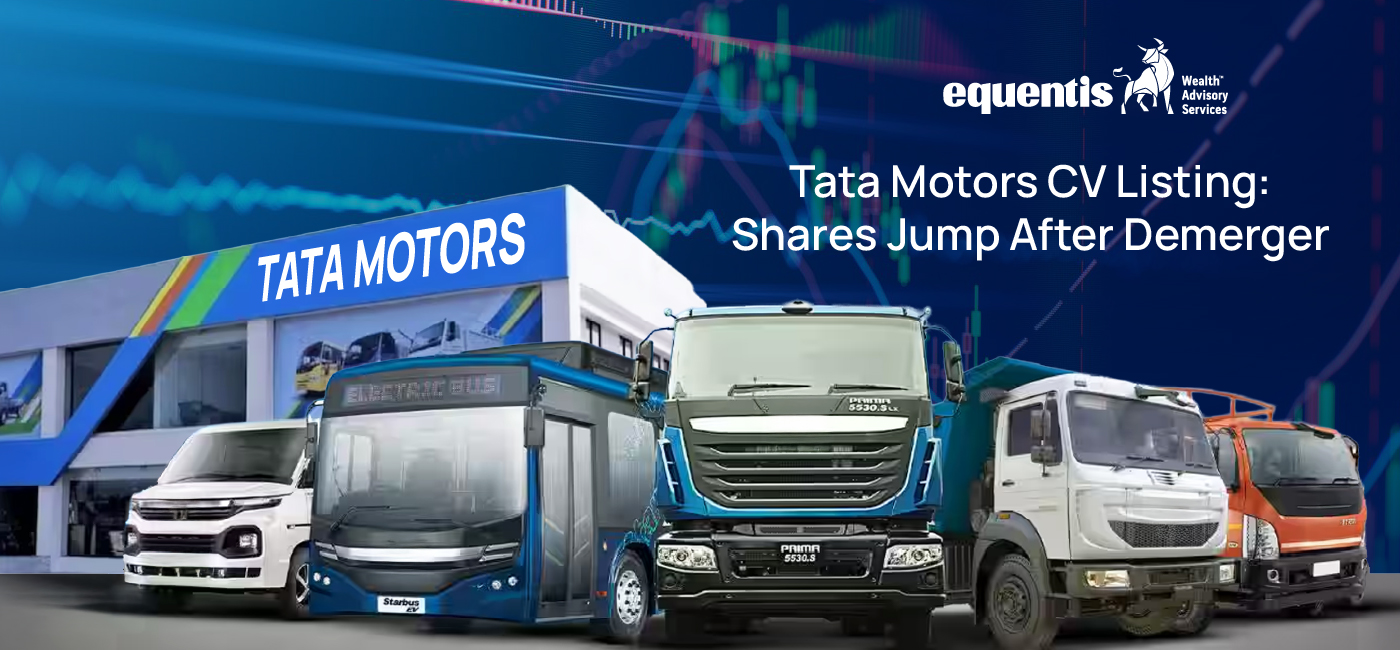

Tata Motors Limited, one of India’s leading automobile manufacturers, recently completed a major corporate restructuring with the demerger of its commercial vehicle (CV) and passenger vehicle (PV) businesses. Following the demerger, shares of Tata Motors’ commercial vehicle arm listed at a 28% premium, reflecting investor optimism about the move and its long-term potential for value creation.
The listing marks an important step in Tata Motors’ strategy to unlock value and improve focus in its key business verticals. The separation was aimed at allowing each entity to operate independently with clear strategic goals, operational efficiency, and capital allocation priorities.
Background of the Demerger
Tata Motors had announced its plan to demerge into two distinct listed entities—one focusing on commercial vehicles, and the other housing the passenger vehicle business along with the electric vehicle (EV) and Jaguar Land Rover (JLR) segments. The move was approved by the company’s board earlier in 2024 as part of a broader plan to streamline its structure and enhance operational agility.
Under the demerger scheme, shareholders of Tata Motors received shares in the newly listed commercial vehicle company in proportion to their existing holdings. This corporate action aimed to create clearer business identities, helping investors assess each company’s performance independently.
Listing and Market Reaction
After the demerger, the commercial vehicle shares made a strong market debut, listing at a 28% premium compared to the derived price from the parent company’s pre-demerger valuation. The listing was seen as a positive sign by market participants who believe the CV business has significant potential in the coming years, especially with India’s infrastructure growth and rising logistics demand.
Investors noted that the CV business of Tata Motors has been showing consistent improvement over the past few quarters, supported by a rebound in economic activity and increased government spending on infrastructure. The market’s initial response suggested confidence in the business’s standalone growth potential.
Why the Demerger Matters
The separation of Tata Motors’ businesses was designed to allow both entities—commercial and passenger vehicles—to pursue independent strategies and capitalize on different growth opportunities.
- Focused Management – Each company now has the freedom to define its priorities and allocate resources based on its business needs. The CV division can focus on fleet modernization, electric commercial vehicles, and international expansion, while the PV arm can drive innovation in passenger and electric cars.
- Operational Clarity – The demerger allows investors and analysts to better understand each segment’s performance. Earlier, the strong performance of one division could mask the challenges of another, making valuation complex.
- Capital Efficiency – With separate balance sheets, each company can raise funds independently, pursue acquisitions, or invest in R&D without being limited by the priorities of the other division.
- Enhanced Shareholder Value – Over time, such reorganizations tend to help unlock value as the market can assign fair valuations based on specific business strengths and growth prospects.
The Commercial Vehicle Business Outlook
Tata Motors’ commercial vehicle arm remains one of the largest players in India’s CV segment, with a diverse product portfolio spanning trucks, buses, small commercial vehicles, and defense mobility solutions. The company has been steadily regaining market share, driven by product upgrades and a focus on cleaner, more efficient technologies.
The government’s continued emphasis on infrastructure development, logistics efficiency, and rural connectivity provides a strong foundation for growth in the commercial vehicle sector. Additionally, the increasing adoption of electric commercial vehicles is likely to create new opportunities for Tata Motors CV in both domestic and export markets.
The company’s strategy includes expanding its alternative fuel lineup, improving after-sales service networks, and leveraging digital solutions to enhance fleet management for customers.
Passenger Vehicle and JLR Segment Post-Demerger
While the focus of the listing was on the CV business, the demerger also positions the passenger vehicle and JLR segments for greater independence. The PV business, which includes Tata’s growing electric vehicle lineup, has been performing strongly in recent years. With this separation, it can focus entirely on design innovation, EV expansion, and strengthening its premium product portfolio under the JLR brand.
Both divisions will now have the flexibility to pursue partnerships and strategic collaborations suited to their respective markets.
Analyst Views and Future Outlook
Market analysts view the Tata Motors demerger as a strategic move that can enhance long-term shareholder returns. By creating two focused and financially independent companies, Tata Motors has positioned itself to capture opportunities across different segments of the auto industry.
The commercial vehicle market in India is expected to grow steadily over the next decade, supported by economic expansion, construction activity, and the logistics industry’s formalization. Meanwhile, the passenger vehicle and EV divisions are likely to benefit from the shift toward sustainable mobility and changing consumer preferences.
However, analysts also caution that each new entity will need to maintain financial discipline and adapt to evolving market conditions. The commercial vehicle business, for example, remains sensitive to cyclical demand and input cost fluctuations, while the PV and JLR segments face global competition and evolving emission norms.
Conclusion
The listing of Tata Motors’ commercial vehicle shares at a 28% premium marks a significant milestone in the company’s corporate journey. The demerger allows both the CV and PV businesses to operate with greater clarity, focus, and agility. Investors appear to have welcomed the move, reflecting confidence in Tata Motors’ long-term vision and execution capabilities.
As both new entities chart their independent paths, the success of this restructuring will depend on how effectively they capitalize on their respective strengths. For now, the market’s early reaction signals optimism that Tata Motors’ strategic separation could lead to a stronger, more resilient automotive group in the years ahead.
Disclaimer Note: The securities quoted, if any, are for illustration only and are not recommendatory. This article is for education purposes only and shall not be considered as a recommendation or investment advice by Equentis – Research & Ranking. We will not be liable for any losses that may occur. Investments in the securities market are subject to market risks. Read all the related documents carefully before investing. Registration granted by SEBI, membership of BASL & certification from NISM in no way guarantee the performance of the intermediary or provide any assurance of returns to investors.










