

Introduction
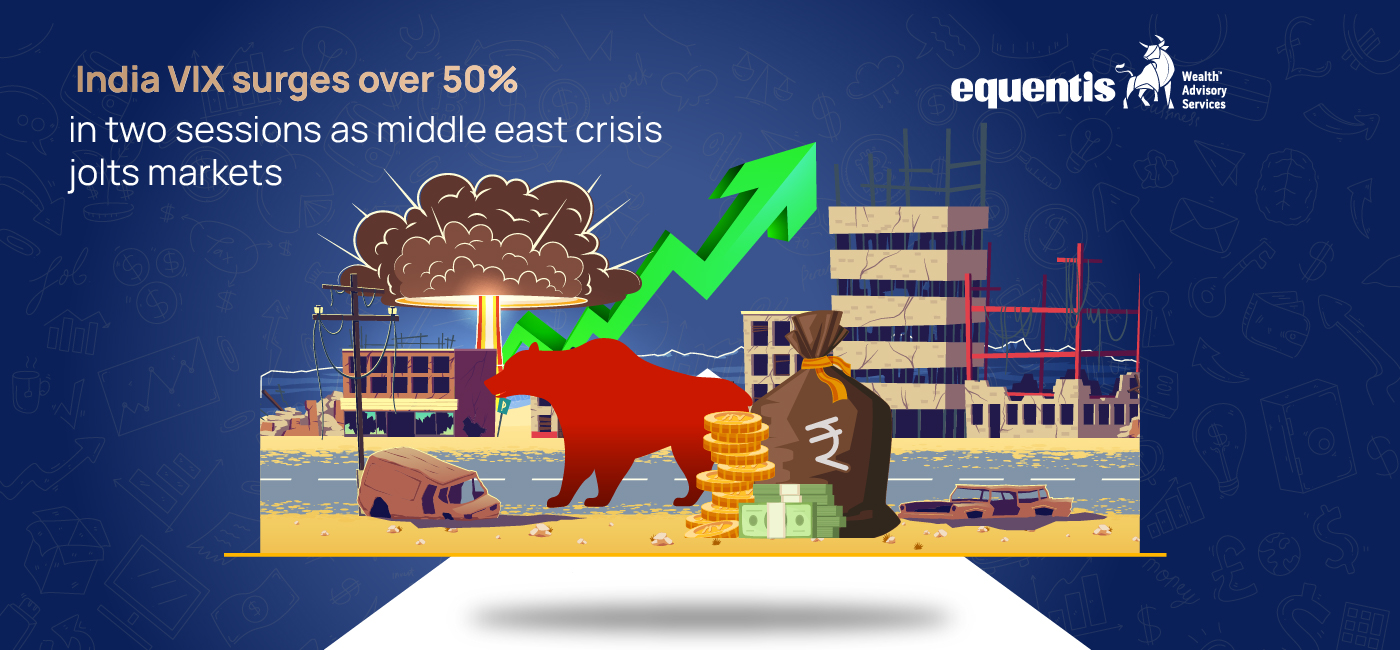
Financial markets dislike uncertainty, and the recent spike in the India VIX, often called the market’s “fear gauge,” is a clear reflection of rising global tensions. Over the past two trading sessions, the India VIX has surged more than 50 percent, sending a strong signal that volatility in the Indian stock market is increasing.
The sudden jump comes amid escalating concerns surrounding the Middle East crisis, which has unsettled global markets and triggered risk aversion among investors. Whenever geopolitical tensions rise, equity markets tend to react quickly, and volatility indicators often move sharply.
For investors tracking Large Cap Stocks and Mid Cap Stocks, the rise in India VIX is an important development. It suggests that the market may witness sharper swings in the near term, making it essential to understand what is driving the volatility and what it could mean for investment strategies.
Understanding the India VIX and Market Volatility
The India VIX (Volatility Index) measures the market’s expectation of volatility in the near future based on options pricing in the Nifty index. When the VIX rises sharply, it indicates that investors anticipate higher market fluctuations.
In simple terms, a rising India VIX means traders are pricing in uncertainty. This does not always mean markets will fall, but it signals that price movements, both upward and downward, may become more intense.
Historically, spikes in India VIX are often linked to major global events such as geopolitical conflicts, financial crises, or sudden economic policy changes. In the current situation, the Middle East tensions have created concerns around energy supply, global trade stability, and inflation, all of which directly impact financial markets.
What Triggered the Sharp Spike in India VIX?
The sharp surge in the India VIX is largely tied to global geopolitical developments and their potential economic impact.
Escalating Middle East Tensions
The Middle East plays a critical role in the global energy market. Any escalation in the region raises concerns about oil supply disruptions. Since India imports a significant portion of its crude oil, geopolitical instability in this region can quickly influence inflation expectations and economic outlook.
When oil prices show signs of volatility due to geopolitical risks, equity markets often respond with caution.
Global Market Reaction
International markets have also reacted to the unfolding developments. Investors across the world have shifted toward safer assets, while equities have witnessed increased volatility.
Such global sentiment tends to spill over into emerging markets, including India. As global investors adjust their portfolios, volatility indicators like the India VIX can rise sharply.
Increased Hedging Activity
Another factor behind the surge in the volatility index is increased hedging activity in the derivatives market. Traders and institutional investors often buy options to protect their portfolios during uncertain times.
This increased demand for protective options drives up the implied volatility, which in turn pushes the India VIX higher.
Impact on the Indian Stock Market
A sharp rise in the India VIX can influence the broader market in several ways.
Higher Market Volatility
One of the immediate effects is increased market volatility. Indices like the Nifty and Sensex may witness larger intraday movements as investors react to global news and sentiment shifts.
While volatility can create opportunities for traders, it can also increase risk for investors who are not prepared for sudden market swings.
Pressure on Certain Sectors
Sectors that are sensitive to global developments, such as oil and gas, aviation, and logistics, may experience stronger market reactions during geopolitical tensions.
At the same time, defensive sectors such as pharmaceuticals or consumer staples may attract relatively stable investor interest.
Shift in Investor Preference
During periods of uncertainty, investors often gravitate toward Large Cap Stocks, which are generally perceived as more stable due to stronger financial positions and diversified operations.
Meanwhile, Mid Cap Stocks may experience higher volatility because they are often more sensitive to market sentiment and liquidity changes.
Opportunities and Risks for Investors
Periods of market volatility often bring both risks and potential opportunities.
Opportunities
Volatility can create attractive entry points for long-term investors. When markets react strongly to global news, some fundamentally strong stocks may experience temporary price corrections.
Investors with a long-term perspective often use such phases to gradually accumulate quality companies with strong earnings potential.
Another opportunity lies in disciplined portfolio allocation. Diversification across sectors and market capitalizations can help investors manage volatility more effectively.
Risks
At the same time, rising volatility carries clear risks. Short-term market reactions can sometimes lead to emotional decision-making, such as panic selling or impulsive buying.
Global geopolitical developments can also evolve quickly. If tensions escalate further, markets may experience prolonged uncertainty.
Additionally, sharp swings in crude oil prices could impact inflation, currency stability, and corporate profitability, all of which may influence the broader market outlook.
For investors, maintaining a balanced approach and avoiding reactionary decisions becomes particularly important during such periods.
Conclusion
The surge in the India VIX by more than 50 percent in two sessions highlights how sensitive financial markets can be to geopolitical developments. The ongoing Middle East crisis has introduced a new layer of uncertainty, leading to increased volatility in the Indian stock market.
While volatility can make markets appear unpredictable, it is also a natural part of investing. Periods of uncertainty often test investor discipline and long-term strategy.
For those tracking Large Cap Stocks and Mid Cap Stocks, the current environment underscores the importance of focusing on fundamentals, diversification, and risk management. Rather than reacting to short-term market noise, investors may benefit from maintaining a structured approach to investing.
As global developments continue to unfold, the direction of market volatility will depend on geopolitical stability, energy prices, and investor sentiment. In the coming weeks, markets may remain sensitive to global cues, making careful observation and informed decision-making more important than ever.
Disclaimer Note: The securities quoted, if any, are for illustration only and are not recommendatory. This article is for education purposes only and shall not be considered as a recommendation or investment advice by Equentis – Research & Ranking. We will not be liable for any losses that may occur. Investments in the securities market are subject to market risks. Read all the related documents carefully before investing. Registration granted by SEBI, membership of BASL & certification from NISM in no way guarantee the performance of the intermediary or provide any assurance of returns to investors.

Jaspreet Singh Arora is the Chief Investment Officer at Equentis, where he heads a seasoned team of equity analysts and turns two decades of market experience into portfolios that consistently beat the benchmark. A go-to voice on cement, building-materials, real-estate, and construction stocks, Jaspreet previously ran research desks at leading brokerages, honing an eye for the metrics that truly move share prices. His plain-spoken analysis helps investors cut through noise and act with conviction. When he’s not deep-diving into earnings calls, you’ll find him unwinding over sports, weekend cricket or a good history podcast.










