

Summary
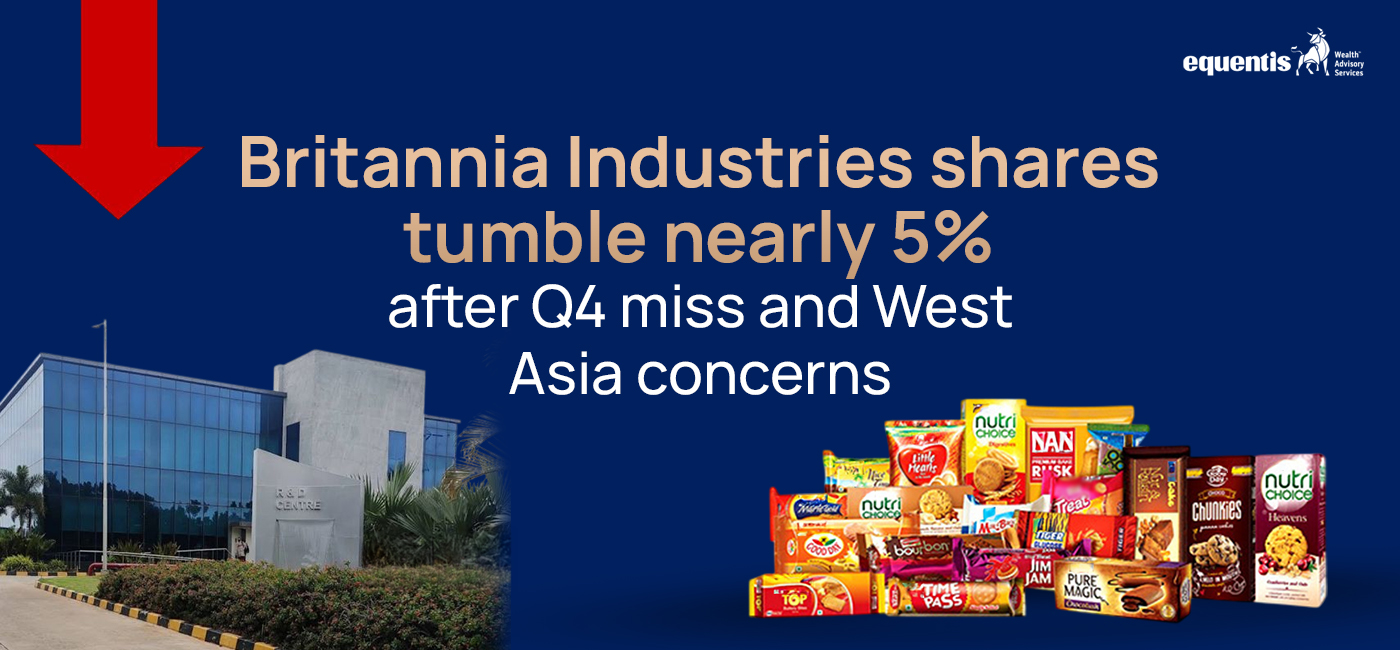
Shares of Britannia Industries Ltd fell nearly 5% after the company reported weaker-than-expected Q4 results and highlighted concerns related to geopolitical tensions in West Asia. Investors reacted negatively to slower volume growth, pressure on margins, and management commentary around uncertainty in international markets. The decline in Britannia shares reflects broader market caution toward FMCG companies facing rising input costs, muted rural demand recovery, and global business risks. Despite the short term pressure, analysts continue to closely monitor Britannia’s long term growth potential, brand strength, and ability to navigate changing consumer trends.
Introduction
India’s fast moving consumer goods sector has long been considered one of the more stable corners of the stock market. Companies selling daily essentials like biscuits, dairy products, and packaged foods usually attract investors looking for steady growth and defensive business models.
That is why the recent fall in Britannia Industries Ltd shares grabbed market attention.
The stock dropped nearly 5% after the company posted Q4 earnings that missed market expectations. Alongside the weaker financial performance, management commentary regarding concerns in West Asia added another layer of uncertainty for investors.
The development matters because Britannia is not just another FMCG stock. It is one of India’s leading packaged food brands with a strong nationwide presence and significant exposure to both urban and rural consumption trends. Any signs of slowing growth or operational challenges are often viewed as indicators of broader demand patterns within the FMCG sector.
The latest correction in Britannia shares has sparked discussions around consumer demand, input cost pressures, export market uncertainties, and the future outlook for FMCG companies operating in a changing economic environment.
About Britannia Industries and Its Market Position
Britannia Industries Ltd is among India’s leading food and bakery companies. The brand has built strong recognition through products such as:
- Biscuits
- Cakes
- Dairy products
- Bread
- Rusks
- Snacks
The company has maintained a significant market share in the biscuit segment for years and continues expanding its portfolio into adjacent food categories.
Britannia’s business model benefits from:
- Wide distribution networks
- Strong brand recall
- Everyday consumer demand
- Product affordability across price points
- Presence in urban and rural markets
Because of these strengths, the company is often considered a benchmark stock within the Indian FMCG sector.
Why Did Britannia Shares Fall?
The sharp decline in Britannia Industries Ltd shares came after investors assessed two major concerns.
Q4 Earnings Miss
The company’s quarterly performance came below market expectations. Investors were particularly disappointed by:
- Slower than expected revenue growth
- Pressure on operating margins
- Weakness in demand trends
- Lower profitability growth compared to estimates
Market participants typically expect large FMCG companies to deliver stable earnings consistency. Any signs of slowing momentum can trigger sharp reactions in share prices.
West Asia Concerns
Management commentary regarding geopolitical and business uncertainties in West Asia also affected investor sentiment.
West Asia remains an important region for many Indian consumer companies through exports, distribution partnerships, and international business operations.
Geopolitical tensions in the region can create challenges such as:
- Supply chain disruptions
- Currency volatility
- Demand uncertainty
- Logistics cost increases
- Export market pressure
Even though the direct financial impact may vary, investors often react quickly to global uncertainty signals.
Understanding the Q4 Earnings Disappointment
Quarterly earnings are closely tracked because they provide insight into both business performance and consumer demand trends.
In Britannia’s case, the market expected stronger momentum given improving inflation trends and hopes of better consumption growth.
However, the earnings report highlighted certain pressure points.
Demand Recovery Was Slower Than Expected
One of the key concerns was relatively muted demand recovery in some segments.
FMCG companies have been navigating mixed consumption patterns over the past few quarters. Urban demand has remained relatively resilient, but rural recovery has been gradual.
Consumers in many categories continue showing sensitivity toward pricing and discretionary spending.
Margin Pressure Continued
Raw material costs and operational expenses continue affecting profitability for many consumer companies.
Even when inflation eases in certain commodities, companies may still face:
- Packaging cost pressure
- Distribution expenses
- Advertising and promotional spending
- Logistics costs
Margins become particularly important because investors often value FMCG businesses based on earnings stability and predictable profitability.
Volume Growth Remained Under Focus
For consumer companies, volume growth is considered a major indicator of demand strength.
If growth is driven mainly by price increases rather than actual sales expansion, investors may become cautious about future sustainability.
The latest earnings commentary indicated that volume trends remained an important area to monitor.
How West Asia Concerns Impact FMCG Companies
The mention of West Asia concerns added another dimension to the market reaction.
Many Indian companies operate internationally or rely on export markets for additional revenue growth. Geopolitical tensions can create uncertainty even if the immediate impact is not severe.
For FMCG businesses, West Asia is strategically important because:
- Indian brands have a strong consumer base in the region
- Export demand contributes to growth
- The region has a large Indian diaspora population
- Distribution networks are well established
However, geopolitical instability can affect business sentiment and operational planning.
Supply Chain Risks
Global tensions can disrupt shipping routes and increase transportation costs.
For packaged food companies, timely logistics and stable supply chains are critical.
Currency Volatility
International business exposure also creates currency related risks.
Sharp currency fluctuations can impact profitability and pricing strategies.
Consumer Sentiment Impact
Economic uncertainty in export markets may affect consumer spending patterns and product demand.
Broader FMCG Sector Challenges
The decline in Britannia Industries Ltd shares also reflects broader concerns surrounding the FMCG sector.
Over the last few quarters, consumer companies have been balancing multiple challenges simultaneously.
Rural Demand Recovery Remains Uneven
While rural consumption has shown signs of improvement, recovery has not been uniform across regions.
Factors affecting rural demand include:
- Inflation impact on household budgets
- Monsoon dependence
- Agricultural income trends
- Employment conditions
Rural markets are especially important for food and packaged goods companies.
Input Cost Volatility
Commodity prices remain unpredictable.
Companies dealing with wheat, sugar, edible oils, milk products, and packaging materials often face fluctuating input costs.
Managing pricing without hurting consumer demand becomes a delicate balancing exercise.
Competitive Market Environment
India’s packaged food sector remains highly competitive.
Companies compete across:
- Pricing
- Distribution reach
- Product innovation
- Advertising
- Brand positioning
Regional brands and private labels have also increased competition in certain categories.
Investor Sentiment Toward FMCG Stocks
FMCG stocks are generally viewed as defensive investments because consumer demand for essential products tends to remain relatively stable even during economic slowdowns.
However, valuation expectations for FMCG companies are often high.
This means markets expect:
- Consistent earnings growth
- Strong margins
- Stable demand
- Predictable cash flows
When earnings fail to meet expectations, corrections can become sharper because investors reassess growth assumptions.
The recent decline in Britannia shares reflects this valuation sensitivity.
What Analysts Are Watching Closely
After the Q4 results, analysts and investors are likely to focus on several key areas going forward.
Volume Growth Recovery
Investors want clarity on whether consumption demand can improve over coming quarters.
Margin Stability
The company’s ability to manage costs while maintaining profitability remains important.
Rural Consumption Trends
A stronger rural recovery could improve growth visibility for FMCG companies.
International Business Outlook
Developments in West Asia and export markets will continue influencing sentiment.
Product Innovation
Consumer preferences are evolving rapidly toward health focused and premium packaged foods.
Companies that adapt successfully may strengthen growth opportunities.
Opportunities for Britannia Industries
Despite short term concerns, Britannia Industries Ltd continues to possess several long term strengths.
Strong Brand Equity
Britannia remains one of India’s most recognized food brands.
Brand familiarity often supports long term customer loyalty.
Distribution Strength
The company has extensive reach across urban and rural India.
Distribution networks are critical advantages in the FMCG industry.
Product Diversification
Expansion into adjacent categories can create new revenue opportunities.
Premiumization Trends
As consumer incomes rise, demand for premium packaged foods could increase.
Growing Packaged Food Market
India’s organized packaged food market continues expanding due to urbanization and changing lifestyles.
Risks Investors Should Consider
At the same time, investors should remain aware of important risks.
Commodity Price Inflation
Sudden increases in raw material prices can pressure margins.
Weak Consumer Spending
Slower consumption growth may impact sales momentum.
Geopolitical Risks
International tensions can affect exports and supply chains.
Intense Competition
Competitive pricing pressure may affect profitability.
Valuation Concerns
FMCG stocks often trade at premium valuations compared to broader markets.
Any growth slowdown can lead to sharp price corrections.
How Consumers May Be Affected
Consumers may not immediately notice the impact of quarterly earnings, but broader industry trends can eventually influence pricing and product strategies.
For example:
- Rising input costs could lead to price hikes
- Companies may reduce pack sizes
- Promotional offers may change
- Product innovation may accelerate
Consumer behavior itself also shapes company strategies.
Demand for healthier snacks, convenience foods, and affordable products continues influencing the FMCG landscape.
What This Means for Long Term Investors
The correction in Britannia Industries Ltd shares highlights an important investing lesson.
Even fundamentally strong businesses can face temporary earnings pressure and market volatility.
For long term investors, key considerations may include:
- Business fundamentals
- Market leadership
- Demand resilience
- Management execution
- Valuation discipline
- Long term consumption trends
Rather than reacting only to short term price movement, investors often evaluate whether underlying structural growth drivers remain intact.
India’s packaged food and FMCG sector still benefits from:
- Population growth
- Urbanization
- Rising disposable incomes
- Expanding retail penetration
- Increasing brand awareness
These factors continue supporting long term industry growth potential.
Future Outlook for Britannia Industries
Looking ahead, the future outlook for Britannia Industries Ltd will depend on several interconnected factors.
These include:
- Improvement in consumer demand
- Stability in commodity prices
- Rural market recovery
- Successful product innovation
- International business performance
- Effective cost management
Investors are likely to closely monitor upcoming quarters for signs of demand normalization and margin recovery.
The company’s management commentary around market conditions and geopolitical developments will also remain important.
Conclusion
The nearly 5% fall in Britannia Industries Ltd shares after its Q4 earnings miss and West Asia concerns reflects how sensitive markets remain to growth expectations and global uncertainties.
While the quarterly results disappointed investors in the short term, the broader story also highlights the challenges currently facing India’s FMCG sector, including uneven demand recovery, margin pressures, and geopolitical risks.
At the same time, Britannia continues to retain significant strengths through its brand recognition, distribution network, and strong position within India’s packaged food industry.
For investors, the key question going forward will be whether the company can successfully navigate current headwinds while sustaining long term growth momentum.
As India’s consumption economy evolves, FMCG businesses like Britannia are expected to remain central to the country’s broader economic and consumer growth story.
FAQs
1. Why did Britannia Industries shares fall nearly 5%?
Britannia shares declined after the company reported weaker than expected Q4 results and highlighted concerns related to West Asia operations.
2. What caused the Q4 earnings miss for Britannia?
The earnings miss was linked to slower demand recovery, margin pressure, and softer than expected growth performance.
3. What is Britannia Industries known for?
Britannia Industries Ltd is known for biscuits, cakes, dairy products, bread, and packaged food products.
4. Why are West Asia concerns important for Britannia?
West Asia is an important international market for many Indian consumer companies due to exports and regional demand.
5. How do geopolitical tensions affect FMCG companies?
Geopolitical tensions can disrupt supply chains, increase logistics costs, create currency volatility, and affect demand conditions.
6. What are the major challenges facing the FMCG sector?
Key challenges include inflation, weak rural demand, input cost volatility, and intense competition.
7. What does volume growth mean in FMCG?
Volume growth refers to an increase in actual product sales quantities rather than growth driven mainly by price increases.
8. Why are FMCG stocks considered defensive?
FMCG companies sell essential products that consumers typically continue buying even during economic slowdowns.
9. How important is rural demand for Britannia?
Rural demand is important because a significant portion of FMCG sales comes from smaller towns and villages.
10. Can commodity inflation impact Britannia’s profitability?
Yes. Rising prices of wheat, sugar, milk, and packaging materials can affect margins.
11. Does Britannia have international business exposure?
Yes. The company has export operations and international market exposure, including West Asia.
12. Why do FMCG stocks react sharply to earnings misses?
FMCG stocks often trade at premium valuations, so markets expect consistent earnings performance.
13. What are the long term strengths of Britannia?
Strong brand recognition, wide distribution, product diversification, and market leadership are key strengths.
14. How does competition affect Britannia?
Competition can influence pricing strategies, market share, and profitability within the packaged food industry.
15. What trends are shaping India’s packaged food industry?
Urbanization, convenience consumption, premiumization, and health focused products are major trends.
16. Can FMCG companies pass rising costs to consumers?
Companies may increase prices or adjust pack sizes, but pricing power depends on demand conditions and competition.
17. What should investors watch in upcoming quarters?
Investors will monitor demand recovery, margins, rural growth, and international business conditions.
18. How does consumer sentiment affect FMCG companies?
Consumer confidence influences spending patterns and product demand across categories.
19. Is Britannia considered a long term consumption play?
Yes. Many investors view Britannia as a long term beneficiary of India’s growing consumption economy.
20. What is the future outlook for Britannia Industries?
The outlook depends on demand recovery, cost management, product innovation, and geopolitical stability in export markets.
Disclaimer Note: The securities quoted, if any, are for illustration only and are not recommendatory. This article is for education purposes only and shall not be considered as a recommendation or investment advice by Equentis. We will not be liable for any losses that may occur. Investments in the securities market are subject to market risks. Read all the related documents carefully before investing. Registration granted by SEBI, membership of BASL & certification from NISM in no way guarantee the performance of the intermediary or provide any assurance of returns to investors.

Jaspreet Singh Arora is the Chief Investment Officer at Equentis, where he heads a seasoned team of equity analysts and turns two decades of market experience into portfolios that consistently beat the benchmark. A go-to voice on cement, building-materials, real-estate, and construction stocks, Jaspreet previously ran research desks at leading brokerages, honing an eye for the metrics that truly move share prices. His plain-spoken analysis helps investors cut through noise and act with conviction. When he’s not deep-diving into earnings calls, you’ll find him unwinding over sports, weekend cricket or a good history podcast.










