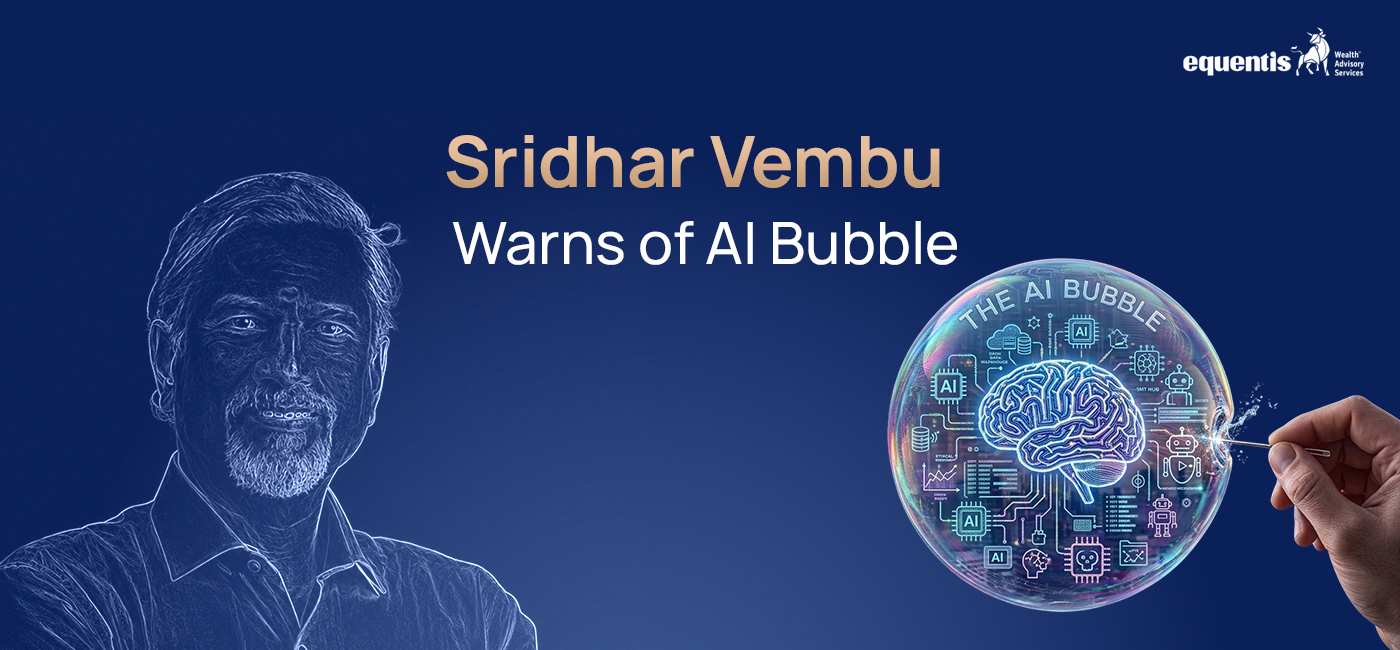

Summary: Sridhar Vembu, founder and chief scientist of Zoho Corporation, has cautioned that the current enthusiasm surrounding artificial intelligence (AI) may be creating conditions similar to a technology bubble. While acknowledging AI’s transformative potential, Vembu has argued that excessive investment, unrealistic expectations, and speculative valuations could lead to disappointment if businesses fail to generate sustainable returns from AI adoption. His warning comes at a time when companies worldwide are investing billions of dollars in AI infrastructure, applications, and talent. The debate is not about whether AI is important, but whether current market expectations accurately reflect the technology’s near-term economic impact.
Sridhar Vembu Warns of AI Bubble: Separating Hype from Long-Term Value
Introduction
Artificial intelligence has become one of the defining technology trends of the decade. From chatbots and content creation tools to healthcare diagnostics and enterprise automation, AI is reshaping industries at a pace few technologies have achieved before.
Investors, startups, technology companies, and governments are racing to capitalize on what many believe could be the next major technological revolution. AI-related stocks have surged, venture capital funding has poured into AI startups, and corporations are allocating significant budgets to AI initiatives.
Amid this optimism, however, some industry leaders have urged caution.
One of the most notable voices raising concerns is Sridhar Vembu, the founder of Zoho Corporation. His warning about a potential AI bubble has sparked discussions across the technology and investment communities.
The key question is not whether AI will transform industries. Instead, the debate centers on whether the current level of excitement and investment is sustainable or whether expectations have moved ahead of reality.
Who is Sridhar Vembu?
Sridhar Vembu is widely regarded as one of India’s most respected technology entrepreneurs.
As the founder of Zoho Corporation, Vembu has built a global software company known for its enterprise applications, customer relationship management tools, and productivity software.
Unlike many technology leaders who focus heavily on market narratives, Vembu is known for his practical and long-term approach to business.
Over the years, he has frequently shared views on:
- Technology trends
- Economic development
- Software engineering
- Entrepreneurship
- Rural innovation
- Workforce transformation
His comments often attract attention because they are rooted in operational experience rather than short-term market sentiment.
Understanding the AI Boom
To understand why Vembu’s comments matter, it is important to examine the scale of the current AI boom.
Massive Investment Flows
Artificial intelligence has attracted unprecedented levels of investment.
Technology giants are spending billions on:
- AI chips
- Data centers
- Cloud infrastructure
- Research and development
- AI talent acquisition
At the same time, startups focused on generative AI, machine learning, and automation have raised significant amounts of venture capital.
Rapid Enterprise Adoption
Businesses across industries are experimenting with AI solutions.
Applications include:
- Customer service automation
- Predictive analytics
- Software development assistance
- Marketing optimization
- Supply chain management
- Financial analysis
The promise of improved productivity has encouraged widespread adoption.
Rising Market Valuations
Public markets have also embraced the AI theme.
Companies associated with AI have experienced substantial increases in market value as investors anticipate future growth opportunities.
This combination of capital inflows, technological excitement, and market optimism has fueled discussions about whether AI is entering bubble territory.
What Did Sridhar Vembu Mean by an AI Bubble?
Vembu’s concerns do not imply that AI lacks value.
Rather, his warning focuses on the possibility that expectations have become disconnected from economic reality.
Excessive Optimism
One of the defining characteristics of technology bubbles is excessive optimism.
Investors and businesses may assume that:
- AI will immediately transform every industry
- Productivity gains will arrive quickly
- Revenue growth will justify current spending
- Competitive advantages will emerge automatically
History suggests that transformative technologies often take longer to deliver widespread economic benefits than initially expected.
Capital Allocation Concerns
Another issue relates to the scale of investment.
Billions of dollars are being invested in AI infrastructure, models, and applications.
The challenge is whether future revenues will justify these expenditures.
If returns fail to match expectations, investors could become more cautious.
The Gap Between Demonstrations and Commercial Value
Many AI tools produce impressive demonstrations.
However, converting technical capabilities into profitable business models is often more difficult.
Companies must answer practical questions such as:
- Who will pay for AI services?
- How much will customers pay?
- Can AI reduce costs enough to justify investment?
- Are productivity gains measurable?
These questions determine long-term economic success.
Lessons from Previous Technology Bubbles
Technology history offers several examples of innovation cycles that experienced periods of excessive enthusiasm.
The Dot-Com Era
The late 1990s saw massive investment in internet-related companies.
Investors correctly identified the internet as a transformative technology.
However, many companies received valuations that were difficult to justify based on actual business performance.
When expectations exceeded reality, a market correction followed.
Importantly, the internet itself did not fail.
Instead, unrealistic expectations surrounding certain companies proved unsustainable.
Similarities with AI
Some analysts see parallels between today’s AI environment and earlier technology booms.
Common characteristics include:
- Rapid investment growth
- High valuations
- Intense media attention
- Fear of missing out (FOMO)
- Aggressive expansion plans
These factors do not necessarily indicate a bubble, but they raise questions about sustainability.
Why the AI Story Is Different
While comparisons to past bubbles are common, AI also differs in important ways.
Real-World Applications Already Exist
Unlike some speculative technologies, AI is already generating practical benefits.
Organizations are using AI for:
- Fraud detection
- Language translation
- Medical imaging
- Process automation
- Customer support
The technology is delivering measurable value in many areas.
Strong Corporate Demand
Demand for AI solutions is being driven by real business needs rather than purely speculative interest.
Companies are seeking ways to:
- Improve efficiency
- Reduce costs
- Enhance decision-making
- Personalize customer experiences
These use cases create genuine commercial opportunities.
Continuous Technological Progress
AI capabilities continue to improve rapidly.
Advancements in:
- Large language models
- Machine learning algorithms
- Computing power
- Data availability
are expanding the technology’s potential applications.
Implications for Investors
Vembu’s comments carry important lessons for investors.
Focus on Business Fundamentals
Investors should evaluate AI-related companies based on:
- Revenue growth
- Profitability
- Customer adoption
- Competitive advantages
- Long-term sustainability
Simply adding AI to a business model does not guarantee success.
Avoid Chasing Hype
Periods of intense excitement can sometimes lead investors to overlook risks.
Disciplined analysis remains essential.
Questions worth asking include:
- Is the company generating revenue from AI?
- Are customers willing to pay for its products?
- Does it have a defensible competitive position?
Distinguish Between Technology and Valuation
A valuable technology can still be associated with overvalued companies.
Investors should separate their belief in AI’s future from their assessment of individual investments.
Impact on Businesses
For companies adopting AI, Vembu’s warning highlights the importance of strategic implementation.
Prioritize Business Outcomes
Organizations should focus on measurable results rather than adopting AI simply because it is popular.
Successful AI projects often address specific business challenges.
Examples include:
- Reducing operational costs
- Improving customer service
- Increasing productivity
- Enhancing decision-making
Manage Expectations
AI can deliver significant benefits, but implementation takes time.
Businesses should avoid assuming immediate transformation.
Build Sustainable Capabilities
Long-term success requires:
- Skilled employees
- Data infrastructure
- Governance frameworks
- Continuous improvement
Technology alone is rarely sufficient.
What It Means for Employees and Professionals
AI discussions often focus on jobs and workforce transformation.
Changing Skill Requirements
Demand is growing for skills related to:
- Data analysis
- Machine learning
- AI governance
- Software development
- Prompt engineering
Professionals who adapt to changing requirements may benefit from new opportunities.
Human Expertise Remains Important
Despite advances in automation, human judgment continues to play a critical role.
Areas such as:
- Strategic thinking
- Creativity
- Leadership
- Relationship management
remain difficult to automate completely.
Opportunities Created by AI
Even if some level of hype exists, AI continues to create substantial opportunities.
Productivity Improvements
Organizations may achieve greater efficiency through automation and decision support systems.
New Business Models
AI enables products and services that were previously difficult or impossible to create.
Innovation Across Industries
Applications continue expanding across:
- Healthcare
- Finance
- Manufacturing
- Retail
- Education
- Agriculture
Economic Growth Potential
Many economists believe AI could contribute significantly to long-term productivity growth.
Risks That Support the Bubble Argument
Several factors support concerns about excessive optimism.
High Infrastructure Costs
Developing and operating advanced AI systems requires substantial investment.
Monetization Challenges
Not all AI products generate sustainable revenue.
Competitive Pressures
As more companies enter the market, maintaining differentiation becomes difficult.
Regulatory Uncertainty
Governments worldwide are developing frameworks to regulate AI usage.
Compliance requirements could affect growth trajectories.
The Bigger Question: Bubble or Transformation?
The debate surrounding AI is unlikely to be settled soon.
Two ideas can be true at the same time:
- AI may be a transformative technology.
- Some AI-related investments may be overvalued.
This distinction is central to understanding Vembu’s comments.
History shows that technological revolutions often involve periods of excessive enthusiasm followed by more realistic assessments.
The technologies themselves frequently endure and reshape industries, even when market expectations fluctuate.
Conclusion
Sridhar Vembu’s warning about a potential AI bubble is not a rejection of artificial intelligence. Instead, it is a reminder that technological promise and economic reality do not always move at the same pace.
AI is already demonstrating its ability to transform industries, improve productivity, and create new business opportunities. However, the scale of investment and optimism surrounding the technology has also raised legitimate questions about valuations, return on investment, and long-term sustainability.
For investors, the key takeaway is to focus on fundamentals rather than hype. For businesses, success will depend on implementing AI in ways that generate measurable value. For professionals, adapting to changing skill requirements remains essential.
Whether today’s AI boom ultimately proves to be a bubble, a revolution, or a combination of both, one thing is clear: artificial intelligence will continue to influence the future of technology, business, and society for years to come.
Frequently Asked Questions (FAQs)
1. Why did Sridhar Vembu warn about an AI bubble?
Sridhar Vembu expressed concerns that excessive investment, inflated expectations, and speculative valuations in the AI sector could create bubble-like conditions.
2. Does Sridhar Vembu believe AI is not useful?
No. His concerns focus on market expectations and investment behavior rather than the underlying value of AI technology.
3. What is an AI bubble?
An AI bubble refers to a situation where enthusiasm and investment in AI-related companies exceed their actual economic value or near-term earning potential.
4. How is the current AI boom similar to the dot-com era?
Both periods involve rapid investment growth, high valuations, strong media attention, and expectations of transformational change.
5. Is artificial intelligence already being used commercially?
Yes. AI is widely used in customer service, healthcare, finance, software development, marketing, and many other industries.
6. What risks do investors face in AI-related stocks?
Key risks include overvaluation, monetization challenges, intense competition, high infrastructure costs, and regulatory uncertainty.
7. Can AI still be transformative even if a bubble exists?
Yes. A technology can deliver long-term value even if certain companies or investments become overvalued during periods of market enthusiasm.
8. How should businesses approach AI adoption?
Businesses should focus on measurable outcomes, practical use cases, cost-benefit analysis, and sustainable implementation strategies.
9. What skills are becoming important in the AI era?
Skills related to data analysis, machine learning, AI governance, software engineering, and critical thinking are increasingly valuable.
10. What is the main takeaway from Sridhar Vembu’s comments?
The main takeaway is that while AI has significant potential, investors and businesses should balance optimism with realistic expectations about costs, timelines, and economic returns.
Disclaimer Note: The securities quoted, if any, are for illustration only and are not recommendatory. This article is for education purposes only and shall not be considered as a recommendation or investment advice by Equentis. We will not be liable for any losses that may occur. Investments in the securities market are subject to market risks. Read all the related documents carefully before investing. Registration granted by SEBI, membership of BASL & certification from NISM in no way guarantee the performance of the intermediary or provide any assurance of returns to investors.

Jaspreet Singh Arora is the Chief Investment Officer at Equentis, where he heads a seasoned team of equity analysts and turns two decades of market experience into portfolios that consistently beat the benchmark. A go-to voice on cement, building-materials, real-estate, and construction stocks, Jaspreet previously ran research desks at leading brokerages, honing an eye for the metrics that truly move share prices. His plain-spoken analysis helps investors cut through noise and act with conviction. When he’s not deep-diving into earnings calls, you’ll find him unwinding over sports, weekend cricket or a good history podcast.