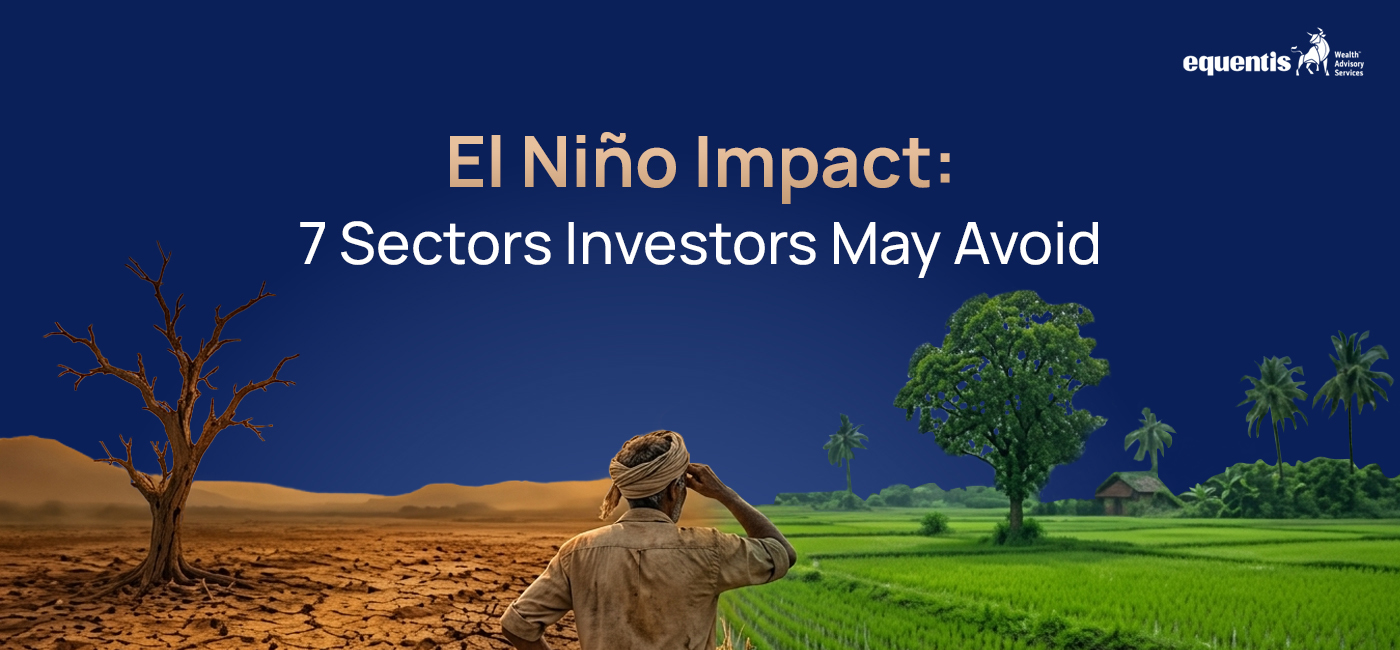

El Niño, a recurring climate phenomenon known for disrupting weather patterns, can have far-reaching consequences for economies and financial markets. In India, a stronger-than-normal El Niño often raises concerns about below-average monsoon rainfall, which can affect agriculture, inflation, consumer spending, and industrial activity. While not every El Niño event has the same economic impact, investors may want to exercise caution toward sectors that are particularly sensitive to weak monsoons, rising input costs, or slowing rural demand. Understanding these risks can help investors make more balanced portfolio decisions during uncertain weather conditions.
Why El Niño Matters for Investors
For many investors, weather may not seem like an obvious factor influencing stock markets. However, in a country like India, where agriculture supports millions of livelihoods and contributes significantly to economic activity, rainfall patterns can affect multiple industries.
A deficient or uneven monsoon may reduce agricultural output, increase food prices, weaken rural purchasing power, and influence inflation. These changes can eventually impact corporate earnings across several sectors.
Although modern India’s economy has become more diversified, the monsoon continues to play an important role in shaping business sentiment and market expectations.
Understanding El Niño and Its Economic Impact
El Niño is a climate pattern characterized by warmer-than-average sea surface temperatures in the central and eastern Pacific Ocean. This phenomenon can alter global weather systems and is often associated with weaker monsoon rainfall in parts of India.
Potential economic effects include:
- Lower agricultural production.
- Rising food inflation.
- Pressure on household budgets.
- Higher input costs for businesses.
- Reduced rural consumption.
- Increased uncertainty for certain industries.
It is important to note that the actual impact depends on the intensity of the El Niño event, regional rainfall distribution, government interventions, and reservoir levels.
1. Agriculture and Agri-Input Companies
Agriculture is usually the first sector affected by weaker monsoon conditions.
Reduced rainfall may lower crop yields, delay sowing activities, and increase irrigation costs.
Companies involved in:
- Seeds
- Fertilisers
- Crop protection
- Farm equipment
could experience weaker demand if farmers postpone spending due to uncertain crop prospects.
However, government support measures and improved irrigation infrastructure may help reduce some of these risks.
2. Fertiliser and Agrochemical Businesses
Although fertiliser demand remains relatively stable over the long term, prolonged rainfall deficiencies can affect purchasing patterns.
Farmers facing uncertain crop conditions may delay or reduce input purchases.
At the same time, higher raw material costs and changing government subsidy policies can influence profitability within the sector.
Investors should closely monitor both weather developments and policy announcements.
3. Fast-Moving Consumer Goods (FMCG) with High Rural Exposure
Many FMCG companies derive a significant portion of their sales from rural India.
When agricultural income weakens, consumers may reduce spending on discretionary household products.
Products that could witness slower demand include:
- Packaged foods
- Personal care products
- Household goods
- Consumer staples with premium pricing
Companies with diversified urban demand may be better positioned to withstand temporary weakness in rural markets.
4. Two-Wheeler Manufacturers
The two-wheeler industry has historically shown a close relationship with rural income.
Farmers and rural households often postpone vehicle purchases during periods of agricultural uncertainty.
As a result, weaker monsoon conditions could affect demand for:
- Motorcycles
- Scooters
- Entry-level transportation vehicles
However, urban demand and financing availability can partially offset rural weakness.
5. Consumer Durables
Consumer durable companies selling products such as refrigerators, washing machines, air conditioners, televisions, and kitchen appliances may also experience slower rural demand if household incomes come under pressure.
Large purchases are often delayed during periods of financial uncertainty.
Companies with stronger urban sales and premium product offerings may remain relatively resilient compared to those heavily dependent on rural markets.
6. Rural-Focused NBFCs and Microfinance Institutions
Non-Banking Financial Companies (NBFCs) and microfinance institutions serving rural borrowers could face additional challenges if agricultural income declines.
Potential concerns include:
- Slower loan growth.
- Delayed repayments.
- Higher credit risk.
- Increased provisioning requirements.
That said, diversified lenders with strong risk management practices may be better positioned to navigate temporary disruptions.
7. Sugar and Select Food Processing Companies
Sugar production depends significantly on sugarcane cultivation, which requires adequate water availability.
Poor rainfall may affect crop yields in certain regions, influencing raw material availability for sugar mills.
Similarly, food processing companies dependent on agricultural commodities may face higher procurement costs if crop output declines.
The extent of the impact varies based on crop type, inventory levels, and regional weather conditions.
Sectors That May Remain More Resilient
While certain industries could face challenges during an El Niño year, others may remain relatively less affected.
Examples include:
- Information Technology
- Pharmaceuticals
- Telecom
- Financial Services with diversified exposure
- Digital businesses
- Export-oriented manufacturing
These sectors are generally less dependent on monsoon conditions and rural consumption.
However, they remain influenced by other factors such as global demand, interest rates, and corporate earnings.
What Should Investors Do?
Rather than making portfolio decisions based solely on weather forecasts, investors should evaluate broader economic conditions.
A disciplined investment approach may include:
- Maintaining sector diversification.
- Reviewing exposure to rural-focused businesses.
- Monitoring inflation trends.
- Tracking government policy responses.
- Evaluating company-specific fundamentals.
- Continuing long-term investment plans.
Weather-related risks often affect industries differently, making diversification an important strategy.
Opportunities and Risks
Opportunities
Despite the challenges associated with El Niño, investors may find opportunities in companies that demonstrate resilience through:
- Diversified revenue streams.
- Strong balance sheets.
- Efficient cost management.
- Urban demand exposure.
- Export-oriented businesses.
- Technology-driven operations.
Companies capable of adapting to changing economic conditions may continue delivering steady long-term performance.
Risks
Potential risks include:
- Lower agricultural output.
- Higher food inflation.
- Reduced rural consumption.
- Slower earnings growth in affected sectors.
- Increased input costs.
- Greater market volatility.
Investors should regularly review both macroeconomic developments and company-specific performance before making investment decisions.
Conclusion
El Niño has the potential to influence multiple sectors of the Indian economy by affecting rainfall, agricultural output, inflation, and rural demand. Industries closely linked to farming and rural consumption, including agriculture, FMCG, two-wheelers, consumer durables, rural finance, and sugar, may face temporary headwinds if monsoon conditions weaken.
However, weather is only one of many factors influencing financial markets. Government support measures, irrigation infrastructure, corporate execution, and broader economic growth can significantly shape outcomes. Rather than reacting to weather forecasts alone, investors should focus on diversification, quality businesses, and long-term investment objectives while staying informed about evolving economic conditions.
Frequently Asked Questions (FAQs)
1. What is El Niño?
El Niño is a climate phenomenon caused by warmer-than-average sea surface temperatures in the Pacific Ocean, which can influence global weather patterns, including India’s monsoon.
2. How does El Niño affect the Indian economy?
A weaker monsoon associated with El Niño can affect agriculture, food inflation, rural income, consumer spending, and business activity across several sectors.
3. Which sectors are most affected by El Niño in India?
Agriculture, fertilisers, agrochemicals, rural-focused FMCG companies, two-wheelers, consumer durables, rural finance, and sugar companies are among the sectors that may face challenges.
4. Does El Niño always lead to weak stock market performance?
No. Stock market performance depends on multiple factors including corporate earnings, global economic conditions, government policies, and investor sentiment.
5. Why are FMCG companies affected during El Niño?
Many FMCG companies generate substantial revenue from rural markets, where weaker agricultural income may reduce consumer spending.
6. Can banking stocks be affected by El Niño?
Banks with significant rural lending exposure may experience slower credit growth or higher loan repayment risks, although diversified banks are generally less affected.
7. Which sectors are relatively resilient during El Niño?
Information technology, pharmaceuticals, telecom, export-oriented businesses, and diversified financial services are generally less dependent on monsoon conditions.
8. Should investors sell stocks because of El Niño?
Not necessarily. Investors should assess company fundamentals, diversification, long-term growth prospects, and broader economic conditions before making investment decisions.
9. How does El Niño influence inflation?
Lower agricultural production can increase food prices, contributing to higher inflation and affecting household purchasing power.
10. What investment strategy works best during an El Niño year?
Maintaining diversification, focusing on fundamentally strong businesses, monitoring macroeconomic trends, and investing with a long-term perspective can help investors navigate weather-related uncertainties.
Disclaimer Note: The securities quoted, if any, are for illustration only and are not recommendatory. This article is for education purposes only and shall not be considered as a recommendation or investment advice by Equentis. We will not be liable for any losses that may occur. Investments in the securities market are subject to market risks. Read all the related documents carefully before investing. Registration granted by SEBI, membership of BASL & certification from NISM in no way guarantee the performance of the intermediary or provide any assurance of returns to investors.

Jaspreet Singh Arora is the Chief Investment Officer at Equentis, where he heads a seasoned team of equity analysts and turns two decades of market experience into portfolios that consistently beat the benchmark. A go-to voice on cement, building-materials, real-estate, and construction stocks, Jaspreet previously ran research desks at leading brokerages, honing an eye for the metrics that truly move share prices. His plain-spoken analysis helps investors cut through noise and act with conviction. When he’s not deep-diving into earnings calls, you’ll find him unwinding over sports, weekend cricket or a good history podcast.