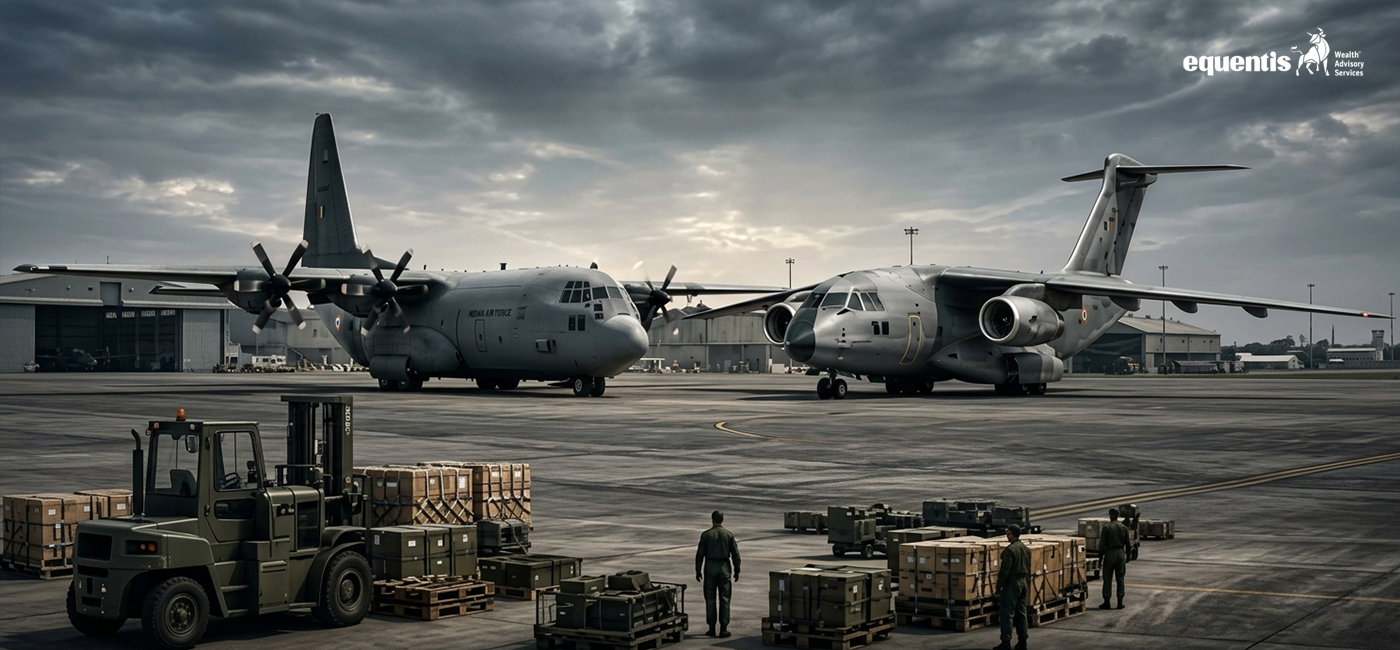

India has issued a tender worth around ₹1 lakh crore to acquire 60 multirole transport aircraft for the Indian Air Force, putting Indian defence companies including Tata, Mahindra and Hindustan Aeronautics Limited (HAL) in focus. The programme is aimed at replacing ageing transport aircraft and strengthening India’s airlift capability. For investors, the bigger takeaway is the scale of the potential manufacturing programme, but the ₹1 lakh crore figure should not be treated as immediate revenue for any one company.
Why Is the ₹1 Lakh Crore Defence Tender Important?
The Indian Air Force relies on transport aircraft to move troops, equipment, vehicles and supplies across the country. These aircraft are particularly important for operations in difficult terrain and at high-altitude locations, where road and rail connectivity can be limited.
The new medium transport aircraft programme is intended to modernise this capability. The requirement involves 60 aircraft, with reports indicating that around 20% will be delivered in fly-away condition, while the remaining aircraft will be manufactured in India with more than 60% indigenous content.
This makes the programme important not only from a defence perspective but also for India’s aerospace manufacturing ecosystem.
What Does the Transport Aircraft Programme Involve?
The aircraft are expected to perform multiple roles rather than simply carrying cargo. Their potential applications include transporting personnel and military equipment, supporting rapid deployment and potentially serving in aerial refuelling roles.
The programme is also designed around local manufacturing. Instead of importing all 60 aircraft, the larger portion would be produced in India through partnerships between Indian companies and global original equipment manufacturers.
This model is significant because building aircraft locally involves much more than final assembly. It can create demand for aerostructures, avionics, components, maintenance, engineering services and other aerospace capabilities.
Tata vs Mahindra: What Are They Offering?
Two prominent private-sector contenders are Tata Advanced Systems and Mahindra Defence, each partnered with a global aircraft manufacturer.
Tata Advanced Systems has partnered with US-based Lockheed Martin and is associated with the C-130J Super Hercules proposal. The Indian Air Force already operates 12 C-130J aircraft, giving the platform an existing operational and support base in India.
Mahindra Defence has partnered with Brazil’s Embraer to offer the C-390 Millennium. The C-390 is a jet-powered transport aircraft with a payload capacity of around 26 tonnes, compared with roughly 20 tonnes for the C-130J.
The competition therefore involves more than aircraft specifications. The Indian government’s assessment is also likely to consider operational requirements, manufacturing plans, technology transfer, indigenous content, lifecycle support and delivery timelines.
What Is HAL’s Role?
HAL is also in focus as an Indian aerospace player in the programme. Reports have identified HAL among the Indian companies involved in the tender process, with earlier reporting indicating that Russia’s Ilyushin could potentially be associated with HAL for the programme.
HAL’s presence is significant because the company has decades of experience in aircraft manufacturing, maintenance and aerospace engineering. However, the current programme is structured around competition and partnerships with original equipment manufacturers, meaning the final industrial arrangement will depend on the procurement process.
For investors, this distinction matters. Being involved in a tender does not automatically mean a company will receive the full value of the eventual contract.
Why Is India Building Transport Aircraft Locally?
The programme fits into India’s broader push to increase domestic defence production and reduce dependence on imports.
The government has increasingly encouraged foreign defence manufacturers to partner with Indian companies and establish production capabilities in the country. The C-295 programme, involving Tata and Airbus, is an existing example of this approach, with aircraft being manufactured in India.
The new transport aircraft programme could take this model further by creating another large-scale aircraft manufacturing line.
For India’s aerospace sector, the long-term benefit could extend beyond the 60 aircraft themselves. A domestic production facility can support future orders, exports, maintenance and component manufacturing if the ecosystem develops successfully.
What Could It Mean for Defence Stocks?
The tender has naturally drawn attention to defence-related companies. However, investors should separate tender participation, order potential and confirmed revenue.
If Tata, Mahindra or HAL eventually wins a significant portion of the programme, the selected entity and its suppliers could gain greater order visibility. The manufacturing requirement could also create opportunities for companies involved in aerospace components, electronics, engineering and maintenance.
At the same time, the reported ₹1 lakh crore programme value is not equivalent to the revenue of a single Indian company. The total cost can include aircraft, equipment, support, training and other elements, while the final commercial arrangement could involve multiple companies and partners.
Opportunities and Risks for Investors
The main opportunity is the creation of a large domestic military aerospace programme. Producing 48 aircraft in India, as reported, could deepen India’s capability in complex aircraft manufacturing and support a wider supplier network.
The programme could also help Indian companies gain experience in aircraft integration, manufacturing and lifecycle support.
However, there are several risks. Procurement decisions can take time, technical evaluations can alter the shortlist and negotiations can affect the final contract value. Competition between aircraft manufacturers could also make the outcome difficult to predict.
Investors should therefore avoid assuming that every company mentioned in connection with the tender will benefit equally.
What Should Investors Watch Next?
The next major developments will include the detailed tender process, technical evaluations, aircraft selection, commercial negotiations and eventual contract award.
Investors should also monitor the proposed manufacturing structure. The percentage of aircraft produced in India, the level of technology transfer, the Indian partner’s responsibilities and the size of the domestic supply chain could determine the long-term financial impact.
The C-390 and C-130J comparison will also remain important. The C-130J has the advantage of existing IAF operational experience, while the C-390 offers higher payload and jet-powered performance.
Conclusion
The ₹1 lakh crore defence tender for 60 multirole transport aircraft is an important step in India’s effort to modernise the IAF’s transport fleet while expanding domestic aerospace manufacturing. Tata, Mahindra and HAL are among the Indian companies attracting attention, with different international partnerships and aircraft platforms involved.
For investors, the development is significant because of the potential size and long-term manufacturing opportunity. However, the tender is not the same as a confirmed order for any individual company.
The key factors to watch will be the final aircraft selection, contract value, indigenous manufacturing commitments, technology transfer and execution timeline. These will ultimately determine which companies and suppliers gain the most from the programme.
Frequently Asked Questions
1. What is the ₹1 lakh crore defence tender?
The Defence Ministry has issued a tender for around 60 multirole transport aircraft for the Indian Air Force. The programme is estimated at around ₹1 lakh crore and is intended to modernise the IAF’s ageing transport fleet while increasing domestic aircraft manufacturing.
2. How many transport aircraft will India buy?
The Indian Air Force is looking to acquire 60 medium multirole transport aircraft. Reports indicate that around 12 aircraft could be delivered in fly-away condition, while the remaining 48 are planned for manufacturing in India under the programme’s localisation requirements.
3. Which companies are in focus for the ₹1 lakh crore defence tender?
Tata Advanced Systems, Mahindra Defence and HAL are among the Indian companies associated with the programme. Tata has partnered with Lockheed Martin, while Mahindra Defence has partnered with Embraer. Earlier reports also linked HAL with a potential Russian-Ilyushin offering.
4. Which aircraft is Tata offering for the IAF tender?
Tata Advanced Systems is associated with Lockheed Martin’s C-130J Super Hercules proposal. The aircraft is already operated by the Indian Air Force, which has 12 C-130J aircraft, providing an existing operational and support base for the platform.
5. Which aircraft is Mahindra Defence offering?
Mahindra Defence has partnered with Brazil’s Embraer to offer the C-390 Millennium. The jet-powered aircraft has a reported payload capacity of around 26 tonnes and is being positioned as a multirole transport platform for the IAF.
6. Why is India manufacturing transport aircraft locally?
Local manufacturing is intended to increase indigenous defence capability and reduce dependence on imported equipment. The programme is expected to involve manufacturing a majority of the aircraft in India, with more than 60% indigenous content reported as part of the requirement.
7. Will the ₹1 lakh crore go entirely to Tata, Mahindra or HAL?
No. The ₹1 lakh crore represents the reported overall programme value, not guaranteed revenue for one company. The final contract could involve an international aircraft manufacturer, Indian partner, suppliers and other service providers. The actual financial benefit to individual companies will depend on the final procurement structure.
8. Why does the transport aircraft deal matter for Indian defence stocks?
A large aircraft manufacturing programme could improve order visibility for selected companies and create additional business for aerospace suppliers. However, investors should wait for confirmed contracts and evaluate each company’s financials, valuation, execution capability and actual share of the programme rather than relying only on the headline tender value.
9. When will the Indian Air Force receive the new transport aircraft?
The final delivery schedule will depend on the procurement process, aircraft selection, negotiations and manufacturing arrangements. The programme envisages an initial portion being delivered in fly-away condition, with the larger share manufactured in India, but the complete induction timeline should not be assumed until the contract is finalised.
10. What should investors watch after the ₹1 lakh crore defence tender?
Investors should track the aircraft shortlisted for evaluation, technical trials, the final platform selected, the Indian manufacturing partner, technology-transfer terms, indigenous-content commitments and the eventual contract award. These details will provide a clearer picture of the programme’s actual impact on Tata, Mahindra, HAL and their wider supplier networks.
Disclaimer Note: The securities quoted, if any, are for illustration only and are not recommendatory. This article is for education purposes only and shall not be considered as a recommendation or investment advice by Equentis. We will not be liable for any losses that may occur. Investments in the securities market are subject to market risks. Read all the related documents carefully before investing. Registration granted by SEBI, membership of BASL & certification from NISM in no way guarantee the performance of the intermediary or provide any assurance of returns to investors.

Jaspreet Singh Arora is the Chief Investment Officer at Equentis, where he heads a seasoned team of equity analysts and turns two decades of market experience into portfolios that consistently beat the benchmark. A go-to voice on cement, building-materials, real-estate, and construction stocks, Jaspreet previously ran research desks at leading brokerages, honing an eye for the metrics that truly move share prices. His plain-spoken analysis helps investors cut through noise and act with conviction. When he’s not deep-diving into earnings calls, you’ll find him unwinding over sports, weekend cricket or a good history podcast.