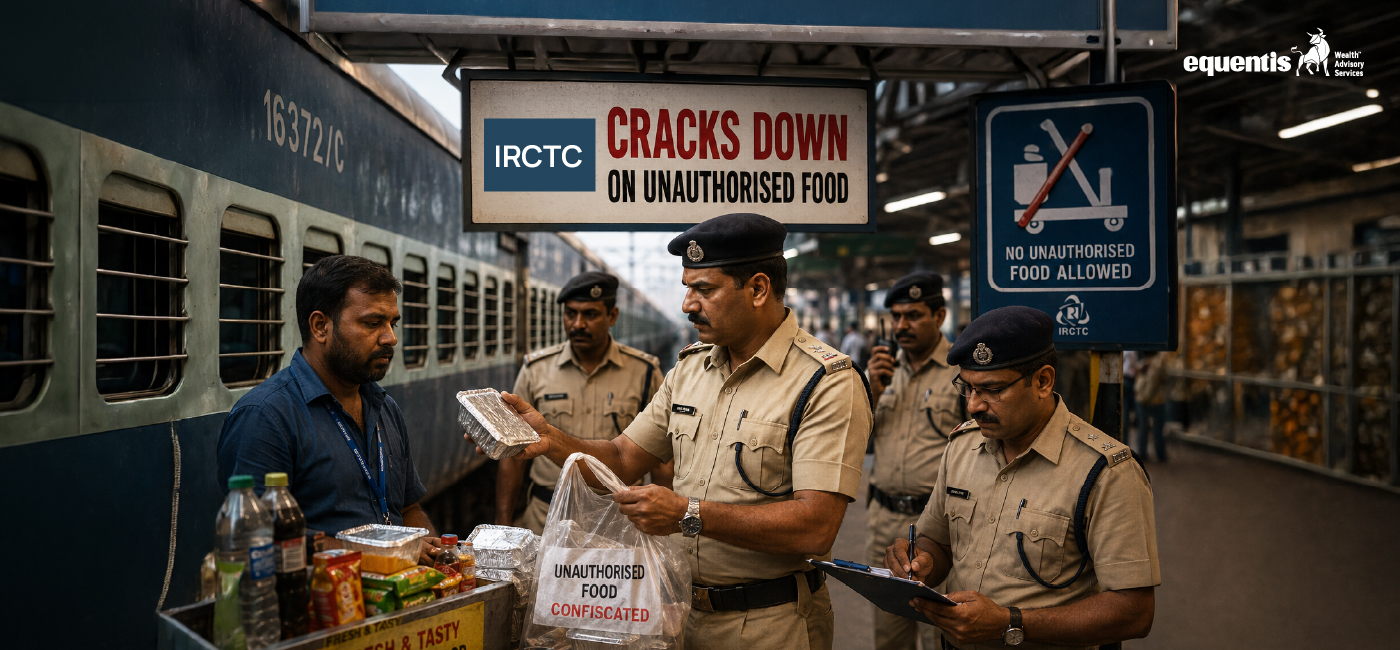

IRCTC has intensified its crackdown on unauthorised food sales and e-catering services across Indian Railways, targeting vendors and online operators that operate without proper approval. The move matters because unauthorised sellers can expose passengers to overcharging, poor food quality, hygiene concerns and, in the case of fake online platforms, payment and data risks. For investors, the enforcement drive also highlights IRCTC’s focus on strengthening its catering ecosystem and protecting its regulated business operations.
Why Is IRCTC Cracking Down on Unauthorised Food Sales?
Food sold on trains is subject to specific railway and catering rules. Unauthorised hawking and vending in passenger areas is prohibited under Section 144 of the Railways Act, 1989, and railway authorities regularly conduct inspections to identify vendors operating without valid permission.
The issue extends beyond people selling tea, snacks or meals inside trains. IRCTC has also been taking action against unauthorised e-catering websites and operators that present themselves as legitimate railway food services.
In June 2026, IRCTC said it had initiated legal proceedings against non-compliant e-catering operators and advised passengers to use its official e-catering website, the Food on Track application or authorised e-catering food aggregators.
How Is IRCTC Identifying Unauthorised Vendors?
One of the key measures is the use of QR code-enabled identity cards for authorised catering personnel. These cards can help passengers and railway officials verify a vendor’s identity and association with a licensed catering operation.
According to the Ministry of Railways, the QR code can be linked to details such as the vendor’s name, Aadhaar information, medical fitness and police verification. Food packets can also carry QR codes showing information such as the kitchen and manufacturing date.
This creates a clearer distinction between authorised staff and individuals who simply enter trains to sell food.
A February 2026 special drive in Mumbai illustrates the scale of the problem. IRCTC officials reportedly removed 203 unauthorised vendors from long-distance trains departing Mumbai between January 31 and February 22. Some were allegedly selling food, tea, coffee, snacks and bottled water at prices higher than prescribed rates.
Why Does Unauthorised Food Selling Matter to Passengers?
For passengers, the issue is not limited to paying a few extra rupees. Food purchased from an unauthorised seller may not have the same traceability or quality controls associated with approved catering operations.
Hygiene is another concern. Railway authorities have been increasing monitoring of catering kitchens through measures including CCTV surveillance, food safety supervisors, surprise inspections and third-party audits.
IRCTC has also expanded technology-based monitoring of food preparation. In June 2026, reports said its AI-enabled monitoring system had been extended to more than 800 kitchens, using thousands of cameras to identify hygiene-related issues.
The focus on traceability becomes particularly important when passengers complain about food quality. With an authorised seller, the railway catering ecosystem has a clearer route for identifying the responsible contractor or food provider.
Fake E-Catering Platforms Add Another Risk
The crackdown is also moving into the digital space.
IRCTC has warned passengers about websites and platforms that use railway-related branding while operating outside the authorised e-catering system. In 2026, the organisation initiated action against several non-compliant operators, citing concerns around food safety, financial losses and cyber fraud.
Passengers should therefore be careful when searching for train food online. A website appearing to offer “IRCTC food delivery” is not necessarily an official IRCTC service.
Before placing an order, passengers should check whether the service is available through IRCTC’s official e-catering channels or an authorised partner.
What Should Passengers Do If They Find an Unauthorised Vendor?
Passengers can take a few simple precautions:
- Check whether an onboard catering employee has the required uniform and identification.
- Look for the QR-enabled identity card where applicable.
- Check the displayed or prescribed price before paying.
- Avoid sharing payment or personal information with suspicious online platforms.
- Use official IRCTC e-catering channels when ordering food in advance.
- Report suspected unauthorised vending or overcharging to railway authorities.
IRCTC’s official e-catering service also advises passengers to use its official helpline and authorised platforms when dealing with food orders.
What Does the Crackdown Mean for IRCTC?
For IRCTC, tighter enforcement could help strengthen control over its catering operations and reduce the presence of sellers operating outside the authorised system.
However, enforcement alone does not eliminate every food-quality concern. In May 2026, the Food Safety and Standards Authority of India issued a notice to IRCTC after a video circulated showing alleged unhygienic handling of utensils on a train. The incident demonstrates that monitoring authorised catering contractors remains important even as action against unauthorised sellers increases.
For investors tracking IRCTC, the development is therefore better viewed as part of a broader focus on operational controls, passenger experience, food safety and digital authentication rather than as an immediate trigger for the company’s financial performance.
Opportunities and Risks to Watch
The increased use of QR-based identification, digital payments, traceable food packets and technology-led kitchen monitoring could make the catering system more transparent.
It could also make it easier to identify contractors or vendors when complaints arise. Over time, stronger enforcement may help create a more organised environment for authorised catering businesses.
At the same time, implementation remains a challenge. Indian Railways operates across a vast network, and monitoring vendors, contractors, kitchens and digital platforms requires continuous coordination. Passenger awareness is equally important because unauthorised sellers can adapt their methods.
For investors, the key factors to watch include the effectiveness of enforcement, catering-related complaints, digital e-catering adoption, food safety compliance and IRCTC’s broader operational performance.
Conclusion
IRCTC’s crackdown on unauthorised food sales is aimed at making train catering more controlled, traceable and safer for passengers. The introduction of QR-enabled identification, digital food traceability, stronger inspections and action against unauthorised e-catering platforms shows a wider shift towards technology-supported monitoring.
Passengers can play an important role by checking vendor credentials, avoiding suspicious food-ordering platforms and reporting overcharging or unauthorised activity. For investors, the more relevant question is how consistently these measures improve operational standards and passenger experience while supporting the long-term efficiency of IRCTC’s catering business.
Frequently Asked Questions
1. What is IRCTC’s crackdown on unauthorised food sales?
IRCTC’s crackdown involves identifying and taking action against vendors and e-catering operators that do not have proper authorisation to sell food to railway passengers. The measures include inspections, QR-enabled identity cards for authorised catering staff, action against illegal vendors and legal proceedings against unauthorised online food-ordering platforms.
2. Is selling food without authorisation on Indian Railways illegal?
Yes. Unauthorised hawking and vending in passenger areas of Indian Railways is prohibited under Section 144 of the Railways Act, 1989. Railway authorities and RPF conduct inspections and special drives to identify and take action against unauthorised vendors operating on trains and railway premises.
3. How can passengers identify an authorised food vendor on a train?
Passengers can look for the prescribed uniform and QR-enabled identity card carried by authorised catering personnel. The QR system is designed to help establish the identity and credentials of onboard catering staff associated with licensed operators.
4. Why is unauthorised train food a concern?
Unauthorised food sales can create risks related to hygiene, food quality, overcharging and accountability. When a seller operates outside the authorised system, passengers may have greater difficulty verifying the source of the food or identifying the responsible service provider if a problem occurs.
5. Are there fake IRCTC e-catering websites?
Yes. IRCTC has taken action against unauthorised e-catering operators and warned passengers about platforms that may misuse railway-related branding. Passengers should use official IRCTC e-catering channels or authorised food partners rather than relying on websites discovered through unverified advertisements or messages.
6. Can passengers report overcharging for food on trains?
Yes. Passengers can report suspected overcharging, unauthorised vending and other catering-related irregularities through official railway and IRCTC channels. Keeping the bill, payment record or other details of the transaction can make it easier for authorities to investigate a complaint.
7. What is the purpose of QR codes on IRCTC food packets?
QR codes on food packets are intended to improve traceability. According to the Ministry of Railways, these codes can provide information such as the name of the kitchen and manufacturing date, helping authorities and passengers identify the source of food supplied through the catering system.
8. Does the crackdown guarantee better food quality?
No. Stronger enforcement can improve monitoring and accountability, but it does not guarantee that every meal will meet expectations. Food quality also depends on kitchen hygiene, contractor compliance, storage, preparation and handling. IRCTC continues to use inspections, CCTV and other monitoring measures to address these issues.
9. What does the crackdown mean for IRCTC investors?
The crackdown may support better control over the authorised catering ecosystem, but investors should not treat it as a standalone reason to make an investment decision. IRCTC’s financial performance depends on several businesses and operating factors. Investors should consider financial results, segment performance, regulatory developments and broader business trends.
10. What should passengers watch for when ordering food on trains?
Passengers should verify the vendor or platform, check prices, avoid suspicious payment requests and use official IRCTC e-catering channels where possible. They should also be cautious of websites or individuals claiming to represent IRCTC without verifiable credentials. Using authorised services improves traceability if a problem occurs.
Disclaimer Note: The securities quoted, if any, are for illustration only and are not recommendatory. This article is for education purposes only and shall not be considered as a recommendation or investment advice by Equentis. We will not be liable for any losses that may occur. Investments in the securities market are subject to market risks. Read all the related documents carefully before investing. Registration granted by SEBI, membership of BASL & certification from NISM in no way guarantee the performance of the intermediary or provide any assurance of returns to investors.

Jaspreet Singh Arora is the Chief Investment Officer at Equentis, where he heads a seasoned team of equity analysts and turns two decades of market experience into portfolios that consistently beat the benchmark. A go-to voice on cement, building-materials, real-estate, and construction stocks, Jaspreet previously ran research desks at leading brokerages, honing an eye for the metrics that truly move share prices. His plain-spoken analysis helps investors cut through noise and act with conviction. When he’s not deep-diving into earnings calls, you’ll find him unwinding over sports, weekend cricket or a good history podcast.