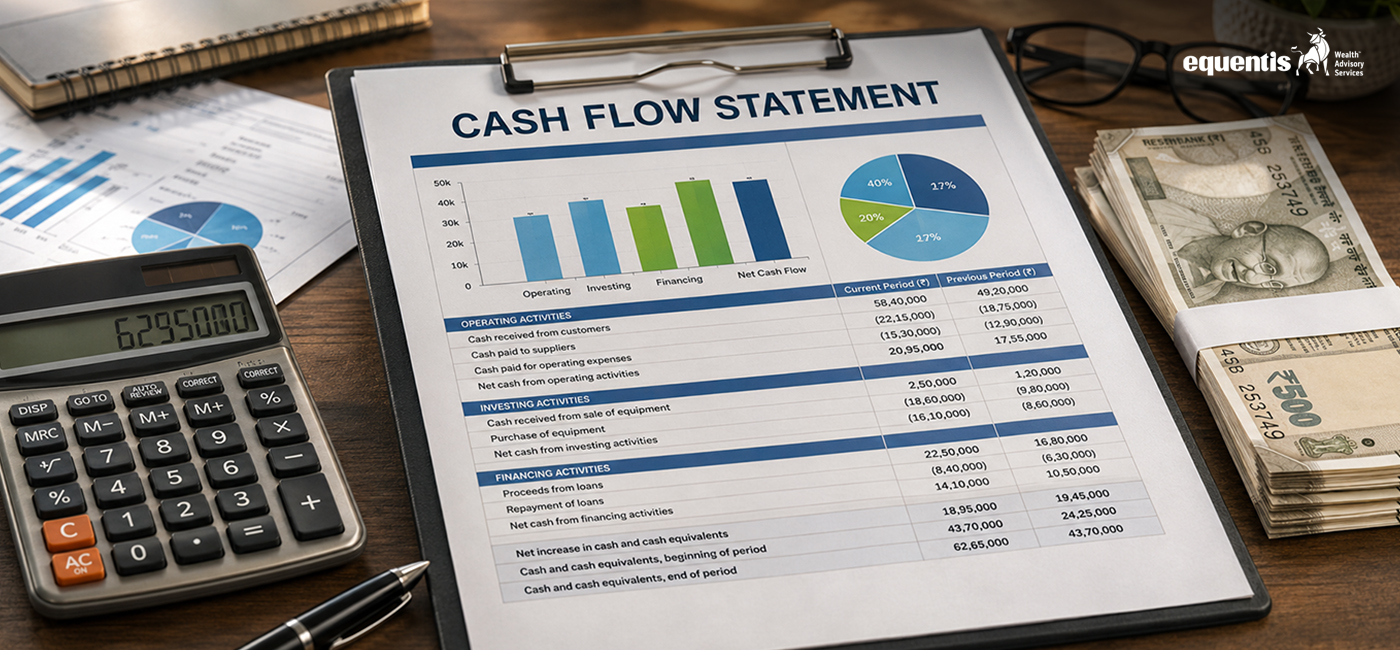

When investors evaluate a company, they often focus on revenue, profit and earnings per share. These numbers are important, but they do not always tell the complete story. A company can report rising profits while struggling to generate actual cash. This is where Free Cash Flow becomes an important measure.
Free Cash Flow, commonly called FCF, helps investors understand how much cash a business has left after spending on the assets and investments needed to run its operations. A company that consistently generates healthy Free Cash Flow may have greater flexibility to reduce debt, invest in growth, pay dividends or buy back shares.
For investors looking for businesses that could potentially compound value over many years, studying cash generation can provide useful insights. It can also help investors distinguish between genuine business growth and growth that requires continuous external funding.
What Is Free Cash Flow?
Free Cash Flow is broadly the cash generated by a company’s operations after accounting for capital expenditure, or Capex.
A commonly used formula is:
Free Cash Flow = Operating Cash Flow − Capital Expenditure
Operating cash flow represents the cash generated from the company’s core business. Capital expenditure refers to spending on assets such as factories, machinery, technology infrastructure and other long term assets required to operate or expand the business.
For example, suppose an Indian manufacturing company generates ₹1,000 crore in operating cash flow during a financial year and spends ₹400 crore on new plants and equipment. Its Free Cash Flow would be approximately ₹600 crore.
This ₹600 crore gives management financial flexibility. It could be used to strengthen the balance sheet, fund expansion, distribute dividends or pursue other capital allocation decisions.
However, investors should remember that FCF can fluctuate significantly between years, particularly in capital intensive or cyclical businesses.
Why Do Investors Track Free Cash Flow?
Profit is calculated using accounting principles, whereas cash flow focuses on actual movement of cash. This distinction matters because revenue recognised on credit, changes in working capital and non-cash accounting expenses can cause reported profits and cash generation to differ.
A company reporting ₹500 crore in net profit but consistently generating much lower operating cash flow deserves further investigation.
On the other hand, a business that steadily converts profits into cash may have stronger financial flexibility.
Free Cash Flow can therefore help investors assess the quality of earnings, the company’s ability to fund growth internally and its capacity to return capital to shareholders.
Free Cash Flow and Long Term Wealth Creation
Businesses capable of generating and reinvesting substantial cash can potentially create value over long periods.
Imagine two companies operating in the same industry. Company A generates strong profits but requires significant additional borrowing to fund expansion. Company B generates similar profits but produces enough internal cash to fund most of its expansion.
All else being equal, Company B may have greater financial flexibility and lower dependence on external financing.
This does not mean every high FCF company will become one of the multibagger stocks investors search for. Shareholder returns also depend on future growth, competitive advantages, management decisions, risks and the valuation investors pay.
Free Cash Flow is therefore one part of a broader investment analysis rather than a standalone signal.
How to Analyse Free Cash Flow
Look at the Trend, Not One Year
One year’s FCF can be misleading. A company may report unusually high cash flow because of a temporary working capital release or unusually low capital expenditure.
Instead, investors can examine FCF over several years and ask whether the business has demonstrated consistent cash generation across different economic conditions.
A rising trend is useful, but stability can also be valuable. A company generating positive FCF through multiple business cycles may have a different risk profile from one whose cash generation changes sharply with market conditions.
Compare Free Cash Flow With Net Profit
The relationship between net profit and cash flow can reveal the quality of earnings.
If a company reports ₹1,000 crore of cumulative profits over several years but generates only ₹300 crore of operating cash flow, investors should understand why.
Working capital requirements, receivables, inventory and other factors may explain the difference. But a persistent gap requires closer analysis.
Conversely, operating cash flow that consistently supports or exceeds reported profits can indicate healthy cash conversion.
Examine Capital Expenditure
High Capex is not necessarily negative.
A growing company may deliberately invest heavily in factories, stores, technology or distribution infrastructure. This can temporarily reduce FCF while creating capacity for future growth.
The important question is whether those investments generate attractive returns over time.
This is where metrics such as ROCE become useful. If a company continually invests large amounts of capital but its returns remain weak, investors should question whether the expansion is creating value.
Free Cash Flow, ROCE and Balance Sheet Strength
Free Cash Flow becomes more meaningful when considered alongside other financial indicators.
ROCE can help investors assess how efficiently a company uses capital to generate operating profits. A company with healthy and sustainable returns on capital and strong cash generation can have favourable underlying economics.
The balance sheet also matters. A company producing strong FCF but carrying excessive debt may use much of its cash to service interest and repay borrowings.
On the other hand, a company with manageable debt and consistent FCF may have more flexibility during difficult market conditions.
Investors should therefore examine cash flow, profitability, ROCE and debt together rather than relying on a single ratio.
What Is Stock Market and Why Does Cash Flow Matter?
For someone asking what is stock market, the stock market is a marketplace where shares representing ownership in publicly listed companies are bought and sold. In India, investors participate through exchanges such as the NSE and BSE.
Over long periods, the value of a company is influenced by its ability to generate earnings and cash, grow its business and allocate capital effectively. However, share prices can move independently of fundamentals over shorter periods because of sentiment, interest rates, economic conditions and investor expectations.
This is why Free Cash Flow matters to fundamental investors. A company consistently generating cash may have the financial resources to reinvest in its business or return money to shareholders. But the market price still determines whether buying its shares at a particular point represents an attractive valuation.
For investors comparing different asset classes and their characteristics, understanding the broader investment landscape can also be useful. The discussion around Gold vs Stocks 2026 provides another perspective on investing choices.
Free Cash Flow Does Not Automatically Mean a Good Stock
A common mistake is assuming that a company with high FCF must be a good investment.
A business may generate substantial cash but operate in a declining industry. Another company may have excellent cash generation but trade at a valuation that already reflects years of expected growth.
This distinction is important.
A good business and a good stock are not always the same thing.
Investors should consider the price being paid relative to expected future cash flows. Valuation metrics such as price-to-free-cash-flow, price-to-earnings and enterprise value to EBITDA can provide context, although the appropriate metric varies by industry.
For example, a capital intensive company may naturally have lower FCF during periods of expansion, while a mature asset-light business may consistently generate higher FCF. Comparing the two without considering their business models can lead to incorrect conclusions.
How Investors Can Use Free Cash Flow in Their Research
Investors can begin by studying a company’s annual reports and financial statements over several years. Look at operating cash flow, Capex and the resulting FCF.
Then ask a few practical questions:
Is FCF consistently positive?
Does cash generation broadly support reported profits?
How much capital does the company need to maintain its existing operations?
Is management reinvesting cash at attractive returns?
Is debt increasing despite healthy cash generation?
What does management do with surplus cash?
These questions can help investors understand whether cash is being used to strengthen the business or simply compensate for weak underlying economics.
Investors who prefer professional guidance can also consider a SEBI Registered Investment Advisory approach while conducting their own research and evaluating investment decisions.
Risks and Limitations of Free Cash Flow
Free Cash Flow has limitations. It can be volatile for businesses with large capital expenditure requirements. A temporary reduction in working capital can make FCF appear stronger than normal, while inventory buildup can temporarily depress it.
Some companies also report adjusted or customised cash flow measures. Investors should therefore understand how the numbers are calculated rather than relying solely on management-defined metrics.
Business cycles can create another challenge. Companies in sectors such as metals, automobiles, chemicals and infrastructure may experience significant swings in cash generation depending on demand and commodity prices.
Finally, strong historical FCF does not guarantee future performance. Technology changes, competition, regulation, poor capital allocation or a change in consumer behaviour can weaken a company’s economics.
Conclusion
Free Cash Flow gives investors a practical view of how much cash a business generates after funding the capital required to operate and grow. Consistent FCF can support debt reduction, reinvestment, dividends and other forms of capital allocation.
However, investors should not use FCF in isolation. The most useful analysis combines cash generation with revenue growth, profitability, ROCE, competitive advantages, balance sheet strength, management quality and valuation.
For investors researching potential long term wealth creators, the key is to understand why a company generates cash, whether that cash can grow sustainably and how efficiently management uses it. Strong Free Cash Flow can be an important piece of the puzzle, but the quality of the business and the valuation paid ultimately determine whether an investment thesis makes sense.
Disclaimer Note: The securities quoted, if any, are for illustration only and are not recommendatory. This article is for education purposes only and shall not be considered as a recommendation or investment advice by Equentis. We will not be liable for any losses that may occur. Investments in the securities market are subject to market risks. Read all the related documents carefully before investing. Registration granted by SEBI, membership of BASL & certification from NISM in no way guarantee the performance of the intermediary or provide any assurance of returns to investors.

Parvati Rai is the Vice President of the Research team at Equentis. She has over 15 years of equity-research and strategy-consulting experience. A specialist in deep-dive valuations, financial modelling, and forecasting, she has built research desks from the ground up, by steering buy-side, sell-side, and independent coverage across sectors. When she isn’t fine-tuning models, Parvati unwinds on nature treks and mentors aspiring analysts.