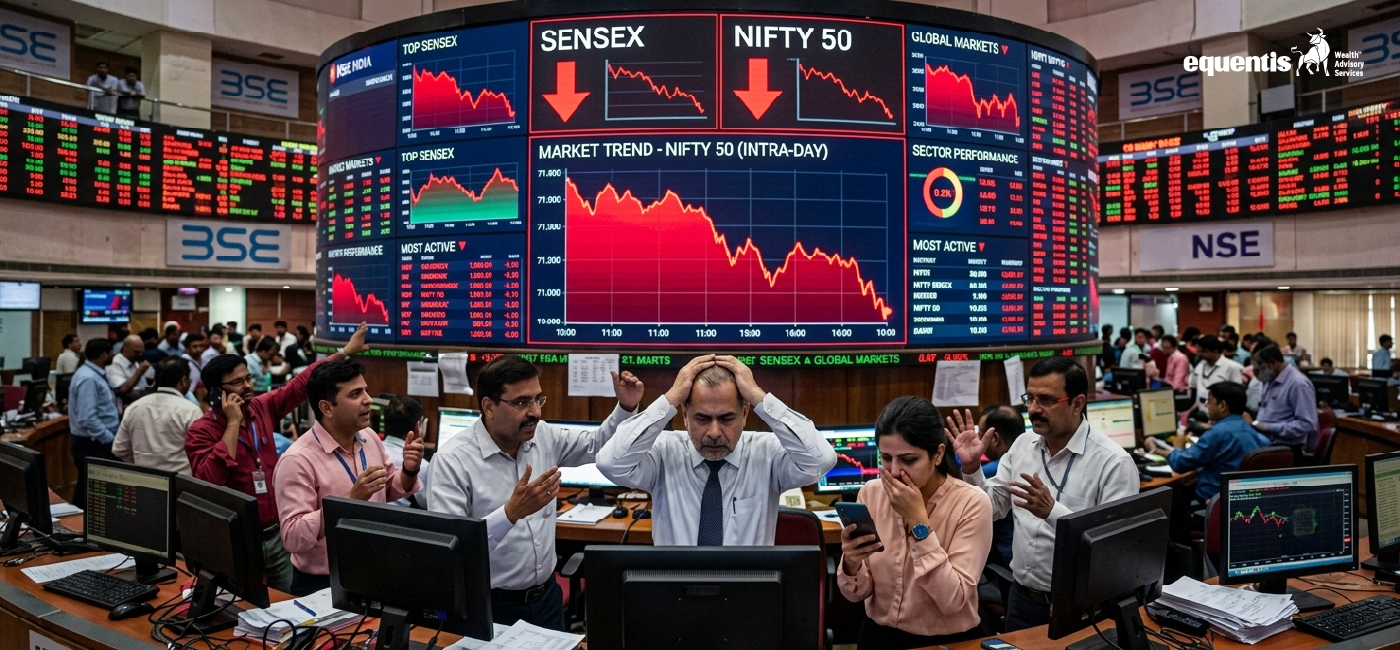

The Indian stock market is under pressure as the Sensex fell more than 170 points and the Nifty slipped below 24,200, with investors cautious over geopolitical tensions, elevated crude oil prices and global market cues. On August 25, the weakness followed Monday’s decline, when the Sensex closed at 77,369.11, down 171.72 points, while the Nifty 50 settled at 24,219.05, lower by 32.95 points. For investors, the immediate focus is on whether Nifty can hold the 24,200–24,000 support zone and whether concerns around crude and US-Iran tensions intensify.
Why Is the Stock Market Falling Today?
The current weakness is being driven primarily by a combination of geopolitical uncertainty, crude oil prices and cautious global sentiment.
Investors have been monitoring developments between the US and Iran after Washington announced tougher sanctions targeting Iran-linked entities. The possibility that sanctions could affect Iranian oil exports has kept the energy market and Indian equities on edge.
For India, crude oil is particularly important because the country imports a large share of its energy requirements. A sustained increase in crude prices can raise the import bill, put pressure on the rupee and potentially add to inflationary pressures.
Sensex and Nifty: What Happened?
On Monday, the Sensex declined 171.72 points, or 0.22%, to 77,369.11, while the Nifty 50 fell 32.95 points, or 0.14%, to 24,219.05. The Nifty had recovered from an intraday low of 24,144.30 but could not regain stronger levels by the close.
Early trading on Tuesday continued to reflect caution. Around 9:15 AM, the Sensex was down about 116 points at 77,252.88, while the Nifty traded at 24,167.30, below the 24,200 mark.
The relatively modest percentage decline may look small, but the important issue for traders is the index’s position near key technical support levels.
Nifty Below 24,200: Why Does It Matter?
The 24,200 level is an important near-term zone for the Nifty.
Technical analysts have identified the broader 24,200–24,000 area as immediate support, while 24,350 is considered an important resistance level. A sustained move below support could indicate that selling pressure is gaining strength, whereas a recovery above resistance would improve the short-term technical picture.
It is important, however, not to treat a single intraday move below 24,200 as confirmation of a prolonged downtrend. Market participants generally look for sustained closes and supporting volumes before drawing stronger conclusions.
Crude Oil Remains a Key Market Driver
Oil prices have become one of the most important variables for Indian equities.
Brent crude remained around the $92–$93-a-barrel region as investors assessed the potential effect of new US sanctions on Iran. On Monday, Brent fell 1.68% to around $92.80 a barrel, but the market remains sensitive to developments involving Iranian exports and shipping routes.
Higher crude can affect Indian companies in several ways. Airlines, logistics companies, chemical producers and other fuel-intensive businesses may face higher costs. At the macroeconomic level, expensive oil can widen India’s import bill and influence inflation and the rupee.
That explains why even a relatively small change in crude prices can have an outsized effect on investor sentiment.
US-Iran Tensions Add to Uncertainty
The latest US sanctions against Iran have become a major market focus.
The concern for investors is not simply the sanctions themselves, but whether they eventually lead to a meaningful reduction in Iranian oil exports or create disruptions around important shipping routes.
If Iranian crude supply remains largely available through alternative channels, the impact on oil prices may remain manageable. But a physical supply disruption would create a much larger risk for global markets.
For Indian equities, the combination of higher crude and geopolitical uncertainty can be particularly challenging because it can simultaneously affect corporate costs, inflation expectations, the rupee and foreign investor sentiment.
Which Sectors Are Under Pressure?
Financial stocks were among the major drags during Monday’s session. Bajaj Finance fell 1.64%, State Bank of India declined 0.88% and Reliance Industries dropped 0.47%.
IT stocks, meanwhile, have also remained volatile as investors assess global technology spending and uncertainty around the US operating environment for Indian technology companies.
Not every sector is moving in the same direction. IT and metals helped the Nifty recover from its intraday low on Monday, illustrating that sector rotation remains active even during a weak market session.
For investors, this means the headline index movement does not necessarily describe what is happening across every part of the market.
What Does the Market Weakness Mean for Investors?
For long-term investors, a decline in the Sensex or Nifty does not automatically mean that portfolios need to be changed.
The more useful approach is to separate market-wide volatility from company-specific fundamentals. A fundamentally strong company can decline during a broad market sell-off even when its earnings outlook remains unchanged.
Short-term traders, however, need to pay closer attention to support and resistance levels because geopolitical headlines can cause rapid moves.
Investors should also be careful about reacting to every market headline. Volatility can increase when traders are waiting for major events, and price movements may reverse quickly when new information emerges.
Key Levels to Watch
For the Nifty 50, the immediate levels are:
- 24,200: Important near-term support area.
- 24,000: Broader support level to watch if selling intensifies.
- 24,350: Key resistance that the index needs to reclaim for stronger upward momentum.
- 24,700: The upper end of the recent broader trading range identified by analysts.
For the Sensex, traders should similarly monitor whether the index can stabilise after falling below the previous session’s close.
Opportunities and Risks
Market weakness can create opportunities for investors who are building positions gradually and have a long-term horizon. However, the current environment also carries meaningful risks.
The main risks include a further escalation in US-Iran tensions, higher crude oil prices, continued foreign capital outflows, elevated global bond yields and weak corporate earnings expectations.
On the positive side, any easing in geopolitical tensions or sustained decline in crude could quickly improve sentiment. Strong domestic earnings and buying by domestic institutional investors could also provide support to Indian equities.
What Should Investors Watch Next?
The next market direction will depend on several variables rather than one headline.
Investors should monitor Brent crude, the USD/INR exchange rate, US-Iran developments, foreign institutional flows, global equity markets and upcoming economic data.
The NSE’s monthly derivatives expiry is another important factor because derivatives positioning can increase short-term volatility. The Federal Reserve’s Jackson Hole symposium is also being watched for clues about the global interest-rate outlook.
Conclusion
The stock market today remains under pressure, with the Sensex down more than 170 points and the Nifty trading below 24,200, as geopolitical uncertainty and elevated crude prices weigh on sentiment. The immediate technical focus is on the Nifty’s 24,200–24,000 support zone and whether the index can reclaim the 24,350 resistance level.
For Indian investors, crude oil and US-Iran developments are likely to remain the biggest short-term market triggers. Rather than focusing only on daily index movements, investors should track whether the underlying risks are improving or worsening and assess individual companies based on their earnings, valuations and financial strength.
Frequently Asked Questions
1. Why is the Indian stock market falling today?
The Indian stock market is under pressure due to geopolitical uncertainty surrounding US-Iran tensions, elevated crude oil prices and cautious global sentiment. The previous session saw the Sensex fall 171.72 points and the Nifty decline 32.95 points. Investors are also monitoring global bond yields and upcoming economic and monetary-policy signals.
2. Why is the Nifty below 24,200?
The Nifty slipped below 24,200 amid selling pressure linked to geopolitical concerns and crude oil prices. The 24,200 level is being watched as an important near-term support zone. A sustained move below this area could indicate continued weakness, although one intraday breach does not necessarily confirm a longer-term downtrend.
3. What are the key Nifty levels to watch?
The immediate support zone is around 24,200–24,000, while 24,350 is an important resistance level. Analysts have also identified the broader 23,800–24,700 range as relevant for the index. Investors should watch for sustained moves rather than relying on a single intraday breach of these levels.
4. How do US-Iran tensions affect Indian stocks?
US-Iran tensions can affect Indian stocks mainly through crude oil, global risk sentiment and currency movements. If geopolitical developments push oil prices higher, India’s import costs could increase. Higher energy costs can affect corporate margins, inflation expectations and the rupee, potentially creating additional pressure on Indian equities.
5. Why is crude oil important for the Indian stock market?
India imports a large share of its crude oil requirements, so changes in international oil prices affect the country’s import bill and businesses that consume fuel. Higher crude can pressure inflation and the rupee while raising costs for sectors such as aviation, logistics and chemicals. This makes crude an important macroeconomic indicator for Indian investors.
6. Which stocks were major drags on the Nifty?
During Monday’s session, Bajaj Finance, State Bank of India and Reliance Industries were among the notable Nifty drags. Bajaj Finance fell 1.64%, SBI declined 0.88% and Reliance Industries dropped 0.47%. However, individual stocks can move differently from the broader index based on company-specific developments.
7. Is the current market fall a buying opportunity?
A market decline does not automatically make every stock attractive. Investors should evaluate individual companies based on earnings growth, valuation, balance-sheet strength and long-term prospects. Those investing for the long term may consider gradual allocation strategies, while short-term investors need to account for elevated volatility and geopolitical risks.
8. Could the Nifty recover above 24,350?
A recovery above 24,350 could improve the short-term technical setup, according to market analysts. However, whether the index can sustain such a move will depend on crude prices, global markets, institutional flows and geopolitical developments. Technical resistance levels should be treated as indicators rather than guaranteed market turning points.
9. What should investors watch if crude prices rise further?
Investors should monitor the impact on the rupee, inflation, corporate margins and sectors that depend heavily on fuel or petroleum-based inputs. Oil marketing companies, airlines, logistics, chemicals and paints can have different levels of sensitivity. The impact also depends on whether higher crude prices are temporary or sustained.
10. What could improve Indian stock market sentiment?
A decline in geopolitical tensions, lower crude oil prices, stronger foreign investment flows and stable global bond yields could support market sentiment. Positive corporate earnings and improving domestic economic indicators could provide additional support. However, investors should assess whether such improvements are sustained rather than reacting to a single positive trading session.
Disclaimer Note: The securities quoted, if any, are for illustration only and are not recommendatory. This article is for education purposes only and shall not be considered as a recommendation or investment advice by Equentis. We will not be liable for any losses that may occur. Investments in the securities market are subject to market risks. Read all the related documents carefully before investing. Registration granted by SEBI, membership of BASL & certification from NISM in no way guarantee the performance of the intermediary or provide any assurance of returns to investors.

Parvati Rai is the Vice President of the Research team at Equentis. She has over 15 years of equity-research and strategy-consulting experience. A specialist in deep-dive valuations, financial modelling, and forecasting, she has built research desks from the ground up, by steering buy-side, sell-side, and independent coverage across sectors. When she isn’t fine-tuning models, Parvati unwinds on nature treks and mentors aspiring analysts.