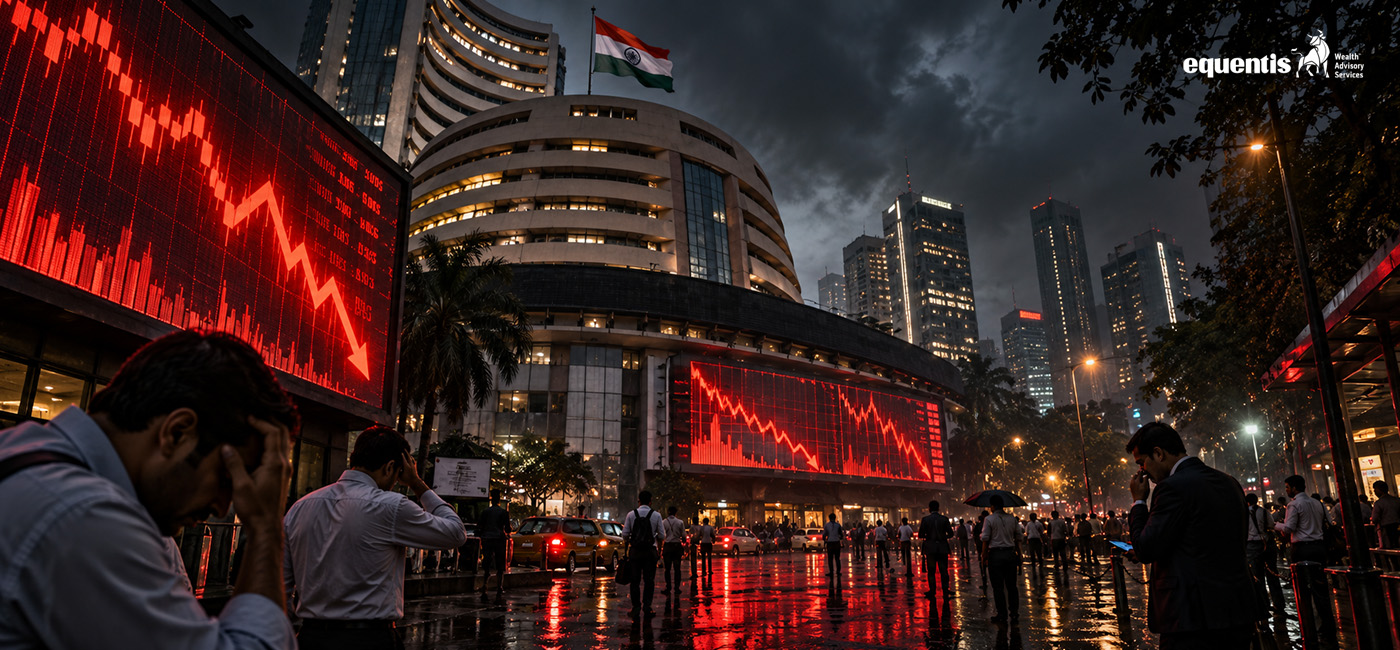

The Indian stock market today remained under pressure, with the Sensex falling below the 76,000 mark and the Nifty 50 trading near 23,700 as banking and other heavyweight stocks dragged the benchmarks lower. By mid-morning, the Sensex was around 75,727, down roughly 0.53%, while the Nifty stood near 23,669, down about 0.46%. Rising crude oil prices, geopolitical tensions in West Asia and weakness in financial stocks were among the key factors weighing on sentiment.
Stock Market Today: Why Are Sensex and Nifty Falling?
Indian equities opened lower on Tuesday, September 8, and selling pressure increased as the session progressed. The Nifty 50 slipped below 23,700, while the Sensex moved further away from the 76,000 level.
Banking stocks were among the major drags on the benchmarks. Heavyweight names such as HDFC Bank, ICICI Bank and other financial stocks came under pressure, while Reliance Industries also contributed to the decline. Since these companies have significant weight in the benchmark indices, their movements can have an outsized effect on the overall market.
The weakness comes after Indian equities have already been dealing with a difficult global environment. Monday’s session also ended lower, with the Nifty closing below 23,800 amid pressure across several sectors.
Rising Crude Oil Prices Add to Market Pressure
One of the biggest concerns for investors today is the rise in crude oil prices. Brent crude moved above $97 a barrel and was around $98 during Tuesday’s trading, as geopolitical tensions in the Middle East raised concerns about potential disruptions to oil supplies.
This is particularly important for India because the country imports roughly 85% of its crude oil requirements. Higher crude prices can increase the import bill and put pressure on the rupee, inflation and corporate costs.
For businesses that depend heavily on fuel or transportation, sustained high oil prices can increase operating expenses. Investors therefore tend to watch crude closely when assessing India’s market outlook.
Why Are Banking Stocks Dragging the Market?
Banks and financial companies have a large influence on both the Sensex and Nifty 50. When heavyweight banking stocks fall together, the impact can quickly show up in benchmark indices.
The weakness in financial stocks today comes amid broader risk aversion. Higher oil prices can create concerns about inflation and interest rates, while a weaker rupee can add another layer of pressure.
The market is also adjusting to changes in domestic liquidity conditions. The Reserve Bank of India has been absorbing excess liquidity from the banking system after an unusually large surplus emerged, with more than ₹6 trillion withdrawn through overnight and 30-day operations on September 7.
Liquidity is important because easier financial conditions can support lending and risk-taking, while tighter liquidity can have the opposite effect. However, today’s market decline cannot be attributed to liquidity alone; global geopolitical developments and crude prices remain important drivers.
Global Markets and Geopolitical Risks
The weakness in Indian equities is also part of a broader cautious mood across Asian markets. Investors are assessing the implications of escalating tensions in the Middle East and their potential impact on energy supplies and inflation.
The situation is particularly relevant for India because a prolonged rise in crude prices could affect the country’s inflation trajectory and current-account position. It could also complicate monetary policy decisions if higher fuel and imported costs begin feeding into domestic prices.
At the same time, the rupee has weakened against the US dollar. The currency was around ₹94.69 per dollar on Tuesday, while traders reported intervention by state-run banks, believed to be on behalf of the RBI, to limit the decline.
What Does the Market Fall Mean for Retail Investors?
For retail investors, a fall in the Sensex and Nifty does not necessarily mean every stock or sector is declining. Market movements are often uneven, and individual companies can perform differently from the broader indices.
Today’s session is a good example. While banking and several large-cap stocks were under pressure, some individual stocks moved higher on company-specific developments. GE Vernova T&D India, for example, gained sharply after being selected as the lowest bidder for a major Power Grid project.
This highlights why investors should distinguish between market-wide factors and company-specific developments rather than judging a stock only by the direction of the Sensex or Nifty.
Key Levels Investors Are Watching
The Nifty’s move below 23,700 has made the 23,600-23,700 zone important for market participants. Some technical analysts are watching 23,600 as a potential support level, while a sustained recovery above 23,800 could improve near-term sentiment.
These levels should not be treated as guaranteed turning points. Technical support and resistance are simply areas where buying or selling activity may increase.
For the Sensex, holding above the 75,000-76,000 region will remain relevant as investors assess whether the recent weakness develops into a deeper correction or stabilises.
Opportunities and Risks for Investors
Opportunities
Market declines can bring individual stocks to valuations that investors may find more interesting, particularly when the weakness is driven by broad macroeconomic concerns rather than a deterioration in a company’s fundamentals.
Investors may also find opportunities in sectors benefiting from specific developments, such as infrastructure, defence or commodities, although company-level analysis remains important.
Risks
The biggest near-term risk is a further rise in crude oil prices. A prolonged geopolitical escalation could increase energy costs and put additional pressure on inflation and the rupee.
Another risk is continued selling by foreign investors. Foreign portfolio flows can have a meaningful impact on Indian equities, particularly during periods of global uncertainty.
Investors should also be cautious about making decisions based solely on one day’s market movement. Short-term volatility can be significant when several macroeconomic factors are changing simultaneously.
What Should Investors Watch Next?
The next direction for the Sensex and Nifty today will depend on several factors, including crude oil prices, developments in the Middle East, the rupee’s movement, global market cues and activity in heavyweight banking stocks.
For the Nifty, the 23,600-23,800 range could remain important in the near term. A sustained move above the upper end may improve sentiment, while further weakness around the lower end could keep investors cautious.
Conclusion
The stock market today is under pressure, with the Sensex below 76,000 and the Nifty near 23,700 as banks and other heavyweight stocks weigh on the benchmarks. Rising crude prices and geopolitical tensions remain the central concerns for investors, while tighter liquidity and rupee weakness add to the uncertainty.
For Indian investors, the key takeaway is to look beyond the headline index moves. Crude prices, banking stocks, currency movements, global cues and upcoming economic developments will be important in determining whether the current weakness remains temporary or develops into a broader market correction.
Frequently Asked Questions
1. Why is the Indian stock market falling today?
Indian shares are falling mainly because of rising crude oil prices, geopolitical tensions in West Asia and weakness in heavyweight financial stocks. The Sensex and Nifty are also responding to broader global uncertainty and concerns about inflation and interest rates. The decline is broad enough to pressure the major indices, although some individual stocks are still gaining.
2. Where is the Sensex trading today?
The Sensex fell below the 76,000 mark on September 8, 2026. Around mid-morning, it was near 75,727, down about 0.53%. The index later moved within a volatile range as investors assessed crude prices, banking stocks and geopolitical developments.
3. Why is the Nifty below 23,700?
The Nifty 50 slipped below 23,700 as selling pressure affected banking, financial and other heavyweight stocks. Rising crude prices and concerns over geopolitical tensions also weakened investor sentiment. The index touched an intraday low around 23,680 during the session.
4. Which sectors are dragging the Indian market today?
Banking and financial stocks are among the major drags on the benchmark indices. Energy-related stocks and several large-cap companies are also contributing to the weakness. At the same time, some sectors and individual stocks are outperforming because of company-specific developments, showing that the market decline is not uniform.
5. How do higher crude oil prices affect Indian stocks?
India imports most of its crude oil, so higher international oil prices can increase the country’s import bill and put pressure on the rupee. They can also raise transportation and operating costs for businesses and potentially add to inflation. These factors can influence corporate earnings and investor sentiment.
6. What Nifty levels should investors watch?
The 23,600-23,700 area is being watched as an important support zone, while 23,800 is a level that some analysts consider important for a potential improvement in near-term sentiment. These are technical reference points rather than guaranteed market turning points.
7. Is the Sensex fall a sign of a market crash?
A decline of around 0.5% in the Sensex does not by itself indicate a market crash. Equity markets regularly experience corrections and short-term volatility. Investors need to consider the duration and breadth of the decline, corporate earnings, economic conditions and global factors before determining whether a larger trend is developing.
8. How is the rupee affecting the stock market?
The rupee has weakened to around ₹94.69 against the US dollar amid higher crude prices and geopolitical uncertainty. A weaker rupee can increase the cost of imported goods, particularly crude oil, although exporters may benefit from stronger foreign-currency revenue. The overall market impact therefore varies by company and sector.
9. What should retail investors do when the market falls?
Retail investors should avoid making decisions purely because the Sensex or Nifty has fallen on a particular day. Instead, they can review their investment horizon, portfolio diversification, company fundamentals and risk tolerance. Short-term market movements are difficult to predict, so investment decisions should be based on individual circumstances rather than headlines alone.
10. What will determine the next move in Sensex and Nifty?
Crude oil prices, developments in the Middle East, global market trends, the rupee, foreign investment flows and movements in heavyweight banking stocks are likely to remain important. Investors will also watch domestic economic data and corporate developments for signs of whether market sentiment is stabilising or weakening further.

Jaspreet Singh Arora is the Chief Investment Officer at Equentis, where he heads a seasoned team of equity analysts and turns two decades of market experience into portfolios that consistently beat the benchmark. A go-to voice on cement, building-materials, real-estate, and construction stocks, Jaspreet previously ran research desks at leading brokerages, honing an eye for the metrics that truly move share prices. His plain-spoken analysis helps investors cut through noise and act with conviction. When he’s not deep-diving into earnings calls, you’ll find him unwinding over sports, weekend cricket or a good history podcast.