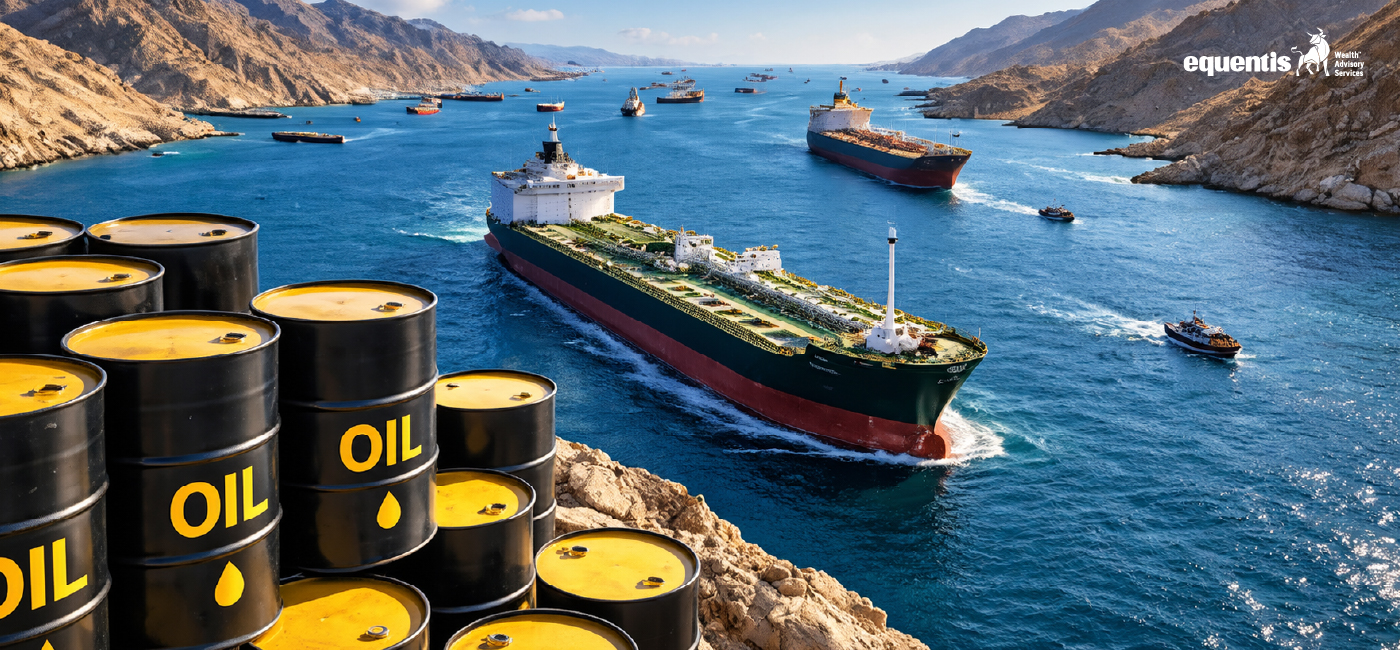

Brent crude oil has moved above $100 a barrel, and prices could test $110 if disruptions to Middle East supply and shipping continue. Brent settled at $101.21 a barrel on September 9, its highest close since May, after attacks involving Iran and the US intensified concerns about oil flows through the Strait of Hormuz. For India, the move matters well beyond petrol and diesel because expensive crude can pressure inflation, the rupee, corporate margins and the stock market.
Why Has Crude Oil Crossed $100?
The latest rally is primarily being driven by supply concerns rather than a sudden surge in global consumption.
The Strait of Hormuz is at the centre of the problem. The waterway has historically handled a significant share of global oil and gas shipments, but vessel traffic has fallen sharply amid the escalating conflict. Preliminary tracking data showed only seven vessel transits through the strait on Wednesday, compared with a 10-day average of 14.
The situation has become more complicated after attacks on commercial shipping and oil-related infrastructure. Reuters reported that Iran claimed attacks on 10 ships near the Strait of Hormuz, while the US had sunk five Iranian tankers. The resulting uncertainty has increased the risk premium embedded in crude prices.
Brent has already risen nearly 30% since early August, showing how quickly geopolitical risk can be reflected in energy prices.
Could Brent Crude Reach $110?
Yes, $110 is a realistic risk scenario if supply disruptions become more severe or persist for an extended period. However, it is not a certainty.
The most important factor will be the volume of crude that can actually reach international buyers. If shipping through Hormuz remains severely restricted, traders may continue pricing in tighter supply.
Recent estimates indicate that Gulf oil exports remain well below pre-conflict levels. Reuters reported that daily exports were averaging around 15–16 million barrels per day, approximately two-thirds of pre-war levels.
That does not necessarily mean prices must rise indefinitely. Higher prices can reduce demand, encourage alternative supplies and make previously uneconomic production more attractive.
The duration of the disruption therefore matters as much as its severity.
What Would Push Oil Towards $110?
Several developments could take Brent from around $101 toward $110.
1. Longer disruption in the Strait of Hormuz
If tanker traffic remains restricted, the market could price in a larger and longer supply shortage. Hormuz is particularly important because alternative routes cannot immediately replace all the volumes normally transported through the waterway.
2. More attacks on energy infrastructure
Further attacks on oil production, storage or transportation infrastructure in Gulf countries could create additional supply concerns.
The recent escalation involving Saudi energy infrastructure has already added to market anxiety.
3. Lower global inventories
When inventories are already tight, even a temporary disruption can have a larger impact on prices. Traders may pay a higher premium for immediately available barrels.
4. Strong Chinese demand
China’s crude imports are another factor to watch. Reuters noted that increased Chinese purchases have contributed to recent market sentiment, although weaker buying could limit further price gains.
What Would Stop Oil From Reaching $110?
The opposite scenario is also possible.
A de-escalation in the Middle East could quickly reduce the geopolitical premium in crude. If shipping through Hormuz improves, some of the supply fears currently supporting prices could fade.
Demand is another balancing factor. Sustained oil prices above $100 can make fuel more expensive for consumers and businesses, potentially reducing consumption.
Additional production from countries outside the Gulf could also help compensate for some lost supply, although bringing new production online is not always immediate.
In other words, $110 depends heavily on whether the market continues to lose physical barrels or simply remains worried about losing them.
What Does $110 Crude Mean for India?
India is particularly sensitive to crude prices because it relies heavily on imported oil. A sustained increase in international crude prices can raise the country’s import bill and put pressure on the rupee.
The impact is already visible in financial markets. On September 9, the Indian crude basket was reported at $108.91 a barrel, while the rupee weakened to around ₹95.10 against the US dollar. The Sensex fell 813 points and the Nifty dropped 203.6 points as investors reacted to the oil shock and geopolitical uncertainty.
Higher crude can also affect inflation. Transport, logistics and manufacturing costs can rise, while industries that rely heavily on petroleum-based inputs may see margin pressure.
Which Indian Stocks Could Be Affected?
The impact is unlikely to be uniform across the Indian stock market.
Upstream oil producers such as ONGC and Oil India can potentially benefit from higher crude realisations. Their shares were among the stocks gaining attention after Brent moved above $100.
On the other hand, airlines, tyre companies, paint manufacturers and some chemical businesses can face higher input costs. The extent of the impact depends on their ability to pass those costs on to customers.
Oil marketing companies are more complicated because their profitability depends on crude procurement costs, fuel pricing and government policies rather than simply moving in line with international oil prices.
What Should Investors Watch?
For Indian investors, several indicators will be particularly important over the next few weeks:
- Brent crude’s ability to remain above $100
- Tanker traffic through the Strait of Hormuz
- Developments involving Iran, the US and Gulf countries
- The Indian rupee against the US dollar
- India’s crude import costs
- Inflation expectations
- Oil-sensitive sectors such as aviation, paints and tyres
- Upstream oil companies such as ONGC and Oil India
The key distinction is between a temporary price spike and a prolonged oil shock. A short-lived move above $100 may have a manageable economic impact, while months of elevated crude prices could create much greater pressure.
Opportunities and Risks
Higher crude prices can benefit energy producers and companies connected to oil exploration and production. They can also improve economics for some domestic energy projects.
However, the broader risks for India are significant. Persistent expensive crude can worsen the trade balance, pressure the rupee, increase inflation risks and squeeze corporate margins.
For households, the effects can eventually appear through transportation and other costs. For investors, the main challenge is that oil prices are currently being driven by geopolitical events that can change rapidly.
Conclusion
Crude oil at $100 is no longer just a psychological threshold; it has become an important risk factor for global markets and India’s economy. Brent could move toward $110 if Middle East supply disruptions deepen or shipping through the Strait of Hormuz remains severely restricted.
But $110 is not inevitable. A reduction in geopolitical tensions, recovery in shipping activity or weaker demand could ease prices.
For Indian investors, the more important question is therefore not simply whether crude reaches $110, but how long it stays elevated. The duration of the oil shock will determine how significant its impact becomes on inflation, the rupee, corporate earnings and Indian equities.
Frequently Asked Questions
1. Why has crude oil crossed $100 per barrel?
Brent crude crossed $100 primarily because escalating Middle East tensions have raised concerns about physical oil supply and shipping. Attacks involving commercial vessels and disruption around the Strait of Hormuz have increased the risk premium in crude prices. Brent settled at $101.21 on September 9, its highest close since May.
2. Could Brent crude reach $110?
Yes, Brent could potentially reach $110 if supply disruptions become deeper or persist for longer. Reduced tanker traffic through the Strait of Hormuz, additional attacks on energy infrastructure and tight inventories could push prices higher. However, $110 is a scenario rather than a confirmed forecast, and a de-escalation could cause prices to retreat.
3. Why is the Strait of Hormuz important for crude oil?
The Strait of Hormuz is one of the world’s most important energy shipping routes. A large volume of Middle Eastern oil and gas traditionally passes through it. Recent vessel traffic has fallen sharply amid the conflict, increasing concerns about how much crude can reach global markets.
4. How does $100 crude oil affect India?
Higher crude prices can increase India’s import bill because the country relies heavily on imported oil. This can pressure the rupee and inflation while raising costs for transportation and industries that use petroleum-based inputs. The impact becomes more significant if crude remains above $100 for an extended period.
5. Which Indian stocks benefit from higher crude prices?
Upstream oil producers such as ONGC and Oil India can potentially benefit from higher crude realisations. Their earnings sensitivity differs from companies that purchase crude as an input. However, stock prices also depend on valuations, government policies, production levels and broader market conditions.
6. Which sectors could suffer if crude stays above $100?
Airlines, paints, tyres, chemicals and other businesses with significant fuel or petroleum-linked input costs could face margin pressure. The impact varies by company because some businesses can pass higher costs to customers, while others may have limited pricing power.
7. Will petrol and diesel prices immediately rise if crude reaches $110?
Not necessarily. Domestic fuel prices depend on several factors, including international crude prices, refining costs, taxes, the rupee-dollar exchange rate and pricing decisions. Therefore, a move in Brent crude does not automatically translate into an equivalent change in Indian retail fuel prices.
8. What happens to the rupee when crude oil prices rise?
Higher crude prices can put pressure on the Indian rupee because India needs more foreign currency to pay for energy imports. A weaker rupee can, in turn, make imports more expensive. However, exchange rates are influenced by several other factors, including capital flows, US interest rates and global risk sentiment.
9. What could bring crude oil prices back below $100?
A reduction in Middle East tensions and a recovery in oil shipments could remove some of the geopolitical premium from crude. Weaker global demand, increased production elsewhere and higher inventories could also put downward pressure on prices.
10. Should investors buy oil stocks because crude is above $100?
Higher crude prices can create favourable conditions for some upstream oil producers, but they do not automatically make an oil stock attractive. Investors should also consider production volumes, valuations, government policies, earnings, debt and company-specific risks. A temporary oil-price spike may have a different impact from a sustained period of elevated prices.
Disclaimer Note: The securities quoted, if any, are for illustration only and are not recommendatory. This article is for education purposes only and shall not be considered as a recommendation or investment advice by Equentis. We will not be liable for any losses that may occur. Investments in the securities market are subject to market risks. Read all the related documents carefully before investing. Registration granted by SEBI, membership of BASL & certification from NISM in no way guarantee the performance of the intermediary or provide any assurance of returns to investors.

Parvati Rai is the Vice President of the Research team at Equentis. She has over 15 years of equity-research and strategy-consulting experience. A specialist in deep-dive valuations, financial modelling, and forecasting, she has built research desks from the ground up, by steering buy-side, sell-side, and independent coverage across sectors. When she isn’t fine-tuning models, Parvati unwinds on nature treks and mentors aspiring analysts.