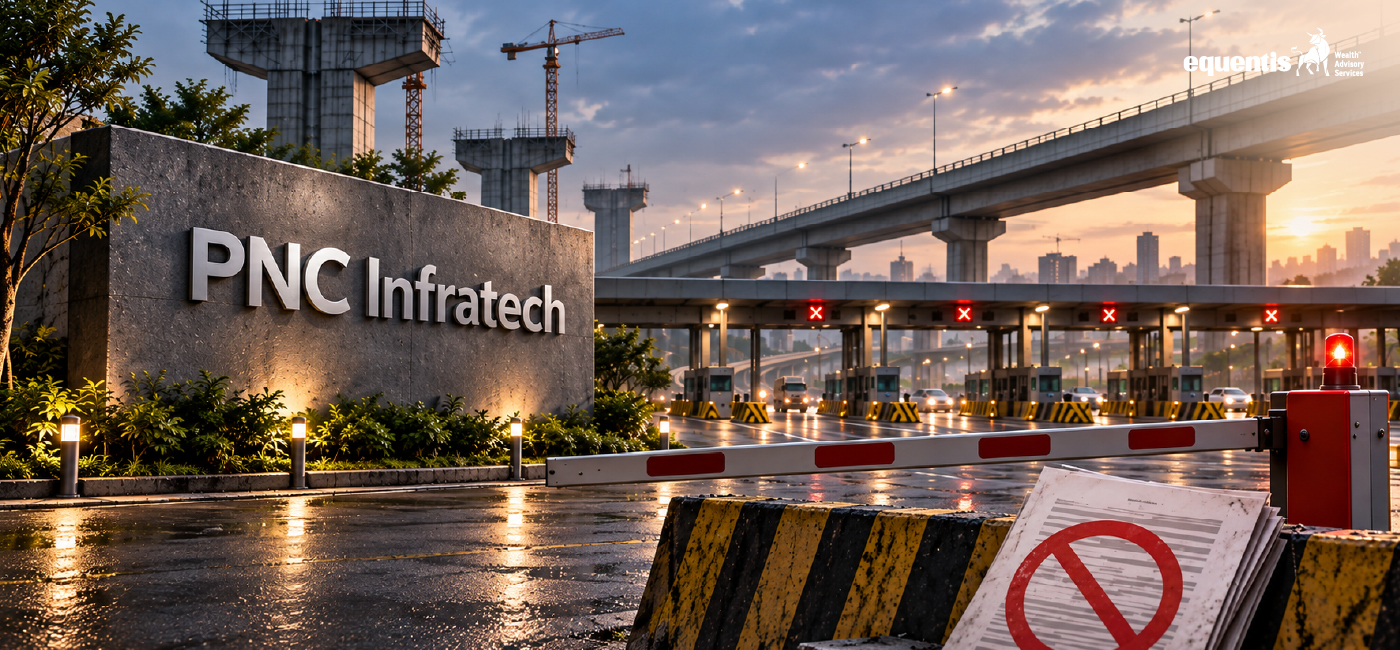

PNC Infratech shares crashed 20% to hit the lower circuit on September 15, 2026, after the National Highways Authority of India (NHAI) extended a three-year debarment to the company. The action prevents PNC Infratech from participating in new bids floated by NHAI, the Ministry of Road Transport and Highways (MoRTH) and their executing agencies during the debarment period. For investors, this is a serious development because highways account for a large portion of the company’s order book. However, the immediate impact should be distinguished from the company’s existing projects, which PNC says remain unaffected.
Why did PNC Infratech stock fall 20%?
The sharp fall followed a communication received by PNC Infratech from NHAI on September 11. The authority extended the debarment of Awadh Expressway Private Limited, a PNC Infratech subsidiary and concessionaire, to PNC Infratech itself in its capacity as promoter.
As a result, PNC Infratech will not be able to participate in bids floated by NHAI, MoRTH and their executing agencies for three years. The company has said it is evaluating legal remedies against the decision.
The stock fell to around ₹140, marking a 20% decline and a fresh 52-week low. The magnitude of the reaction reflects investor concerns about what the bidding restriction could mean for PNC Infratech’s future order inflows.
What triggered the NHAI action?
The matter is connected to the Kanpur-Lucknow Expressway Package-II project.
In August, PNC Infratech had clarified that the project had received provisional and final completion certificates in October 2025 and February 2026. The company also said that certain stretches affected by heavy rains were being repaired and that show-cause proceedings were pending at that stage.
The latest development is more significant because the earlier action against the concessionaire has now been extended to PNC Infratech as its promoter.
This distinction matters. The current action does not mean that PNC’s entire business has been shut down or that all its existing contracts have been cancelled.
How important are NHAI projects for PNC Infratech?
This is where the concern for investors becomes clearer.
PNC Infratech had an unexecuted order book of more than ₹19,100 crore as of June 2026, providing substantial revenue visibility. Around 64% of the order book was linked to highway contracts, while water, canal, railway and airport projects accounted for around 21%, with coal mining contributing the remaining portion.
That highway exposure means a three-year restriction on bidding for new NHAI and MoRTH projects could affect future order-book replenishment.
Infrastructure companies generally need a steady flow of new projects to replace contracts as existing projects are completed. If a company cannot bid for a major source of road projects for an extended period, investors may start questioning its growth beyond the current order book.
Does the ban affect ongoing projects?
According to PNC Infratech’s exchange disclosure, the debarment does not affect the company’s status as a going concern or the execution, operation and maintenance of its ongoing projects. The company also said it would disclose any financial implications as clarity emerges.
This is an important point for investors. The immediate issue is primarily future order acquisition, rather than the cancellation of the company’s existing project portfolio.
What was PNC Infratech’s financial position before the NHAI action?
The company’s latest quarterly performance was relatively strong on an operating basis.
For Q1 FY27, standalone revenue increased 34% year-on-year to ₹1,518 crore, while standalone EBITDA rose 167% to ₹375 crore and PAT increased 235% to ₹271 crore. Consolidated revenue stood at ₹1,688 crore, up 19% year-on-year.
PNC also secured five new projects worth approximately ₹4,259 crore in FY27 up to the June quarter, including two HAM projects from NHAI and three EPC projects from other authorities.
However, investors should remember that the reported Q1 profit benefited from an NHAI-related arbitration award, meaning the quarter’s unusually strong profit growth should not simply be extrapolated into future quarters.
Should investors worry about PNC Infratech?
Yes, the development deserves close attention, but the 20% fall alone does not establish the company’s long-term outcome.
The biggest concern is the potential impact on future order inflows. With highways making up a substantial share of the order book, losing access to NHAI and MoRTH tenders for three years could make diversification more important.
At the same time, PNC has an existing order book, ongoing projects and exposure to other segments such as airports, water, railways and mining. The company had also been pursuing non-highway opportunities before the latest action.
Investors should therefore watch the company’s legal response, order inflows from non-NHAI clients, project execution and management’s ability to maintain its revenue guidance.
Key risks and opportunities for investors
The main risks are straightforward:
- Three-year restriction on major government road bids
- Potential slowdown in future order-book growth
- Concentration in the highways segment
- Possible reputational and execution concerns
- Uncertainty over the outcome of legal remedies
There are also factors that could cushion the impact. PNC has a sizeable existing order book, ongoing projects are continuing, and the company has demonstrated its ability to win airport and other infrastructure contracts. Its FY27 guidance had included standalone revenue of ₹6,000 crore and substantial new-order ambitions.
Whether those targets remain achievable after the NHAI action will be an important question for upcoming management commentary.
What should investors watch next?
The next major triggers are likely to be the company’s legal response to the debarment, clarification of any financial impact, fresh orders from non-NHAI sources and changes in its order-book composition.
Investors should also track whether PNC can successfully diversify beyond highway projects. A strong existing order book provides some near-term visibility, but the ability to replenish that order book is critical for longer-term growth.
Conclusion
The PNC Infratech share price crash is justified by a significant regulatory development, particularly because highways represent a major part of its business pipeline. The three-year NHAI/MoRTH bidding restriction creates a genuine risk to future order inflows and deserves careful monitoring.
However, investors should not confuse the debarment with an immediate shutdown of PNC Infratech’s existing operations. Current projects continue, the company has a substantial order book and it is evaluating legal options. The key issue now is whether PNC can protect its existing execution, diversify its order pipeline and resolve the NHAI matter.
Frequently Asked Questions
1. Why did PNC Infratech shares fall 20%?
PNC Infratech shares fell 20% on September 15 after NHAI extended the debarment of Awadh Expressway Private Limited to PNC Infratech as its promoter. The three-year restriction prevents the company from participating in new bids floated by NHAI, MoRTH and their executing agencies, raising concerns about future order inflows.
2. What is the NHAI action against PNC Infratech?
NHAI has extended the debarment of PNC Infratech for three years in connection with the debarment of its subsidiary, Awadh Expressway. During this period, PNC cannot participate in new bids floated by NHAI, MoRTH and their executing agencies. The company has said it is evaluating legal remedies against the action.
3. Does the PNC Infratech ban affect its existing projects?
According to PNC Infratech’s exchange disclosure, the debarment does not affect the execution, operation and maintenance of its ongoing projects. The immediate restriction relates to participation in new bids. Therefore, the more significant concern is the company’s ability to secure future projects rather than an immediate stoppage of existing work.
4. Why is the Kanpur-Lucknow Expressway linked to the issue?
The NHAI action is connected to structural distress reported on the Kanpur-Lucknow Expressway Package-II. PNC Infratech’s subsidiary Awadh Expressway is the concessionaire for the project. Earlier, the company said affected stretches were being repaired and that the project had received completion certificates.
5. How large is PNC Infratech’s order book?
PNC Infratech reported an unexecuted order book of more than ₹19,100 crore as of June 2026. Highway contracts accounted for around 64% of the order book, while water, canal, railway and airport projects contributed around 21%. This provides near-term revenue visibility but also highlights the importance of highway-related orders.
6. Is PNC Infratech financially strong?
PNC’s Q1 FY27 operating performance was strong, with standalone revenue rising 34% year-on-year to ₹1,518 crore and EBITDA increasing 167% to ₹375 crore. However, some of the quarter’s profit benefited from an NHAI arbitration award, so investors should distinguish one-time gains from recurring operating performance.
7. Can PNC Infratech participate in non-NHAI projects?
The current restriction specifically affects bids floated by NHAI, MoRTH and their executing agencies. PNC Infratech has exposure to other areas including airports, water, railways and mining. The company’s ability to expand these segments could become increasingly important while the three-year bidding restriction remains in place.
8. Is the PNC Infratech stock fall a buying opportunity?
A sharp fall does not automatically make a stock attractive. Investors need to assess the potential impact of the NHAI restriction on future orders, the company’s legal response, valuation, existing order book and cash flows. The appropriate assessment also depends on an investor’s risk tolerance and investment horizon rather than the percentage decline alone.
9. What should investors monitor after the NHAI debarment?
Investors should watch the company’s legal proceedings, management commentary, new orders from non-NHAI customers and the pace of execution of its existing order book. Any clarification regarding the financial impact of the debarment will also be important. Changes in the highway share of future orders can indicate how effectively the company is diversifying its business.
10. Will the NHAI ban affect PNC Infratech’s future growth?
The ban could affect future growth because highways form a substantial part of PNC Infratech’s order book and government road contracts are an important source of new business. However, the eventual impact will depend on the company’s legal options, diversification into other infrastructure segments and its ability to win projects from customers outside the restricted agencies.
Disclaimer Note: The securities quoted, if any, are for illustration only and are not recommendatory. This article is for education purposes only and shall not be considered as a recommendation or investment advice by Equentis. We will not be liable for any losses that may occur. Investments in the securities market are subject to market risks. Read all the related documents carefully before investing. Registration granted by SEBI, membership of BASL & certification from NISM in no way guarantee the performance of the intermediary or provide any assurance of returns to investors.

Jaspreet Singh Arora is the Chief Investment Officer at Equentis, where he heads a seasoned team of equity analysts and turns two decades of market experience into portfolios that consistently beat the benchmark. A go-to voice on cement, building-materials, real-estate, and construction stocks, Jaspreet previously ran research desks at leading brokerages, honing an eye for the metrics that truly move share prices. His plain-spoken analysis helps investors cut through noise and act with conviction. When he’s not deep-diving into earnings calls, you’ll find him unwinding over sports, weekend cricket or a good history podcast.