
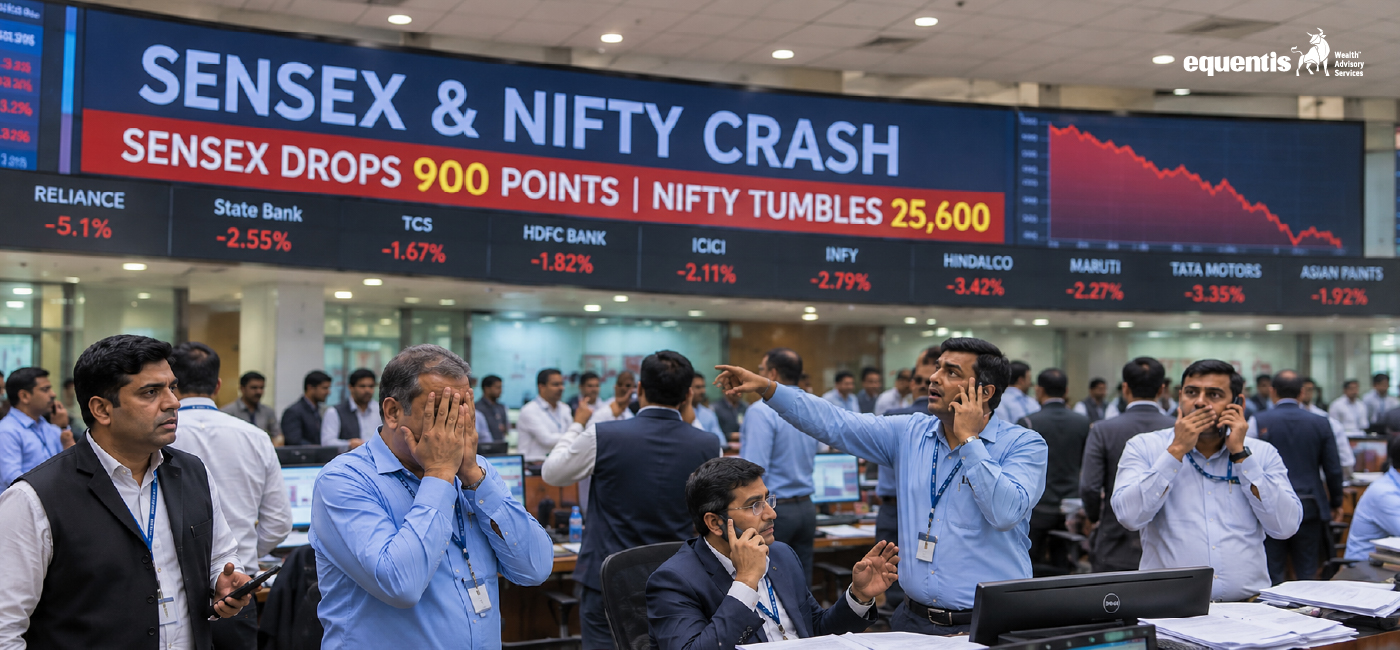

The Indian stock market witnessed a sharp correction on November 23, 2026, as the BSE Sensex fell nearly 900 points and the Nifty 50 slipped below 25,600 amid global market weakness and heavy selling in banking and metal stocks. The decline came after a strong four-week rally, prompting investors to book profits while concerns over US interest rates and global technology valuations added pressure. For investors, the fall highlights rising volatility rather than confirming a long-term reversal in the market trend.
Introduction: Why Is the Stock Market Falling Today?
Indian equity benchmarks started Monday’s trading session on a positive note but quickly reversed their gains. The Sensex, which had climbed to an intraday high of around 84,663, subsequently dropped to approximately 82,900, registering a decline of more than 1,700 points from the day’s peak.
The Nifty 50 also lost its early momentum and slipped below the psychologically important 25,600 level. By around 12:45 pm, the Sensex was trading at 82,880.89, down 1,038.82 points, while the Nifty stood at 25,487.75, declining 312.85 points.
The sell-off affected broader markets as well, with mid-cap and small-cap stocks witnessing selling pressure.
Context and Background: What Triggered the Market Correction?
The decline followed four consecutive weeks of gains in Indian equities. The Nifty and Sensex had rallied significantly during November, supported by foreign investor buying, improving earnings expectations and positive domestic economic conditions.
However, when markets rise rapidly, investors often become more cautious about valuations. Even moderately negative global developments can trigger profit booking when stock prices are approaching record levels.
Monday’s correction reflected a combination of domestic selling pressure and international uncertainty. Investors were particularly concerned about the technology-led sell-off in the United States, uncertainty surrounding Federal Reserve interest-rate decisions and weakness across Asian markets.
Key Reasons Behind the Sensex and Nifty Fall Today
1. Global stock market sell-off
Weakness in international markets was one of the biggest reasons behind Monday’s decline.
Concerns about artificial intelligence valuations and the sustainability of heavy investments in AI-related businesses triggered selling in US technology stocks. The Nasdaq Composite had suffered a sharp weekly decline, while concerns spread across Asian equity markets.
South Korea’s Kospi and several Chinese and Hong Kong market indices also witnessed significant weakness. Since global investors allocate money across multiple markets, a widespread risk-off environment can affect Indian equities even when domestic fundamentals remain relatively stable. Reuters+2
2. Heavy profit booking after a strong rally
Profit booking emerged as another major trigger.
After four consecutive weeks of gains, investors used Monday’s higher opening levels to lock in profits. The Nifty had moved closer to its previous record high of 26,373, while the Sensex was also approaching its historical peak.
When valuations become stretched and momentum slows, traders often reduce positions to protect earlier gains. This selling can accelerate when important psychological levels fail to hold.
3. Banking and metal stocks lead the decline
Banking and metal shares were among the biggest contributors to the market weakness.
Private banks and public sector lenders faced selling pressure after a strong recent rally. Banking stocks carry substantial weight in benchmark indices, meaning declines in major lenders can significantly affect the Sensex and Nifty.
Metal stocks also weakened amid lower global metal prices and concerns about international demand. Tata Steel was among the notable losers, while other heavyweight companies also faced selling pressure.
4. Concerns over US Federal Reserve interest rates
Investors are also monitoring upcoming US inflation data and the Federal Reserve’s monetary policy outlook.
The US Personal Consumption Expenditures (PCE) inflation report is particularly important because it helps policymakers assess inflation trends.
If US inflation remains elevated, expectations of higher interest rates could increase. This may make American bonds and other dollar-denominated assets more attractive compared with emerging-market equities such as India.
5. Rupee weakness adds to investor concerns
Currency movements are another factor influencing sentiment.
The rupee was approaching the ₹93-per-dollar level after weakening in recent sessions. A weaker rupee can increase the cost of imported crude oil and other essential commodities, potentially adding to inflationary pressure.
It can also affect foreign investors’ dollar-denominated returns from Indian investments. However, export-oriented companies, including IT businesses, may benefit from favourable currency movements.
Which Stocks and Sectors Were Most Affected?
The market decline was not limited to a handful of companies. Selling pressure was visible across several sectors.
- Banking: HDFC Bank, ICICI Bank, Axis Bank and State Bank of India faced selling pressure.
- Metals: Tata Steel and other metal companies declined amid weaker global sentiment.
- Cement: UltraTech Cement was among the stocks under pressure.
- Information Technology: IT stocks showed relative resilience, with TCS, Infosys, HCL Technologies and Tech Mahindra among the gainers in early market reports.
The divergence suggests that investors were not selling every sector equally. Instead, they were reducing exposure to selected heavyweight stocks while some export-oriented technology companies attracted buying interest.
Impact on Retail Investors: What Does the Market Fall Mean?
For retail investors, a sharp Sensex and Nifty decline can create uncertainty, particularly when their portfolios are heavily exposed to banking, metal and mid-cap stocks.
However, a one-day correction does not necessarily indicate that the broader market has entered a bear phase.
Investors should consider three important factors:
Portfolio concentration: Investors with excessive exposure to a single sector may experience larger portfolio losses. Diversification across sectors and asset classes can help manage this risk.
Investment horizon: Long-term investors should evaluate whether their original investment reasons remain valid rather than reacting to every market movement.
Liquidity requirements: Investors who may need their money in the short term should be cautious about taking additional equity exposure during volatile conditions.
It is also important to remember that index movements do not represent the performance of every individual stock. Some companies may remain resilient even when the broader market declines.
Opportunities and Risks: Is This a Buying Opportunity?
A market correction can create opportunities to reassess valuations and identify fundamentally strong businesses trading at more reasonable prices.
For long-term investors, periods of volatility can provide an opportunity to review companies with sustainable earnings, manageable debt and consistent cash flows.
However, there are risks that should not be ignored.
- Further weakness in global technology stocks could affect international investor sentiment.
- Unexpected US inflation data may increase interest-rate uncertainty.
- Continued foreign investor selling could put pressure on Indian equities.
- A weaker rupee and higher import costs could affect corporate margins.
- Banking and metal stocks may remain volatile if selling pressure continues.
Investors should avoid assuming that every stock becomes attractive simply because its price has fallen. Business fundamentals and valuations remain important.
What Should Investors Watch Next?
The immediate direction of the Indian stock market will depend on both domestic and global developments.
Some important levels and indicators worth tracking include:
- Nifty 25,500: An important psychological and near-term support area highlighted by market analysts.
- Nifty 26,000: A key resistance level that could influence bullish sentiment.
- Bank Nifty: Its performance will be important because banking stocks have a significant influence on benchmark indices.
- India VIX: A rising volatility index indicates increasing expectations of market fluctuations.
- Foreign institutional investor flows: Continued buying or a reversal towards selling could influence market direction.
These are reference levels and indicators, not guaranteed support or resistance points. The Economic Times+2
Conclusion: Is the Indian Stock Market Entering a Downtrend?
The November 23 stock market fall reflects a combination of global uncertainty, profit booking and weakness in banking and metal shares after a strong rally.
Although the Sensex lost nearly 900 points during the session and the Nifty slipped below 25,600, a single trading session is not enough to establish a long-term market trend.
Investors should focus on earnings growth, valuations, global interest-rate developments and foreign fund flows rather than reacting emotionally to short-term volatility. Whether the correction remains temporary or develops into a deeper decline will depend on how markets respond to upcoming global economic data and domestic buying interest.
Frequently Asked Questions
1. Why is the Indian stock market falling today?
The Indian stock market declined on November 23, 2026, due to profit booking after a four-week rally, weak global market sentiment and selling in banking and metal stocks. Concerns about US interest rates, technology valuations and rupee weakness also contributed to the decline in investor confidence.
2. How many points did the Sensex fall today?
The Sensex declined by approximately 900 points during Monday’s trading session, November 23, 2026. At around 12:45 pm, it was down 1,038.82 points at 82,880.89. The index had also fallen significantly from its intraday high of approximately 84,663.
3. Why did the Nifty fall below 25,600?
The Nifty 50 slipped below 25,600 because of selling pressure in heavyweight banking and metal stocks. Profit booking following recent gains and negative international market cues added to the pressure. The index also struggled to sustain its early gains near the psychologically important 26,000 level.
4. Which stocks contributed to the Sensex and Nifty decline?
Banking and metal companies were among the major contributors to the decline. HDFC Bank, ICICI Bank, Axis Bank, SBI and Tata Steel faced selling pressure. UltraTech Cement also declined. However, several IT stocks showed relative strength during the trading session.
5. Why are global markets affecting Indian stock markets?
Indian markets are connected to international financial markets through foreign investment, trade and currency movements. When global investors become cautious because of US interest rates or technology-sector valuations, they may reduce exposure to emerging markets. This can increase volatility in Indian equities.
6. What is profit booking in the stock market?
Profit booking happens when investors sell shares to secure gains after prices have increased. For example, if someone purchases a stock at ₹500 and sells it at ₹650, the investor books a ₹150 gain per share before costs and taxes. Widespread profit booking can trigger market-wide corrections.
7. How does US Federal Reserve policy affect the Indian stock market?
US Federal Reserve interest-rate decisions influence global investment flows. Higher American interest rates can make US bonds more attractive, potentially reducing foreign investment in emerging markets such as India. This can affect Indian stock prices, currency movements and overall market sentiment.
8. What happens to Indian stocks when the rupee weakens?
A weaker rupee can increase costs for companies importing crude oil, machinery and other commodities. It may also reduce foreign investors’ dollar-denominated returns. However, export-oriented businesses such as IT and pharmaceuticals may benefit because overseas earnings translate into more rupees.
9. Is the current stock market fall a good opportunity for long-term investors?
A market correction can create opportunities to evaluate fundamentally strong companies at more attractive valuations. However, investors should examine earnings, debt, cash flows and business prospects before investing. A falling stock price alone does not establish that a company is undervalued.
10. What should investors watch after the Sensex and Nifty fall?
Investors should monitor Nifty’s ability to hold the 25,500 area, movement towards the 26,000 resistance level, Bank Nifty performance, India VIX, foreign investor activity and upcoming US inflation data. These indicators can help assess whether market volatility is easing or selling pressure is continuing.
Disclaimer Note: The securities quoted, if any, are for illustration only and are not recommendatory. This article is for education purposes only and shall not be considered as a recommendation or investment advice by Equentis . We will not be liable for any losses that may occur. Investments in the securities market are subject to market risks. Read all the related documents carefully before investing. Registration granted by SEBI, membership of BASL & certification from NISM in no way guarantee the performance of the intermediary or provide any assurance of returns to investors.