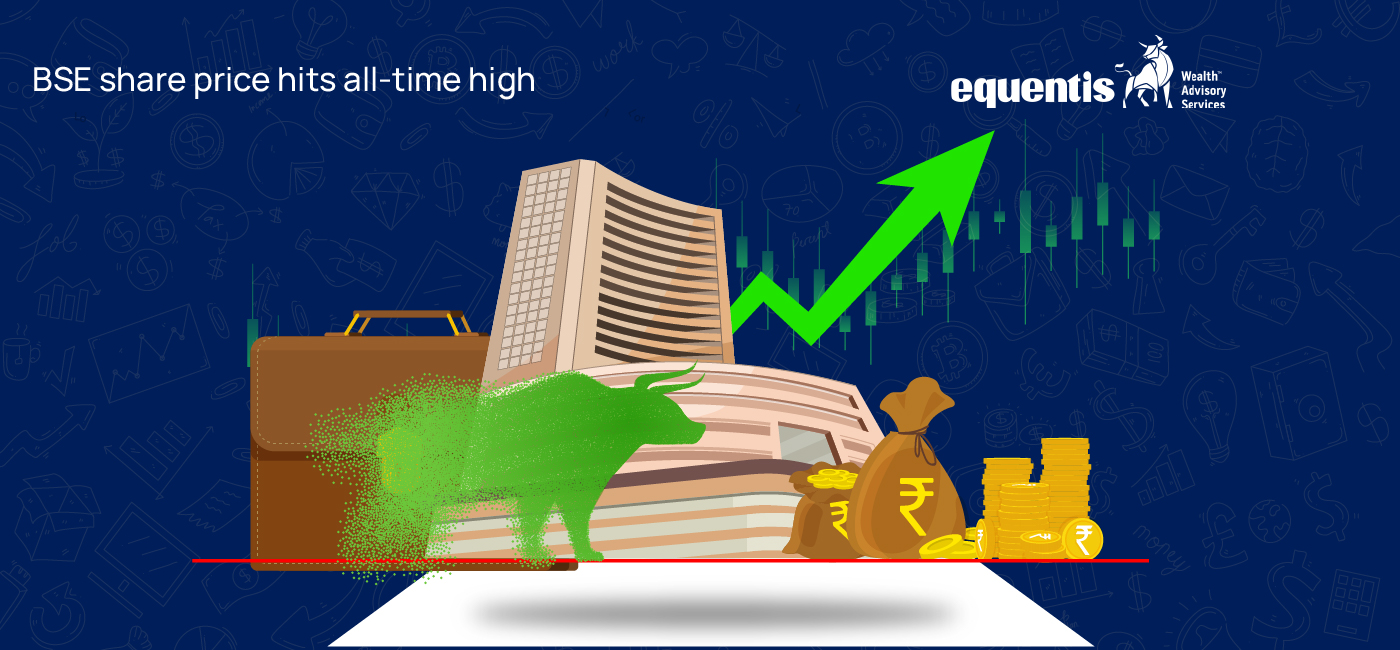

The Indian stock market has seen many rally stories over the years, but some stand out for their timing and underlying fundamentals. The recent surge in BSE shares is one such moment. As BSE’s share price touched a fresh all-time high following a sharp jump in quarterly profits, it caught the attention of investors across the spectrum. This move is not just about one strong quarter. It reflects deeper shifts in India’s capital markets and the evolving role of market infrastructure institutions.
The Bigger Picture: Why BSE’s Performance Matters
BSE is not just another listed company. It sits at the heart of India’s financial ecosystem. From equity trading and mutual fund platforms to data services and clearing operations, BSE’s performance often mirrors broader market activity.
Over the past few years, Indian capital markets have undergone a structural transformation. Retail participation has surged, systematic investment plans have become mainstream, and financialisation of household savings has accelerated. In this environment, exchanges like BSE benefit directly from higher volumes, wider participation, and deeper market penetration.
The latest quarterly numbers suggest that these long-term trends are now translating into meaningful profitability.
Q3 Results Explained in Simple Terms
In the December quarter, BSE reported a consolidated net profit of ₹602 crore, marking a year-on-year growth of 174 percent. This sharp rise was driven by a combination of higher operating income and better cost efficiency.
Transaction charges, which form a key part of exchange revenues, saw a strong uptick as trading activity remained robust across cash, derivatives, and mutual fund platforms. At the same time, BSE’s non-core but high-margin businesses, such as data dissemination and listing services, continued to scale steadily.
Importantly, this profit growth was not purely volume-driven. Improved operating leverage played a significant role, meaning incremental revenues translated more efficiently into bottom-line growth.
Key Developments Behind the Rally.
One of the biggest contributors to BSE’s improving financials has been the rapid expansion of its mutual fund distribution platform. Over the years, this platform has quietly become a backbone for India’s SIP-driven investment culture. As assets under management grow and transaction counts rise, this business adds stable, recurring income.
Another important factor is the growing traction in derivatives and new product segments. While BSE historically lagged its peers in derivatives, recent initiatives have started to show results. Increased participation and better product positioning have helped improve revenue visibility.
Cost discipline has also played a role. With much of the core infrastructure already in place, incremental growth now comes at relatively lower marginal costs, supporting margin expansion.
What This Means for Investors
For investors, BSE’s strong Q3 performance reinforces the idea that market infrastructure companies can offer scalable and relatively stable business models. Unlike many cyclical sectors, exchanges benefit from both rising markets and higher participation during volatile phases.
The all-time high in the BSE share price reflects growing confidence in the company’s earnings trajectory. It also signals that the market is beginning to assign greater value to steady, annuity-like revenue streams rather than viewing exchanges as purely volume-driven plays.
That said, valuations have moved up sharply following the rally, making future performance and execution critical.
Opportunities Ahead
Looking forward, several factors could continue to support BSE’s growth story.
India’s retail investor base is still expanding, particularly in smaller towns and cities. As more investors enter the market through SIPs and digital platforms, BSE’s ecosystem stands to benefit.
New products, enhanced derivatives offerings, and potential technology-led services could open additional revenue streams. Regulatory push towards transparency and formalisation also favours established exchanges with strong governance frameworks.
Over the medium term, rising listings, deeper debt markets, and growing interest in passive products may further strengthen BSE’s business mix.
Risks to Keep in Mind
Despite the positive momentum, risks remain. Exchange revenues are inherently linked to market activity. Any prolonged slowdown in trading volumes or investor participation could impact earnings.
Competition from other exchanges continues to be intense, particularly in derivatives. Sustaining market share gains will require consistent product innovation and competitive pricing.
Regulatory changes are another variable. While regulation often supports long-term market stability, sudden shifts in fee structures or product norms can affect profitability in the short term.
Conclusion: A Strong Quarter with Long-Term Implications
BSE’s Q3 performance and the resulting all-time high in its share price mark more than just a headline-grabbing rally. They highlight how structural changes in India’s capital markets are benefiting institutions that provide the underlying plumbing.
The 174 percent jump in profit to ₹602 crore underscores the operating leverage inherent in BSE’s business model. For long-term investors, the key question now is not about one quarter’s numbers but about consistency, market share gains, and disciplined execution going forward.
As India’s equity culture deepens, BSE’s role in enabling participation, transparency, and growth places it in a unique position. The recent rally reflects optimism, but the next phase will depend on how well the exchange converts this momentum into sustainable value creation.
Disclaimer Note: The securities quoted, if any, are for illustration only and are not recommendatory. This article is for education purposes only and shall not be considered as a recommendation or investment advice by Equentis – Research & Ranking. We will not be liable for any losses that may occur. Investments in the securities market are subject to market risks. Read all the related documents carefully before investing. Registration granted by SEBI, membership of BASL & certification from NISM in no way guarantee the performance of the intermediary or provide any assurance of returns to investors.

Parvati Rai is the Vice President of the Research team at Equentis. She has over 15 years of equity-research and strategy-consulting experience. A specialist in deep-dive valuations, financial modelling, and forecasting, she has built research desks from the ground up, by steering buy-side, sell-side, and independent coverage across sectors. When she isn’t fine-tuning models, Parvati unwinds on nature treks and mentors aspiring analysts.