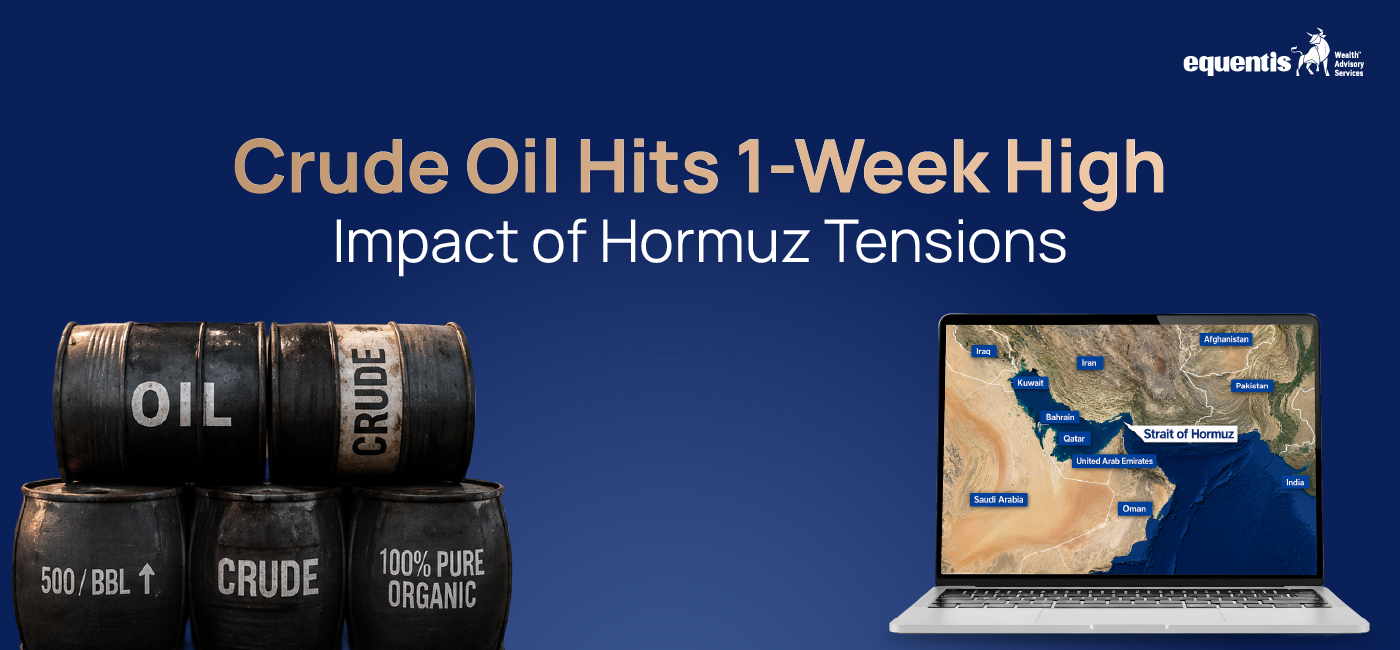

Crude oil prices moved close to a one week high on August 11, 2026, as uncertainty over the reopening of the Strait of Hormuz and stalled US Iran discussions kept supply concerns elevated. Brent crude was around $87.80 a barrel, while WTI crude traded near $82.22, with both benchmarks supported by concerns that disruption around the key shipping route could continue. For India, where crude oil imports play a major role in meeting energy demand, a prolonged rise in oil prices could affect inflation, the rupee, fuel costs, corporate margins and the broader stock market.
Why Is Crude Oil Rising?
The latest rise in crude oil prices is primarily linked to geopolitical uncertainty surrounding the Strait of Hormuz.
The waterway connects the Persian Gulf with the Gulf of Oman and is a critical route for global energy shipments. Any prolonged disruption can create concerns about whether oil and refined products can move smoothly from major producers in the Middle East to international buyers.
On August 11, oil remained near a one week high as expectations of a quick reopening of the Strait weakened. Reports also indicated that direct US Iran talks were not currently taking place, adding to uncertainty over the next stage of the situation.
For oil markets, the concern is not necessarily that global production immediately disappears. Even the possibility of shipping delays can push traders to price in a higher risk premium.
What Makes the Strait of Hormuz Important?
The Strait of Hormuz is one of the world’s most important energy chokepoints.
Large volumes of crude oil, petroleum products and liquefied natural gas move through the region. When shipping becomes uncertain, buyers and traders begin considering alternative routes, higher insurance costs, longer voyages and possible supply delays.
That can increase the delivered cost of energy even when production itself remains relatively stable.
The impact can therefore extend beyond oil prices. Higher transportation costs, insurance premiums and fuel prices can feed into the prices of other commodities and manufactured goods.
How Could Higher Crude Prices Affect India?
India is particularly sensitive to movements in international crude prices because it imports a significant share of its crude oil requirement.
When crude becomes more expensive, the first impact is on the country’s import bill. If the increase persists, it can put pressure on the current account and potentially weigh on the Indian rupee.
A weaker rupee can make imported crude even more expensive in local currency terms, creating a second layer of pressure.
Higher oil prices can also influence inflation. Transportation, logistics and manufacturing costs can rise as fuel becomes more expensive, although the actual impact on consumer prices depends on government policies, domestic fuel pricing and the duration of the oil shock.
Impact on Indian Stock Market
The relationship between crude oil and Indian equities is important because higher energy costs can affect different sectors in very different ways.
Oil marketing companies can face pressure if they are unable to fully pass higher input costs to consumers. Airlines are also sensitive because aviation turbine fuel is a major operating expense.
Paint, chemicals, tyres and other businesses that use petroleum based inputs could experience margin pressure if higher raw material costs cannot be passed on quickly.
On the other hand, upstream oil and gas producers may benefit from higher crude prices because stronger realisations can support revenue and profitability.
This creates a mixed picture for the Indian stock market rather than a uniform negative impact.
Which Indian Sectors Could Be Most Sensitive?
Airlines
Higher crude prices can raise aviation fuel costs, potentially affecting airline margins. The impact depends on ticket pricing, fuel hedging and the ability to pass higher costs to passengers.
Paints and Chemicals
Many chemical and paint companies use crude derived inputs. A sustained rise in input prices could put pressure on margins if selling prices do not increase at the same pace.
Tyres
Synthetic rubber and other petroleum linked inputs can become more expensive when crude prices rise. Companies with strong pricing power may be better positioned to manage temporary increases.
Oil Marketing Companies
Companies involved in fuel marketing can face a difficult environment when international crude prices rise sharply, particularly if domestic fuel prices do not adjust proportionately.
Upstream Oil Producers
Exploration and production companies can potentially benefit from higher crude prices because their realised prices may improve. However, taxes, government policies, production volumes and operating costs also matter.
What Does It Mean for Inflation?
Oil is closely connected to inflation because energy is embedded in many parts of the economy.
A transport operator facing higher diesel costs may increase freight rates. Manufacturers may see higher logistics and input costs. Airlines may face higher fuel bills. These increases can gradually affect the prices consumers pay.
The key issue is duration.
A temporary spike in crude may have a limited impact if prices quickly retreat. A sustained period of elevated oil prices is more significant because businesses and consumers have less ability to absorb higher costs indefinitely.
UN Trade and Development has previously highlighted how disruptions around the Strait of Hormuz can sharply increase crude and refined product prices, underlining the wider economic risks associated with prolonged disruption.
Could Higher Oil Prices Affect Interest Rates?
A sustained crude oil rally can complicate the inflation outlook.
If higher energy prices contribute to broader inflation, central banks may have less flexibility to ease monetary policy. Higher interest rates for longer can affect borrowing costs for businesses and consumers and may influence equity valuations.
However, central banks generally look at a broader basket of inflation indicators rather than reacting to every short term movement in crude.
Therefore, investors should focus on whether the oil shock becomes persistent enough to affect underlying inflation expectations.
What Should Investors Watch Next?
The next major trigger for crude oil could be developments around the Strait of Hormuz and US Iran relations.
Investors should watch:
- Whether shipping through Hormuz improves
- Any progress in US Iran negotiations
- Brent crude’s ability to remain above recent trading levels
- Changes in global oil inventories
- OPEC+ production decisions
- The impact on India’s inflation and rupee
- Quarterly earnings of oil sensitive companies
The market could react sharply in either direction. Any credible development that improves the chances of normal shipping could push the geopolitical risk premium out of crude prices. Conversely, further disruption could keep prices elevated.
Opportunities and Risks for Investors
Higher crude prices create both winners and losers.
Energy producers may benefit from higher prices, while companies with significant fuel or petroleum based input costs could face margin pressure.
For investors, this means sector selection becomes more important during periods of commodity volatility.
However, buying a stock simply because it benefits from higher crude prices carries its own risk. Oil prices can reverse quickly when geopolitical tensions ease, supply routes reopen or demand expectations change.
Investors should therefore examine whether higher prices are likely to be temporary or part of a longer trend.
Conclusion
The rise in crude oil prices to a one week high reflects growing uncertainty around the Strait of Hormuz and the lack of clarity over US Iran negotiations. Brent crude near $88 and WTI above $82 highlight how quickly geopolitical developments can influence global energy markets.
For India, the implications extend beyond petrol and diesel. Higher crude prices can affect the import bill, rupee, inflation, corporate margins and stock market sentiment.
The immediate focus for investors should therefore remain on the duration and severity of the disruption. If shipping normalises, some of the geopolitical premium in crude could fade. If tensions persist, higher energy costs could become a broader macroeconomic concern.
For Indian investors, the key is to understand which sectors gain from higher crude prices and which face margin pressure, rather than treating the oil rally as uniformly positive or negative for the market.
Frequently Asked Questions
1. Why has crude oil hit a one week high?
Crude oil prices have risen to around one week highs because uncertainty over the reopening of the Strait of Hormuz has increased supply concerns, while expectations for a quick US Iran resolution have weakened.
2. What is the Strait of Hormuz?
The Strait of Hormuz is a strategically important waterway connecting the Persian Gulf with the Gulf of Oman. It is a major route for global oil and energy shipments.
3. What are the latest Brent crude prices?
On August 11, 2026, Brent crude was trading around $87.80 a barrel, close to a one week high.
4. What are the latest WTI crude prices?
WTI crude was trading around $82.22 a barrel on August 11, 2026.
5. How do higher crude prices affect India?
Higher crude prices can increase India’s import bill, put pressure on the rupee and potentially contribute to inflation through higher transportation, logistics and input costs.
6. Which Indian stocks can benefit from higher crude prices?
Upstream oil and gas producers can potentially benefit from higher crude realisations. However, actual stock performance also depends on production volumes, government policies, taxes, costs and valuations.
7. Which sectors can be hurt by higher crude prices?
Airlines, paints, chemicals, tyres, logistics and other businesses with significant fuel or petroleum based input costs can face margin pressure when crude prices rise sharply.
8. Can higher crude prices increase inflation in India?
Yes. Sustained increases in crude prices can raise transportation and input costs and potentially contribute to broader inflation. The actual impact depends on the duration of the oil price increase and domestic pricing policies.
9. Could crude oil prices fall if Hormuz tensions ease?
Yes. If shipping conditions improve and geopolitical risks decline, the risk premium built into crude prices could reduce. This could put downward pressure on Brent and WTI prices.
10. What should investors watch amid the crude oil rally?
Investors should monitor developments around the Strait of Hormuz, US Iran negotiations, Brent prices, global inventories, OPEC+ supply decisions, the Indian rupee, inflation and the earnings impact on oil sensitive sectors.
Disclaimer Note: The securities quoted, if any, are for illustration only and are not recommendatory. This article is for education purposes only and shall not be considered as a recommendation or investment advice by Equentis. We will not be liable for any losses that may occur. Investments in the securities market are subject to market risks. Read all the related documents carefully before investing. Registration granted by SEBI, membership of BASL & certification from NISM in no way guarantee the performance of the intermediary or provide any assurance of returns to investors.

Parvati Rai is the Vice President of the Research team at Equentis. She has over 15 years of equity-research and strategy-consulting experience. A specialist in deep-dive valuations, financial modelling, and forecasting, she has built research desks from the ground up, by steering buy-side, sell-side, and independent coverage across sectors. When she isn’t fine-tuning models, Parvati unwinds on nature treks and mentors aspiring analysts.