
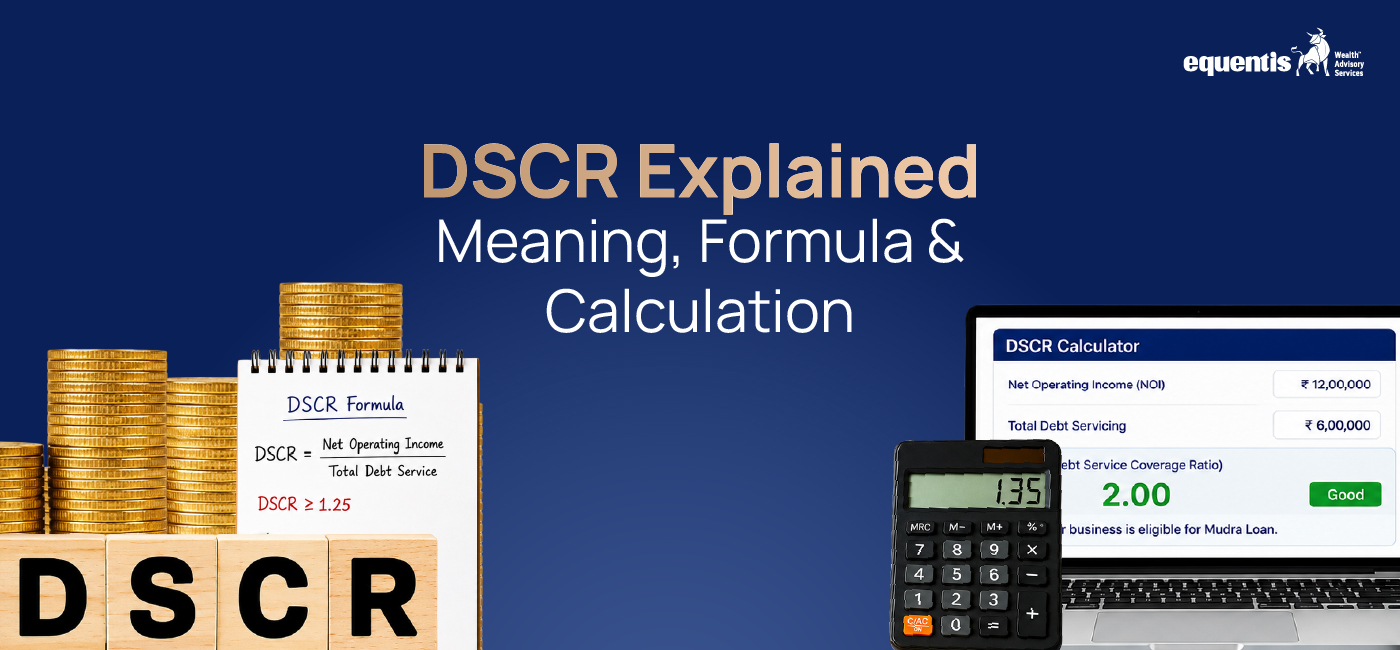

Summary: The Debt Service Coverage Ratio (DSCR) is a financial metric that measures whether a business generates enough income to meet its debt obligations. It is calculated by dividing a company’s Net Operating Income (NOI) by its total debt service, which includes both principal and interest payments. A higher DSCR generally indicates a stronger ability to repay debt, making it an important factor for lenders, investors, and businesses when evaluating financial health and borrowing capacity.
Why Understanding DSCR Matters
Whether you’re a business owner seeking a loan, an investor analyzing a company’s financial statements, or simply trying to understand financial ratios, the Debt Service Coverage Ratio (DSCR) is one metric worth knowing.
Banks and financial institutions often use DSCR to determine whether a borrower can comfortably repay a loan. Similarly, investors look at the ratio to assess a company’s financial stability and its ability to manage debt without affecting operations.
Understanding how DSCR works can help businesses plan borrowing responsibly and give investors deeper insights into a company’s financial strength.
What is DSCR?
The Debt Service Coverage Ratio (DSCR) measures the relationship between a company’s operating income and its debt repayment obligations over a given period.
Simply put, it answers one important question:
Can the business generate enough cash from its operations to repay its loans?
A DSCR above 1 generally means the business earns enough income to cover its debt payments, while a ratio below 1 may indicate that operating income is insufficient to meet debt obligations.
Although lenders may have different benchmarks depending on the industry and borrower profile, DSCR remains one of the most widely used indicators of repayment capacity.
Understanding the DSCR Formula
The standard DSCR formula is:
DSCR = Net Operating Income (NOI) ÷ Total Debt Service
Where:
Net Operating Income (NOI) refers to the income generated from normal business operations before interest and taxes, depending on the calculation method used.
Total Debt Service includes:
- Loan principal repayments
- Interest payments
- Other scheduled debt obligations during the period
The resulting figure helps determine how comfortably a business can meet its debt commitments.
DSCR Calculation: A Simple Example
Let’s understand the calculation with a simple example.
Suppose a company reports:
- Net Operating Income: ₹20,00,000
- Annual Loan Principal Repayment: ₹10,00,000
- Annual Interest Payment: ₹5,00,000
Total Debt Service:
₹10,00,000 + ₹5,00,000 = ₹15,00,000
Now apply the formula:
DSCR = ₹20,00,000 ÷ ₹15,00,000 = 1.33
This means the company generates 1.33 times the income required to meet its annual debt obligations.
In simple terms, the business has a financial cushion beyond its loan repayments.
What Does DSCR Indicate?
The ratio can generally be interpreted as follows:
DSCR Less Than 1
A ratio below 1 indicates that the business is not generating sufficient operating income to cover its debt payments.
This could signal higher financial stress and may affect the company’s ability to obtain additional financing.
DSCR Equal to 1
A ratio of exactly 1 means the business generates just enough income to repay its debt.
While obligations can be met, there is little room for unexpected expenses or income fluctuations.
DSCR Greater Than 1
A ratio above 1 indicates that the company earns more than enough income to cover debt obligations.
Generally, the higher the ratio, the greater the financial flexibility available for debt repayment.
However, an unusually high DSCR may also indicate that a business is relying less on debt financing, which may or may not align with its growth strategy.
Why Lenders Use DSCR
Financial institutions rely on DSCR to assess lending risk before approving loans.
A stronger DSCR suggests that the borrower is more likely to make timely repayments, reducing the lender’s credit risk.
Banks may evaluate DSCR alongside several other factors, including:
- Business profitability
- Cash flow stability
- Industry conditions
- Existing debt levels
- Credit history
- Future business projections
Therefore, DSCR should be viewed as one component of a broader credit assessment rather than the sole deciding factor.
Why Investors Should Understand DSCR
For investors, DSCR provides valuable insights into a company’s financial health.
A business with a comfortable debt servicing ability may be better positioned to:
- Continue operations during economic slowdowns
- Invest in future growth
- Manage interest rate increases
- Maintain financial stability
However, investors should evaluate DSCR alongside other financial metrics such as profitability, leverage, cash flow, and return ratios to gain a complete picture.
Factors That Influence DSCR
Several business factors can impact the Debt Service Coverage Ratio.
These include:
- Revenue growth or decline
- Changes in operating expenses
- Rising interest rates
- Additional borrowings
- Improved operational efficiency
- Loan restructuring
- Economic conditions affecting business performance
Because these variables change over time, DSCR should be reviewed regularly rather than relying on a single calculation.
Opportunities and Risks
Opportunities
Understanding DSCR offers several practical benefits:
- Helps businesses evaluate borrowing capacity.
- Assists lenders in assessing repayment ability.
- Enables investors to compare financial strength across companies.
- Encourages better financial planning and cash flow management.
- Supports informed lending and investment decisions.
Risks
There are also limitations to consider:
- DSCR does not capture every aspect of financial health.
- Different industries may have different acceptable DSCR ranges.
- Temporary income fluctuations can affect the ratio.
- Accounting methods may influence reported operating income.
- A healthy DSCR today does not guarantee future repayment capacity.
Therefore, DSCR should always be interpreted in context with broader financial analysis.
Practical Tips for Businesses
Businesses looking to improve their DSCR may consider:
- Increasing operational efficiency.
- Reducing unnecessary expenses.
- Managing debt responsibly.
- Improving revenue generation.
- Refinancing loans where appropriate.
- Monitoring cash flows regularly.
Maintaining a healthy balance between growth and debt can improve long-term financial resilience.
Conclusion
The Debt Service Coverage Ratio (DSCR) is a valuable financial metric that helps assess whether a business generates sufficient income to meet its debt obligations. By comparing operating income with total debt repayments, DSCR provides lenders, investors, and business owners with useful insights into financial stability and repayment capacity.
While a higher DSCR generally reflects stronger debt servicing ability, the ratio should always be evaluated alongside other financial indicators, industry conditions, and business performance. Understanding how to calculate and interpret DSCR can support better borrowing decisions, smarter investments, and stronger financial planning.
Frequently Asked Questions (FAQs)
1. What is DSCR?
DSCR, or Debt Service Coverage Ratio, measures a business’s ability to repay its debt using the income generated from its operations.
2. What is the formula for calculating DSCR?
The formula is:
DSCR = Net Operating Income ÷ Total Debt Service
3. What does a DSCR greater than 1 mean?
A DSCR above 1 generally indicates that the business earns enough operating income to comfortably meet its debt obligations.
4. What does a DSCR below 1 indicate?
A ratio below 1 suggests that the business may not be generating sufficient operating income to cover scheduled debt repayments.
5. Why is DSCR important for loan approval?
Lenders use DSCR to evaluate whether a borrower has adequate cash flow to repay a loan, making it an important factor in credit assessment.
6. Is DSCR important for investors?
Yes. Investors use DSCR to understand a company’s financial stability, debt management, and repayment capacity.
7. Can DSCR vary across industries?
Yes. Different industries have different operating models and borrowing requirements, so acceptable DSCR levels may vary.
8. How often should businesses calculate DSCR?
Businesses should review DSCR periodically, especially before applying for loans, making large investments, or evaluating financial performance.
9. What factors can improve DSCR?
Higher operating income, lower debt repayments, improved cost management, and stronger cash flow can contribute to a better DSCR.
10. Is DSCR the only ratio lenders consider?
No. Lenders also evaluate factors such as profitability, credit history, cash flow, leverage, business performance, and overall financial position before approving loans.
Disclaimer Note: The securities quoted, if any, are for illustration only and are not recommendatory. This article is for education purposes only and shall not be considered as a recommendation or investment advice by Equentis. We will not be liable for any losses that may occur. Investments in the securities market are subject to market risks. Read all the related documents carefully before investing. Registration granted by SEBI, membership of BASL & certification from NISM in no way guarantee the performance of the intermediary or provide any assurance of returns to investors.

Parvati Rai is the Vice President of the Research team at Equentis. She has over 15 years of equity-research and strategy-consulting experience. A specialist in deep-dive valuations, financial modelling, and forecasting, she has built research desks from the ground up, by steering buy-side, sell-side, and independent coverage across sectors. When she isn’t fine-tuning models, Parvati unwinds on nature treks and mentors aspiring analysts.










