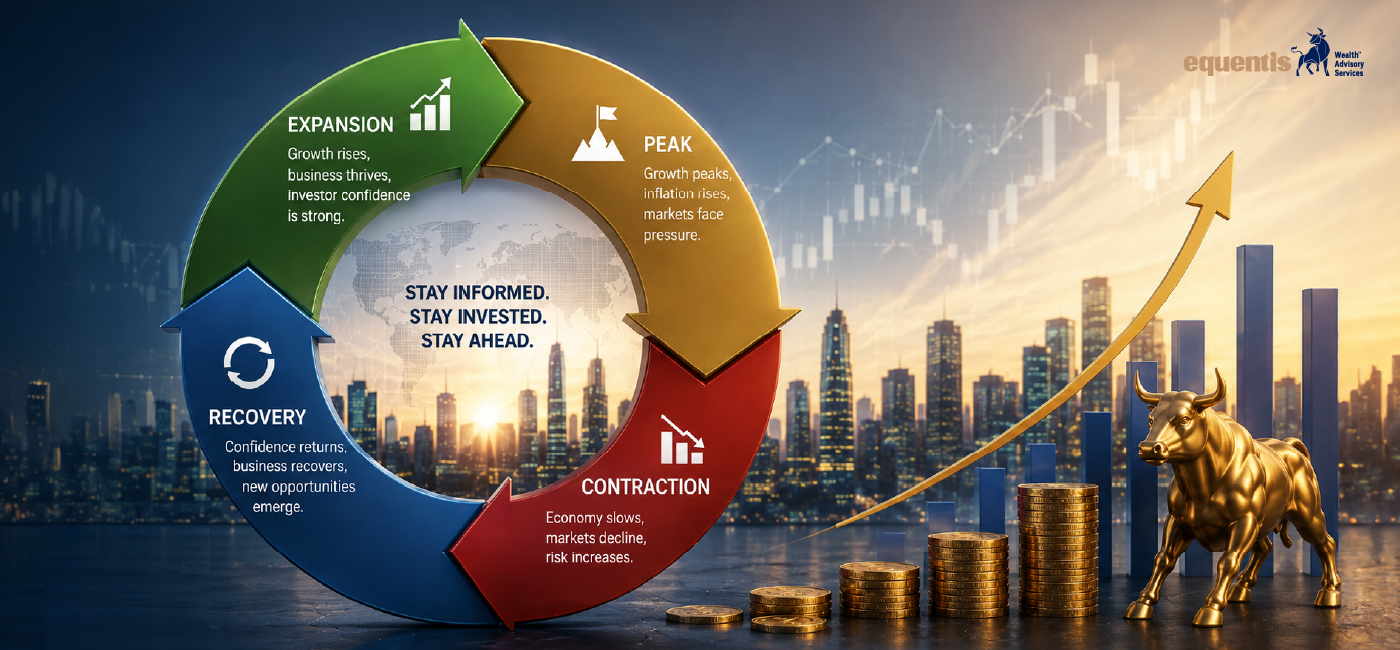

Understanding economic cycles is important for investors because economic activity moves through periods of expansion, slowdown, contraction and recovery, and each phase can affect company earnings, interest rates, consumer spending and asset prices differently. Knowing where the economy may be in its cycle can help investors understand changing risks and opportunities, although it cannot predict exactly when markets will rise or fall.
Summary
Economic cycles describe the recurring changes in economic activity over time. The four broad phases are expansion, peak, contraction and recovery. These phases can influence interest rates, corporate profits, employment and investor sentiment. Understanding economic cycles can help investors build diversified portfolios and evaluate which sectors may perform differently as economic conditions change.
Context and Background
The economy does not grow at the same pace every year.
There are periods when businesses expand, consumers spend more and companies hire additional workers. There are also periods when demand weakens, investment slows and businesses become more cautious.
These changes are commonly described as the economic cycle or business cycle.
For someone learning stock market basics, understanding this cycle provides useful context for why different companies and sectors can perform differently at different points in time.
For example, companies selling discretionary products may benefit when consumers have more disposable income. During an economic slowdown, however, households may reduce spending on products they consider non-essential.
At the same time, businesses providing essential goods and services may experience relatively stable demand.
Economic cycles therefore affect not only the overall market but also individual companies and sectors.
The Four Main Phases of an Economic Cycle
1. Expansion
During an expansion, economic activity generally increases.
Businesses may see stronger demand, employment can improve and companies may increase investment in new capacity.
Corporate earnings can benefit from rising sales and improved operating conditions.
Cyclical sectors such as automobiles, industrials, construction and certain financial businesses may benefit from stronger economic activity.
However, investors should remember that share prices often anticipate future conditions rather than simply reflecting the current economy.
2. Peak
The peak represents a period when economic growth reaches a relatively high point before beginning to slow.
Demand may remain strong, but inflationary pressures and rising costs can become concerns.
Central banks may respond to persistent inflation by maintaining or increasing interest rates, depending on economic conditions.
Higher interest rates can affect borrowing costs, valuations and consumer demand.
3. Contraction
During a contraction, economic activity weakens.
Companies may experience slower sales, lower capacity utilisation and reduced investment.
Businesses with high fixed costs or significant debt can face additional pressure because expenses may remain high even when revenue declines.
Investors may become more cautious, which can increase market volatility.
However, not every company performs poorly during a contraction. Businesses selling essential products may experience more resilient demand.
4. Recovery
Recovery begins when economic activity starts improving after a slowdown.
Consumer confidence may strengthen, businesses can restart investment and employment conditions may gradually improve.
Markets may begin anticipating this improvement before economic data clearly shows a recovery.
This is one reason stock markets can rise while economic indicators still appear weak.
How Economic Cycles Affect Investments
Equity Markets
Economic cycles can influence corporate earnings, which are a major factor in stock valuations.
During periods of strong growth, companies may experience rising revenue and profits.
During a slowdown, earnings expectations can decline.
But stock markets are forward-looking. Investors often price expectations about future economic conditions rather than reacting only to current data.
This can produce situations where stocks rise before the economy improves or fall before economic weakness becomes visible in official statistics.
Bonds
Interest rates and inflation are particularly important for fixed-income investments.
When interest rates rise, existing bonds with lower coupon rates can become less attractive, which can put pressure on their market prices.
When rates fall, existing bonds with relatively higher coupon rates can become more attractive.
Investors therefore need to understand how interest rates interact with the economic cycle.
Gold
Gold can behave differently from equities and bonds because its price is influenced by factors including interest rates, currency movements, inflation expectations and investor demand.
Some investors use gold as part of diversification rather than relying entirely on equities.
Real Estate
Economic conditions can influence property demand, construction activity, financing costs and household purchasing power.
Higher interest rates can increase borrowing costs for homebuyers and developers, while stronger economic growth can support demand.
Key Indicators Investors Can Track
Investors do not need to predict the exact stage of the economic cycle to benefit from understanding it.
Instead, they can monitor several indicators.
GDP growth
Gross domestic product provides information about the overall pace of economic activity.
Inflation
Changes in consumer prices can influence household purchasing power and central-bank policy.
Interest rates
Interest rates affect borrowing costs, savings returns, bond prices and equity valuations.
Employment
Employment trends can provide clues about household income and consumer spending.
Corporate earnings
Company results show how economic conditions are affecting actual businesses.
Impact and Implications
Impact on Investors
Economic cycles can influence the risk and return characteristics of different investments.
An investor with a portfolio concentrated in economically sensitive sectors may experience greater volatility during a slowdown.
Diversification across sectors and asset classes can help reduce dependence on one particular economic outcome.
However, diversification does not eliminate market losses.
Impact on Businesses
Companies adjust their strategies according to economic conditions.
During expansions, businesses may increase hiring, production and capital expenditure.
During slowdowns, they may focus on controlling costs, preserving cash and reducing unnecessary investment.
Companies with strong balance sheets may have greater flexibility during difficult periods.
Impact on Consumers
Economic cycles can affect employment, income, borrowing costs and spending.
During strong economic periods, consumers may feel more comfortable making large purchases.
During slowdowns, households may prioritise essential expenses and delay discretionary purchases.
These changes directly affect companies that depend on consumer demand.
Economic Cycles and Different Investment Sectors
Different sectors can respond differently to economic conditions.
Defensive sectors
Healthcare, consumer staples and utilities may have relatively stable demand because they provide essential products and services.
Cyclical sectors
Automobiles, metals, construction and some industrial companies can be more sensitive to economic growth.
Financial sector
Banks and financial companies can be affected by credit demand, interest rates, asset quality and economic activity.
Technology
Technology companies can have different sensitivities depending on whether they serve consumers, businesses or specific industries.
The important lesson is that sector performance is not guaranteed by the economic cycle alone.
Company-specific factors such as valuation, management quality, competitive advantage and financial strength remain important.
Opportunities and Risks
Understanding economic cycles can help investors identify potential opportunities.
During a recovery, businesses with strong exposure to improving demand may experience better earnings prospects.
During uncertainty, companies with stable cash flows and stronger balance sheets may become more attractive to some investors.
However, trying to perfectly time the economic cycle creates significant risks.
Key risks include:
- Misjudging the current economic phase
- Acting on short-term economic forecasts
- Ignoring company-specific fundamentals
- Overconcentrating in one sector
- Buying or selling based on market emotions
- Assuming past economic patterns will repeat exactly
Economic data is also released with delays and can be revised.
Therefore, investors should treat economic-cycle analysis as a framework rather than a precise market-timing tool.
How Beginners Can Use Economic Cycles
People learning stock market basics can start with a simple approach.
First, understand the economic environment.
Look at growth, inflation, interest rates and employment.
Next, identify sector sensitivity.
Determine which industries may benefit or face pressure under current conditions.
Then examine individual companies.
Study earnings, debt, cash flow and valuation.
Finally, maintain diversification.
Avoid building a portfolio around one economic prediction.
This approach helps investors use economic information without becoming overly dependent on forecasts.
Role of an Investment Advisor
Economic data can be difficult to interpret, particularly for investors who are new to markets.
People searching for an investment advisor near me may be looking for professional assistance with portfolio construction, risk management and investment planning.
Before engaging an adviser, investors should verify credentials, understand the services offered and check applicable regulatory registration.
Professional investment advice does not guarantee returns or eliminate market risk. Investors should understand the risks and costs associated with any advisory relationship.
Future Outlook
Economic cycles will continue to influence investment markets, but the timing and duration of each phase can vary.
India’s growth prospects, inflation trends, interest-rate decisions, government spending, global trade and international financial conditions can all influence the domestic economy.
For investors, the most useful approach may be to focus on flexibility rather than trying to predict every turning point.
A diversified portfolio containing financially strong businesses and suitable asset classes can help investors remain prepared for different economic environments.
Conclusion
Understanding economic cycles helps investors recognise why markets, sectors and companies behave differently as economic conditions change.
Expansion, peak, contraction and recovery can influence corporate earnings, interest rates, consumer demand and investor sentiment.
However, economic-cycle analysis should not be used as a standalone market-timing strategy. Investors should combine macroeconomic information with company fundamentals, valuation, diversification and personal financial goals.
For beginners studying stock market basics, learning how economic conditions affect investments is an important step toward making more informed decisions. Investors who need personalised guidance can also consider a suitably regulated investment advisor after checking their credentials and services.
The goal is not to predict every economic turn. It is to build an investment approach that can remain practical across different market environments.
Frequently Asked Questions
1. What is an economic cycle?
An economic cycle refers to recurring changes in economic activity. It generally includes four broad phases: expansion, peak, contraction and recovery.
2. How do economic cycles affect stock markets?
Economic cycles can affect company earnings, interest rates, consumer spending and investor sentiment. These factors can influence stock valuations and market performance.
3. Which sectors perform well during an economic expansion?
Cyclical sectors such as automobiles, industrials, construction and some financial businesses may benefit from stronger economic activity. However, performance varies by company and market conditions.
4. What happens to investments during an economic slowdown?
Economic slowdowns can reduce corporate earnings and increase market uncertainty. Defensive businesses and companies with stronger balance sheets may sometimes prove more resilient, but no investment is guaranteed to perform well.
5. What are the four stages of an economic cycle?
The four broad stages are expansion, peak, contraction and recovery. The length and intensity of each stage can vary significantly.
6. Can economic cycles be predicted accurately?
No. Economic forecasts are uncertain, and data can be delayed or revised. Investors should use economic-cycle analysis as a framework rather than relying on precise predictions.
7. Why are interest rates important for investors?
Interest rates influence borrowing costs, bond prices, corporate earnings and stock valuations. Changes in rates can therefore affect several types of investments.
8. How can beginners learn stock market basics?
Beginners can start by learning financial statements, valuation, diversification, risk management, economic indicators and how different sectors respond to market conditions.
9. How can I find an investment advisor near me?
Investors should first identify advisers who serve their location and then verify their credentials and applicable regulatory registration. In India, SEBI’s investor resources can help with basic verification.
10. Should investors change their portfolio during every economic cycle?
Not necessarily. Frequent portfolio changes based on economic forecasts can increase costs and risk. Investors should consider their objectives, time horizon, diversification and risk tolerance before making changes.
Disclaimer Note: The securities quoted, if any, are for illustration only and are not recommendatory. This article is for education purposes only and shall not be considered as a recommendation or investment advice by Equentis. We will not be liable for any losses that may occur. Investments in the securities market are subject to market risks. Read all the related documents carefully before investing. Registration granted by SEBI, membership of BASL & certification from NISM in no way guarantee the performance of the intermediary or provide any assurance of returns to investors.

Parvati Rai is the Vice President of the Research team at Equentis. She has over 15 years of equity-research and strategy-consulting experience. A specialist in deep-dive valuations, financial modelling, and forecasting, she has built research desks from the ground up, by steering buy-side, sell-side, and independent coverage across sectors. When she isn’t fine-tuning models, Parvati unwinds on nature treks and mentors aspiring analysts.