

Equity Investing
Equity investing means investing in the shares of a company traded in the stock market after quantitative equity analysis. If you buy shares or stocks of a company, you are essentially a shareholder or part of the company. The company’s success will potentially benefit you in the form of dividends and capital appreciation.
What is Equity Analysis, and Why is it Important for Investors?
Equity analysis involves assessing a company’s financial health, competitive position, and future growth potential. It provides insights into the intrinsic value of stocks, helping investors identify undervalued or overvalued shares. This process is crucial for:
- Informed Decision-Making: Ensuring investments align with financial goals.
- Risk Mitigation: Avoiding overvalued or unstable stocks.
- Optimizing Returns: Identifying high-growth potential stocks.
What is Equity Analysis?
Definition of Equity Analysis: A Comprehensive Overview
Equity analysis evaluates a company’s financial performance, competitive landscape, and market position to determine the value of its shares. It encompasses qualitative and quantitative methods, providing a holistic view of investment opportunities.
The Role of Equity Analysis in Portfolio Management
Equity analysis aids in constructing and managing a balanced portfolio by:
- Diversifying investments across sectors and risk levels.
- Identifying long-term growth opportunities.
- Aligning investments with market trends and individual goals.
Difference Between Equity Analysis and Stock Analysis
While both focus on evaluating companies, equity analysis is broader and includes financial health, market dynamics, and qualitative factors. Stock analysis often emphasizes price movements and technical patterns.
Types of Equity Analysis
1. Fundamental Equity Analysis: Assessing Intrinsic Value
Fundamental analysis evaluates a company’s core financial health and growth potential. Key components include:
- Financial Statements: Income statements provide insights into a company’s revenue and profit margins, clearly showing operational efficiency. Balance sheets detail the company’s assets, liabilities, and shareholder equity, revealing its financial stability and ability to meet obligations. Cash flow statements track inflows and outflows, highlighting liquidity and the company’s capacity to fund operations or expansions without external financing.
- Ratios: Metrics like the price-to-earnings (P/E) ratio indicate whether a stock is overvalued or undervalued by comparing the current share price to earnings per share. The debt-to-equity ratio assesses a company’s financial leverage and ability to meet its debt obligations. Return on equity (ROE) measures profitability relative to shareholders’ equity, indicating how effectively the company uses investments to generate earnings.
- Market Trends: Understanding industry dynamics, including demand patterns, competitive forces, and regulatory impacts, helps forecast a company’s future performance. Competitive positioning within its sector also reveals its ability to maintain or grow market share amidst rivals.
2. Technical Equity Analysis: Understanding Charts and Patterns
Technical analysis studies stock price movements and trading volumes to predict future trends. Key indicators include:
- Moving Averages (MA): Moving averages are statistical calculations that smooth out price data over a specific time period to identify overall trend direction. They are handy for filtering market noise and highlighting bullish or bearish trends. Commonly used moving averages include the 50-day and 200-day averages. Short-term averages cross above long-term averages, which signals potential upward momentum, while the reverse indicates possible declines.
- Relative Strength Index (RSI): The RSI is a momentum oscillator that measures the speed and change of price movements on a scale of 0 to 100. A reading above 70 suggests that the stock is overbought and may experience a pullback, while a reading below 30 indicates that it is oversold and could see a rebound. RSI helps traders determine entry and exit points by identifying overbought or oversold conditions.
- Bollinger Bands: Bollinger Bands consist of three lines—a moving average in the center and two standard deviation lines above and below it. They expand and contract based on market volatility. When prices approach the upper band, the stock may be overbought, and when they touch the lower band, it could be oversold. This indicator is effective for spotting potential breakouts or reversals.
3. Quantitative and Qualitative Equity Analysis
- Quantitative Analysis: This approach analyzes numerical data such as revenue growth, profit margins, and debt ratios. It relies on historical performance metrics to forecast future trends. By comparing key financial ratios like P/E and ROI, investors can determine whether a stock is undervalued or overvalued relative to its peers. Quantitative analysis is crucial for assessing a company’s financial health with measurable data points.
- Qualitative Analysis: Beyond the numbers, qualitative analysis evaluates non-measurable aspects such as the company’s leadership quality, brand reputation, and competitive advantages. For example, understanding how a company’s management navigates challenges or how its brand resonates with consumers can significantly influence its long-term success. This analysis also considers factors like industry dynamics, customer loyalty, and market share to provide a complete picture of the company’s potential.
How to Perform Equity Analysis
1. Identify and Research the Company: Key Metrics to Watch
Analyze a company’s history, products, and competitive advantages in detail. Consider the following:
- Revenue Growth and Profitability Trends: Look at the historical and current revenue growth rates to assess how well the company is expanding its operations. Examine profit margins to understand operational efficiency and profitability sustainability.
- Market Share and Customer Base: Evaluate the company’s position within its industry by identifying its market share. Analyze the diversity and loyalty of its customer base to gauge stability and potential growth.
2. Evaluate Financial Performance: Understanding Revenue, Profitability, and Debt
Examine the company’s financial statements comprehensively to:
- Assess Revenue and Profit Trends: Identify consistent revenue growth and profitability. Compare these figures with industry benchmarks to ensure competitive performance.
- Evaluate Debt Levels and Interest Coverage Ratios: Scrutinize the company’s debt-to-equity ratio and ability to meet interest obligations. High manageable debt levels can indicate growth opportunities, while excessive debt poses risks.
- Determine Cash Flow Stability: Review cash flow statements to understand the company’s ability to generate consistent cash inflows. Ensure that operational cash flow can cover expenses and fund growth initiatives.
3. Analyze Market Trends and Competitive Positioning
Delve into industry reports, government policies, and global macroeconomic indicators to:
- Identify Growth Sectors: Pinpoint industries experiencing robust growth due to technological advancements, consumer demand, or regulatory changes. Assess how the company aligns with these trends.
- Understand Competitive Forces Shaping the Market: Use frameworks like Porter’s Five Forces to evaluate competitive intensity, barriers to entry, and the bargaining power of suppliers and customers within the industry.
4. Compare Against Peer Companies for Relative Valuation
Perform a thorough peer analysis by:
- P/E and P/B Ratios: Compare these ratios across companies in the same industry to determine relative valuation. A lower P/E ratio may indicate an undervalued stock with strong growth prospects.
- Market Capitalization and Revenue Comparisons: Compare the company’s size and revenue to those of competitors to identify its market positioning and growth potential.
Internal Link: [Top Strategies for Building a Balanced Portfolio]
Common Mistakes to Avoid in Equity Analysis
1. Relying Solely on Historical Data Without Considering Market Trends
Ignoring current market dynamics can lead to outdated assessments and missed opportunities.
2. Overlooking Qualitative Factors Like Management and Governance
Strong leadership and ethical governance are critical for long-term success but are often overlooked.
3. Failing to Reassess Investments Periodically
Regularly reviewing portfolio holdings ensures alignment with evolving market conditions and financial goals.
Benefits of equity investments
- It allows the possibility of earning money through dividends and capital gains.
- It is a diversified investment option with minimum initial investment.
- Though riskier, you can earn better returns than investments like savings accounts or fixed deposits. The risks can be minimized with the help of a share market research analyst.
Why Equity Research Matters
A crucial role of equity research is filling the gap in information between the sellers and buyers of shares. Most investors do not have the expertise or resources to assess and analyze every stock.
Stock market research analysts dedicate a lot of energy, time, and expertise to analyzing relevant stocks out of the pool of stocks. These researchers help you make better-informed decisions for your investment.
Equity research guides analysts in identifying trading strategies, patterns, etc., and using this data to identify profitable stocks for investment opportunities.
Fundamental Analysis: Understanding the Business
Fundamental analysis offers a holistic approach to understanding a company profile for investment. It is considered a guiding compass for equity investment. It provides details of a company’s fundamentals and industry dynamics, like growth prospects, earnings reports, management team, current financials, and competitive advantages.
Below are some critical factors offered by fundamental analysis:
- It evaluates the health and performance of the company through income statements, balance sheets, and cash flow statements. These financial statements help investors assess profitability, cash flow stability, revenue growth, and debt levels.
- Fundamental analysis of the earnings reports is like viewing a company’s report card. One can check if they’re growing their earnings, regularly making profits, or facing challenges.
- Understanding a company’s competitive position in the market is imperative. Knowing the company’s market share, advantages, and industry dynamics helps assess future growth.
- Fundamental analysis provides insight into the expertise and quality of the management team. Strong leadership indicates a healthy company capable of making smart decisions.
- The analysis of industry and market trends by stock market research analysts can predict if the industry will benefit from or face challenges with changes in the global financial market.
All these smaller pieces of information help an investor gauge the bigger picture and evaluate the core of a company’s financial health. So, investors should let the expert share market research analysts guide them.
Qualitative Factors: Beyond the Numbers
Having sound financial data to back investment decisions is crucial, but many other factors must be considered. Non-quantitative factors like competitive advantage, management quality, corporate governance, etc., are equally vital in deciding.
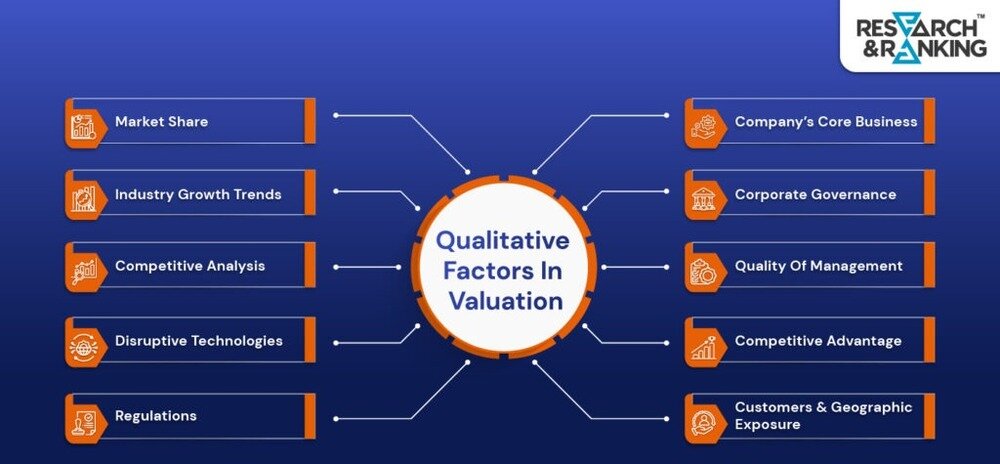
These are the qualitative factors in valuation. They cannot be directly quantified from annual reports, financial models, relative valuation tools, etc. These non-tangible elements also impact a stock’s worth.
A few qualitative factors are:
- Company’s core business
- Competitive analysis
- Quality of management
- Corporate governance
- Market share
- Customers and geographic exposure
- Competitive advantage
- Industry growth trends
- Disruptive technologies
- Government regulations
Technical Analysis
Technical analysis helps investment research analysts and traders predict the stock’s future prices. The analysts look for patterns and base their predictions on the study regarding when investors should buy or sell stocks. Thus, technical analysis provides a better understanding of the intrinsic value of a stock, the innate value, and the market price.
There are two main approaches to technical analysis
- Top-down: In this approach, the share market research analysts first examine the overall economy. They study how the economy will impact the business sectors, local markets, and individual stocks. This approach typically works for short-term investors.
- Bottom-up: This is the opposite approach and is mainly used for long-term investments. Here, the stock market research analysts look at a specific stock to understand if it is undervalued and then decide on the ideal time to trade this particular stock.
Different technical analysis techniques help investors make informed decisions of entry and exit for each stock in their portfolio.

Valuation Methods: Determining Fair Value
In simple terms, stock valuation is like determining the fair price of a product. Investors might become overwhelmed by the different valuation techniques when deciding on the ideal valuation method.
This is when stock market research analysts use their expertise to value a stock. These valuation methods might be straightforward or complicated. Unfortunately, there is no one particular method that suits all. Each stock has unique characteristics, strengths, and weaknesses, which may require various valuation methods.
Types of stock valuation techniques
Primarily, there are two types of stock valuation methods:
- Absolute: This stock valuation method is based on a company’s fundamental analysis and not comparing it with peers. It bases its valuation on financial information like financial statements, cash flow metrics, dividends, and growth rates. This method of calculating a stock value involves the computation of the dividend discount model (DDM) and discounted cash flow model (DCF).
- Discounted Cash Flow (DCF): It estimates a company’s value by considering its expected cash flows in the future based on revenue growth, profit margins, and the cost of capital. Money to be received in the future is less valuable than today’s. DCF analysis calculates a value by discounting future cash flows. As the DCF method involves projecting forecasts and making assumptions, it is crucial to evaluate the inputs.
- Dividend Discount Model (DDM): This technique uses the present value of the dividends expected in the future to calculate a stock’s value. This assumes that the stock’s value is equivalent to the sum of all dividends expected in the future, discounted from their present value.
- Relative: The term indicates that financial reports of companies like the focus company are compared. This approach uses the P/E (Price-to-Earnings) method. In cases where the P/E ratio of the focus company is lower than its competitors, it means the stocks of the focus company are undervalued.
- Price-to-Earnings (P/E): The stock’s market price is compared to the earnings per share (EPS) the company generates. A higher P/E ratio indicates better future growth, whereas a lower ratio implies a lower valuation.
Building a Robust Investment Strategy
Building equity investment portfolios can often feel daunting. However, stock market research analysts offer tips on creating a well-rounded equity investment portfolio through quantitative equity analysis and strategy. Without due diligence, your investments can collapse.
A few critical factors involved include the following:
- Ascertain your risk tolerance and investment time range
- Plan how active you want to be
- Pick an account that meets your goals
- Choose your investments wisely with the help of stock market research analysts
- Fix a budget
- Review and adjust your investments.
To Conclude:

Equity research by a stock market research analyst is a crucial piece that investors use to make better-informed decisions when investing in different share types. This research is often funded by institutional investors who use investment research analysts mainly on a fee basis. The credibility of a research firm or stock market research analyst depends on their efforts in providing reliable research.
Research and analysis benefit stock market research analysts seeking insights and finance enthusiasts understanding equity details.
FAQ
What does a stock market research analyst do?
Research analysts conduct financial analyses, examine data, build financial models, and submit research reports with investment recommendations.
What skills are required for a stock market research analyst?
An investment research analyst requires a thorough understanding of financial markets, strong analytical abilities, and proficiency in financial modeling.
What are the different types of analysis in equity research?
Quantitative equity analysis has various types, such as –
fundamental analysis
technical analysis
sentimental analysis
Read more: How Long-term investing helps create life-changing wealth – TOI.