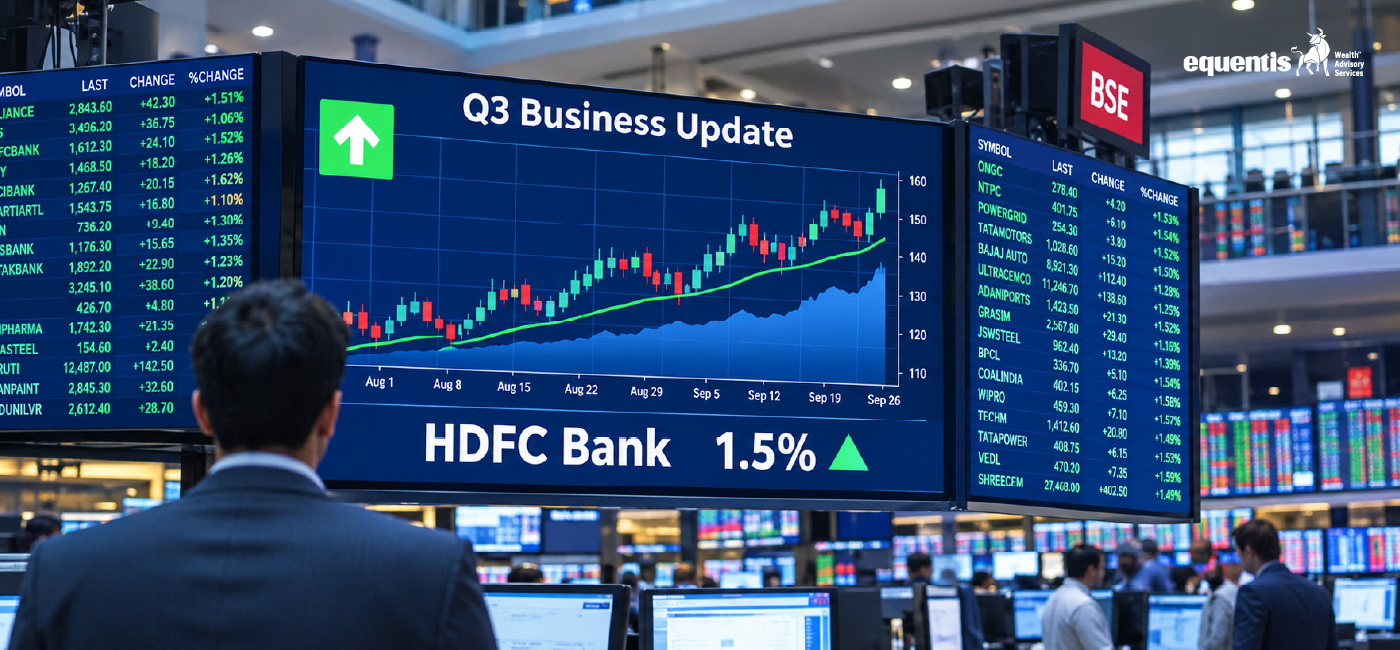

HDFC Bank shares have rebounded sharply from their recent 52 week low, adding roughly ₹87,000 crore to the bank’s market capitalisation as the stock recovered towards ₹740. The recovery comes after HDFC Bank touched a 52 week low of around ₹682 on September 11, 2026. By September 23, the stock was trading around ₹741, while its market capitalisation stood at roughly ₹11.4 lakh crore. The rebound has also coincided with renewed attention around the bank’s upcoming leadership transition, making the next phase particularly important for investors.
HDFC Bank share price: From 52 week low to a sharp recovery
HDFC Bank’s recent performance stands out because the stock had been under considerable pressure for much of the year. Its 52 week high is around ₹1,020, meaning the stock remains well below its previous peak despite the latest recovery.
The stock touched approximately ₹681.90 on September 11. From that level, the move towards ₹741 represents a gain of roughly 8.7%. Given HDFC Bank’s enormous equity base, even a relatively modest percentage movement translates into tens of thousands of crores in market value.
As of September 22, HDFC Bank’s market capitalisation was approximately ₹11.39 lakh crore.
The important point is that the recent gain does not mean the stock has completely reversed its longer term weakness. HDFC Bank remains about 27% below its 52 week high.
What is driving the HDFC Bank share price recovery?
CEO succession is back in focus
One of the biggest developments surrounding HDFC Bank is the upcoming change in leadership.
The current MD and CEO, Sashidhar Jagdishan, is due to complete his term in October 2026. Recent reports indicate that the bank’s board has submitted two names to the RBI as potential successors, with Anup Bagchi being discussed as a possible external candidate and Kaizad Bharucha representing an internal option. The RBI is considering the candidates, but HDFC Bank has not made a final formal announcement.
Leadership transitions are closely watched at large banks because the CEO influences strategy, loan growth, capital allocation, technology investment and risk management.
The market’s recent reaction therefore reflects expectations around the succession process, but the final appointment and subsequent execution will be more important than speculation around individual candidates.
Why has HDFC Bank struggled this year?
HDFC Bank’s share price has remained below its previous high for several reasons, including concerns around growth, margins and the post merger adjustment following its combination with HDFC Ltd.
The merger significantly increased the scale of the bank’s balance sheet. Investors have subsequently focused on whether the enlarged bank can maintain healthy loan growth while managing deposit mobilisation, margins and asset quality.
The stock’s decline has also occurred against a difficult backdrop for Indian equities. The Nifty 50 recently experienced a six week losing streak, while concerns around crude oil, global interest rates and foreign fund flows weighed on sentiment.
Large financial stocks such as HDFC Bank are particularly important for the benchmark indices, so changes in their valuation can also influence overall market sentiment.
What do HDFC Bank’s financials indicate?
Despite the share price weakness, HDFC Bank continues to operate on a very large earnings and balance sheet base.
For Q4 FY26, HDFC Bank reported net revenue of approximately ₹87,182 crore, compared with ₹86,779 crore a year earlier. Profit after tax increased to ₹20,351 crore from ₹18,835 crore, representing growth of about 8%.
These numbers show that profitability remained positive even as revenue growth was relatively modest.
For investors, the more important question is whether earnings growth can accelerate as the post merger base normalises.
What could determine HDFC Bank’s next move?
The next phase for HDFC Bank share price is likely to depend on several business factors rather than the recent rebound alone.
Loan growth
Credit growth remains one of the most important indicators for a bank. Investors will watch whether HDFC Bank can expand its loan book at a healthy pace without compromising underwriting standards.
Deposit growth
Banks need deposits to fund loans. A sustained gap between loan growth and deposit growth can put pressure on funding costs and margins.
Net interest margin
Net interest margin, or NIM, measures the difference between interest earned on loans and interest paid on funding relative to interest earning assets. It is an important profitability indicator for banks.
Asset quality
Gross and net NPA ratios, credit costs and fresh slippages will remain important. Strong loan growth is more meaningful when asset quality remains under control.
Leadership transition
The final decision on the next MD and CEO and the market’s response to the transition could remain an important near term catalyst.
What does the recovery mean for investors?
The rebound from ₹682 to around ₹741 shows that market sentiment towards HDFC Bank has improved from the recent lows. However, investors should distinguish between a recovery from a 52 week low and a fundamental turnaround.
A stock can rebound because of bargain buying, changing expectations or a specific news event without immediately resolving the factors that caused the earlier decline.
For long term investors, the more useful indicators are earnings growth, book value growth, return on equity, loan and deposit growth, asset quality and valuation.
Opportunities and risks
HDFC Bank’s scale, diversified loan book and large customer base provide a strong operating foundation. A successful leadership transition, improving margins and healthier credit growth could support the bank’s financial performance over time.
However, risks remain. Deposit competition, slower loan growth, pressure on margins, regulatory changes and weaker economic conditions could affect earnings. The bank’s share price also remains significantly below its 52 week high, showing that the recent rebound has not eliminated the concerns that affected the stock earlier.
Investors should also remember that a large market capitalisation means even small percentage changes can create substantial changes in the bank’s reported market value.
What should investors watch next?
The immediate focus will be on the RBI’s decision regarding the next HDFC Bank CEO, followed by the bank’s quarterly performance.
Investors should track loan growth, deposit growth, NIM, asset quality, credit costs and management commentary. The broader environment will also matter, particularly interest rates, liquidity, crude oil prices and foreign institutional flows.
Conclusion
The HDFC Bank share price has staged a notable recovery from its recent 52 week low near ₹682, with the move towards ₹741 translating into roughly ₹87,000 crore of additional market value based on the bank’s large equity base.
The rebound has been supported by improving sentiment around the bank and renewed focus on its leadership transition. However, the stock remains well below its 52 week high, so the next phase will depend on whether business fundamentals improve alongside the share price.
For investors tracking HDFC Bank, the key indicators to watch are the CEO transition, loan and deposit growth, margins, asset quality and quarterly earnings. These factors will provide a clearer picture of whether the recent recovery can be supported by the bank’s underlying performance.
Frequently Asked Questions
1. Why is HDFC Bank share price rising?
HDFC Bank shares have recovered from their recent 52 week low amid improving investor sentiment and renewed attention around the bank’s upcoming CEO succession. Reports that the RBI is considering candidates for the next MD and CEO have also contributed to market interest. The stock has recently traded around ₹740 after falling to approximately ₹682 earlier in September.
2. What is HDFC Bank’s 52 week low?
HDFC Bank touched a 52 week low of approximately ₹681.90 on September 11, 2026. The stock subsequently recovered towards ₹741 by September 23. Its 52 week high is around ₹1,020.50, leaving the stock significantly below its previous peak.
3. How much market capitalisation has HDFC Bank added recently?
HDFC Bank has added roughly ₹87,000 crore in market value during its recent rebound from the September low, based on the change in share price and the bank’s large outstanding share base. Its market capitalisation was around ₹11.39 lakh crore on September 22, 2026.
4. Why is HDFC Bank’s CEO succession important?
The CEO has a major role in determining a bank’s strategy, loan growth, risk management, capital allocation and operational priorities. HDFC Bank’s current MD and CEO Sashidhar Jagdishan’s term ends in October 2026. The bank has submitted candidate names to the RBI, making the succession process an important factor for investors.
5. Who could become the next HDFC Bank CEO?
Reports have identified Anup Bagchi and Kaizad Bharucha among the names being considered in the succession process. Bagchi is an external candidate who currently leads ICICI Prudential Life Insurance, while Bharucha is HDFC Bank’s Deputy Managing Director. The RBI has the role of considering the proposed candidates, and no final appointment should be assumed until formally announced.
6. What is HDFC Bank’s current market capitalisation?
HDFC Bank’s market capitalisation was approximately ₹11.39 lakh crore as of September 22, 2026. The exact figure changes continuously with the share price because market capitalisation is calculated by multiplying the current share price by the number of outstanding shares.
7. How did HDFC Bank perform in Q4 FY26?
HDFC Bank reported net revenue of approximately ₹87,182 crore in Q4 FY26, compared with ₹86,779 crore a year earlier. Profit after tax increased to ₹20,351 crore from ₹18,835 crore, representing around 8% year on year growth.
8. What should investors watch in HDFC Bank’s next results?
Investors should monitor loan growth, deposit growth, net interest margin, asset quality, credit costs and profitability. Management commentary on the post merger business trajectory and the impact of the leadership transition will also be relevant. These indicators can provide more information about the bank’s underlying performance than its daily share price.
9. Is HDFC Bank still below its 52 week high?
Yes. HDFC Bank’s 52 week high is around ₹1,020.50, while the stock was trading around ₹741 on September 23, 2026. This means the stock remained roughly 27% below its 52 week high despite the recent recovery.
10. What could influence HDFC Bank share price going forward?
The stock could be influenced by the CEO succession, quarterly earnings, loan and deposit growth, net interest margins, asset quality, interest rates and broader market conditions. Global factors such as crude oil prices and foreign investor flows can also affect large Indian banking stocks and overall market sentiment.
Disclaimer Note: The securities quoted, if any, are for illustration only and are not recommendatory. This article is for education purposes only and shall not be considered as a recommendation or investment advice by Equentis. We will not be liable for any losses that may occur. Investments in the securities market are subject to market risks. Read all the related documents carefully before investing. Registration granted by SEBI, membership of BASL & certification from NISM in no way guarantee the performance of the intermediary or provide any assurance of returns to investors.

Parvati Rai is the Vice President of the Research team at Equentis. She has over 15 years of equity-research and strategy-consulting experience. A specialist in deep-dive valuations, financial modelling, and forecasting, she has built research desks from the ground up, by steering buy-side, sell-side, and independent coverage across sectors. When she isn’t fine-tuning models, Parvati unwinds on nature treks and mentors aspiring analysts.