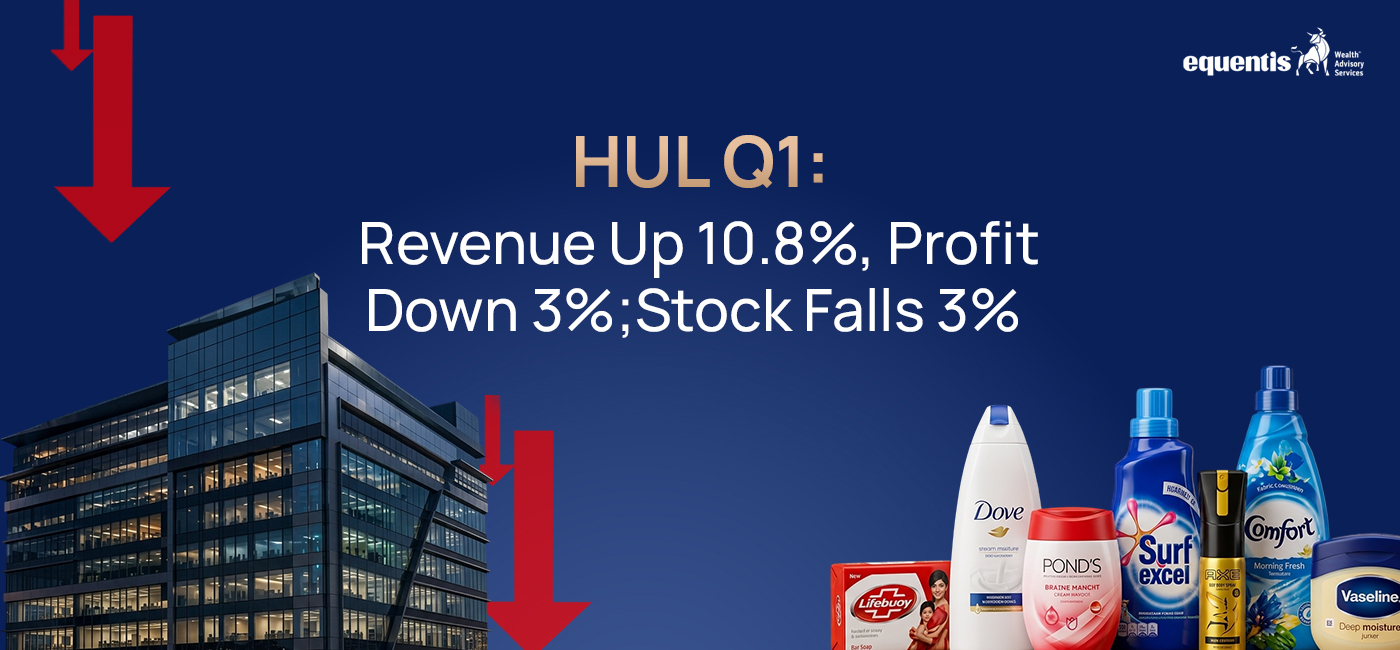

Summary: Hindustan Unilever Limited (HUL) reported a mixed set of Q1 FY27 results. Revenue increased 10.8% year on year, reflecting healthy demand and contributions from acquisitions, while net profit declined around 3% due to higher input costs, investments in brands, and one-time factors. Following the earnings announcement, HUL shares fell over 3%, as investors focused more on profitability pressures than revenue growth. The results highlight that while consumer demand is gradually improving, margin challenges and valuation expectations continue to influence investor sentiment.
Introduction
Hindustan Unilever Limited (HUL), India’s largest fast moving consumer goods (FMCG) company, is often considered a barometer of urban and rural consumption trends. Every quarterly result from the company is closely watched by investors, analysts, and businesses because it offers valuable insights into consumer spending patterns and the health of the FMCG sector.
HUL’s Q1 FY27 earnings reflected two contrasting trends. Revenue growth remained healthy, suggesting demand is recovering across several product categories. However, profitability came under pressure, leading to a decline in net profit and a negative reaction in the stock market. Understanding why revenue increased while profits fell provides a clearer picture of the company’s current business environment.
Understanding HUL’s Q1 FY27 Performance
For the quarter, HUL reported:
- Revenue growth of 10.8% year on year
- Net profit declined by approximately 3%
- Shares fell over 3% after the results announcement
While the revenue growth appeared encouraging, investors were more concerned about earnings quality and future margin trends.
Several factors contributed to this mixed performance.
Strong Revenue Growth
The double digit increase in revenue was supported by:
- Healthy demand across key product categories
- Premium product sales
- Contributions from recent acquisitions and portfolio expansion
- Improved distribution reach
Categories including beauty, personal care, home care, and foods continued to contribute to overall sales growth.
Why Did Profit Decline Despite Higher Sales?
A common question among investors is how profits can fall even when sales increase.
Revenue simply represents the money earned from selling products. Profit, however, depends on how much remains after accounting for all expenses.
HUL faced several cost pressures during the quarter.
Higher Raw Material Costs
Prices of key commodities remained elevated, including:
- Palm oil
- Packaging materials
- Certain agricultural commodities
Higher input costs reduced operating margins despite stronger sales.
Increased Brand Investments
HUL continued investing in:
- Advertising campaigns
- Product innovation
- Distribution expansion
- Digital initiatives
These investments may support long term growth but can temporarily impact quarterly profitability.
One Time Expenses
Some analysts also attributed the lower profit to one time adjustments and integration costs related to business expansion, which affected overall earnings.
Why Did HUL Shares Fall More Than 3%?
Stock prices are influenced not only by current earnings but also by market expectations.
Before the results, investors had anticipated stronger profitability alongside revenue growth.
Although revenue exceeded expectations in some areas, concerns emerged regarding:
- Margin pressure
- Slower earnings growth
- Rising input costs
- Future profitability outlook
As a result, investors booked profits, leading to a decline in the share price.
The reaction highlights an important principle in investing—markets often respond more to future expectations than headline numbers.
What Do These Results Say About India’s FMCG Sector?
HUL’s earnings provide useful insights into broader consumer trends.
Demand Is Gradually Improving
The revenue growth indicates that consumer spending is showing signs of recovery, particularly in:
- Urban markets
- Premium products
- Personal care
- Home care
Companies are witnessing better volumes compared to previous quarters.
Cost Inflation Remains a Challenge
Despite improving demand, companies continue to deal with volatile commodity prices.
Managing input costs while maintaining competitive pricing remains a key challenge across the FMCG industry.
Premiumisation Continues
Consumers are increasingly willing to spend more on premium products offering added convenience, quality, or health benefits. This trend continues to support long term revenue growth for large FMCG companies.
What Does This Mean for Investors?
For investors, HUL’s Q1 results present both encouraging signs and areas requiring caution.
Opportunities
- Healthy revenue growth reflects resilient consumer demand.
- Strong brand portfolio continues to provide pricing power.
- Long term consumption trends in India remain supportive.
- Continued investments may strengthen future growth prospects.
- Expansion into newer product categories can diversify revenue streams.
Risks
- Persistent inflation could continue affecting margins.
- Higher advertising and operating costs may pressure profitability.
- Increased competition from domestic and global FMCG players.
- Premium valuations leave limited room for earnings disappointments.
- Changes in consumer spending patterns may impact future growth.
Investors may benefit from monitoring upcoming quarters to assess whether margins begin to recover alongside revenue growth.
What Should Businesses Learn from HUL’s Results?
HUL’s quarterly performance offers valuable lessons beyond the stock market.
Businesses can observe how:
- Revenue growth alone does not guarantee higher profits.
- Cost management remains equally important.
- Investing in brands during challenging periods can support long term growth.
- Consumer preferences continue evolving toward premium products.
- Operational efficiency plays a significant role in sustaining profitability.
These lessons apply across industries, especially in highly competitive consumer markets.
Outlook for HUL
Looking ahead, HUL’s performance will likely depend on several factors:
- Commodity price movements
- Rural consumption recovery
- Urban demand trends
- Success of new product launches
- Operating margin improvement
- Overall economic conditions
If inflation moderates and demand remains stable, the company could see better profitability in the coming quarters. However, continued cost pressures may keep margins under watch.
Conclusion
HUL’s Q1 FY27 results highlight the complexity of today’s consumer business environment. Revenue growth of 10.8% indicates that demand remains healthy, but the 3% decline in net profit shows that rising costs and continued investments are weighing on earnings. The subsequent 3% fall in the share price reflects investor concerns over margins rather than sales performance.
For long term investors, the results reinforce the importance of looking beyond headline revenue numbers and evaluating profitability, cost management, and future growth potential. As India’s consumption story continues to evolve, upcoming quarters will provide greater clarity on whether HUL can translate strong sales growth into stronger earnings.
Frequently Asked Questions (FAQs)
1. Why did HUL’s revenue increase while profit declined?
Revenue grew because of stronger sales and business expansion, but higher raw material costs, increased brand investments, and other expenses reduced overall profitability.
2. Why did HUL shares fall after the Q1 results?
The market reacted to weaker profit growth and margin pressures, despite healthy revenue growth, as investors had expected stronger earnings.
3. What was HUL’s revenue growth in Q1 FY27?
HUL reported approximately 10.8% year on year revenue growth during Q1 FY27.
4. How much did HUL’s net profit decline?
The company’s net profit declined by around 3% compared to the same quarter last year.
5. Which factors affected HUL’s profitability?
Higher commodity prices, increased advertising expenditure, operational investments, and certain one time costs affected profit margins.
6. What does HUL’s performance indicate about India’s FMCG sector?
The results suggest improving consumer demand, especially in urban markets, while inflation and input costs continue to challenge profitability.
7. Is HUL still considered a defensive stock?
HUL is often viewed as a relatively defensive FMCG company because of its diversified product portfolio and stable demand, though its share price can still react to earnings and valuation expectations.
8. What should investors monitor in HUL’s upcoming quarters?
Investors should track operating margins, raw material costs, volume growth, rural demand, pricing strategy, and future earnings performance.
9. How do commodity prices affect HUL’s business?
Higher prices for inputs such as palm oil, packaging materials, and agricultural commodities increase production costs, which can reduce profit margins if costs cannot be fully passed on to consumers.
10. What is the long term outlook for HUL?
The long term outlook depends on sustained consumer demand, effective cost management, successful product innovation, and the company’s ability to improve margins while maintaining revenue growth.
Disclaimer Note: The securities quoted, if any, are for illustration only and are not recommendatory. This article is for education purposes only and shall not be considered as a recommendation or investment advice by Equentis. We will not be liable for any losses that may occur. Investments in the securities market are subject to market risks. Read all the related documents carefully before investing. Registration granted by SEBI, membership of BASL & certification from NISM in no way guarantee the performance of the intermediary or provide any assurance of returns to investors.

Parvati Rai is the Vice President of the Research team at Equentis. She has over 15 years of equity-research and strategy-consulting experience. A specialist in deep-dive valuations, financial modelling, and forecasting, she has built research desks from the ground up, by steering buy-side, sell-side, and independent coverage across sectors. When she isn’t fine-tuning models, Parvati unwinds on nature treks and mentors aspiring analysts.