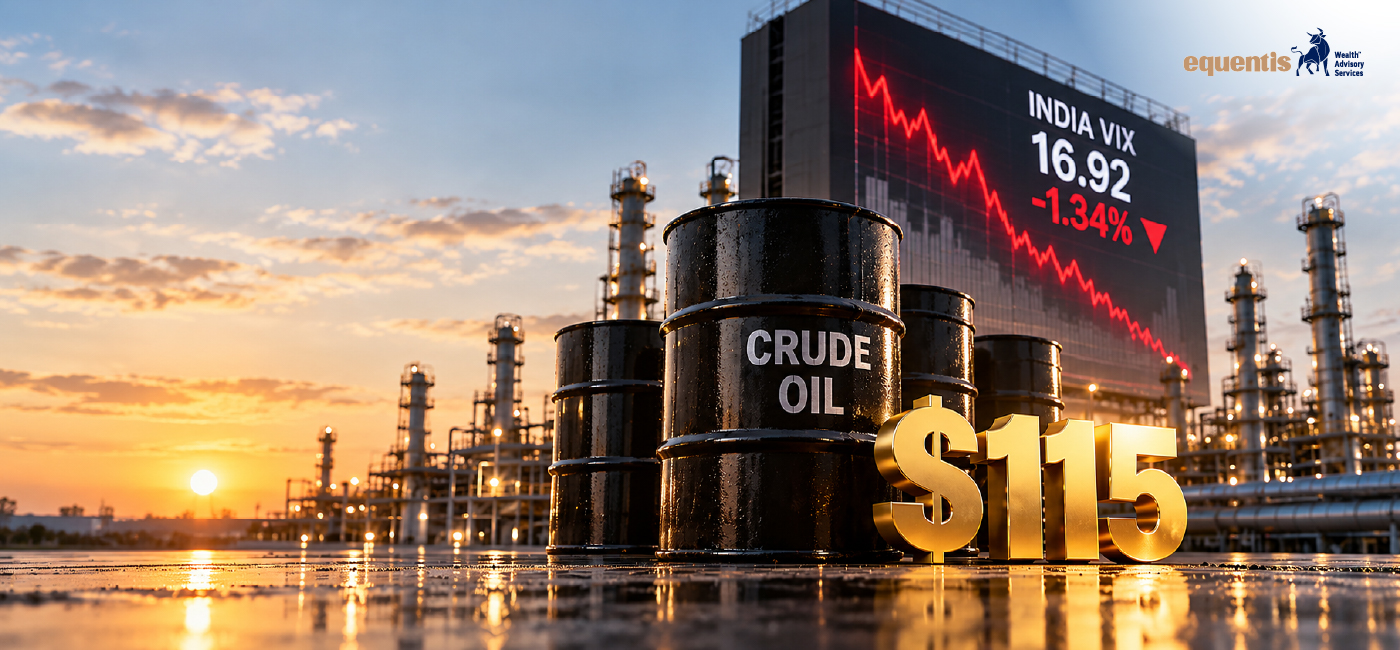

India VIX fell 1.34% to 16.92 as crude oil prices approached $115 per barrel and investors awaited the US Federal Reserve’s interest rate decision. The decline indicates a modest easing in expectations of near term market volatility, but it does not mean risks have disappeared. For Indian investors, the direction of crude oil prices, the Fed’s policy signals, foreign investor flows and the rupee will remain important factors influencing the Sensex and Nifty 50.
What Is India VIX and Why Does It Matter?
India VIX, or the India Volatility Index, measures the market’s expectations of volatility in the Nifty 50 over the next 30 calendar days. It is calculated using option prices and reflects how much movement traders expect in the market, rather than predicting whether share prices will rise or fall.
When India VIX declines, it generally suggests that traders expect relatively lower volatility. When it rises, it can indicate greater uncertainty or increased demand for protection against sharp market movements.
The fall to 16.92 is therefore a sign of some easing in expected volatility. However, investors should interpret the movement alongside other market indicators instead of treating it as a standalone signal for buying or selling shares.
Why Are Crude Oil Prices Near $115 a Concern for India?
India imports a substantial share of its crude oil requirements, making international oil prices an important factor for inflation, economic growth and financial markets. When crude becomes more expensive, the impact can extend beyond fuel costs to transportation, manufacturing, aviation and household spending.
Impact on inflation and the rupee
Higher crude oil prices can increase India’s import bill and put pressure on the current account balance. If demand for US dollars rises to pay for imports, the rupee may face additional pressure, although currency movements also depend on capital flows, monetary policy and global conditions.
Expensive oil can also make it harder for inflation to ease. If fuel and transport costs rise, businesses may pass some of those expenses on to consumers. This can affect household budgets and corporate profit margins.
Which sectors could be affected?
The impact varies across industries. Oil marketing companies may face pressure if retail fuel prices do not adjust in line with input costs. Aviation companies can face higher fuel expenses, while paint, chemicals and other petroleum-linked businesses may experience rising raw material costs.
Upstream oil producers may benefit from higher realisations, depending on their production costs and applicable policies. The overall market impact depends on how long crude stays elevated and how companies manage the additional expenses.
How Could the US Federal Reserve Decision Affect Indian Markets?
The US Federal Reserve’s October 27 to 28 meeting is another major event for global markets, with its policy decision expected on Wednesday, October 28. Investors are assessing whether interest rates will remain unchanged and what policymakers signal about future decisions.
Why US interest rates matter for India
US interest rates influence global borrowing costs, bond yields and the attractiveness of dollar denominated assets. If the Fed signals that interest rates may stay higher for longer, investors could prefer US assets over riskier emerging markets, potentially putting pressure on foreign portfolio investment in India.
On the other hand, a measured policy statement may support investor confidence if it reduces uncertainty about future interest rates. The market reaction will depend not only on the decision itself but also on the Fed’s explanation of inflation, economic growth and its policy outlook.
The Fed’s response to rising energy prices is especially important because expensive crude can complicate the fight against inflation.
What Does the India VIX Fall Mean for Retail Investors?
The decline in India VIX to 16.92 suggests a modest reduction in expected market swings, but it should not be interpreted as confirmation that the market has reached a stable phase.
Indian benchmark indices remained largely flat on October 27 as elevated oil prices and uncertainty before the Fed decision weighed on sentiment. The Nifty 50 closed at 22,738.55, while the Sensex ended at 73,497.28.
For retail investors, the practical implications include:
- Avoid relying on one indicator: India VIX should be considered alongside market breadth, corporate earnings, crude prices and foreign investor activity.
- Understand derivatives risk: Options premiums can change as expected volatility changes. Lower VIX does not eliminate the possibility of sudden market moves.
- Keep investment goals in focus: Long term investors should assess their financial goals and risk tolerance rather than reacting to every daily market fluctuation.
- Watch portfolio concentration: Sudden changes in oil prices, currency movements or global sentiment can affect sectors differently.
Opportunities and Risks to Watch
A fall in volatility can create a relatively calmer trading environment, allowing investors to evaluate corporate earnings and economic developments with less immediate market stress. If crude prices ease and the Fed’s communication reassures markets, sentiment could improve.
However, several risks remain. Geopolitical tensions can disrupt energy supplies, while persistently high oil prices can increase inflationary pressure and reduce corporate margins. Foreign investor selling may also weigh on equities, particularly if US bond yields and the dollar strengthen.
The rupee is another important variable. Elevated crude prices and importer demand contributed to pressure on the currency, highlighting how global energy prices can affect Indian financial markets beyond the stock indices.
Investors should also remember that India VIX measures expected volatility, not the direction of the market. It can fall even when indices decline, and it can rise during a market rally if traders expect larger price movements ahead.
Conclusion
India VIX falling 1.34% to 16.92 indicates a modest easing in expected volatility, but crude oil near $115 per barrel and the upcoming US Federal Reserve decision keep uncertainty elevated. For Indian markets, the next signals to monitor are the Fed’s policy guidance, global oil prices, the rupee and foreign investment flows.
Rather than treating the VIX decline as a definitive bullish signal, investors can use it as one part of a broader assessment of market conditions and portfolio risk.
Frequently Asked Questions
1. What is India VIX?
India VIX is the India Volatility Index, which measures expected volatility in the Nifty 50 over the next 30 calendar days based on option prices. It indicates how much market movement traders anticipate, but it does not predict whether the market will rise or fall.
2. Why did India VIX fall to 16.92?
India VIX fell 1.34% to 16.92, indicating a modest decline in expected market volatility. However, the movement should be considered alongside global developments, crude oil prices and the upcoming Federal Reserve decision. A single day’s fall does not necessarily mean uncertainty has ended.
3. Is a lower India VIX good for the stock market?
A lower India VIX generally suggests that traders expect smaller market swings. This can indicate relatively calmer conditions, but it does not guarantee that stock prices will rise. Investors should consider market direction, economic data, earnings and global risks before drawing conclusions.
4. What does India VIX at 16.92 mean for investors?
An India VIX reading of 16.92 reflects the market’s expectations of future volatility, not a guaranteed range for stock prices. Investors can use it to understand changing risk expectations, but should not rely on the figure alone to make investment decisions.
5. Why is crude oil near $115 a concern for India?
India imports much of its crude oil, so elevated prices can increase the import bill, contribute to inflation and put pressure on the rupee. Higher energy costs can also affect transportation, manufacturing and corporate profitability, depending on how businesses absorb or pass on those expenses.
6. When is the US Federal Reserve’s October 2026 decision?
The Federal Open Market Committee is meeting on October 27 and 28, 2026. The policy decision is scheduled for October 28 in the United States. Indian investors will also watch the Fed’s accompanying statement and press conference for signals about future interest rates.
7. How can the Fed decision affect the Indian stock market?
The Fed’s decision can influence US bond yields, the dollar and international investment flows. A more hawkish outlook may put pressure on emerging market equities, including Indian shares, while reassuring guidance could support sentiment. The actual reaction depends on how the announcement compares with market expectations.
8. Which Indian sectors are sensitive to rising crude oil prices?
Aviation, paints, chemicals and other businesses that use petroleum based inputs may face higher costs. Oil marketing companies can also be affected by changes in fuel pricing and margins. Upstream oil producers may benefit from higher realisations, depending on their costs and operating conditions.
9. Does a fall in India VIX mean the market will rise?
No. India VIX measures expected volatility, not market direction. It can decline while the stock market falls if traders expect smaller future swings. Investors should assess other indicators and avoid interpreting a lower VIX as a standalone signal to buy shares.
10. What should investors watch after the India VIX decline?
Investors should monitor the Federal Reserve’s decision and guidance, crude oil prices, the rupee, foreign portfolio investment flows and quarterly earnings. These factors can influence both volatility and market direction. A sustained change in these indicators is more informative than a single day’s movement in India VIX.
Disclaimer Note: The securities quoted, if any, are for illustration only and are not recommendatory. This article is for education purposes only and shall not be considered as a recommendation or investment advice by Equentis . We will not be liable for any losses that may occur. Investments in the securities market are subject to market risks. Read all the related documents carefully before investing. Registration granted by SEBI, membership of BASL & certification from NISM in no way guarantee the performance of the intermediary or provide any assurance of returns to investors.

Parvati Rai is the Vice President of the Research team at Equentis. She has over 15 years of equity-research and strategy-consulting experience. A specialist in deep-dive valuations, financial modelling, and forecasting, she has built research desks from the ground up, by steering buy-side, sell-side, and independent coverage across sectors. When she isn’t fine-tuning models, Parvati unwinds on nature treks and mentors aspiring analysts.