
Introduction
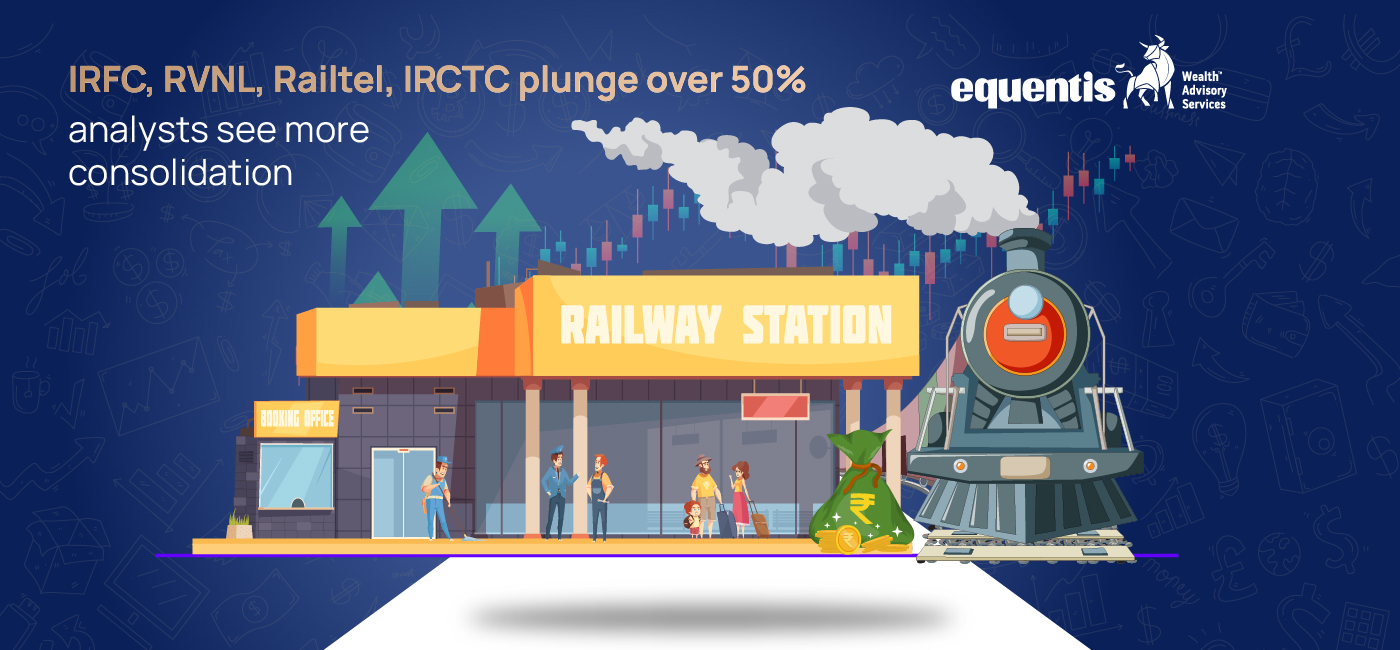
Railway-related stocks that once dominated market conversations are now facing a sharp reality check. Companies such as IRFC, RVNL, RailTel, and IRCTC have seen their stock prices fall more than 50 percent from their peaks, raising fresh concerns among investors.
These stocks had witnessed a strong rally in the past few years as the Indian government accelerated railway modernization, infrastructure spending, and digital transformation within the rail ecosystem. Investor enthusiasm pushed valuations higher as railway stocks became one of the most discussed themes in the market.
However, after a phase of rapid gains, the sector is now going through a correction. Analysts believe the current phase could be a period of consolidation rather than a complete reversal of the railway growth story. Understanding why these stocks have fallen and what lies ahead can help investors navigate the current market environment more effectively.
The Rise of Railway Stocks in India
The surge in railway stocks did not happen overnight. Over the past several years, India has significantly increased investments in railway infrastructure. Government initiatives aimed at modernizing rail networks, improving freight capacity, and enhancing passenger services created a strong growth narrative.
Companies like Indian Railway Finance Corporation (IRFC) provide financing for railway infrastructure projects. Rail Vikas Nigam Limited (RVNL) focuses on project execution, including track expansion and railway infrastructure development. RailTel provides telecom and digital infrastructure for railway networks, while IRCTC manages online ticketing, catering services, and tourism operations.
As railway infrastructure spending expanded, these companies saw improved revenue visibility. Investors began viewing railway stocks as a long term infrastructure opportunity backed by government support.
This optimism drove significant rallies in these stocks, with many of them delivering strong returns within a short period.
Why Railway Stocks Have Fallen Sharply
Despite strong long term narratives, railway stocks have recently experienced sharp corrections. Several factors have contributed to the decline.
One of the key reasons is valuation adjustment. After the rally, many railway stocks were trading at significantly higher valuations compared with their historical averages. When valuations stretch beyond earnings growth, markets often enter a consolidation phase.
Profit booking has also played a major role. Investors who entered early during the rally may have chosen to lock in gains, leading to selling pressure in these stocks.
Another factor is broader market volatility. When overall market sentiment weakens, high momentum sectors often see sharper corrections as investors shift toward more stable segments.
In addition, some analysts believe that expectations around railway-related companies had become too optimistic. While infrastructure spending continues, revenue growth may not always match the pace implied by earlier stock price movements.
What Consolidation Means for the Sector
The term consolidation does not necessarily imply a long-term negative outlook. In financial markets, consolidation often refers to a period where stock prices stabilize after a sharp rally.
For railway stocks such as IRFC, RVNL, RailTel, and IRCTC, consolidation could mean that prices move within a range while earnings growth gradually catches up with valuations.
This phase can also help remove speculative excess from the sector. Stocks that rise rapidly often attract short-term traders, which increases volatility. A consolidation phase allows markets to reassess fundamentals.
During such periods, investors typically pay closer attention to company performance, project execution, and revenue growth rather than relying solely on sector narratives.
Impact on Investors
The correction in railway stocks has affected many retail investors who entered the sector during its peak popularity.
Sharp price declines can create uncertainty, especially for those who invested based on short term momentum rather than long term fundamentals. However, experienced investors often view corrections as a natural part of market cycles.
For long term investors, the key question is whether the underlying business prospects of these companies remain intact. If government investment in railway infrastructure continues, these companies may still have opportunities to grow over time.
At the same time, investors may need to adjust expectations regarding short-term returns. Rapid rallies are often followed by periods of slower price movement.
Opportunities and Risks Ahead
Despite the recent decline, the broader railway infrastructure theme in India remains relevant.
The Indian government continues to invest heavily in expanding railway capacity, improving freight corridors, and modernizing passenger services. Projects related to electrification, signaling systems, and digital infrastructure could create long-term opportunities for companies involved in railway operations.
For example, companies like RVNL may benefit from infrastructure expansion projects, while RailTel could gain from digital connectivity initiatives across railway networks.
However, risks remain. Execution delays, slower project approvals, or budget constraints could affect revenue growth for railway-related companies.
Market sentiment is another important factor. If investor enthusiasm toward infrastructure themes weakens, railway stocks may continue to move sideways for some time.
Investors should also consider diversification and avoid concentrating too heavily in a single sector.
Conclusion
The sharp decline in IRFC, RVNL, RailTel, and IRCTC stocks highlights how quickly market sentiment can shift after a strong rally. While these companies benefited from the excitement around India’s railway infrastructure growth story, rising valuations and profit booking have triggered a significant correction.
Analysts now expect a phase of consolidation as stock prices stabilize and company earnings gradually align with investor expectations.
For investors, the current phase may serve as a reminder that sector themes can drive momentum, but long term investment decisions should be based on business fundamentals and realistic growth assumptions.
As India continues to invest in railway modernization, companies connected to this ecosystem will likely remain part of the broader infrastructure narrative. However, patience and careful evaluation will be important as the sector moves through its next phase of market adjustment.
Disclaimer Note: The securities quoted, if any, are for illustration only and are not recommendatory. This article is for education purposes only and shall not be considered as a recommendation or investment advice by Equentis – Research & Ranking. We will not be liable for any losses that may occur. Investments in the securities market are subject to market risks. Read all the related documents carefully before investing. Registration granted by SEBI, membership of BASL & certification from NISM in no way guarantee the performance of the intermediary or provide any assurance of returns to investors.

Parvati Rai is the Vice President of the Research team at Equentis. She has over 15 years of equity-research and strategy-consulting experience. A specialist in deep-dive valuations, financial modelling, and forecasting, she has built research desks from the ground up, by steering buy-side, sell-side, and independent coverage across sectors. When she isn’t fine-tuning models, Parvati unwinds on nature treks and mentors aspiring analysts.