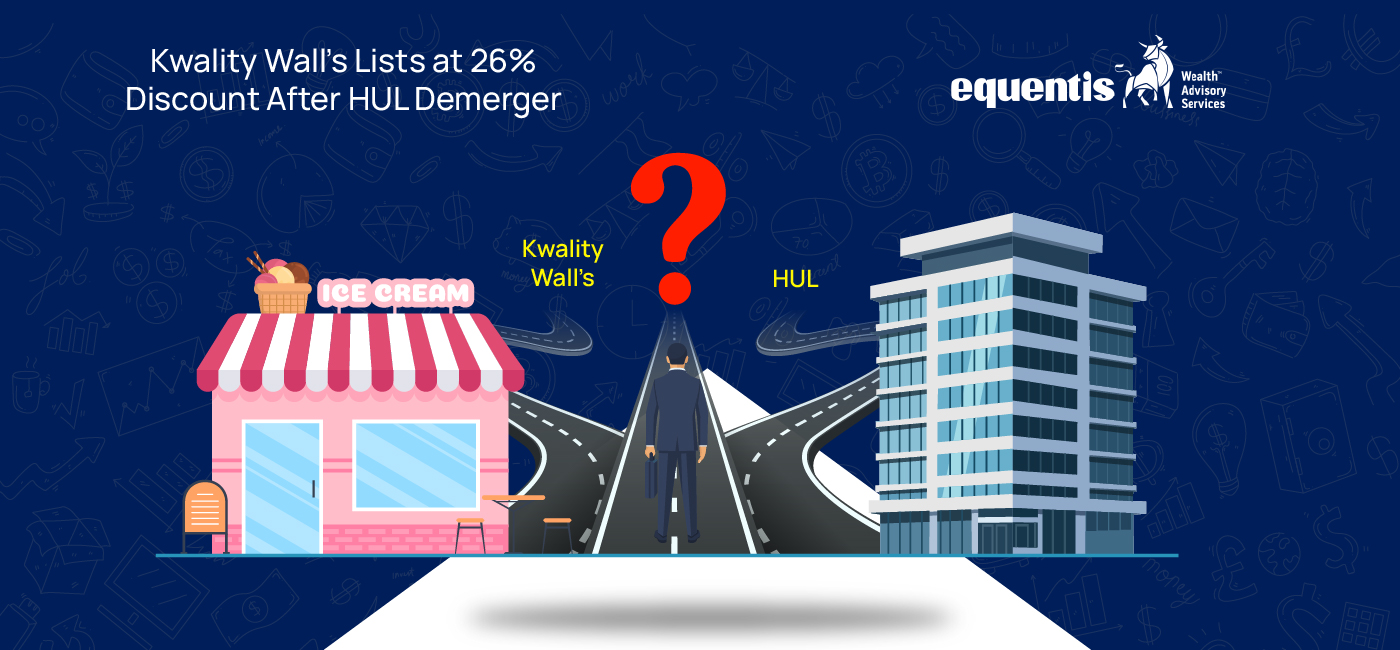

The stock market does not always reward new listings with enthusiasm. Kwality Wall’s found this out on its debut, listing at nearly a 26 percent discount to its discovered price after being demerged from Hindustan Unilever. The sharp gap between expectation and reality has left investors divided. Is the weak listing a warning sign, or is the market overlooking a long-term consumer business with a strong brand recall?
This moment matters because demergers often unlock value over time, but early price action can test investor conviction. Understanding what really drove the discount is key before drawing conclusions.
The Bigger Picture Behind the HUL Demerger
Kwality Wall’s became a separately listed entity following its demerger from Hindustan Unilever Limited. The idea behind the move was simple. Ice cream is a seasonal, capital-intensive business with different margin dynamics compared to HUL’s core FMCG portfolio. Separating it allows sharper management focus and more transparent valuation.
Demerger structures usually distribute shares of the new entity to existing shareholders. In such cases, there is no fresh capital raised, and initial trading is often driven by short-term supply-demand mismatches rather than fundamentals. Many institutional investors who owned HUL for its stable cash flows may not want exposure to a pure-play ice cream business, leading to selling pressure on the listing.
This broader context helps explain why debut day prices do not always reflect long-term potential.
What Happened on Listing Day
Kwality Wall’s shares listed at a significant discount to the discovered price, catching many retail investors off guard. The immediate selling pressure suggested that the market was still trying to find the right valuation for the business as a standalone entity.
Such price discovery phases are common after demergers. Investors reassess earnings visibility, working capital needs, and growth sustainability. In Kwality Wall’s case, concerns around seasonality, margin volatility, and competition weighed on sentiment.
At the same time, the broader market environment has been cautious, with investors preferring predictable earnings over discretionary consumption themes.
Understanding the Kwality Wall’s Business Model
Kwality Wall’s operates in the highly competitive ice cream and frozen desserts segment. While it enjoys strong brand recognition and a wide distribution network, the business faces unique challenges.
Ice cream demand peaks in the summer months, leading to uneven cash flows across the year. The business also requires continuous investment in cold chain infrastructure, logistics, and freezer placements, which impacts return ratios.
On the positive side, Kwality Wall’s benefits from decades of brand building, a diverse product portfolio, and deep reach across urban and semi-urban markets. As a standalone company, management now has the flexibility to tailor strategies specifically for this category rather than competing internally for capital allocation.
What the Discount Means for Investors
For investors, a 26 percent discount can mean two very different things depending on perspective. For short-term participants, it reflects weak sentiment and uncertainty around near-term performance. For long-term investors, it raises the question of whether the market is pricing in too much pessimism too early.
Standalone valuations often look unattractive initially because historical financials were part of a larger parent company. Over time, as quarterly numbers provide clarity on margins, growth, and capital efficiency, valuations tend to stabilise.
However, patience is crucial. Demerger stories rarely play out in weeks. They unfold over several quarters as management execution becomes visible.
Opportunities That Could Emerge
One opportunity lies in a sharper strategic focus. As an independent company, Kwality Wall’s can prioritise product innovation, regional flavours, and premium offerings without being overshadowed by larger FMCG categories.
There is also room for margin improvement through better cost controls, supply chain optimisation, and selective price hikes. Rising disposable incomes and changing consumption habits could support long-term demand growth, especially in smaller towns where ice cream penetration remains low.
If execution improves and earnings visibility strengthens, current prices may eventually appear more reasonable.
Risks That Should Not Be Ignored
At the same time, risks remain real. Competition from regional players and private labels continues to intensify. Input cost fluctuations, especially dairy and fuel, can pressure margins.
Seasonality means earnings can be lumpy, which does not always suit investors seeking steady compounding. Additionally, any slowdown in discretionary spending can directly impact volumes.
Investors should also be cautious about assuming that every demerger leads to value creation. Execution quality matters more than structure.
Conclusion: Signal or Setup for the Long Term
Kwality Wall’s discounted listing after the HUL demerger is neither an automatic red flag nor an obvious bargain. It reflects a market still adjusting to a new standalone consumer business with distinct risks and opportunities.
For investors, the key lies in watching how the company performs over the next few quarters. Margin trends, cost discipline, and volume growth will matter far more than debut-day price action.
In demerger stories, early volatility is common. Whether this turns into a hidden opportunity will depend on execution, not emotion.
Disclaimer Note: The securities quoted, if any, are for illustration only and are not recommendatory. This article is for education purposes only and shall not be considered as a recommendation or investment advice by Equentis – Research & Ranking. We will not be liable for any losses that may occur. Investments in the securities market are subject to market risks. Read all the related documents carefully before investing. Registration granted by SEBI, membership of BASL & certification from NISM in no way guarantee the performance of the intermediary or provide any assurance of returns to investors.

Parvati Rai is the Vice President of the Research team at Equentis. She has over 15 years of equity-research and strategy-consulting experience. A specialist in deep-dive valuations, financial modelling, and forecasting, she has built research desks from the ground up, by steering buy-side, sell-side, and independent coverage across sectors. When she isn’t fine-tuning models, Parvati unwinds on nature treks and mentors aspiring analysts.