
Introduction
The data from two significant depositories, NSDL and CSDL, validates the fact, stating that the total number of Demat accounts has nearly tripled to 11 crores as of Jan 2023. More demat accounts imply investors pouring more money into the stock market. Success stories of winning investors always motivate us to start our investment journey.
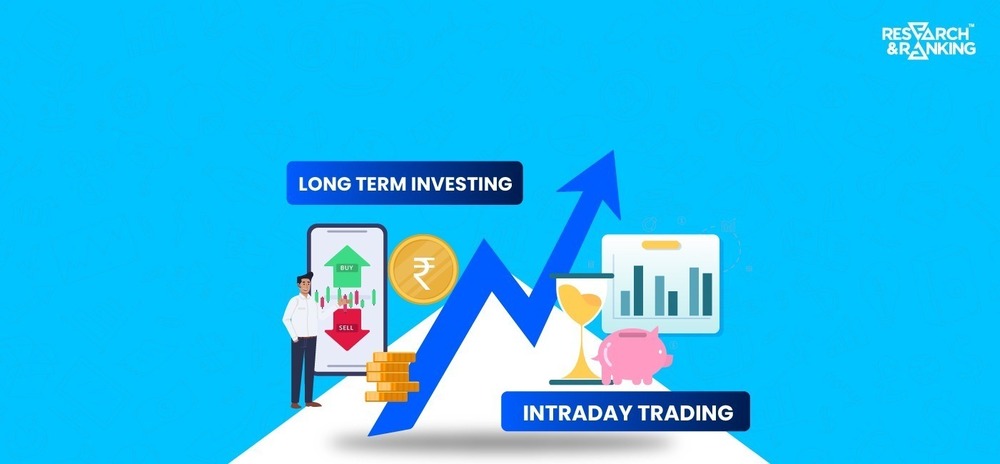
But, the next big question that crosses our minds is which investing strategy you should use to maximize your returns: intraday, stock trading, or long-term investing. Let’s face it: you must get the basics right before we can answer. But don’t worry, this isn’t a quick-fire round.
Take your time and get the fundamentals right before making investment decisions. In this blog, we will share everything you need to know about stock trading, intraday trading or long term investment. Then, we will delve deeper into these investing methods to discover how to get returns, stay steady during market volatility and avoid common mistakes that can cost you money.
You will understand these methods and decide which suits your goals, personality, and lifestyle better. So, are you ready to take off? Let’s begin…
What is Intraday Trading and How Does It Work?
Trading within the same day is referred to as intraday trading. In simple terms, an intraday trade occurs when an investor enters into a trade transaction and settles the work by the end of the same day. Securities include stocks, ETFs (Exchange Traded Funds), and other long term investment assets.
To get this concept clearly, say you bought 100 shares of company A at Rs. 10 at 9:45 am. Now you decide you settle the trade at 3:00 pm.
Case 1:Say, Stock A trades at Rs. 11. In this case, you will book a profit of Rs. 100 (i.e. Rs. 1100- Rs. 1000)
Case 2: Sa, Stock A trades at Rs. 9 at 3:00 pm, and you still keep waiting for the stock price to recover and the session for the day close when the stock price further falls to Rs. 8. Then, your broker will have to square-off the transaction on your behalf at the closing stock price of Rs. ,8 and you make a loss of Rs. 20 i.e.e Rs 80 – Rs. 100).
Risks and Rewards of Intraday Trading
Let’s begin with the rewards–
- Unlike long term investments, your returns are not affected by overnight vital economic or earnings reports about the stock you traded or off-hour broker news.
- To protect your position, use tight stop-loss orders.
- More margin leverage
Some disadvantages are as follows:
- High transaction or commission costs
- In-depth knowledge of the stock market is required, including intraday charts, sophisticated algorithms, and much more.
- High volatility necessitates greater risk.
- More time is required to keep track of intraday price movements.
What is Stock Trading, and How Does It Work?
Stock trading is the buying and selling of stocks of publicly traded companies on stock exchanges such as the NSE, BSE, and NASDAQ. When you purchase a share of a company, you gain partial ownership. However, it is much riskier, and you could lose your investment in the pursuit of quick returns.
Stock trading can be divided into two categories: short-term trading and long term investment, depending on the investor’s preferred holding period. Short-term trading, as opposed to long term investment, refers to buying and selling stocks after holding them for less than one year.
Assume you purchased 100 shares of company A at Rs. 10/- and decide to sell them after a week when prices rise to Rs. 12/-, possibly due to positive news about the stock hitting the market. Then you profit from Rs. 200/- on this short-term trade.
Risks and Rewards of Stock Trading
- Chances of gaining quick profits are higher if invested with proper fundamental and technical analysis.
- You can beat inflation with good returns
- High liquidity
Some challenges of stock trading include-
- Involves higher risk than long term investment
- Active participation, sound market research and analysis are required for quick returns.
- Easily get driven by emotions.
- You have to pay higher taxes than long term investment.
How Long-Term Investment Helps Build Wealth Over Time
Compounding plays a vital role in long-term investing. By reinvesting earnings, investors can exponentially increase the value of their portfolios over time.
Long-Term Investment vs Short-Term Investment
Risk and Volatility: Which One is Safer?
- Long-term investing has lower risk and provides stability, as markets tend to correct over time.
- Intraday and stock trading have high volatility, making them riskier.
Returns Comparison: Compounding vs Quick Gains
- Long-term investments leverage compounding to generate wealth.
- Intraday and stock trading focus on immediate profits but come with significant risks.
Tax Benefits: How Each Investment Type is Taxed
- Long-term capital gains tax (LTCG): Taxed at 10% for profits exceeding ₹1 lakh.
- Short-term capital gains tax (STCG): Taxed at 15%, and intraday trading profits are taxed as regular income.
Time Commitment: Active Trading vs Passive Investing
- Intraday and stock trading require constant monitoring.
Long-term investing is more passive and requires occasional review.
What is Long Term Investment, and How Does It Work?
Long-term stock investment refers to the buy-and-hold strategy we discussed in depth in our coffee can investing article. Long term investment frequently refers to buying and holding stocks, mutual funds, ETFs, or other securities for more than a year, which can last several decades.
Say you invest in a company that builds commercial towers and malls, generates solar power, deals with EV technology, or any other company/industry that will take three to seven years to grow. You opt for long term investment.
Risks and Rewards of Long Term Investments
Here are the benefits of long term investments
- Long term investments outperform intraday or short-term trades.
- Most appropriate for newcomers or investors with limited technical knowledge or time
- The least volatile and most secure investment strategy
- Avoid stress because there is no need for constant monitoring.
- Easily ride out the Highs and Lows
- Earn good returns with the benefit of compounding
- Get desired flexibility and room for taking corrective measures
Here are a few risks of long term investments
Sitting with long term investments is not always a good idea in an aggressive market scenario.
Long term investments may not always be liquid.
Benefits of Long-Term Investment
1. Wealth Creation Through Compounding
Investments grow exponentially over time, making long-term investing the best strategy for wealth generation.
2. Reduced Market Volatility Impact
Market downturns have a lower impact on long-term investors as stocks generally recover.
3. Tax Efficiency Compared to Frequent Trading
Long-term investors pay lower capital gains tax than frequent traders.
Benefits of Short-Term Investments
1. Faster Liquidity and Access to Funds
Short-term investments provide quick returns and cash flow.
2. Higher Returns During Bullish Markets
Short-term traders can benefit from price swings in strong market uptrends.
3. Ideal for Tactical Market Moves and Quick Gains
Short-term trading is suitable for investors looking to capitalize on market trends.
Stock Trading vs Long term Investing
| Long Term Investment | Stock Trading | |
| Risks and Returns | Low Risk and High Returns | High Risk and High Returns |
| Time Horizon | Long term (Min 1 year) | Very Short term (Upto few hours) |
| Analysis | Fundamental analysis that includes financial analysis, earnings reports and ratios etc. | Tracking price movements Technical analysis that includes charts, historical patterns etc. |
| Commission/ Fees | Low | Medium |
| Types of Assets | High growth potential and fundamentally strong stocks are picked | Highly volatile stocks that show a vast range of price movements give better gains. |
| Risk tolerance | Low | High |
| Taxes | Long-term capital gains are taxed at 10% (only when gains are above Rs. 1 lacs) | Capital gains are taxed as regular income and can push you to a higher tax bracket |
| Skills | Patience and discipline are most important | Require a professional approach in making swift trades. |
Intraday Trading vs Long Term Investing
| Long Term Investment | Intraday Trading | |
| Risks and Returns | Low Risk and High Returns | Very High Risk and High Returns |
| Time Horizon | From one year to several years | From minutes to a few hours |
| Approach | Long term investment to pick high-potential stocks | Earning quick returns |
| Analysis | Require fundamental analysis to understand the business model, financial health and company philosophies | Require technical analysis and knowledge of market trends. |
| Commission/ Fees | Low | High |
| Types of Assets | High growth potential and fundamentally strong stocks are picked | Highly volatile stocks that show a vast range of price movements give better gains. |
| Risk tolerance | Low | High |
| Taxes | Long-term capital gains are taxed at 10% without indexation benefit for listed shares (only when gains are above Rs. 1 lac) | Capital gains are treated as speculative income and taxed according to your income tax slab. |
Key Takeaways
- Long-term investing is safer and allows compounding to work for wealth creation.
- Intraday and stock trading require extensive market analysis and carry higher risks.
- Tax benefits favor long-term investors, while short-term traders pay higher taxes.
- Choosing the right investment strategy depends on risk tolerance, time commitment, and financial goals.
FAQs
Is Intraday trading advisable for beginner investors?
No, beginners should start with long-term investing, as intraday trading requires experience and market expertise.
Do long-term investments require research?
Analyzing financials, growth potential, and market trends is crucial before investing.
What is the biggest advantage of long-term investment?
The power of compounding leads to exponential wealth creation over time.
Which is better: long-term investment or stock trading?
It depends on your risk tolerance and financial goals. Long-term investing is safer, while stock trading offers quick profits but at higher risk.
Can short-term investments offer stable returns?
No, short-term investments are highly volatile and depend on market conditions.
What type of investment is best for retirement planning?
Long-term investments like mutual funds, ETFs, and stocks are ideal for retirement planning.
How do taxes differ for short-term trading vs long-term investing?
Short-term trading: Taxed at 15% (STCG) or as business income.
Long-term investing: Taxed at 10% (LTCG) on gains above ₹1 lakh.Can I combine both long-term and short-term investment strategies?
A balanced portfolio with both strategies can maximize returns and manage risks.
How useful was this post?
Click on a star to rate it!
Average rating 3.6 / 5. Vote count: 13
No votes so far! Be the first to rate this post.