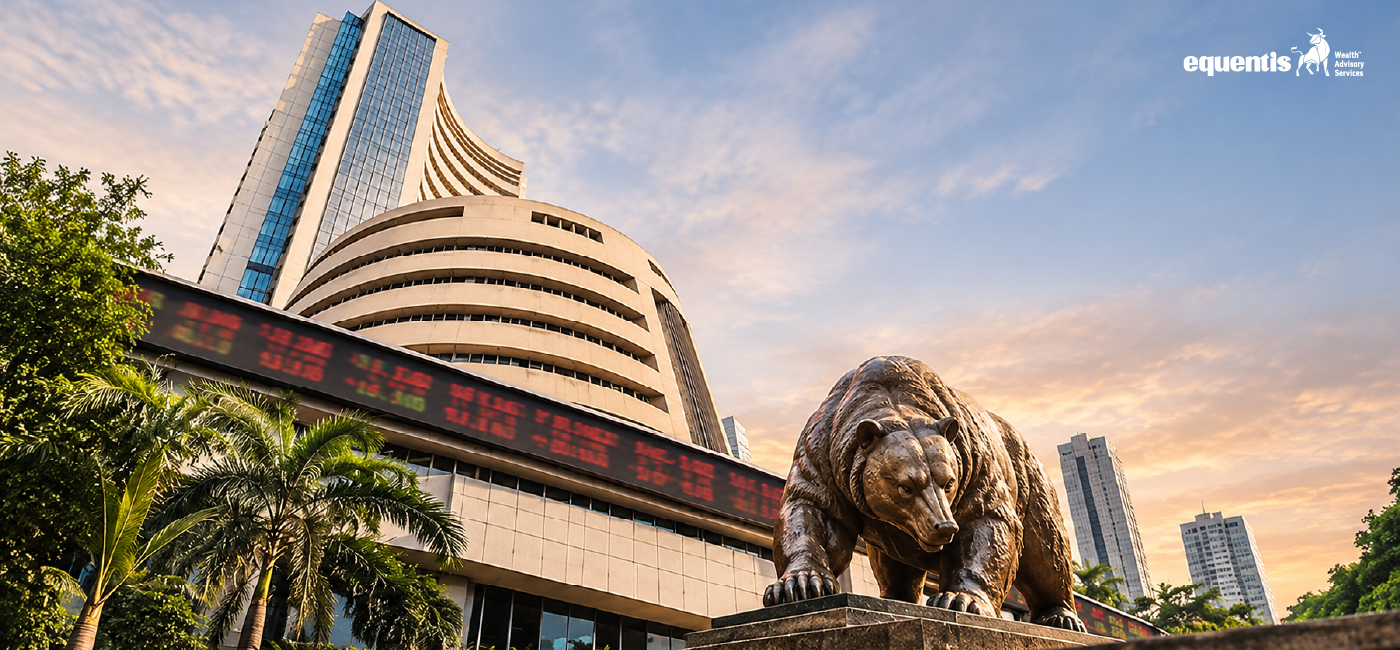

Indian stock markets declined sharply in early trade on November 13, 2026, as the Sensex tumbled 460 points to 81,441.17 and the Nifty fell 179 points to 25,119.50. The decline followed a three-day market rally, with investors booking profits amid rising retail inflation and concerns about a possible RBI interest rate hike in December. The Week+1
Introduction
The Indian stock market witnessed renewed selling pressure on Friday after benchmark indices struggled to sustain their recent recovery. The Sensex and Nifty opened lower and extended losses during early trading, reflecting cautious investor sentiment.
The immediate trigger was a combination of profit booking and rising inflation concerns. Although foreign institutional investors continued buying Indian equities in the previous session, domestic market sentiment remained vulnerable to economic developments and global uncertainty.
Context and Background: Why Did the Market Fall?
Profit Booking After Three-Day Rally
The Sensex and Nifty had advanced during the preceding three sessions, encouraging some investors to lock in profits.
Profit booking occurs when investors sell shares after a price increase to realise gains. Such selling is common after a rally, particularly when markets approach important technical resistance levels or fresh economic concerns emerge.
On Thursday, November 12, the Sensex closed at 81,911.01, gaining 31.61 points, while the Nifty settled at 25,299.35, up 44.30 points. Friday’s decline interrupted this recovery. The Week
Retail Inflation Rises Above RBI’s Tolerance Limit
A major concern for investors was India’s October retail inflation, which increased to 6.09% from 5.54% in September.
The inflation reading crossed the Reserve Bank of India’s upper tolerance limit of 6% for the first time in two years. Food inflation also increased sharply to 8.94% in October from 7.74% in September. DD India+1
Higher inflation can complicate monetary policy decisions because the RBI must balance price stability with economic growth.
Key Developments Behind the Sensex and Nifty Fall
RBI Rate Hike Expectations Increase
The rise in inflation has raised expectations that the RBI could consider tightening monetary policy at its December 4 meeting.
Higher interest rates generally increase borrowing costs for businesses and consumers. They can also influence equity valuations by making fixed-income investments relatively attractive.
However, a rate hike is not guaranteed. The RBI will assess inflation trends, economic growth and other indicators before making its policy decision.
Banking, Automobile and Financial Stocks Lead Declines
Several heavyweight stocks contributed to the early market weakness.
Mahindra & Mahindra, HDFC Bank, InterGlobe Aviation, Trent, Bharat Electronics and Bajaj Finserv were among the major Sensex laggards.
Meanwhile, Tech Mahindra, Sun Pharma, HCL Technologies and Hindustan Unilever traded higher, showing that selling pressure was not uniform across all sectors. The Week+1
Foreign Investor Buying Offers Some Support
Foreign institutional investors purchased Indian equities worth ₹7,830.60 crore on Thursday, according to exchange data.
Foreign investment flows can support market sentiment, particularly when international investors increase exposure to Indian equities. However, institutional buying does not necessarily prevent short-term corrections when inflation concerns or profit booking dominate trading activity. Rediff+1
Impact and Implications for Indian Investors
The market decline highlights how quickly sentiment can change when economic indicators surprise investors.
For retail investors, the fall does not automatically indicate a deterioration in the fundamentals of every listed company. Broad index movements reflect the combined performance of multiple stocks, including large companies that have significant weight in benchmark indices.
Investors should distinguish between:
- Temporary profit booking following a rally
- A correction driven by economic concerns
- Company-specific weakness arising from earnings or business developments
These situations can have different implications for investment decisions.
Opportunities and Risks: What Should Investors Watch?
Potential Opportunities
A market correction can bring valuations closer to levels that long-term investors consider reasonable. It may also create opportunities to reassess companies with strong earnings visibility, sustainable cash flows and manageable debt.
However, a lower share price alone does not make a stock attractive. Investors need to evaluate the company’s financial performance and valuation.
Key Risks
Several factors could continue influencing market sentiment:
- Inflation: Persistently high food prices could keep inflation elevated.
- Interest rates: Expectations of tighter monetary policy may pressure valuations.
- Global markets: Weak international equities or higher bond yields could affect foreign flows.
- Crude oil: Elevated oil prices could increase India’s import bill and inflationary pressure.
- Profit booking: Investors may continue reducing positions after recent market gains.
The direction of inflation over the coming months will be particularly important for assessing monetary policy expectations.
Conclusion
The Sensex tumbles 460 points and Nifty slips below 25,200 headline reflects a combination of profit booking after a three-day rally and renewed concerns about inflation and interest rates.
While foreign institutional buying offers some support, investors remain cautious about the economic outlook. The next market direction will depend on inflation developments, RBI policy expectations, global cues and corporate earnings.
For retail investors, maintaining a long-term perspective and avoiding decisions based solely on daily market movements remains important.
Frequently Asked Questions
1. Why did the Sensex fall 460 points on November 13, 2026?
The Sensex declined 460 points in early trade because investors booked profits after a three-day rally. Rising October retail inflation to 6.09%, above the RBI’s 6% upper tolerance limit, also increased concerns about a possible interest rate hike in December.
2. What was the Nifty closing level on November 12, 2026?
The Nifty 50 closed at 25,299.35 on November 12, 2026, gaining 44.30 points during the session. The index subsequently declined to 25,119.50 in early trade on November 13, reflecting profit booking and inflation-related concerns.
3. Why is rising inflation negative for the stock market?
Higher inflation can increase production costs, reduce consumer purchasing power and pressure corporate profit margins. It can also encourage central banks to maintain higher interest rates. These factors may affect company earnings expectations and stock valuations, creating uncertainty for equity investors.
4. Will the RBI increase interest rates in December 2026?
A possible RBI rate hike has become a concern following October inflation of 6.09%. However, the decision is not confirmed. The RBI will evaluate inflation, economic growth, liquidity conditions and other economic indicators before announcing its monetary policy decision.
5. Which Sensex stocks fell the most during early trading?
Mahindra & Mahindra, HDFC Bank, InterGlobe Aviation, Trent, Bharat Electronics and Bajaj Finserv were among the major laggards in early trade on November 13. Their declines contributed to pressure on the benchmark index.
6. Which stocks gained despite the market decline?
Tech Mahindra, Sun Pharma, HCL Technologies and Hindustan Unilever were among the Sensex constituents trading higher during early market weakness. Their performance demonstrated that certain companies can remain resilient even when benchmark indices decline.
7. What is profit booking in the stock market?
Profit booking refers to selling shares after their prices have increased to realise gains. Investors frequently book profits after market rallies, particularly when valuations appear stretched or fresh economic developments create uncertainty. Profit booking can temporarily push indices lower without necessarily indicating a long-term market downturn.
8. How does retail inflation affect Indian investors?
Retail inflation influences purchasing power, corporate costs and monetary policy. Higher inflation may reduce real returns for investors and increase borrowing costs if interest rates rise. Investors therefore monitor inflation data to understand its potential effect on earnings, valuations and economic growth.
9. Is a stock market correction a good time to invest?
A correction can create opportunities to evaluate companies at more reasonable valuations, but it does not guarantee attractive entry prices. Investors should examine financial performance, business quality, valuations and risk tolerance rather than investing simply because share prices have fallen.
10. What should investors watch after the November 13 market fall?
Investors should monitor upcoming inflation readings, the RBI’s December policy decision, crude oil prices, global equity trends, institutional investment flows and corporate earnings. These factors can help explain whether the market weakness represents temporary profit booking or a more sustained change in investor sentiment.
Disclaimer Note: The securities quoted, if any, are for illustration only and are not recommendatory. This article is for education purposes only and shall not be considered as a recommendation or investment advice by Equentis . We will not be liable for any losses that may occur. Investments in the securities market are subject to market risks. Read all the related documents carefully before investing. Registration granted by SEBI, membership of BASL & certification from NISM in no way guarantee the performance of the intermediary or provide any assurance of returns to investors.

Parvati Rai is the Vice President of the Research team at Equentis. She has over 15 years of equity-research and strategy-consulting experience. A specialist in deep-dive valuations, financial modelling, and forecasting, she has built research desks from the ground up, by steering buy-side, sell-side, and independent coverage across sectors. When she isn’t fine-tuning models, Parvati unwinds on nature treks and mentors aspiring analysts.