
Summary
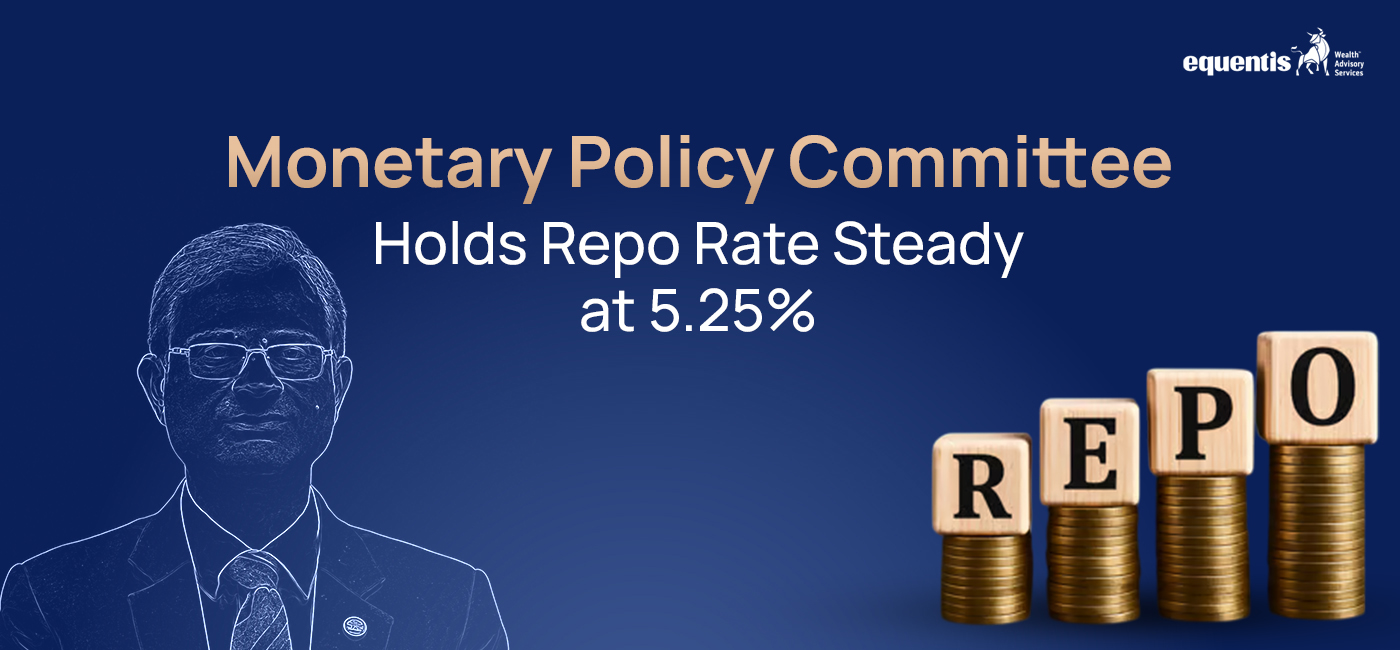
The Monetary Policy Committee (MPC) has decided to keep the repo rate unchanged at 5.25%, signaling a cautious approach toward balancing economic growth and inflation. While the decision provides stability for borrowers and businesses by preventing an immediate increase in borrowing costs, it also reflects the Reserve Bank of India’s continued focus on inflation management amid global uncertainties. For investors, consumers, and businesses, the unchanged repo rate offers clarity on the interest rate environment and may influence decisions related to loans, investments, savings, and spending in the months ahead.
Introduction
As investors track the performance of Large Cap Stocks and Mid Cap Stocks amid changing economic conditions, one of the most closely watched events is the Reserve Bank of India’s monetary policy announcement. Interest rate decisions influence everything from home loan EMIs and business borrowing costs to stock market sentiment and economic growth.
In its latest meeting, the Monetary Policy Committee has chosen to keep the repo rate unchanged at 5.25%. While the move may appear routine, it carries significant implications for households, businesses, banks, and financial markets.
The decision comes at a time when policymakers are navigating a complex economic environment marked by inflation concerns, global trade uncertainties, fluctuating commodity prices, and the need to support India’s growth momentum. Understanding why the MPC maintained the status quo and what it means for different stakeholders can help investors and consumers make better financial decisions.
What Is the Repo Rate?
Before examining the MPC’s decision, it is important to understand what the repo rate represents.
The repo rate is the interest rate at which commercial banks borrow funds from the Reserve Bank of India (RBI) against government securities.
In simple terms, it acts as a benchmark interest rate for the economy.
When the RBI increases the repo rate:
- Borrowing becomes more expensive.
- Loan interest rates may rise.
- Spending and demand can slow down.
- Inflationary pressures may reduce.
When the RBI lowers the repo rate:
- Borrowing becomes cheaper.
- Businesses and consumers may spend more.
- Economic activity can increase.
- Inflation may rise if demand grows too quickly.
Because of this relationship, the repo rate is one of the RBI’s most powerful monetary policy tools.
Understanding the Monetary Policy Committee
The Monetary Policy Committee is responsible for setting India’s benchmark interest rates.
The committee consists of six members:
- Three members from the RBI.
- Three external members appointed by the government.
The MPC evaluates multiple economic indicators before deciding whether to raise, reduce, or maintain policy rates.
Some of the factors considered include:
- Inflation trends
- GDP growth
- Employment conditions
- Global economic developments
- Commodity prices
- Currency movements
- Financial market stability
The objective is to maintain price stability while supporting economic growth.
Why Did the MPC Keep the Repo Rate Unchanged?
The decision to maintain the repo rate at 5.25% reflects a balancing act between inflation control and growth support.
Inflation Remains a Key Concern
Although inflation has moderated from previous peaks, policymakers remain cautious.
Food prices, weather-related disruptions, energy costs, and global supply chain developments continue to pose risks.
An immediate rate cut could potentially increase demand and create fresh inflationary pressures.
Therefore, maintaining the current rate allows the RBI to monitor inflation trends before taking further action.
Growth Momentum Remains Healthy
India continues to be among the faster-growing major economies globally.
Consumption demand, government infrastructure spending, manufacturing activity, and services sector growth have supported economic expansion.
Keeping rates unchanged allows growth momentum to continue without adding unnecessary borrowing pressure.
Global Economic Uncertainty
Central banks around the world continue to monitor inflation, interest rates, and economic growth.
Geopolitical tensions, trade policies, and commodity price volatility remain sources of uncertainty.
Maintaining policy stability helps India navigate external risks while preserving financial stability.
Stable Financial Conditions
The current interest rate environment has helped maintain relatively stable financial conditions.
The RBI may prefer to observe additional economic data before altering its policy stance.
What Does the Repo Rate Decision Mean for Borrowers?
For borrowers, the unchanged repo rate is generally a positive development.
Home Loan Borrowers
Individuals with floating-rate home loans may see no immediate change in their EMIs.
This stability helps families plan their finances more effectively.
Those considering buying a house can continue evaluating financing options without worrying about sudden increases in borrowing costs.
Personal Loan Customers
Interest rates on personal loans are unlikely to experience significant changes in the near term.
Banks may continue offering competitive lending rates depending on their funding costs and business strategies.
Auto Loan Borrowers
Consumers planning vehicle purchases may benefit from stable financing conditions.
Predictable loan costs can support purchasing decisions in the automobile sector.
Impact on Businesses
Businesses across sectors closely monitor interest rate movements.
Lower Financing Uncertainty
Stable policy rates provide clarity for companies planning investments and expansion projects.
Businesses can estimate future borrowing costs more accurately.
Capital Expenditure Planning
Companies considering capacity expansion, technology upgrades, or infrastructure investments may find it easier to proceed when interest rates remain predictable.
Support for Small and Medium Enterprises
SMEs often rely heavily on bank financing.
An unchanged repo rate reduces the risk of sudden increases in borrowing costs.
Impact on Banks
Banks play a crucial role in transmitting monetary policy changes to the broader economy.
Lending Rates May Remain Stable
Banks may maintain existing lending rates unless liquidity conditions change significantly.
Deposit Rates Could Stabilize
Customers may see limited changes in fixed deposit rates and savings account returns in the short term.
Focus on Credit Growth
Stable interest rates may encourage banks to focus on expanding loan books and improving credit penetration.
What Does It Mean for Stock Markets?
The stock market often reacts strongly to monetary policy announcements.
Positive for Equity Markets
A stable interest rate environment generally supports investor confidence.
Companies benefit from predictable financing costs, which can improve earnings visibility.
Impact on Large Cap Stocks
Large Cap Stocks often perform well during periods of monetary stability because investors view them as relatively resilient amid economic uncertainty.
Banks, infrastructure companies, consumer businesses, and industrial firms may benefit from stable borrowing conditions.
Impact on Mid Cap Stocks
Mid Cap Stocks can also benefit because many growth-oriented businesses rely on external financing for expansion.
Stable rates reduce financial pressure and may support future growth plans.
Sector-Specific Impact
Certain sectors are particularly sensitive to interest rates:
- Banking
- Real estate
- Automobile
- Infrastructure
- Consumer discretionary
Stable rates can provide a supportive environment for these industries.
Impact on Fixed Income Investors
Bond investors closely track interest rate decisions.
Bond Yields
When rates remain unchanged, bond yields often adjust based on future expectations rather than current policy action.
Fixed Deposits
FD investors may not see significant changes in interest rates immediately.
Banks are likely to maintain current deposit pricing strategies.
Debt Mutual Funds
Debt fund performance will depend on future interest rate expectations and market yield movements.
Opportunities Emerging from the MPC Decision
Economic Stability
Stable interest rates contribute to economic predictability, which supports investment and business activity.
Consumer Confidence
Households may feel more confident making large purchases when borrowing costs remain stable.
Corporate Expansion
Businesses can continue long-term planning without immediate concerns about rising financing costs.
Investment Planning
Investors can make portfolio decisions with greater clarity regarding the interest rate environment.
Risks Investors Should Watch
Although the decision offers stability, risks remain.
Inflation Surprises
Unexpected increases in inflation could force future policy tightening.
Global Commodity Prices
Oil and commodity price volatility can affect inflation and economic growth.
Geopolitical Developments
International conflicts and trade disruptions can influence economic conditions.
Currency Volatility
Sharp movements in currency markets can impact imports, exports, and inflation.
Global Interest Rate Trends
Actions by major central banks worldwide may influence capital flows and financial markets.
What Could Happen Next?
Future monetary policy decisions will largely depend on incoming economic data.
Key indicators to monitor include:
- Consumer inflation
- Food inflation
- GDP growth
- Industrial production
- Employment trends
- Global economic developments
- Crude oil prices
If inflation remains under control, policymakers may gain greater flexibility in future meetings.
However, if inflationary pressures re-emerge, the RBI may maintain a cautious approach.
How Should Investors Respond?
Investors should avoid making decisions solely based on one policy announcement.
Instead, they should focus on:
- Asset allocation
- Long-term financial goals
- Risk tolerance
- Portfolio diversification
For equity investors, sectors benefiting from economic growth and stable financing conditions may remain attractive.
For fixed-income investors, understanding future interest rate expectations remains important.
Most importantly, investors should view monetary policy decisions as one component of a broader economic picture rather than a standalone investment signal.
Conclusion
The Monetary Policy Committee’s decision to keep the repo rate unchanged at 5.25% reflects a measured approach to balancing growth and inflation concerns. The move provides stability for borrowers, businesses, banks, and investors while allowing policymakers additional time to assess evolving economic conditions.
For households, stable borrowing costs offer financial predictability. For businesses, the decision supports investment planning and expansion efforts. For investors, it reinforces the importance of monitoring economic trends, inflation dynamics, and future policy signals.
While the current rate environment remains supportive, future decisions will depend on inflation trends, domestic growth performance, global developments, and financial market conditions. As India continues its growth journey, monetary policy will remain a critical tool in maintaining economic stability and supporting sustainable development.
FAQs
1. What is the repo rate?
The repo rate is the interest rate at which commercial banks borrow money from the Reserve Bank of India against government securities.
2. Why did the MPC keep the repo rate at 5.25%?
The MPC maintained the rate to balance inflation management with economic growth while monitoring global and domestic economic developments.
3. How does the repo rate affect home loan EMIs?
Changes in the repo rate can influence lending rates. An unchanged repo rate generally means no immediate impact on floating-rate home loan EMIs.
4. What is the role of the Monetary Policy Committee?
The MPC determines India’s benchmark interest rates with the objective of maintaining price stability and supporting economic growth.
5. How does the repo rate affect inflation?
Higher repo rates can reduce inflation by making borrowing costlier, while lower rates can increase demand and potentially raise inflation.
6. Is an unchanged repo rate positive for stock markets?
Generally, stable interest rates support market confidence because businesses face predictable borrowing costs.
7. Which sectors benefit from stable interest rates?
Banking, real estate, automobiles, infrastructure, and consumer sectors often benefit from a stable rate environment.
8. How does the repo rate impact fixed deposits?
Repo rate changes can influence bank deposit rates over time, though transmission may vary across institutions.
9. What economic indicators influence MPC decisions?
The MPC considers inflation, GDP growth, employment, commodity prices, global developments, liquidity conditions, and financial stability.
10. What should investors watch after the latest MPC decision?
Investors should monitor inflation data, economic growth trends, RBI commentary, global interest rates, crude oil prices, and future monetary policy guidance.
Disclaimer Note: The securities quoted, if any, are for illustration only and are not recommendatory. This article is for education purposes only and shall not be considered as a recommendation or investment advice by Equentis. We will not be liable for any losses that may occur. Investments in the securities market are subject to market risks. Read all the related documents carefully before investing. Registration granted by SEBI, membership of BASL & certification from NISM in no way guarantee the performance of the intermediary or provide any assurance of returns to investors.

Jaspreet Singh Arora is the Chief Investment Officer at Equentis, where he heads a seasoned team of equity analysts and turns two decades of market experience into portfolios that consistently beat the benchmark. A go-to voice on cement, building-materials, real-estate, and construction stocks, Jaspreet previously ran research desks at leading brokerages, honing an eye for the metrics that truly move share prices. His plain-spoken analysis helps investors cut through noise and act with conviction. When he’s not deep-diving into earnings calls, you’ll find him unwinding over sports, weekend cricket or a good history podcast.