

Summary
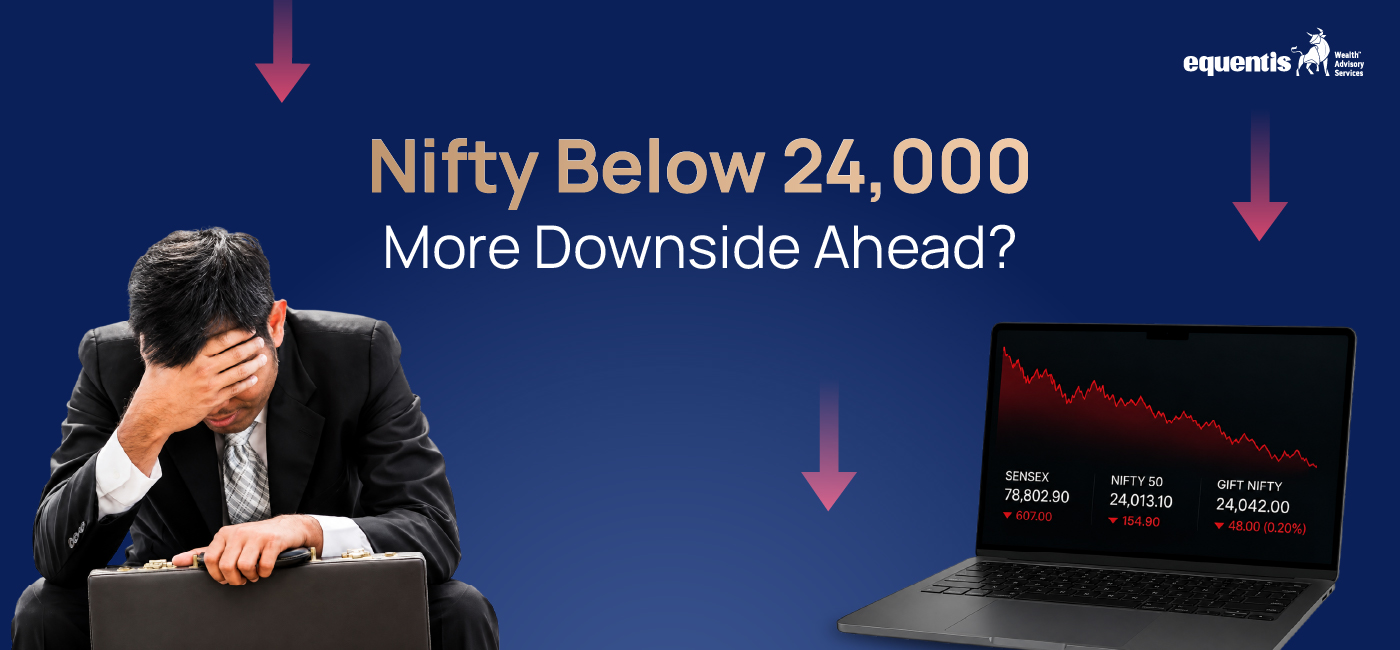
The Nifty has slipped below the 24,000 mark, raising concerns about whether the market could see further downside in the coming sessions. While the decline reflects a mix of global uncertainties, cautious investor sentiment, profit booking, and sector-specific weakness, it does not necessarily signal a prolonged bear market. The market’s next move will depend on corporate earnings, foreign investor activity, global economic developments, and domestic macroeconomic indicators. Investors should focus on fundamentals rather than reacting to short-term volatility.
Why Is the Nifty Below 24,000?
The Indian stock market has entered another phase of volatility, with the Nifty falling below the psychologically important 24,000 level. Such milestones often attract attention because they influence both investor sentiment and trading strategies.
While a decline of this nature may appear worrying, markets frequently move through periods of correction after strong rallies. Today’s weakness reflects several interconnected factors rather than a single trigger.
Investors are currently weighing quarterly earnings, global market trends, inflation concerns, interest rate expectations, and foreign institutional investor (FII) activity before making fresh investment decisions.
Understanding the Bigger Picture
Stock markets are influenced by a combination of economic, corporate, and global developments. Even when domestic fundamentals remain stable, international events can impact investor confidence.
In recent sessions, uncertainty has increased due to:
- Weak global equity markets.
- Mixed corporate earnings.
- Profit booking after recent gains.
- Uncertainty over global interest rates.
- Fluctuations in crude oil prices.
- Cautious FII participation.
These factors have collectively created selling pressure across benchmark indices, leading the Nifty below the 24,000 level.
It is worth remembering that market corrections are a natural part of long-term investing and often occur after periods of sustained upward movement.
Key Factors Behind the Market Weakness
Profit Booking Continues
One of the primary reasons behind the recent decline is profit booking.
After months of gains, many investors have chosen to lock in profits, particularly in large-cap stocks that had seen strong price appreciation.
This selling has weighed on the benchmark index even as some sectors continue to show resilience.
Global Uncertainty Remains High
Global markets continue to react to inflation data, central bank policy expectations, geopolitical developments, and slowing economic growth in several regions.
Since India is closely connected with global financial markets, overseas weakness often affects domestic investor sentiment.
Quarterly Earnings Are Driving Stock-Specific Moves
The ongoing earnings season has led to increased volatility.
Companies delivering results above expectations have generally witnessed buying interest, while weaker-than-expected earnings have resulted in sharp corrections.
This divergence has increased overall market uncertainty.
Foreign Investor Activity
Foreign Institutional Investors remain one of the key drivers of Indian equities.
Any sustained selling by FIIs can put pressure on benchmark indices, especially when domestic investors become cautious.
On the other hand, renewed FII buying could improve market sentiment.
Technical Levels Matter
The 24,000 mark is considered an important psychological and technical level for the Nifty.
A sustained move below this level may encourage additional short-term selling by traders. However, if buying emerges near support zones, markets could stabilise and attempt a recovery.
Technical levels should always be viewed alongside fundamental developments rather than in isolation.
Which Sectors Are Feeling the Pressure?
Today’s weakness has not been limited to a single sector.
Selling pressure has been visible across several major industries, including:
- Banking
- Financial Services
- Information Technology
- Auto
- Metals
Meanwhile, sectors such as pharmaceuticals and consumer staples have shown relatively better resilience, reflecting a defensive shift in investor preferences.
Sector rotation is common during periods of uncertainty as investors rebalance portfolios.
What Does This Mean for Investors?
Market corrections often test investor confidence, particularly among those who closely follow daily market movements.
However, experienced investors typically focus on long-term fundamentals rather than short-term volatility.
Some practical considerations include:
- Reviewing portfolio allocation.
- Staying invested according to financial goals.
- Continuing systematic investment plans (SIPs), where appropriate.
- Avoiding panic selling based solely on market headlines.
- Monitoring company earnings and business fundamentals.
Volatility can be uncomfortable, but it also reminds investors that equity investing involves both opportunities and risks.
Is More Downside Ahead?
This is the question many investors are asking.
The answer depends on how several factors evolve over the coming weeks.
Markets may remain under pressure if:
- Global markets continue to weaken.
- Corporate earnings disappoint expectations.
- FIIs continue selling.
- Crude oil prices remain elevated.
- Inflation concerns increase.
- Interest rate expectations become less favourable.
However, markets could also stabilise if earnings improve, global sentiment strengthens, and domestic economic indicators remain supportive.
Rather than focusing on predicting exact market levels, investors may benefit more from maintaining a disciplined investment approach.
Opportunities and Risks
Potential Opportunities
Corrections often encourage investors to identify fundamentally strong companies that may be trading at more reasonable valuations.
Long-term investors may use periods of volatility to gradually build positions while maintaining diversification across sectors.
Companies with consistent earnings, healthy balance sheets, and sustainable business models often attract investor interest during uncertain periods.
Risks to Monitor
Several uncertainties remain.
Global geopolitical developments, inflation, crude oil prices, currency fluctuations, central bank decisions, and corporate earnings could all influence market direction.
Investors should therefore avoid making decisions based purely on short-term market movements and instead evaluate the broader economic picture.
Conclusion
The Nifty falling below 24,000 reflects increased caution in the market rather than a clear indication of a prolonged downturn. Profit booking, mixed earnings, global uncertainties, and cautious investor sentiment have all contributed to recent weakness.
Whether further downside lies ahead will depend on upcoming earnings, foreign investor flows, global economic developments, and domestic macroeconomic indicators.
For investors, the focus should remain on disciplined investing, diversification, and company fundamentals instead of reacting to daily market fluctuations. While volatility may continue in the near term, maintaining a long-term perspective can help navigate uncertain market conditions more effectively.
Frequently Asked Questions (FAQs)
1. Why did the Nifty fall below 24,000?
The Nifty slipped below 24,000 due to a combination of global market weakness, profit booking, mixed corporate earnings, and cautious investor sentiment.
2. Does Nifty below 24,000 mean a bear market has started?
Not necessarily. A move below 24,000 indicates market weakness, but a bear market depends on sustained declines driven by broader economic and corporate factors.
3. Can the Nifty fall further from current levels?
Further downside is possible if global uncertainties persist, corporate earnings disappoint, or foreign investors continue selling. However, markets can also recover if sentiment improves.
4. Which sectors are under pressure?
Banking, financial services, IT, auto, and metal stocks have experienced notable selling pressure during the recent decline.
5. How do foreign investors affect the Nifty?
Foreign Institutional Investors influence market liquidity and sentiment. Large buying or selling by FIIs often impacts benchmark indices.
6. Should investors stop SIPs during market corrections?
Many long-term investors continue SIPs during corrections, as market declines can allow investments at relatively lower prices. Individual financial goals should guide decisions.
7. Is this a good time to invest in stocks?
Investment decisions should be based on company fundamentals, valuation, financial goals, and risk tolerance rather than short-term market movements.
8. What factors could help the market recover?
Strong corporate earnings, improved global sentiment, stable crude oil prices, supportive economic data, and renewed FII buying could support market recovery.
9. Why is the 24,000 level important for the Nifty?
It is viewed as a key psychological and technical level that traders and investors closely monitor for potential support or resistance.
10. What should investors watch in the coming weeks?
Key indicators include quarterly earnings, FII activity, inflation data, crude oil prices, central bank decisions, and global market trends.
Disclaimer Note: The securities quoted, if any, are for illustration only and are not recommendatory. This article is for education purposes only and shall not be considered as a recommendation or investment advice by Equentis. We will not be liable for any losses that may occur. Investments in the securities market are subject to market risks. Read all the related documents carefully before investing. Registration granted by SEBI, membership of BASL & certification from NISM in no way guarantee the performance of the intermediary or provide any assurance of returns to investors.

Parvati Rai is the Vice President of the Research team at Equentis. She has over 15 years of equity-research and strategy-consulting experience. A specialist in deep-dive valuations, financial modelling, and forecasting, she has built research desks from the ground up, by steering buy-side, sell-side, and independent coverage across sectors. When she isn’t fine-tuning models, Parvati unwinds on nature treks and mentors aspiring analysts.










