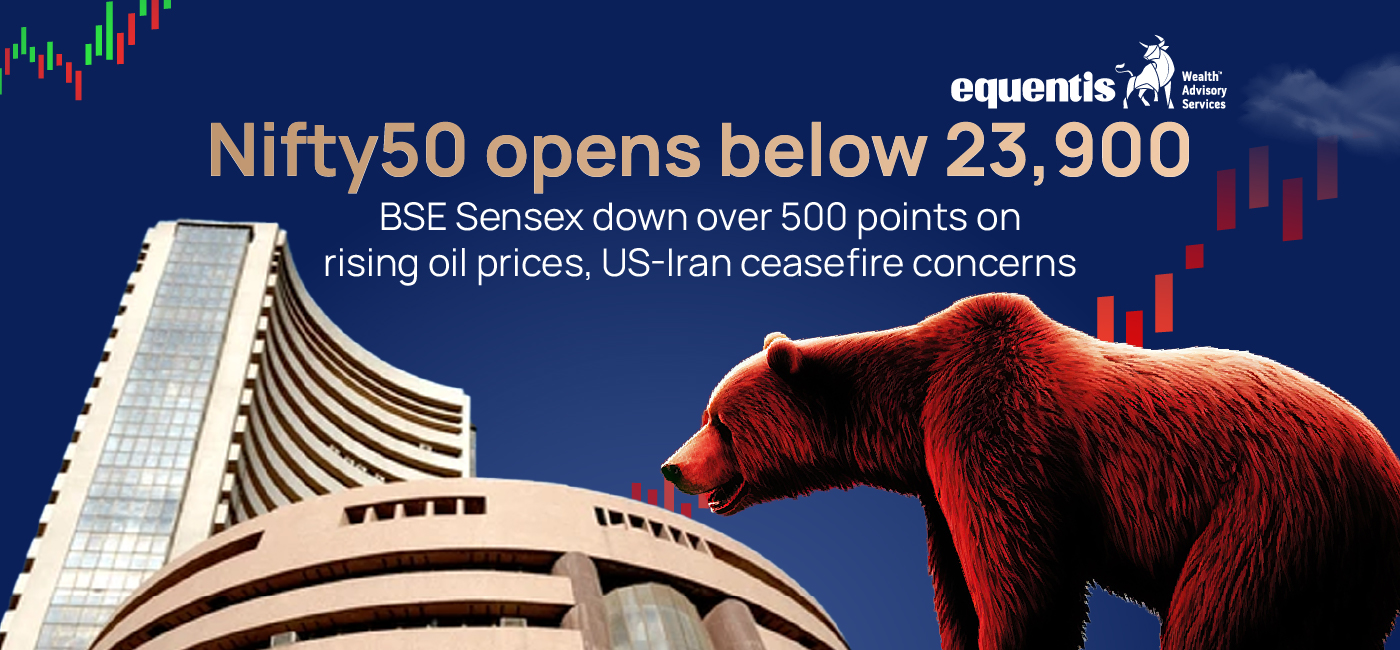

The Indian stock market started the day on a weak note, with the Nifty50 opening below 23,900 and the BSE Sensex dropping over 500 points. The key trigger behind this decline is the sharp rise in global oil prices, coupled with uncertainty surrounding a potential US-Iran tensions ceasefire situation. These global factors have increased market volatility, leading to cautious investor sentiment and selling pressure across sectors.
Why This Market Fall Matters Today
Market movements like these are not just daily fluctuations. They reflect how interconnected global events and domestic markets have become.
When indices like the Nifty50 and Sensex fall sharply at the opening bell, it signals broader concerns. For investors, this can impact portfolio values. For businesses, it may influence funding conditions. And for the overall economy, it highlights sensitivity to global developments.
The combination of rising oil prices and geopolitical uncertainty is particularly important for India, given its dependence on crude imports.
The Bigger Picture: Oil Prices and Global Tensions
To understand today’s market movement, it is essential to look beyond domestic factors.
Rising Oil Prices
Oil prices have surged due to concerns over supply disruptions in the Middle East. Any instability in this region directly affects global crude supply.
For India, higher oil prices mean:
- Increased import bills
- Pressure on inflation
- Potential weakening of the rupee
- Higher costs for businesses and consumers
US-Iran Geopolitical Concerns
The uncertainty around ceasefire developments between the US and Iran has added another layer of risk. Markets generally react negatively to geopolitical instability because it creates unpredictability.
Even the possibility of escalation or prolonged uncertainty can trigger risk-off sentiment among global investors.
Key Developments Driving the Market Today
1. Weak Global Cues
Asian markets and global indices have shown cautious trends, influencing Indian equities at the open.
2. Selling in Key Sectors
Sectors like IT, banking, and oil-sensitive industries have witnessed selling pressure.
3. Volatility Spike
Investor sentiment has turned cautious, leading to increased volatility and lower risk appetite.
4. Foreign Investor Activity
Foreign institutional investors often react quickly to global cues, and outflows can amplify market declines.
Impact on Investors and the Economy
For Equity Investors
Short-term declines can impact portfolio values, especially for those heavily invested in large-cap stocks.
For Retail Investors
Market dips often create anxiety, but they are also part of normal market cycles.
For Businesses
Rising oil prices increase operational costs, especially for sectors like aviation, logistics, and manufacturing.
For the Economy
Persistent high oil prices can lead to inflationary pressures, which may influence monetary policy decisions by the Reserve Bank of India.
Opportunities Emerging from Market Corrections
Market corrections, while uncomfortable, can present opportunities.
1. Entry Points for Long-Term Investors
Quality stocks may become available at more reasonable valuations during dips.
2. Sector Rotation Opportunities
Some sectors, such as energy producers, may benefit from rising oil prices.
3. SIP Advantage
Investors using systematic investment plans can benefit from rupee cost averaging during volatile phases.
4. Focus on Fundamentals
Corrections often shift attention back to company fundamentals rather than short-term momentum.
Risks Investors Should Watch Closely
Prolonged Oil Price Rally
If oil prices remain elevated, it could sustain pressure on markets and inflation.
Escalation of Geopolitical Tensions
Any worsening of US-Iran relations can further unsettle global markets.
Currency Volatility
A weaker rupee can impact import costs and corporate earnings.
Policy Response
If inflation rises significantly, it could influence interest rate decisions, affecting market liquidity.
How Should Investors Respond
In such situations, reacting emotionally can do more harm than good.
Instead, investors can consider:
- Staying invested with a long-term perspective
- Avoiding panic selling during market dips
- Reviewing asset allocation and diversification
- Monitoring global cues alongside domestic fundamentals
Market volatility is not new, and historically, disciplined investors have navigated such phases successfully.
What Lies Ahead for the Indian Markets
The near-term direction of the market will largely depend on:
- Movement in global oil prices
- Developments in US-Iran relations
- Inflation trends in India
- Policy stance of central banks
If geopolitical tensions ease and oil prices stabilize, markets could recover gradually. However, continued uncertainty may keep volatility elevated.
Conclusion
The fall in the Nifty50 and Sensex reflects the immediate impact of rising oil prices and geopolitical uncertainty. While such declines can be unsettling, they are a natural part of market cycles influenced by global events.
For investors, the key is to stay informed, remain patient, and focus on long-term goals rather than short-term fluctuations. Opportunities often emerge during periods of uncertainty, but they require careful evaluation and a disciplined approach.
As global developments unfold, markets will continue to react. Understanding the underlying factors can help investors navigate these movements with greater confidence.
FAQs
1. Why did the Nifty50 fall below 23,900?
Due to rising oil prices and global geopolitical concerns.
2. Why is the Sensex down over 500 points?
Selling pressure driven by weak global cues and investor caution.
3. How do oil prices affect the stock market?
Higher oil prices increase costs and inflation, impacting corporate profits.
4. What is the impact of US-Iran tensions on markets?
They create uncertainty, leading to volatility and risk-off sentiment.
5. Should investors panic during such falls?
No, market corrections are a normal part of investing.
6. Which sectors are most affected?
Oil-sensitive sectors like aviation, logistics, and manufacturing.
7. Can rising oil prices impact inflation?
Yes, they can increase overall price levels in the economy.
8. What should long-term investors do?
Stay invested and focus on fundamentals.
9. Is this a good time to invest?
It can be an opportunity if valuations become attractive.
10. How do foreign investors impact markets?
Their buying or selling can influence market direction significantly.
11. Will the market recover soon?
Recovery depends on global and domestic factors.
12. What is the role of RBI in such situations?
To manage inflation and maintain economic stability.
13. How does a weak rupee affect markets?
It increases import costs and can impact earnings.
14. What is market volatility?
Frequent and sharp price movements in the market.
15. Are such declines common?
Yes, markets often react to global developments.
16. What is a correction in the market?
A temporary decline in stock prices.
17. How can investors manage risk?
Through diversification and disciplined investing.
18. What are safe investment options during volatility?
Diversified portfolios and systematic investments.
19. Can geopolitical events impact long-term markets?
Yes, but their impact may vary over time.
20. What is the key takeaway from this fall?
Global factors play a major role in market movements.
Disclaimer Note: The securities quoted, if any, are for illustration only and are not recommendatory. This article is for education purposes only and shall not be considered as a recommendation or investment advice by Equentis – Research & Ranking. We will not be liable for any losses that may occur. Investments in the securities market are subject to market risks. Read all the related documents carefully before investing. Registration granted by SEBI, membership of BASL & certification from NISM in no way guarantee the performance of the intermediary or provide any assurance of returns to investors.

Parvati Rai is the Vice President of the Research team at Equentis. She has over 15 years of equity-research and strategy-consulting experience. A specialist in deep-dive valuations, financial modelling, and forecasting, she has built research desks from the ground up, by steering buy-side, sell-side, and independent coverage across sectors. When she isn’t fine-tuning models, Parvati unwinds on nature treks and mentors aspiring analysts.