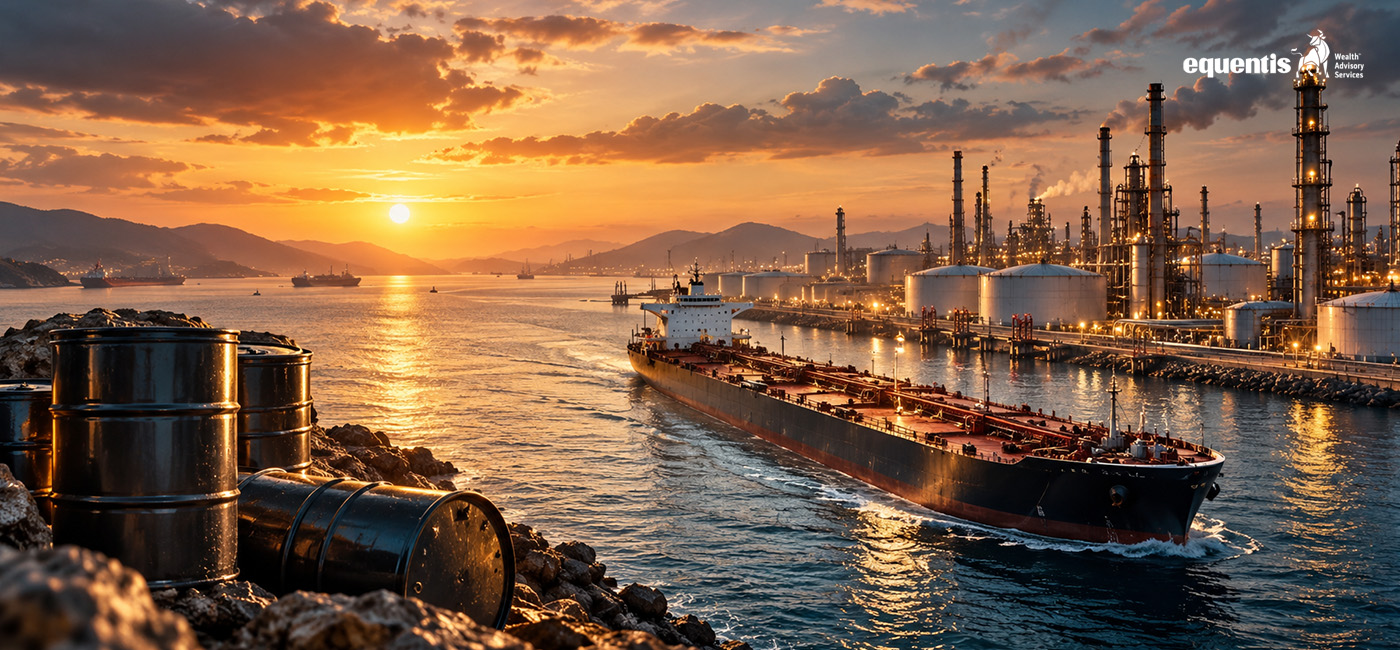

Oil prices surged sharply on October 8, with Brent crude crossing $102 a barrel, as attacks on oil tankers in the Gulf and rising tensions involving Iran increased fears of supply disruptions through the Strait of Hormuz. Brent rose to around $102.28 a barrel, while West Texas Intermediate climbed close to $90. For India, the move matters because the country imports nearly 90% of its crude oil requirements, making a prolonged oil shock a potential risk for inflation, the rupee, fuel costs and corporate earnings.
Why Are Oil Prices Rising?
The latest oil price surge is primarily linked to growing concerns about the security of crude oil shipments through the Strait of Hormuz.
The waterway is one of the world’s most important energy chokepoints. Around one-fifth of global oil shipments have historically passed through the strait, meaning even the possibility of a prolonged disruption can cause traders to price in a supply risk. Recent attacks on tankers have increased those concerns.
A tanker was recently attacked near Qatar, while shipping activity has faced increasing security risks in the region. Iran has also announced restrictions affecting alternative transit routes, adding to uncertainty around the movement of oil and other energy products.
Markets generally react to the possibility of lost supply before an actual shortage occurs. This is why geopolitical tensions can push crude prices higher even when physical supplies have not yet fallen by the same amount.
What Is Happening in the Strait of Hormuz?
The Strait of Hormuz connects the Persian Gulf with the Gulf of Oman and the Arabian Sea. It is a critical route for oil-producing countries including Saudi Arabia, Iraq, the UAE, Kuwait and Qatar.
For oil markets, the concern is not simply whether ships can physically pass through the strait. Higher insurance premiums, longer shipping routes, security escorts and delays can all increase the cost of transporting crude.
Recent attacks have therefore increased what is known as the geopolitical risk premium in oil prices. Traders are effectively paying more because the possibility of disruption has become harder to ignore.
Why Does $102 Brent Matter for India?
India is particularly sensitive to global crude prices because of its high import dependence. PPAC data show India’s crude oil import dependency was around 88.7% in FY2025-26.
A sustained increase in crude prices can affect India through several channels.
First, a higher import bill can put pressure on the country’s current account and foreign exchange requirements. Second, expensive crude can add pressure to inflation if higher energy and transportation costs eventually pass through to consumers.
The impact can also be felt by businesses. Airlines, logistics companies, paint manufacturers, chemicals producers and other fuel-intensive industries may face higher operating costs if crude remains elevated.
Will Petrol and Diesel Prices Rise in India?
A rise in international crude prices does not automatically translate into an immediate increase in petrol and diesel prices in India.
Domestic fuel prices depend on several factors, including international product prices, crude procurement costs, currency movements, taxes, refining margins and the pricing decisions of oil marketing companies.
However, if crude prices remain elevated for an extended period, pressure on domestic fuel economics can increase. Higher transportation costs can also gradually affect the prices of goods and services across the economy.
For Indian consumers, the duration of the oil shock is therefore more important than a single day’s movement in Brent crude.
Impact on the Indian Stock Market
Rising crude prices can create mixed effects across Indian equities.
Oil marketing companies, airlines, paints, tyres, chemicals and other energy-intensive businesses may face margin pressure if higher input costs cannot be passed on quickly.
On the other hand, upstream oil producers can benefit from higher crude prices because their realised prices may increase. The impact on individual companies, however, depends on their business model, hedging arrangements and exposure to imported energy.
The broader market can also be affected through inflation and interest-rate expectations. India’s equity markets were already under pressure on October 8, with rising oil prices adding to concerns after the RBI raised the repo rate by 25 basis points to 5.5%.
Could Oil Prices Rise Further?
The next direction for crude prices will depend heavily on developments around the Middle East and the actual flow of oil through Hormuz.
If tanker attacks continue and shipping disruptions become more widespread, the supply risk premium could remain elevated. A significant reduction in actual oil exports through the strait could create a much larger shock.
However, there are also factors that could limit the increase. India and other major importers have diversified crude suppliers, while strategic reserves and alternative shipping routes can provide some cushion.
India has also increased the share of crude sourced through routes outside Hormuz. Government officials said earlier this year that around 70% of India’s crude imports had been secured from outside the strait, highlighting the country’s efforts to diversify supply.
Opportunities and Risks for Investors
Higher oil prices create both risks and potential beneficiaries.
Companies that rely heavily on crude, fuel or petrochemical feedstock could see costs rise. Airlines and transport businesses are particularly sensitive because fuel represents a significant operating expense.
Meanwhile, upstream oil and gas producers can potentially benefit from stronger crude prices. Some refining companies may also benefit depending on the relationship between crude costs and refined product prices.
For investors, however, the important factor is not simply whether oil crosses $100. The duration of elevated prices, currency movements, company-specific hedging and the ability to pass higher costs to customers will determine the actual financial impact.
What Should Investors Watch Next?
Three developments will be particularly important.
First, investors should track whether oil shipments through the Strait of Hormuz remain disrupted or continue despite the attacks.
Second, the market will watch actual crude inventories and production levels. A geopolitical threat becomes more significant when it begins creating a measurable supply shortage.
Third, Indian investors should monitor the rupee, inflation expectations and corporate earnings. A combination of expensive crude and a weaker rupee could increase India’s imported inflation pressure.
Conclusion
The Brent crude price crossing $102 reflects growing concern over the security of oil supplies amid tanker attacks and escalating Iran-related tensions. The Strait of Hormuz remains central to the outlook because any sustained disruption could affect global energy flows and transportation costs.
For India, the risk is particularly important because of the country’s high dependence on imported crude. While diversified sourcing and alternative routes provide some protection, a prolonged oil shock could still affect inflation, the rupee, fuel costs and corporate profitability. Investors should therefore focus less on one day’s crude price and more on whether supply disruptions persist and how they feed into the Indian economy.
Frequently Asked Questions
1. Why are oil prices rising above $100 per barrel?
Oil prices are rising because attacks on tankers in the Gulf and growing tensions involving Iran have increased fears of disruptions to crude shipments through the Strait of Hormuz. Brent crude crossed $102 on October 8, 2026, as traders priced in a higher risk of supply constraints and increased shipping costs.
2. Why is the Strait of Hormuz important for oil prices?
The Strait of Hormuz is a major global oil transportation chokepoint. A large share of international oil shipments passes through the waterway. Any disruption can increase concerns about supply availability, shipping delays and insurance costs, which can push crude prices higher even before a physical shortage develops.
3. How does higher crude oil affect India?
Higher crude prices can increase India’s import bill because the country relies heavily on imported oil. Expensive crude can also create inflationary pressure, affect the rupee and increase operating costs for fuel-intensive businesses. The impact depends on how long crude remains elevated and how much of the increase is passed through to consumers.
4. Will petrol and diesel prices increase because Brent crossed $100?
Not necessarily immediately. Indian fuel prices depend on several factors, including international petroleum product prices, crude costs, currency movements, taxes, refining margins and oil marketing company pricing decisions. A short-term rise in Brent does not automatically result in an equivalent change in domestic petrol or diesel prices.
5. What happens if the Strait of Hormuz is disrupted?
A prolonged disruption could reduce or delay global oil shipments and increase transportation and insurance costs. Countries that depend heavily on Middle Eastern crude could face greater supply pressure. Alternative routes and suppliers can provide some relief, but they may not have enough capacity to completely replace disrupted flows quickly.
6. How dependent is India on imported crude oil?
India’s crude oil import dependency was approximately 88.7% in FY2025-26, according to data based on Petroleum Planning and Analysis Cell figures. This high dependence means India remains sensitive to major changes in international crude prices and disruptions affecting global energy supply.
7. Which Indian sectors are affected by higher oil prices?
Airlines, logistics, transportation, paints, chemicals, tyres and other energy-intensive sectors can face higher costs when crude prices rise. Oil producers may benefit from stronger crude prices, while refiners can experience different effects depending on crude procurement costs, product prices and refining margins.
8. Can higher crude prices increase inflation in India?
Yes. Higher crude prices can increase transportation, energy and production costs, potentially creating broader inflationary pressure. The final impact depends on the extent and duration of the price increase, currency movements, domestic fuel pricing and how much higher costs are passed through to consumers.
9. Could Brent crude prices fall again?
Yes. Oil prices can move lower if geopolitical tensions ease, shipping through Hormuz remains operational, production increases or concerns about demand weaken. Conversely, further attacks or a significant physical disruption to oil flows could keep prices elevated. The crude market remains highly sensitive to developments in the region.
10. What should Indian investors watch as oil prices rise?
Investors should monitor Brent crude, the rupee-dollar exchange rate, developments around the Strait of Hormuz, India’s inflation data and company earnings. It is also useful to watch sectors with high fuel exposure and businesses that may benefit from stronger crude prices, while assessing each company’s specific financial position and cost structure.
Disclaimer Note: The securities quoted, if any, are for illustration only and are not recommendatory. This article is for education purposes only and shall not be considered as a recommendation or investment advice by Equentis – Research & Ranking. We will not be liable for any losses that may occur. Investments in the securities market are subject to market risks. Read all the related documents carefully before investing. Registration granted by SEBI, membership of BASL & certification from NISM in no way guarantee the performance of the intermediary or provide any assurance of returns to investors.

Parvati Rai is the Vice President of the Research team at Equentis. She has over 15 years of equity-research and strategy-consulting experience. A specialist in deep-dive valuations, financial modelling, and forecasting, she has built research desks from the ground up, by steering buy-side, sell-side, and independent coverage across sectors. When she isn’t fine-tuning models, Parvati unwinds on nature treks and mentors aspiring analysts.