
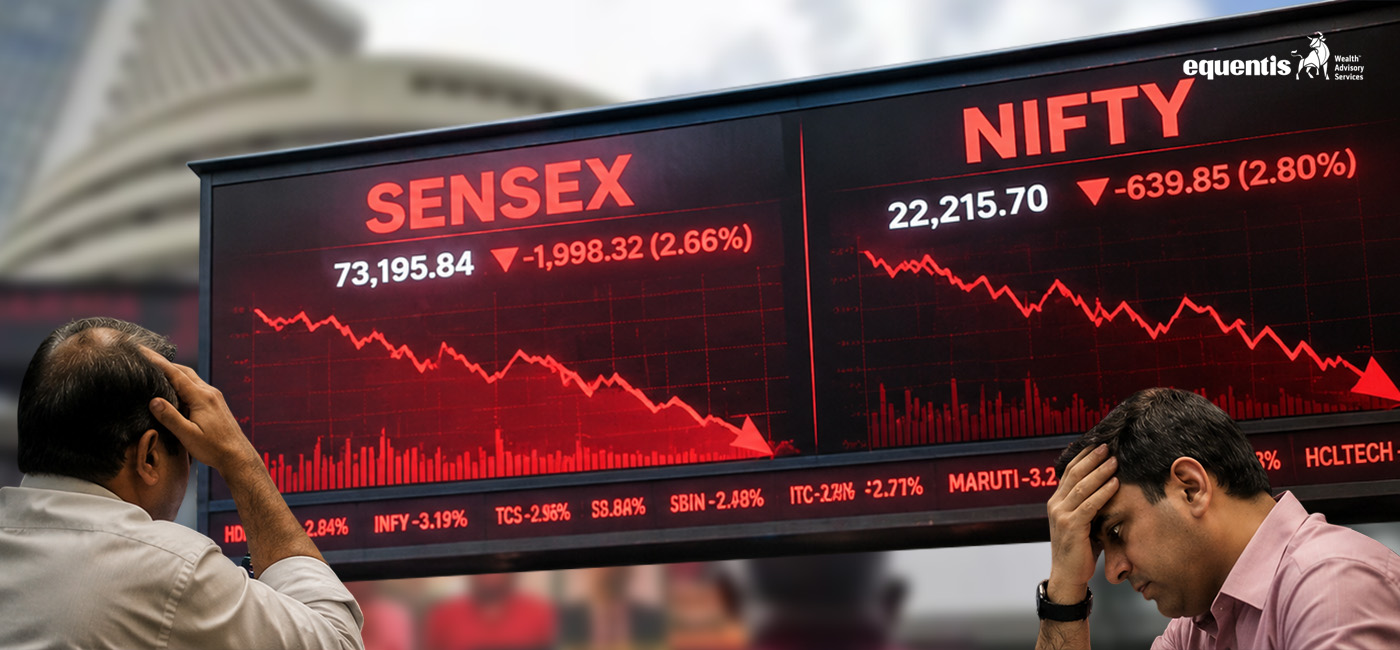

The Indian stock market witnessed selling pressure on November 13, 2026, as the Sensex fell over 450 points and the Nifty 50 slipped below 25,150 amid weakness across multiple sectors. Rising crude oil prices, accelerating retail inflation and concerns over interest rates weighed on investor sentiment, reversing some of the momentum from the recent market rally. NewsDrum+2
Introduction
Indian equity markets turned cautious on Friday as investors reassessed the impact of inflation, expensive crude oil and global uncertainties on the domestic economic outlook. The decline in benchmark indices reflected selling pressure across automobile, banking, information technology and real estate stocks.
The market weakness is particularly significant because it comes after a strong rally during November. Although foreign institutional investors continued buying Indian equities, rising inflation and energy prices emerged as concerns that investors could not ignore.
Sensex and Nifty Fall as Selling Pressure Intensifies
The BSE Sensex and NSE Nifty 50 opened lower and extended their losses during early trading on November 13.
The Sensex declined approximately 450 to 500 points during early trade, while the Nifty 50 slipped below 25,150, approaching the 25,100 level. Both benchmarks faced selling pressure as investors booked profits following recent gains. NewsDrum+1
Market breadth also remained weak, indicating that the decline was not restricted to a handful of heavyweight companies. A larger number of stocks traded lower than higher, reflecting cautious sentiment across the broader equity market.
Why Did the Indian Stock Market Fall Today?
Several factors contributed to the weakness in Indian equities.
1. Rising Crude Oil Prices
Crude oil prices remained elevated, with Brent crude trading around $95 to $96 per barrel amid geopolitical tensions and concerns about disruptions to global energy supplies.
India imports a significant portion of its crude oil requirements. Higher oil prices can increase transportation costs, raise inflationary pressures and put pressure on the country’s import bill.
For companies dependent on fuel, transportation or energy-intensive manufacturing, rising crude prices can affect operating expenses and profitability. Moneycontrol+1
2. Retail Inflation Crosses RBI’s Upper Limit
India’s retail inflation increased to 6.09% in October 2026, moving above the Reserve Bank of India’s upper tolerance limit of 6%.
Higher inflation creates concerns about household purchasing power and the possibility of tighter monetary policy. Investors also assess how rising prices could influence interest rates, borrowing costs and corporate earnings.
This development added another layer of uncertainty to the market outlook. Moneycontrol+1
3. Profit Booking After a Strong Rally
The November rally had supported investor confidence, but sharp gains can encourage traders to book profits.
Profit booking occurs when investors sell shares to realise gains after prices have increased. Such selling can temporarily push indices lower, particularly when valuations have risen or fresh market concerns emerge.
The decline on Friday therefore reflected both profit-taking and concerns about the broader economic environment.
4. Weak Global Market Signals
Overnight weakness in US equities and uncertainty surrounding global technology stocks also influenced investor sentiment.
Global markets remain sensitive to interest rate expectations, geopolitical developments and changes in investor appetite for risk. When international markets turn cautious, Indian equities can experience selling pressure even when domestic fundamentals remain relatively stable. Telangana Today+1
Sectoral Performance: Which Sectors Faced Pressure?
The weakness extended across several major sectors, although healthcare and pharmaceutical stocks showed relative resilience.
Automobile and Realty Stocks Under Pressure
Automobile stocks declined as investors assessed the impact of rising energy prices and broader market weakness. Realty stocks also faced selling pressure, with the Nifty Realty index falling more than 1% during early trading.
Banking and information technology shares also contributed to the decline, reflecting cautious positioning across interest-rate-sensitive and heavyweight sectors. NewsDrum+1
Pharma Stocks Provide Some Support
Pharmaceutical and healthcare stocks moved against the broader market trend.
The Nifty Pharma index gained around 0.5% during early trade, while select healthcare companies also recorded gains.
This relative resilience highlighted how investors may shift towards sectors perceived as less sensitive to certain economic pressures during periods of market uncertainty. NewsDrum+1
Impact on Retail Investors and the Indian Economy
A broad market decline can affect investors differently depending on their investment horizon and portfolio composition.
What Does the Market Decline Mean for Investors?
For retail investors, a falling Sensex or Nifty does not necessarily indicate that every company is experiencing deteriorating fundamentals.
Investors should distinguish between temporary market volatility and changes in a company’s business performance. Short-term price movements can be influenced by global developments, institutional activity and investor sentiment.
For long-term investors, market corrections can serve as a reminder to review portfolio diversification, asset allocation and investment objectives rather than reacting to daily index movements.
Implications for Businesses and Consumers
Higher crude oil prices and inflation can affect businesses through increased transportation, manufacturing and distribution expenses.
Consumers may also experience pressure on household budgets if higher energy costs contribute to rising prices of goods and services.
If inflation remains elevated, borrowing costs could become an important consideration for businesses planning expansion and consumers considering large purchases or loans.
Opportunities and Risks: What Should Investors Watch?
Market corrections can create opportunities for investors to reassess valuations and identify companies with sustainable earnings growth. However, lower share prices alone do not automatically make a stock attractive.
Several developments could influence the market’s direction in the coming sessions:
- Crude oil prices: A sustained decline in oil prices could ease inflation concerns and support market sentiment.
- RBI monetary policy: Investors will closely monitor inflation trends and expectations regarding interest rates.
- Foreign institutional investor activity: Continued foreign buying could provide support to Indian equities.
- Corporate earnings: Upcoming earnings announcements and management commentary may influence stock-specific movements.
- Global markets: Developments in US equities, technology stocks and geopolitical conditions could affect risk appetite.
- Market breadth: A recovery across multiple sectors would provide a clearer indication of improving investor confidence.
The key risk is that persistent inflation, expensive crude oil and higher interest rate expectations could affect corporate profitability and market valuations.
Investors should avoid making investment decisions solely based on one day’s market movement.
Conclusion
The Sensex falling over 450 points and the Nifty slipping below 25,150 on November 13, 2026, reflects a combination of profit booking, rising crude oil prices, inflation concerns and cautious global sentiment. Weakness across automobile, banking, IT and real estate stocks highlighted the pressure on broader market sentiment.
While pharmaceutical and healthcare stocks demonstrated relative resilience, the overall market remained cautious.
The direction of crude oil prices, inflation, RBI policy expectations and institutional investment flows will remain important factors to monitor. For investors, maintaining a disciplined approach and focusing on long-term financial objectives can be more useful than reacting to short-term market fluctuations.
Frequently Asked Questions
1. Why did the Sensex fall over 450 points on November 13, 2026?
The Sensex declined amid rising crude oil prices, higher retail inflation, profit booking after a recent rally and weak global market cues. These factors increased uncertainty regarding interest rates and corporate earnings, prompting investors to reduce exposure to equities.
2. Why did the Nifty 50 fall below 25,150?
The Nifty 50 slipped below 25,150 because selling pressure increased across several major sectors, including automobiles, banking, IT and real estate. Profit booking and concerns about inflation and crude oil prices contributed to the decline.
3. Which sectors were most affected by the stock market decline?
Automobile and real estate stocks experienced significant weakness during early trading. Banking, financial services and IT shares also faced selling pressure. Pharmaceutical and healthcare stocks demonstrated relative resilience against the broader market trend.
4. How do rising crude oil prices affect the Indian stock market?
India imports a substantial share of its crude oil requirements. Higher oil prices can increase transportation costs, fuel inflation and widen the import bill. These developments may affect corporate profitability, consumer spending and investor confidence, putting pressure on equity valuations.
5. What does retail inflation of 6.09% mean for investors?
Retail inflation of 6.09% in October 2026 exceeded the RBI’s upper tolerance limit of 6%. Higher inflation can influence interest rate expectations, borrowing costs and consumption. Investors therefore monitor inflation closely because it can affect economic growth and corporate earnings.
6. Is a falling Sensex a sign of an economic slowdown?
Not necessarily. Stock market declines can result from profit booking, global developments, valuation adjustments or changes in investor sentiment. A sustained economic slowdown generally requires broader evidence, including weaker economic growth, declining consumption and deteriorating corporate earnings.
7. What is profit booking in the stock market?
Profit booking occurs when investors sell securities to realise gains after prices have increased. It can cause temporary declines in stock prices and benchmark indices. Profit booking is a normal part of market activity and does not automatically indicate a long-term bearish trend.
8. How does a falling Nifty affect mutual fund investors?
A falling Nifty can temporarily reduce the market value of equity mutual fund investments. However, the impact depends on the fund’s holdings, sector exposure and investment strategy. Long-term investors should evaluate performance against their investment objectives rather than reacting to individual trading sessions.
9. Can the Indian stock market recover after a sharp decline?
Markets can recover after declines, but the timing and extent of recovery cannot be predicted reliably. Recovery depends on factors such as earnings growth, inflation, interest rates, institutional flows and global sentiment. Investors should avoid assuming that every market correction will be followed by an immediate rebound.
10. What should investors watch after the Sensex and Nifty decline?
Investors should monitor crude oil prices, India’s inflation data, RBI policy expectations, foreign institutional investor activity and corporate earnings. The performance of individual sectors and broader market participation can also help indicate whether selling pressure is easing or continuing.
Disclaimer Note: The securities quoted, if any, are for illustration only and are not recommendatory. This article is for education purposes only and shall not be considered as a recommendation or investment advice by Equentis . We will not be liable for any losses that may occur. Investments in the securities market are subject to market risks. Read all the related documents carefully before investing. Registration granted by SEBI, membership of BASL & certification from NISM in no way guarantee the performance of the intermediary or provide any assurance of returns to investors.

Jaspreet Singh Arora is the Chief Investment Officer at Equentis, where he heads a seasoned team of equity analysts and turns two decades of market experience into portfolios that consistently beat the benchmark. A go-to voice on cement, building-materials, real-estate, and construction stocks, Jaspreet previously ran research desks at leading brokerages, honing an eye for the metrics that truly move share prices. His plain-spoken analysis helps investors cut through noise and act with conviction. When he’s not deep-diving into earnings calls, you’ll find him unwinding over sports, weekend cricket or a good history podcast.