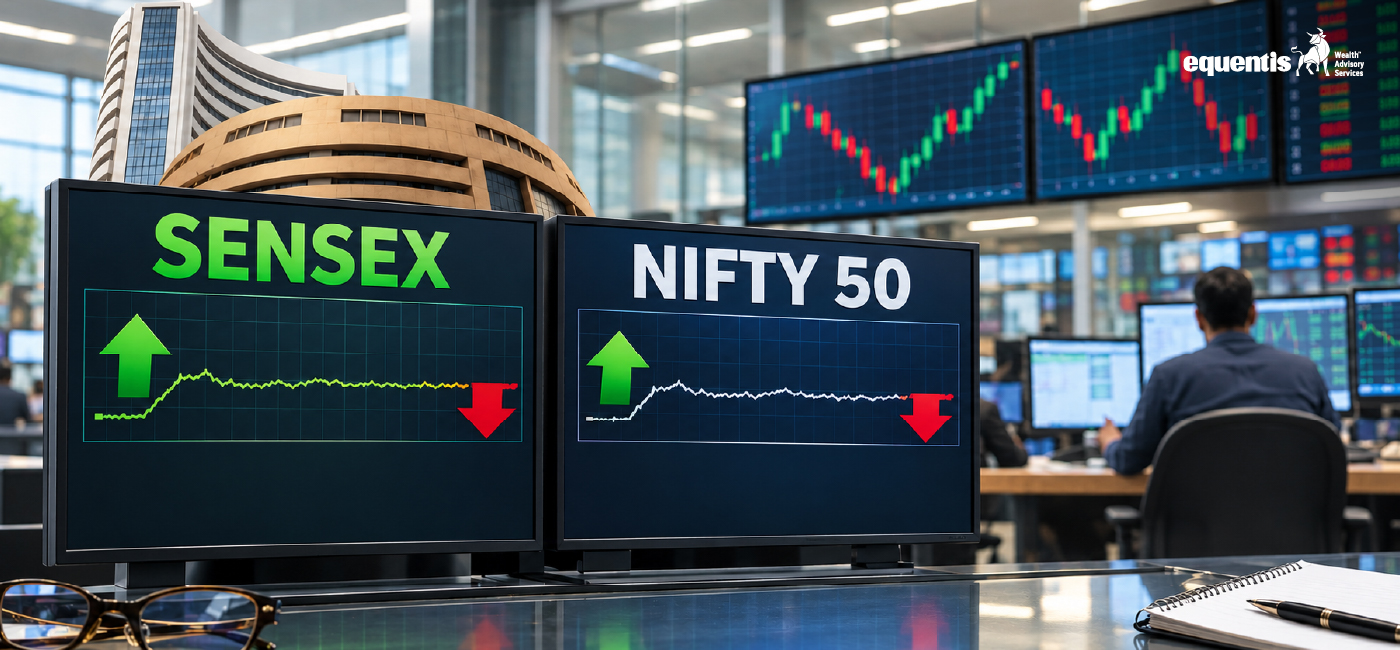

The Sensex and Nifty 50 traded near flat levels on October 26, 2026, after opening sharply lower, while several Asian stock markets declined amid geopolitical uncertainty, elevated crude oil prices and caution ahead of the US Federal Reserve’s policy meeting. Indian benchmarks recovered some early losses as investors assessed quarterly earnings and movements in heavyweight stocks. The market’s direction remains sensitive to global cues, oil prices and foreign investor activity, making this a period for investors to focus on company fundamentals rather than short term index movements.
Sensex Today: Key Market Updates
Indian equity benchmarks began Monday’s session on a weak note. The BSE Sensex dropped more than 500 points in early trading, while the Nifty 50 slipped below 22,500 as selling pressure affected several heavyweight stocks.
The market later recovered part of its losses. By midday, the Sensex was up around 54 points at 73,179.83, while the Nifty 50 gained approximately 11 points to trade at 22,610. This shift showed that investors were buying selected stocks even as broader sentiment remained cautious.
The recovery was not uniform across sectors. Pharmaceutical and selected banking shares showed resilience, while IT and other heavyweight stocks faced pressure. For investors, the important question is whether buying interest can persist or whether global uncertainties will continue to limit gains.
Why Are Asian Shares Trading Lower?
Asian markets were mixed to lower on October 26, with Japan’s Nikkei and South Korea’s Kospi under pressure. Some other regional markets recovered from early losses, reflecting differences in sector performance and local investor sentiment.
1. Geopolitical tensions and crude oil prices
Uncertainty surrounding the Middle East has kept energy markets volatile. Brent crude remained elevated after recent supply concerns, despite retreating from its near six month high.
High oil prices can increase inflation risks and raise costs for businesses. For India, which imports a substantial portion of its crude requirements, a prolonged increase could affect the import bill, the rupee and corporate profit margins.
2. Caution ahead of the US Federal Reserve meeting
Investors are watching the Federal Reserve’s October 27 to 28 policy meeting for signals about the future path of US interest rates.
Even if rates remain unchanged, the central bank’s commentary can influence bond yields, the US dollar and international investment flows. A more restrictive outlook could weigh on emerging markets, including India, while a more measured tone could help improve sentiment.
3. Weakness in global technology stocks
Selling in parts of Asia’s technology sector has added to uncertainty. Investors are assessing whether companies can generate sufficient returns from their spending on artificial intelligence and other technologies.
This matters for Indian IT services companies because global technology budgets influence demand for consulting, software development and digital transformation projects.
Which Indian Stocks and Sectors Are in Focus?
IT stocks face pressure
Indian IT stocks came under selling pressure after Infosys lowered its FY27 constant currency revenue growth guidance to 1% to 2%, citing weakness in North America and pricing pressure on large contracts.
The revised outlook has raised concerns about demand for technology services and the earnings prospects of companies that rely heavily on overseas clients. Investors are likely to watch quarterly results and management commentary for signs of a broader recovery.
Banking and pharmaceutical stocks show selective strength
Kotak Mahindra Bank and Axis Bank were among the stocks showing resilience during early trade, while Sun Pharmaceutical Industries and Dr Reddy’s Laboratories also attracted buying interest. These moves indicate that company specific earnings and expectations can influence share prices even when benchmark indices remain weak.
What Does Flat Trading Mean for Investors?
When the Sensex and Nifty trade near their previous closing levels, it means buying and selling pressure are relatively balanced at that moment. It does not necessarily indicate that the market has stabilised or that a larger recovery is underway.
Investors should consider several indicators together:
- Market breadth: Whether more stocks are advancing or declining.
- Foreign investor flows: Whether overseas investors are buying or selling Indian equities.
- Crude oil prices: Whether energy costs are easing or adding to inflation concerns.
- Corporate earnings: Whether companies are meeting expectations and maintaining their growth outlook.
- Global cues: How Asian markets, US bond yields and Federal Reserve commentary affect sentiment.
A flat benchmark can also conceal significant differences between individual stocks. Diversification and a focus on financial performance can help investors avoid overreacting to intraday movements.
What Should Investors Watch Next?
The immediate focus will remain on quarterly earnings, the Federal Reserve’s policy announcement and movements in crude oil prices. Any escalation in geopolitical tensions or unexpected changes in global interest rate expectations could trigger fresh volatility.
Investors should also monitor the rupee and foreign portfolio investor flows. A weaker rupee can increase import costs, while sustained overseas selling may add pressure to domestic equities.
For long term investors, market corrections can be a reason to review portfolio allocations and valuations. However, buying decisions should be based on individual company fundamentals, financial goals and risk tolerance rather than a single day’s market movement.
Conclusion
The Sensex and Nifty 50 traded near flat levels after recovering some early losses on October 26, 2026, while Asian markets remained mixed to lower. Geopolitical uncertainty, elevated crude oil prices, concerns about IT sector growth and the upcoming US Federal Reserve meeting continue to influence sentiment.
The next market direction will depend on global developments, corporate earnings and investor flows. Investors should look beyond headline index movements and assess whether individual companies can sustain earnings growth in the current environment.
Frequently Asked Questions
1. Why are the Sensex and Nifty trading flat today?
The Sensex and Nifty recovered part of their early losses on October 26, 2026, as investors bought selected stocks despite broader uncertainty. Elevated crude oil prices, geopolitical tensions, IT sector weakness and the upcoming US Federal Reserve meeting continued to limit market sentiment.
2. Why are Asian stock markets trading lower?
Several Asian markets faced pressure because of geopolitical uncertainty, volatile oil prices and concerns about global technology stocks. Investors are also waiting for signals from the US Federal Reserve about interest rates. However, regional markets have shown mixed performance, with some recovering from early declines.
3. What is the latest Sensex level?
During midday trading on October 26, 2026, the Sensex was reported at approximately 73,180, up around 54 points. This was an intraday snapshot, not the closing level. The index changes throughout the session, so the latest exchange data should be checked for current prices.
4. What is the latest Nifty 50 level?
The Nifty 50 traded near 22,610 during midday on October 26, 2026, after recovering from an early decline. Intraday levels can change quickly depending on buying and selling activity, corporate announcements and global market developments.
5. Why are Indian IT stocks under pressure?
Indian IT stocks have faced pressure following concerns about overseas technology spending and Infosys’ reduction in its FY27 constant currency revenue growth guidance to 1% to 2%. Investors are assessing whether weak demand and pricing pressure could affect earnings across the sector.
6. How do crude oil prices affect the Indian stock market?
Higher crude oil prices can increase India’s import bill, raise inflation risks and increase costs for energy intensive businesses. These factors can affect corporate earnings, the rupee and investor sentiment. A sustained decline in oil prices may ease some of these pressures, although the effect varies across sectors.
7. How will the US Federal Reserve meeting affect Indian markets?
The Federal Reserve’s policy decision and commentary can influence global bond yields, the US dollar and foreign investment flows. A more restrictive interest rate outlook could weigh on emerging markets, while a less restrictive outlook may support risk appetite, depending on broader economic conditions.
8. Which sectors are showing resilience in the Indian market?
Selected banking and pharmaceutical stocks showed resilience during early trading on October 26, 2026. Company specific earnings, valuations and business outlooks can support individual stocks even when the broader market is weak. Sector performance can change during the session.
9. What should investors watch when the market trades flat?
Investors should monitor market breadth, corporate earnings, crude oil prices, foreign investor activity and global interest rate expectations. A flat index does not necessarily mean all stocks are stable, as some sectors may rise while others experience substantial selling pressure.
10. Is flat trading a good time to invest in stocks?
Flat trading alone does not determine whether it is a good time to invest. Investors should assess valuations, earnings prospects, financial goals and risk tolerance. Long term investment decisions are generally better grounded in business fundamentals than in short term index movements.
Disclaimer Note: The securities quoted, if any, are for illustration only and are not recommendatory. This article is for education purposes only and shall not be considered as a recommendation or investment advice by Equentis . We will not be liable for any losses that may occur. Investments in the securities market are subject to market risks. Read all the related documents carefully before investing. Registration granted by SEBI, membership of BASL & certification from NISM in no way guarantee the performance of the intermediary or provide any assurance of returns to investors.

Jaspreet Singh Arora is the Chief Investment Officer at Equentis, where he heads a seasoned team of equity analysts and turns two decades of market experience into portfolios that consistently beat the benchmark. A go-to voice on cement, building-materials, real-estate, and construction stocks, Jaspreet previously ran research desks at leading brokerages, honing an eye for the metrics that truly move share prices. His plain-spoken analysis helps investors cut through noise and act with conviction. When he’s not deep-diving into earnings calls, you’ll find him unwinding over sports, weekend cricket or a good history podcast.