
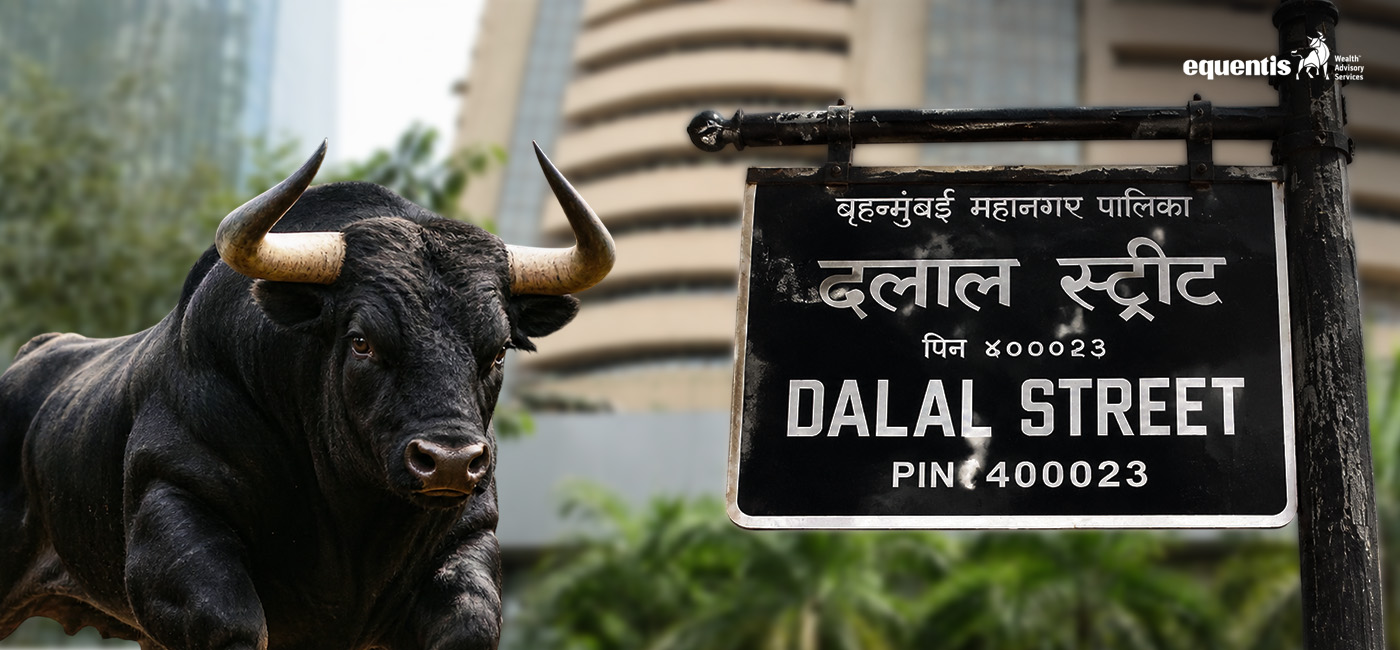

The Indian stock market witnessed a strong recovery on Wednesday, November 25, 2026, as bulls returned to Dalal Street, pushing the Sensex above 83,700 and the Nifty 50 higher by nearly 1.5% in early trade. Heavy buying in private banking, financial services and IT stocks, record foreign investor inflows, easing crude oil prices and a stronger rupee supported the rally. The rebound came after Monday’s sharp sell-off, bringing renewed optimism among investors, although global uncertainties and sector-specific weakness remain important factors to watch.
Sensex and Nifty Rally Today: What Happened in the Stock Market?
Indian benchmark indices opened Wednesday’s trading session with strong gains. The BSE Sensex climbed more than 1,500 points during early trade, while the NSE Nifty 50 crossed the 25,700 mark.
The Sensex touched an intraday high of 83,997.43 in the morning, while the Nifty moved towards 25,800. As buying momentum strengthened, the rally extended further, with the Sensex subsequently crossing 84,400 and the Nifty moving above 25,900 during the session.
The recovery followed a difficult Monday session, when the Sensex declined 1,483.72 points and the Nifty lost 450.95 points. Indian stock exchanges remained closed on Tuesday, November 24, for Guru Nanak Jayanti.
The sharp rebound also lifted investor wealth, with the combined market capitalisation of BSE-listed companies increasing significantly during the session. The Economic Times+2
5 Key Reasons Behind the Indian Stock Market Rally
1. Heavy Buying in Banking and Financial Stocks
Private banking stocks emerged as major contributors to Wednesday’s market gains. Heavyweights such as HDFC Bank and ICICI Bank attracted strong buying interest, helping lift the benchmark indices.
The Nifty Private Bank index gained around 2.4% in early trading, while banking and financial services stocks remained among the strongest sectoral performers.
Large banking stocks have considerable weight in benchmark indices. Consequently, gains in companies such as HDFC Bank and ICICI Bank can have a meaningful impact on the Sensex and Nifty.
2. Record Foreign Institutional Investor Inflows
Foreign Institutional Investors (FIIs), also known as Foreign Portfolio Investors (FPIs), have returned strongly to Indian equities in November.
Foreign investors have made substantial net purchases during the month, reversing the selling trend seen over several previous months. Reports indicated that November inflows had reached approximately $14.28 billion by November 25.
This renewed interest suggests that global investors are reassessing Indian equities amid changing international investment trends.
However, foreign fund flows can change quickly depending on global interest rates, currency movements and geopolitical developments. Reuters+1
3. Declining Crude Oil Prices Support Market Sentiment
Lower crude oil prices are generally positive for India because the country imports a significant portion of its energy requirements.
When international oil prices decline, India’s import bill can come under less pressure. This can support the rupee, reduce inflationary concerns and improve the cost outlook for several industries.
Brent crude’s decline during November has therefore provided an additional positive factor for domestic equities.
Oil-sensitive sectors such as aviation, paints, logistics and automobiles may benefit from lower input costs, although the actual impact depends on company-specific factors.
4. Stronger Indian Rupee Against the US Dollar
The rupee also provided support to market sentiment by strengthening against the US dollar.
A relatively stronger rupee can reduce the cost of imported commodities, including crude oil, and improve confidence among overseas investors.
Currency movements are particularly important for India because a weaker rupee can increase import costs and contribute to inflationary pressure.
5. Improving Corporate Earnings
Better-than-expected corporate earnings have also supported the broader market outlook.
Recent quarterly results indicated stronger earnings momentum among several large Indian companies. This has encouraged investors to reassess valuations and future profit expectations.
The combination of earnings growth, foreign inflows and relatively favourable domestic economic conditions has helped improve sentiment towards Indian equities. The Economic Times+2
Which Stocks and Sectors Led the Market Rally?
The rally was led primarily by heavyweight banking, IT and financial services companies. Several large-cap stocks attracted buying interest as investors looked to recover losses from the previous trading session.
Major gainers included:
- Infosys: IT stocks benefited from renewed buying interest.
- HDFC Bank: Strong buying in the private banking heavyweight supported the indices.
- ICICI Bank: Financial sector momentum contributed to the benchmark rally.
- Axis Bank: Banking stocks remained among the preferred choices during the session.
- Bajaj Finance: Financial services stocks participated in the broader recovery.
- IndiGo: The aviation stock also featured among the notable gainers.
However, the rally was not uniform across all sectors. Tata Steel, Mahindra & Mahindra, Titan, Power Grid and Sun Pharma were among the notable laggards in early trading.
The Nifty Metal index also remained under pressure, highlighting the difference between sectoral performance and the broader market direction. The Economic Times+2
What Does the Stock Market Rally Mean for Retail Investors?
For retail investors, Wednesday’s recovery provides an indication that market sentiment can change quickly when multiple positive factors come together.
However, a sharp single-day rally should not automatically be treated as the beginning of a sustained bull market.
Investors should consider three important aspects:
1. Follow earnings rather than market excitement: Companies with consistent revenue growth, healthy margins and manageable debt may be better positioned to handle market volatility.
2. Avoid chasing sudden price movements: Stocks that rise sharply during a trading session can experience profit booking. Buying decisions based only on intraday momentum can increase investment risk.
3. Maintain portfolio diversification: Exposure across banking, IT, FMCG, pharmaceuticals and other sectors can help reduce dependence on a single industry.
Long-term investors should also review their asset allocation and investment goals instead of reacting to every movement in the Sensex and Nifty.
Can the Market Rally Continue? Key Risks to Watch
Although the return of foreign investors and lower crude oil prices have improved sentiment, several uncertainties remain.
The following factors could influence the next direction of the Indian stock market:
- US economic data: Inflation figures and Federal Reserve policy expectations could influence global liquidity and equity valuations.
- Global trade tensions: Changes in US tariff policies could affect international trade and investor confidence.
- Foreign investor activity: Sustained FII buying could support domestic equities, while renewed selling may create pressure.
- Crude oil prices: A fresh increase in oil prices could put pressure on India’s import bill and inflation outlook.
- Corporate earnings: Companies must continue delivering healthy earnings growth to justify market valuations.
Investors should also watch whether the Nifty can sustain its gains above 25,700–25,800 and whether buying participation extends beyond a handful of heavyweight stocks.
Conclusion
The Indian stock market witnessed a strong comeback on November 25, with the Sensex crossing 83,700 and the Nifty gaining nearly 1.5% in early trade. Buying in private banks, IT companies and financial services stocks, combined with record foreign investor inflows and softer crude oil prices, supported the recovery.
However, the rally needs to be viewed in the context of Monday’s sharp correction and continuing global uncertainties.
For investors, the next important indicators will be sustained FII inflows, corporate earnings, crude oil prices and broader market participation. Whether the recovery develops into a sustained upward trend will depend on how these factors evolve.
Frequently Asked Questions
1. Why is the Indian stock market rising on November 25, 2026?
The Indian stock market is rising because of strong buying in banking, financial services and IT stocks. Record foreign investor inflows, declining crude oil prices, a stronger rupee and improving corporate earnings have also supported investor confidence and encouraged buying across several large-cap companies.
2. What was the Sensex high on November 25, 2026?
The Sensex crossed 83,700 during early trading and subsequently moved above 84,400 during the November 25 session. The benchmark recorded an intraday high of approximately 84,498, reflecting a strong recovery after Monday’s market decline.
3. How much did the Nifty 50 gain on November 25?
The Nifty 50 gained nearly 1.5% in early trade on November 25, 2026. Buying momentum strengthened during the session, pushing the index above 25,900 at its intraday high as banking and IT stocks attracted investor interest.
4. Which sectors are leading the stock market rally today?
Banking, financial services and IT stocks are among the leading contributors to the rally. Private banking companies such as HDFC Bank and ICICI Bank have supported benchmark gains, while FMCG, financial services and selected other sectors have also attracted buying interest.
5. Why are foreign investors buying Indian stocks?
Foreign investors are increasing exposure to Indian equities amid improving earnings expectations, changing global investment trends and relatively attractive domestic growth prospects. Lower crude oil prices and a stronger rupee have also supported sentiment towards Indian financial markets.
6. How do lower crude oil prices benefit the Indian stock market?
India imports a substantial amount of its crude oil requirements. Lower international oil prices can reduce the country’s import bill, ease inflationary pressure and support the rupee. They may also benefit oil-consuming industries such as aviation, logistics and paints through lower input costs.
7. Which stocks gained the most during the November 25 market rally?
Infosys, HDFC Bank, ICICI Bank, Axis Bank, Bajaj Finance and IndiGo were among the notable gainers during early trading. Their performance reflected strong buying interest in banking, financial services and IT companies.
8. Why did the stock market fall on Monday before recovering?
The Sensex and Nifty experienced a sharp correction on Monday, November 23, amid profit booking and selling pressure in major stocks. The market subsequently rebounded on Wednesday as foreign investor buying, softer crude oil prices and renewed demand for heavyweight shares improved sentiment.
9. Is the November 25 stock market rally a sign of a bull market?
A single-day rally does not confirm the beginning of a sustained bull market. Investors need to monitor earnings growth, foreign investment flows, market breadth and global economic conditions. Consistent buying across sectors and sustained index strength would provide stronger evidence of a broader recovery.
10. What should investors watch after the Sensex and Nifty rally?
Investors should monitor FII and domestic institutional investor activity, crude oil prices, rupee movements, global inflation data and upcoming corporate earnings. They should also watch whether the Nifty sustains its gains and whether mid-cap and small-cap stocks participate in the broader recovery.
Disclaimer Note: The securities quoted, if any, are for illustration only and are not recommendatory. This article is for education purposes only and shall not be considered as a recommendation or investment advice by Equentis . We will not be liable for any losses that may occur. Investments in the securities market are subject to market risks. Read all the related documents carefully before investing. Registration granted by SEBI, membership of BASL & certification from NISM in no way guarantee the performance of the intermediary or provide any assurance of returns to investors.

Jaspreet Singh Arora is the Chief Investment Officer at Equentis, where he heads a seasoned team of equity analysts and turns two decades of market experience into portfolios that consistently beat the benchmark. A go-to voice on cement, building-materials, real-estate, and construction stocks, Jaspreet previously ran research desks at leading brokerages, honing an eye for the metrics that truly move share prices. His plain-spoken analysis helps investors cut through noise and act with conviction. When he’s not deep-diving into earnings calls, you’ll find him unwinding over sports, weekend cricket or a good history podcast.