
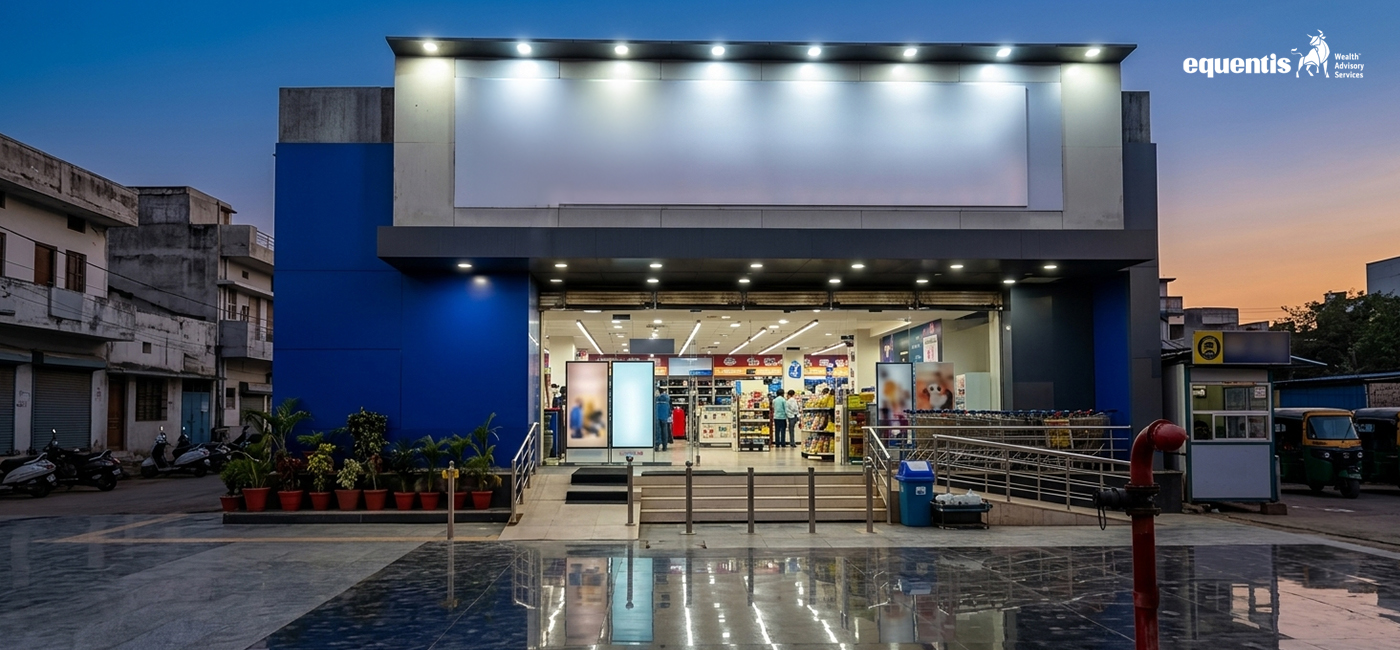

Vishal Mega Mart shares rallied nearly 10% in early trade on August 24, 2026, after the company announced the reappointment of Gunender Kapur as Managing Director and CEO for another five years. The announcement reduced concerns around leadership succession, while Morgan Stanley retained its Overweight rating and a ₹146 target price. Based on the stock’s recent levels, that target implies roughly 41–42% potential upside, although a brokerage target is an estimate, not a guaranteed return.
Why Did Vishal Mega Mart Shares Rally?
The immediate trigger was the company’s decision to extend Kapur’s tenure. The board approved his reappointment as Founder, Managing Director and CEO for five years from September 1, 2026, through August 31, 2031, subject to shareholder approval.
The market reaction was sharp. The stock climbed from a previous close of around ₹103.60 to an intraday high of ₹113.45 on the BSE, while reports from the NSE indicated a high of ₹113.70 during early trade. The move came as investors responded positively to greater clarity over the company’s leadership.
For investors, management continuity can matter particularly when a company is pursuing expansion. A change at the top can create uncertainty around strategy, capital allocation and execution. Extending the existing leadership provides more visibility into the company’s direction.
What Is Morgan Stanley’s View on Vishal Mega Mart?
Morgan Stanley has maintained an Overweight rating on Vishal Mega Mart with a target price of ₹146. The brokerage highlighted the CEO’s five-year reappointment as a positive because succession uncertainty had been one of the concerns affecting sentiment around the stock.
The ₹146 target represents approximately 41–42% upside from the stock’s recent levels. However, investors should distinguish between an analyst target and an expected or guaranteed market price. Brokerage targets are based on assumptions about earnings, valuations and future business performance, and those assumptions can change.
Morgan Stanley also noted that the stock had been relatively weak in recent months and was trading at a comparatively attractive valuation versus discretionary retail peers, despite the company’s consistent execution.
Why Is Leadership Continuity Important?
Vishal Mega Mart has been expanding its presence in India’s value retail segment, making execution an important part of its investment story. The company had 819 stores across 559 cities as of June 30, 2026, covering approximately 1.38 crore square feet of retail area.
Kapur’s continuation gives the company a longer period to execute its existing strategy. He has more than four decades of experience across management, investment, consumer and retail businesses, with previous associations including Hindustan Lever, Unilever Nigeria, Reliance Industries and TPG Capital.
That does not automatically mean the stock will continue rising. Investors still need to evaluate whether store expansion translates into sustainable revenue growth, whether margins remain healthy and whether the company can maintain customer demand across different markets.
What Could Drive Vishal Mega Mart’s Growth?
The broader value retail market remains an important factor. Indian consumers in smaller cities and towns continue to seek affordable products across categories such as apparel, general merchandise and household goods.
Vishal Mega Mart’s expansion across cities provides it with a wider physical footprint. More stores can increase customer reach, but the quality of those stores matters as much as the number of outlets. Sales productivity, inventory management, store-level profitability and customer retention will therefore remain important indicators.
Investors may also watch how the company balances physical stores with its digital and omnichannel presence. A scalable retail model requires efficient supply chains, appropriate inventory levels and disciplined operating costs.
What Are the Risks for Investors?
The recent rally should not be viewed in isolation. A sharp one-day move can reflect a change in sentiment rather than a fundamental change in earnings.
One important consideration is valuation. While Morgan Stanley sees the stock as relatively inexpensive compared with discretionary peers, other analysts have pointed out that the valuation still leaves limited room for execution errors.
Other factors worth monitoring include:
- Store expansion: Rapid expansion can increase costs and capital requirements.
- Same-store sales: Existing-store growth is important for understanding underlying demand.
- Margins: Higher operating or sourcing costs could affect profitability.
- Competition: India’s value retail market includes several established and expanding players.
- Consumer demand: Changes in household spending can influence discretionary retail sales.
- Management execution: Leadership continuity removes one uncertainty, but future performance will depend on execution.
What Should Investors Watch Next?
The next focus should move beyond the CEO announcement and towards business performance. Investors can track quarterly revenue growth, store additions, same-store sales growth, margins, cash generation and management commentary on expansion.
The stock’s reaction also needs to be viewed in the context of the broader market. A brokerage target may support sentiment, but share prices ultimately depend on earnings, valuations and investor expectations.
For retail investors researching Vishal Mega Mart share price, the key takeaway is that the recent rally reflects improved confidence around management continuity and supportive brokerage commentary. It does not, by itself, establish that the stock will reach ₹146.
Conclusion
The Vishal Mega Mart share rally highlights how management decisions can influence investor sentiment, particularly when succession uncertainty has been weighing on a stock. Gunender Kapur’s proposed five-year reappointment provides greater leadership visibility, while Morgan Stanley’s ₹146 target indicates a constructive view on the company’s prospects.
However, the next phase will depend on operating performance. Store expansion, sales growth, margins, customer demand and valuation will be more important over time than a single day’s 10% rally. Investors should therefore treat the Morgan Stanley target as one analytical view and assess the company’s fundamentals before making investment decisions.
Frequently Asked Questions
1. Why did Vishal Mega Mart shares rise 10%?
Vishal Mega Mart shares rose nearly 10% in early trade on August 24, 2026, after the company announced the reappointment of Gunender Kapur as Managing Director and CEO for another five years. Investors viewed the decision positively because it reduces uncertainty around leadership succession and provides continuity for the company’s expansion strategy.
2. What is Morgan Stanley’s target price for Vishal Mega Mart?
Morgan Stanley has maintained an Overweight rating on Vishal Mega Mart with a target price of ₹146 per share. Compared with the stock’s recent trading levels around ₹103–₹104, the target indicates approximately 41–42% potential upside. This is an analyst estimate and should not be interpreted as a guaranteed future price.
3. Who is Gunender Kapur?
Gunender Kapur is the Founder, Managing Director and CEO of Vishal Mega Mart. The company has approved his reappointment for five years from September 1, 2026, through August 31, 2031, subject to shareholder approval. He has more than 42 years of experience across management and investment in consumer and retail businesses.
4. Why is the CEO’s reappointment important for Vishal Mega Mart?
The reappointment provides management continuity at a time when Vishal Mega Mart is expanding its retail network. Morgan Stanley identified succession uncertainty as an overhang on investor sentiment. Extending the CEO’s tenure provides greater visibility around the company’s strategic direction and execution plans.
5. How many stores does Vishal Mega Mart operate?
As of June 30, 2026, Vishal Mega Mart operated 819 stores across 559 cities, covering approximately 1.38 crore square feet of retail area. The company’s expanding store network is an important part of its value-retail strategy and should be monitored alongside sales productivity and profitability.
6. Does Morgan Stanley’s ₹146 target mean the stock will reach ₹146?
No. A brokerage target represents an analyst’s assessment based on assumptions about the company’s earnings, valuation and future performance. Actual share prices can differ significantly because of market conditions, business performance, investor sentiment and changes in valuation expectations.
7. Is Vishal Mega Mart a value retail company?
Yes. Vishal Mega Mart operates in India’s value-focused retail segment, serving consumers across a broad network of cities. Its business model focuses on offering products across categories such as apparel and general merchandise. Its store expansion and ability to maintain customer demand are important factors for future growth.
8. What risks should investors consider in Vishal Mega Mart?
Investors should consider valuation, competition, consumer demand, store expansion costs, margins, inventory management and execution risks. Rapid store additions do not necessarily translate into higher profitability. Same-store sales growth, operating margins and cash generation can provide a clearer picture of business quality.
9. What should investors track after the Vishal Mega Mart share rally?
Investors should look beyond the immediate share price reaction and monitor quarterly revenue growth, same-store sales, margins, new-store additions, cash flows and management guidance. These indicators can help determine whether the positive sentiment following the CEO reappointment is supported by sustained operating performance.
10. Should investors buy Vishal Mega Mart shares after the 10% rally?
The 10% rally alone is not sufficient to determine whether the stock is suitable for an investor. Investors should assess the company’s valuation, financial performance, growth prospects, risk profile and their own investment objectives. Morgan Stanley’s target can be considered as one external analytical view rather than a recommendation to buy or sell the stock.
Disclaimer Note: The securities quoted, if any, are for illustration only and are not recommendatory. This article is for education purposes only and shall not be considered as a recommendation or investment advice by Equentis. We will not be liable for any losses that may occur. Investments in the securities market are subject to market risks. Read all the related documents carefully before investing. Registration granted by SEBI, membership of BASL & certification from NISM in no way guarantee the performance of the intermediary or provide any assurance of returns to investors.

Jaspreet Singh Arora is the Chief Investment Officer at Equentis, where he heads a seasoned team of equity analysts and turns two decades of market experience into portfolios that consistently beat the benchmark. A go-to voice on cement, building-materials, real-estate, and construction stocks, Jaspreet previously ran research desks at leading brokerages, honing an eye for the metrics that truly move share prices. His plain-spoken analysis helps investors cut through noise and act with conviction. When he’s not deep-diving into earnings calls, you’ll find him unwinding over sports, weekend cricket or a good history podcast.










