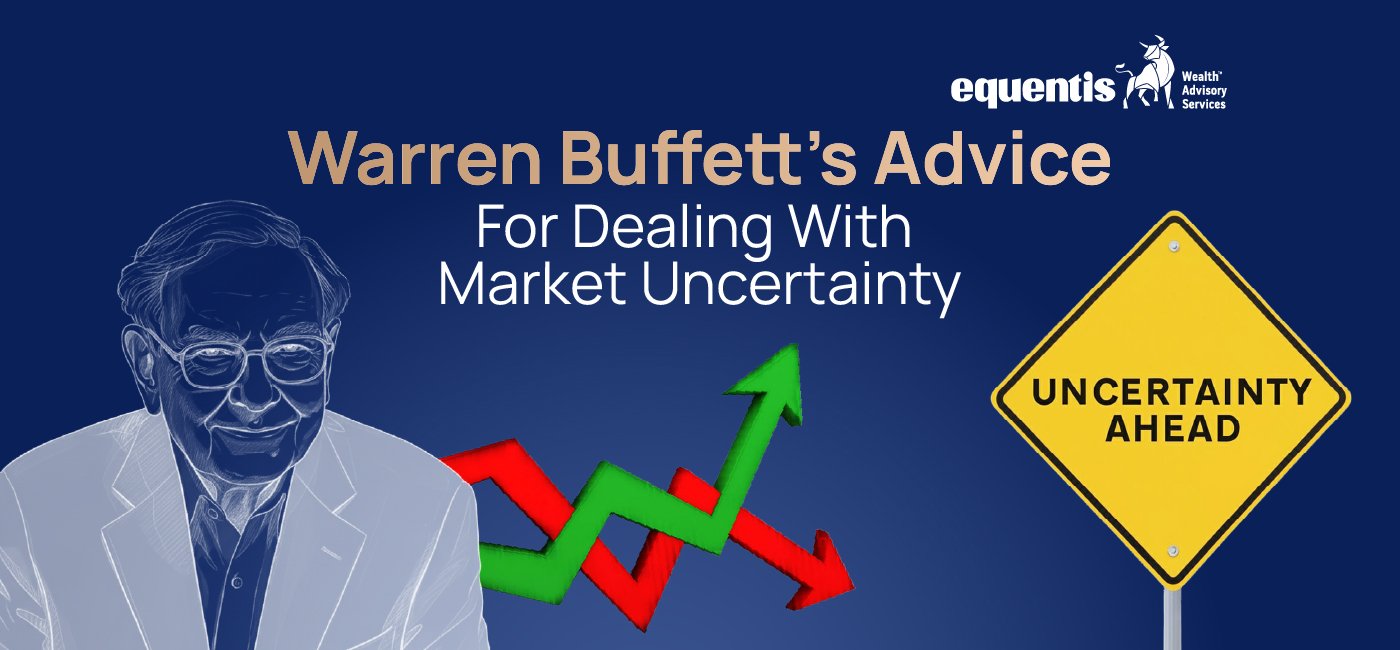

In the financial world, volatility is often viewed as a storm to be feared, but for the Oracle of Omaha, it is merely a change in the weather that presents new opportunities. As of April 2026, the global markets have faced a series of rapid shifts, from geopolitical tensions to the structural impact of artificial intelligence on traditional industries. Amidst this noise, the Warren Buffet advice remains a lighthouse for investors seeking a grounded perspective.
Warren Buffett has spent over seven decades navigating every conceivable market condition—inflationary spikes, high interest rate cycles, and sudden crashes. His philosophy is built on the idea that the market is a “voting machine” in the short term but a “weighing machine” in the long term. To master uncertainty, one must first master their own temperament.
The Strategy of the $373 Billion Cash Pile
Perhaps the most discussed aspect of Berkshire Hathaway in 2026 is its record breaking cash reserve. As of March 2026, Berkshire has amassed a staggering $373 billion in cash and cash equivalents, much of it parked in Treasury bills. For many, this looks like a retreat, but for Buffett, it is a strategic “war chest” awaiting a “fat pitch.”
His primary lesson here is about the value of patience. While retail investors often feel the “fear of missing out” (FOMO) during market rallies, Buffett emphasizes that holding cash is not “dead money.” In the current 2026 environment, these reserves are generating over $13 billion annually in risk free interest. This liquidity provides the ultimate defense against uncertainty, allowing an investor to act with aggression when others are paralyzed by fear.
Warren Buffett’s Investing Lessons: Temperament Over IQ
One of Warren Buffett’s most profound investing lessons is that success in the market depends more on your stomach than your brain. Buffett famously stated that if you have an IQ of 160, you should sell 30 points to someone else, because you do not need it in investing. What you do need is the emotional discipline to ignore the crowd.
In early 2026, as geopolitical strikes and economic shifts caused stock prices to waver, Buffett reiterated his timeless mantra: “Be fearful when others are greedy and greedy when others are fearful.” He argues that uncertainty is actually the friend of the buyer of long term values. When the “news” is bad, prices typically drop, which is exactly when the most attractive deals are found.
Focus on Productive Assets, Not Price Action
When uncertainty hits, the average investor spends their day staring at red and green tickers. Buffett’s advice is to ignore the price and focus on the business. He views a stock not as a piece of paper to be traded, but as a partial ownership in a productive enterprise.
In his recent 2025 and 2026 communications, he highlighted that even while trimming major holdings like Apple to rebalance his portfolio, his conviction in the underlying quality of American business remains unshaken. He encourages investors to ask: “Does this company have a durable competitive advantage? Does it have a moat?” If the answer is yes, then a temporary market dip is irrelevant to the long term value of the asset.
The Antidote for the “Non-Professional” Investor
For those who do not have the time or inclination to analyze individual balance sheets—especially in the complex, AI driven market of 2026—Buffett offers a simple solution. He recommends a low cost S&P 500 index fund combined with a disciplined approach.
His specific “antidote” to market mistiming is to accumulate shares over a long period through dollar cost averaging and to never sell. By consistently buying through both the peaks of exuberance and the troughs of despair, the investor benefits from the natural upward trajectory of the economy without having to “predict” when the uncertainty will end.
Comparing Global Wealth: Buffett vs. Modern Icons
To put the scale of Buffett’s multi decade compounding into perspective, it is interesting to look at other global figures. For example, the Cristiano Ronaldo net worth in 2026 is estimated at $1.4 billion. While Ronaldo is a global icon of individual brand power and active earnings, Buffett’s $140 billion+ personal fortune represents the peak of passive compounding.
The difference lies in the source of wealth. Ronaldo’s wealth is tied to his physical performance and brand deals, whereas Buffett’s wealth is tied to the collective productivity of the thousands of people working within the companies he owns. For the average person, following warren buffet advice is the most realistic path to mimicking that “ownership” model of wealth.
Seeking a Stock Market Advisory in a Volatile Year
While Buffett manages his billions with a small team in Omaha, most retail investors benefit from a professional stock market advisory to help filter the 2026 noise. An advisory service can help implement Buffett’s “margin of safety” principle—the idea of buying a stock at a price significantly below its intrinsic value.
In an era where “paper money can see its value evaporate if fiscal folly prevails,” as Buffett warned in his recent shareholder letter, having a structured plan is essential. Whether it is through a SEBI registered firm in India or a global wealth manager, the goal should always be to match the “Oracle’s” level of discipline.
Summary: The Buffett Blueprint for 2026
- Maintain Liquidity: Keep a cash buffer so you are never a forced seller during a downturn.
- Ignore the Macro Noise: Interest rates and geopolitical headlines are temporary; business quality is permanent.
- Demand a Margin of Safety: Never pay a price that requires a “perfect” future to justify the investment.
- Think in Decades: If you aren’t willing to own a stock for ten years, don’t even think about owning it for ten minutes.
FAQs
What is the best Warren Buffet advice for 2026?
His best advice is to remain patient, keep a high cash reserve for opportunities, and focus on buying “wonderful businesses at fair prices.”
Why is Warren Buffett holding $373 billion in cash?
He believes current market valuations are high and is waiting for a “margin of safety” to appear before deploying capital into major acquisitions.
What does he mean by “be fearful when others are greedy”?
It means when everyone is buying and prices are high, you should be cautious; when everyone is panicking and selling, you should look for bargains.
Is Warren Buffett still investing in Apple in 2026?
Apple remains Berkshire’s top holding, although Buffett has selectively trimmed the position to manage portfolio concentration.
What is a “moat” in investing?
A moat is a competitive advantage—like a brand, a patent, or a cost advantage—that protects a company from its competitors.
How can a beginner follow Warren Buffett’s investing lessons?
A beginner should start by investing in a low-cost S&P 500 index fund and holding it for the long term without trying to time the market.
Does Warren Buffett believe in gold?
Generally, no; he prefers “productive assets” like businesses or farms that produce goods or services, rather than “unproductive” assets like gold.
What is the Cristiano Ronaldo net worth in 2026?
The Cristiano Ronaldo net worth is approximately $1.4 billion, which highlights the difference between active brand wealth and Buffett’s compounding equity wealth.
What is “dollar cost averaging”?
It is the practice of investing a fixed amount of money at regular intervals, regardless of the stock price, to average out the cost over time.
Does he use a stock market advisory service?
No, Buffett and his team at Berkshire Hathaway perform their own internal research, though he often recommends index funds for everyone else.
What was Buffett’s warning about inflation in 2026?
He warned that “paper money” can lose value and encouraged owning businesses with “pricing power” that can adapt to rising costs.
What is the “margin of safety”?
It is the difference between the intrinsic value of a business and its current market price; the larger the gap, the lower the risk.
Does Warren Buffett like tech stocks in 2026?
He has become more open to tech, with major stakes in Apple and Alphabet (Google), but only when he feels he understands the business’s long-term future.
Why does he hate “market timing”?
He believes no one can consistently predict short-term movements and that “time in the market” is much more important than “timing the market.”
How did Berkshire Hathaway perform in 2026?
Berkshire outperformed the S&P 500 by about 23 percentage points in early 2026, largely due to its defensive, cash-rich positioning during a correction.
What is his advice on diversification?
He says “diversification is protection against ignorance,” suggesting that if you know how to analyze businesses, you only need a few great ones.
Does Warren Buffett believe in AI?
He is cautious about the social impact but recognizes its business utility, having recently added to his stake in tech giants that lead in AI development.
What is “intrinsic value”?
It is the calculated value of a company based on all its future cash flows, discounted back to the present day.
Should I sell my stocks when a recession is predicted?
Buffett’s advice is typically “no”—if you own a great business, you should hold it through the cycle rather than trying to jump in and out.
Where can I read more about Warren Buffett’s investing lessons?
The best source is the annual Berkshire Hathaway Shareholder Letters, which are available for free on their official website.
Disclaimer Note: The securities quoted, if any, are for illustration only and are not recommendatory. This article is for education purposes only and shall not be considered as a recommendation or investment advice by Equentis. We will not be liable for any losses that may occur. Investments in the securities market are subject to market risks. Read all the related documents carefully before investing. Registration granted by SEBI, membership of BASL & certification from NISM in no way guarantee the performance of the intermediary or provide any assurance of returns to investors.

Parvati Rai is the Vice President of the Research team at Equentis. She has over 15 years of equity-research and strategy-consulting experience. A specialist in deep-dive valuations, financial modelling, and forecasting, she has built research desks from the ground up, by steering buy-side, sell-side, and independent coverage across sectors. When she isn’t fine-tuning models, Parvati unwinds on nature treks and mentors aspiring analysts.