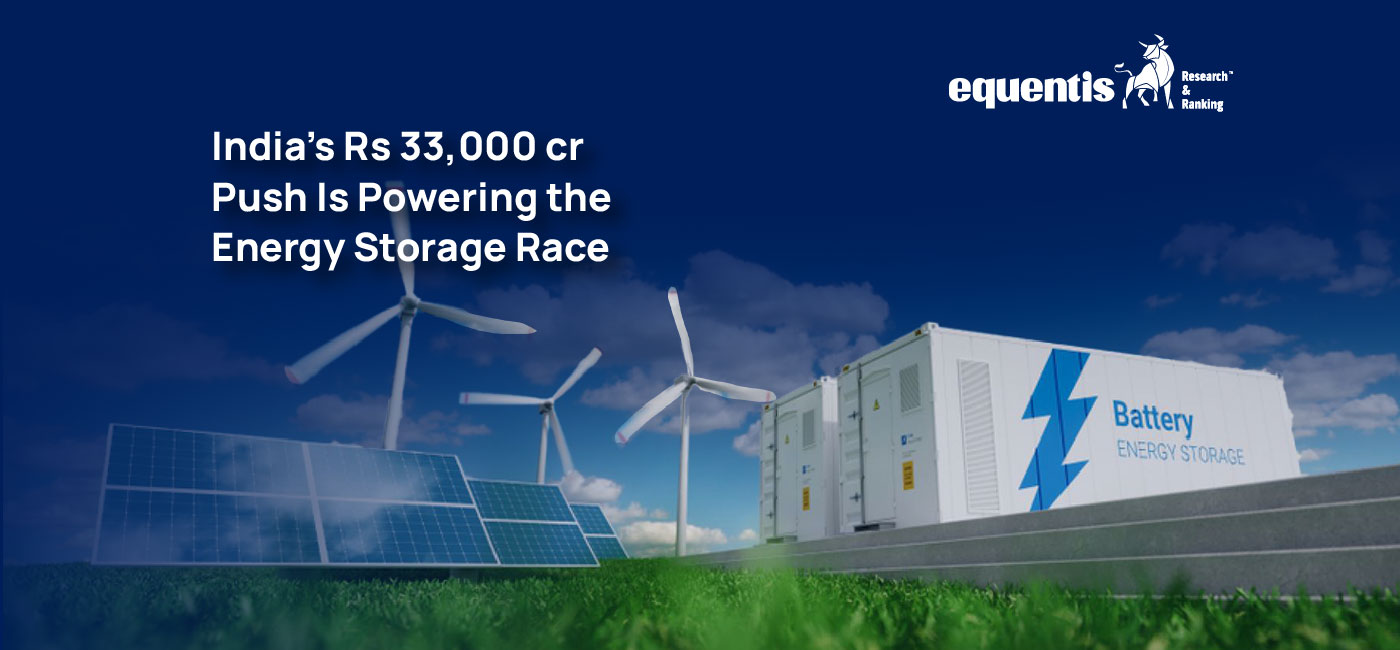

India’s energy sector is no longer just about adding more solar panels or wind turbines—it’s about making that power reliable every hour of the day. That’s where energy storage steps in. Backed by a ₹33,000-crore investment pipeline, new tenders, and government incentives, storage projects are beginning to move from plans to execution. For the first time, companies are securing large-scale orders, timelines are being set, and revenues are visible. This marks a turning point where Battery Energy Storage Systems (BESS) are not just experimental pilots but a central piece of India’s clean energy transition.
Source:The Financial Express
Drivers of Energy Storage Adoption
- India has reached 100 GW of solar PV module manufacturing capacity, giving project developers more local supply options for generation assets. But solar and wind are variable; grid operators need firm, dispatchable power. Storage fills that gap.
- The grid roadmap is explicit: the Central Electricity Authority projects 74 GW of BESS by 2031–32. India’s current BESS capacity of 205 MW is modest compared to global leaders like the U.S. and China, underscoring the scale of opportunity.
- Policy support is material: in June 2025, the Union Cabinet approved ₹54 billion in viability gap funding (VGF) to catalyze 30 GWh of BESS, expected to spur around ₹330 billion (₹33,000 crore) of total investment.
Understanding BESS Metrics and Bid Structures
- Capacity metrics:
- MW (megawatt) = power the system can discharge at once.
- MWh (megawatt-hour) = energy delivered over time. Example: 30 MW / 120 MWh = four hours of discharge.
- Tariff structure:
Indian BESS tenders often pay monthly fees per MW of contracted capacity. Example: NHPC’s Andhra Pradesh awards at ₹2,10,000/MW-month and ₹2,22,000/MW-month, tied to specific MW/MWh configurations. - VGF overlay:
Tenders can include caps like ₹27 lakh/MWh or 30% of project cost, whichever is lower. This reduces upfront burden and makes projects bankable. - Timelines:
Standalone BESS projects typically require commissioning in 15–18 months post-award. - Dispatchable RE (FDRE):
Storage-backed renewable projects can commit fixed delivery schedules, opening up higher-value contracts. Developers disclose linked BESS orders when announcing FDRE projects.
Source: Business Standard
The companies currently moving the market
1) Tata Power: first standalone BESPA and grid-scale plans
- Scale today: 26.03 GW total generation, 4,659 ckm transmission, 4.9 GW integrated cell & module manufacturing capacity.
- Kerala standalone BESS: Tata Power Renewable Energy (TPREL) signed its first Battery Energy Storage Purchase Agreement (BESPA) with NHPC for 30 MW / 120 MWh in Kerala, targeted in 15 months. This sits within NHPC’s 125 MW / 500 MWh Kerala BESS program backed by VGF.
Source: Economic Times
- Mumbai program: plan to install 100 MW of BESS at 10 locations (load-centered sites like metros, hospitals, data centers) over the next two years to bolster city resilience.

Source: Trading View
- Pumped storage: roadmap includes 2.8 GW by August 2028, plus 1.8 GW by 2030. The company is also upgrading its EV charging platform (Easy Charge) for 10x growth over five years.
- Financials (Q1 FY26): revenue ₹180.3 billion (+4.3% YoY); PAT ₹12.6 billion (+6.1%); margin 17.3% (+260 bps). Valuation snapshot: trading at 30x P/E, above its 10-year median 23x and the industry median 21.5x.
2) ACME Solar: large BESS bids, FDRE build-out, strong quarter
- Portfolio: 6.9 GW across solar, wind, storage, and hybrids; 2.8 GW operational; 4.0 GW under construction plus 550 MWh storage under construction; >85% contracted with central offtakers.
- NHPC BESS (AP): ACME signed BESPAs for 275 MW / 550 MWh (two sites). Tariffs are ₹2,10,000/MW-month for 50 MW / 100 MWh and ₹2,22,000/MW-month for 225 MW / 450 MWh. The company indicates 18 months to commissioning, ₹700 million peak annual revenue, and IRR in the mid-teens; risk is described as lower due to no land acquisition or transmission build. Source: Acme SolarRenewable Watch

Source: Trading View
- Quarter print (Q1 FY26): total income ₹5.8 billion (+72% YoY); EBITDA ₹5.3 billion (+76% YoY); PAT ₹1,310 million.
- Capex and FDRE: targeting 10 GW of generation and 15 GWh BESS by 2030; 3.1 GWh of BESS ordered for FDRE which earns ₹9/unit for long-duration supply; 2,500 MWh FDRE battery commissioning pipeline is about 5× the 550 MWh NHPC projects. Planned FY26 capex: ₹120–140 billion. Valuation: 41x P/E.
3) Bondada Engineering: EPC operator stepping into utility-scale storage
- Business mix and clients: EPC and O&M across telecom, railways, and renewable energy; clients include major telcos and PSU power companies. The company is now developing BESS under a build-own-operate model.
- New BESS order (Tamil Nadu): 400 MWh from Tamil Nadu Green Energy Corporation (TNGECL), valued at ₹8.3 billion, to be executed in 18 months with 12-year revenue realisation. This is part of TN’s 1,000 MWh storage tendering round.

Source: Trading View
- Order book and FY25 performance: total order book ₹50.4 billion (renewables ₹35.8 b, telecom ₹10.9 b, railways ₹2.2 b, product manufacturing ₹1.3 b). FY25 revenue ₹15.7 billion (up from ₹8 b in FY24); mix: solar 58%, telecom 28%, products 14%. EBITDA ₹1.8 billion (+156%), margin 11.7% (+280 bps), PAT ₹1.1 billion; Q1 FY26 not yet released in the cited note.
- Pipeline and FY30 ambition: tenders submitted ₹16.7 b; tenders under consideration ₹46.7 b; FY30 revenue target ₹100 b with portfolios of 6 GW solar EPC, 2 GW BESS, 2 GW solar IPP (2 GW solar EPC currently under construction). Valuation: 42x P/E, below a 2-year median of 69x.
Source:The Financial Express
The broader impact on India’s energy sector
The momentum in BESS is not just about three companies or a few tenders. It is reshaping the way India’s power sector is structured:
- Grid reliability: With BESS, variable renewables can now contribute stable, on-demand power, reducing reliance on coal peaking plants.
- Market design: Contracts linked to MW/month tariffs, combined with VGF, create predictable cash flows that attract more private investment.
- Sector diversification: Large integrated utilities like Tata Power, pure-play renewable developers like Acme, and EPC firms like Bondada are all carving space. This widens participation and deepens competition.
- Investment visibility: The ₹330 billion (₹33,000 crore) projected investment is not speculative—it is anchored in active tenders, signed agreements, and clear capacity targets.
- Long-term trajectory: Moving from today’s 205 MW to 74 GW by 2031–32 is a step-change that will redefine India’s generation mix and create new revenue pools across storage hardware, EPC, and operations.
Conclusion
India’s energy transition has moved into its storage phase. What was once a missing piece is now being built at scale, with clear targets, supportive funding, and strong developer interest. Tata Power brings integrated muscle, Acme Solar is pushing aggressively into dispatchable renewables, and Bondada Engineering is proving that even younger EPC players can secure meaningful storage projects.
For the sector overall, this shift changes the conversation. Storage has evolved from a peripheral solution to a core component of India’s renewable energy strategy. With ₹33,000 crore of investments being unlocked and multiple players already securing orders, the energy storage sector is set to become a defining pillar of India’s clean energy story in the years to come.
Disclaimer Note: The securities quoted, if any, are for illustration only and are not recommendatory. This article is for education purposes only and shall not be considered as a recommendation or investment advice by Equentis – Research & Ranking. We will not be liable for any losses that may occur. Investments in the securities market are subject to market risks. Read all the related documents carefully before investing. Registration granted by SEBI, membership of BASL & certification from NISM in no way guarantee the performance of the intermediary or provide any assurance of returns to investors.

Yash Vora is a financial writer with the Informed InvestoRR team at Equentis. He has followed the stock markets right from his early college days. So, Yash has a keen eye for the big market movers. His clear and crisp writeups offer sharp insights on market moving stocks, fund flows, economic data and IPOs. When not looking at stocks, Yash loves a game of table tennis or chess.