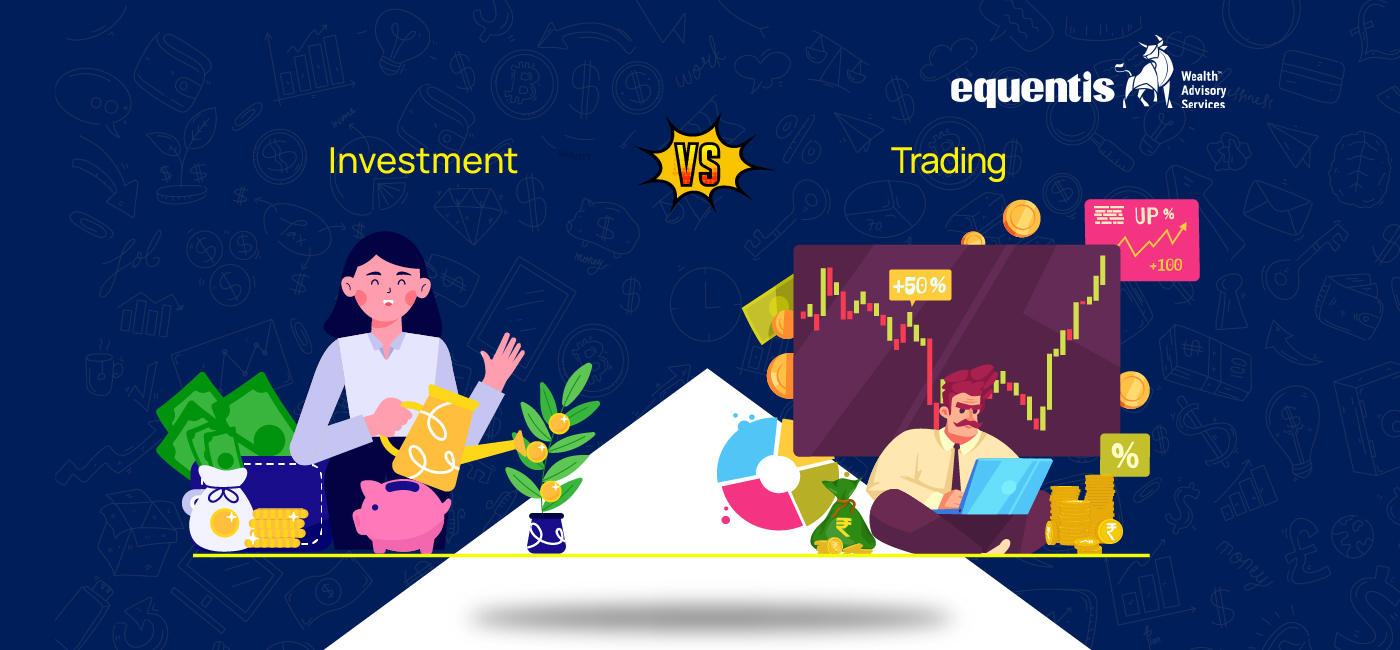

Understanding the difference between investment vs trading is one of the most important steps for anyone entering the stock market. While both involve buying and selling securities, their objectives, time horizons, risk levels, and strategies are entirely different.
Many investors confuse trading with investing and end up choosing an approach that does not match their financial goals, risk appetite, or mindset. In this guide, we break down stock market investment vs trading in simple terms to help you decide what suits you best.
What Is Stock Market Investment?
Stock market investment refers to buying shares or financial instruments with the intention of holding them for the long term. The goal is to build wealth over time through capital appreciation, dividends, and compounding.
Investors focus on business fundamentals such as revenue growth, profitability, management quality, industry outlook, and long-term economic trends. This approach is often guided by a stock market advisor who helps align investments with long-term financial goals.
Key Features of Stock Market Investment
- Long-term holding period (years or decades)
- Focus on company fundamentals and intrinsic value
- Lower transaction frequency
- Less emotional decision-making
- Benefits from compounding and dividends
What Is Trading in the Stock Market?
Trading involves buying and selling stocks frequently to profit from short-term price movements. Traders rely heavily on technical analysis, charts, patterns, volume, and market momentum rather than company fundamentals.
Trading can be intraday, swing-based, or short-term positional. While it offers quick profit opportunities, it also comes with higher risk and stress.
Key Features of Trading
- Short-term holding period (minutes to weeks)
- Focus on price action and technical indicators
- High transaction frequency
- Requires constant monitoring
- Emotionally demanding and risky
Investment vs Trading: Core Differences Explained
Time Horizon: Long Term vs Short Term Investment
The biggest difference between investment vs trading lies in the time horizon. Investing is a long-term strategy, while trading is a short-term activity.
Investors stay invested through market cycles, whereas traders aim to capitalize on short-term volatility.
Risk and Volatility
Investments tend to be less volatile over time, especially when diversified. Trading exposes capital to daily market fluctuations, making risk management critical.
Analysis Approach
Investing uses fundamental analysis—financial statements, business models, and economic trends. Trading relies on technical indicators like RSI, MACD, moving averages, and support-resistance levels.
Cost and Tax Efficiency
Frequent trading leads to higher brokerage costs and short-term capital gains tax. Long-term investing is generally more tax-efficient and cost-effective.
Emotional Discipline
Investing requires patience. Trading demands emotional control and quick decision-making. Most retail traders lose money due to overtrading and emotional bias.
Long Term vs Short Term Investment: Which Is Better?
There is no one-size-fits-all answer. The choice depends on:
- Financial goals
- Risk tolerance
- Time availability
- Market knowledge
- Emotional temperament
Most wealth in the stock market has historically been created through long-term investing, often with the guidance of a reliable stock market advisor.
Can You Combine Investment and Trading?
Yes. Many investors follow a hybrid approach:
- Core portfolio for long-term investment
- Small allocation for short-term trading
This allows participation in market opportunities without compromising long-term wealth creation.
Role of a Stock Market Advisor in Investing and Trading
A professional stock market advisor helps investors:
- Choose between investment vs trading based on goals
- Build diversified long-term portfolios
- Avoid emotional and impulsive decisions
- Manage risk effectively
- Stay compliant with SEBI regulations
For most retail participants, investing with expert guidance delivers more consistent results than self-directed trading.
Investment vs Trading: Which One Should You Choose?
Choose investment if you:
- Want long-term wealth creation
- Have limited time to track markets
- Prefer lower risk and stress
- Believe in business fundamentals
Choose trading if you:
- Can dedicate daily time to markets
- Understand technical analysis
- Have high risk tolerance
- Can control emotions
For beginners, long-term investing is generally the safer and more sustainable approach.
Final Thoughts on Investment vs Trading
The debate of investment vs trading is not about which is superior, but which is suitable for you. Long-term investing builds wealth steadily, while trading aims for quick gains with higher risk.
Understanding this difference can protect your capital, improve decision-making, and help you achieve your financial goals more effectively—especially when supported by a trusted stock market advisor.
Frequently Asked Questions (FAQs)
1. What is the main difference between investment vs trading?
Investment focuses on long-term wealth creation, while trading aims for short-term profits from price movements.
2. Is trading riskier than investing?
Yes, trading generally carries higher risk due to short-term market volatility.
3. Which is better for beginners: investment or trading?
Investment is better for beginners due to lower risk and simpler decision-making.
4. Can I make regular income through trading?
While possible, consistent income from trading is difficult and risky for most individuals.
5. How long should I stay invested in stocks?
Long-term investing usually means staying invested for at least 5–10 years.
6. Does trading require more time than investing?
Yes, trading requires daily monitoring, while investing needs periodic review.
7. Is technical analysis used in investing?
Primarily in trading. Investing relies more on fundamental analysis.
8. What role does a stock market advisor play?
A stock market advisor helps with strategy selection, portfolio construction, and risk management.
9. Is long term vs short term investment important?
Yes, between long term vs short term investment, choosing the right time horizon impacts risk, returns, and tax efficiency.
10. Are taxes higher in trading?
Yes, short-term capital gains tax applies to frequent trading profits.
11. Can long-term investors face losses?
Yes, but long-term investments generally recover over market cycles.
12. Do traders invest in company fundamentals?
Traders focus more on price trends than business fundamentals.
13. Is trading suitable for salaried individuals?
Only if they have time, discipline, and risk tolerance.
14. Can investing beat trading returns?
Historically, long-term investing has created more consistent wealth.
15. How much capital is required for trading?
Trading often requires active capital and strict risk management.
16. Can I switch from trading to investing?
Yes, many traders eventually shift to investing for stability.
17. Is emotional control important in trading?
Extremely important, as emotions can lead to heavy losses.
18. Does investing require professional guidance?
While not mandatory, guidance from a stock market advisor improves outcomes.
19. What is better during volatile markets?
Long-term investing tends to perform better during volatility.
20. Should I do both investing and trading?
A balanced approach can work if trading exposure is limited.
Disclaimer Note: The securities quoted, if any, are for illustration only and are not recommendatory. This article is for education purposes only and shall not be considered as a recommendation or investment advice by Equentis – Research & Ranking. We will not be liable for any losses that may occur. Investments in the securities market are subject to market risks. Read all the related documents carefully before investing. Registration granted by SEBI, membership of BASL & certification from NISM in no way guarantee the performance of the intermediary or provide any assurance of returns to investors.

Jaspreet Singh Arora is the Chief Investment Officer at Equentis, where he heads a seasoned team of equity analysts and turns two decades of market experience into portfolios that consistently beat the benchmark. A go-to voice on cement, building-materials, real-estate, and construction stocks, Jaspreet previously ran research desks at leading brokerages, honing an eye for the metrics that truly move share prices. His plain-spoken analysis helps investors cut through noise and act with conviction. When he’s not deep-diving into earnings calls, you’ll find him unwinding over sports, weekend cricket or a good history podcast.