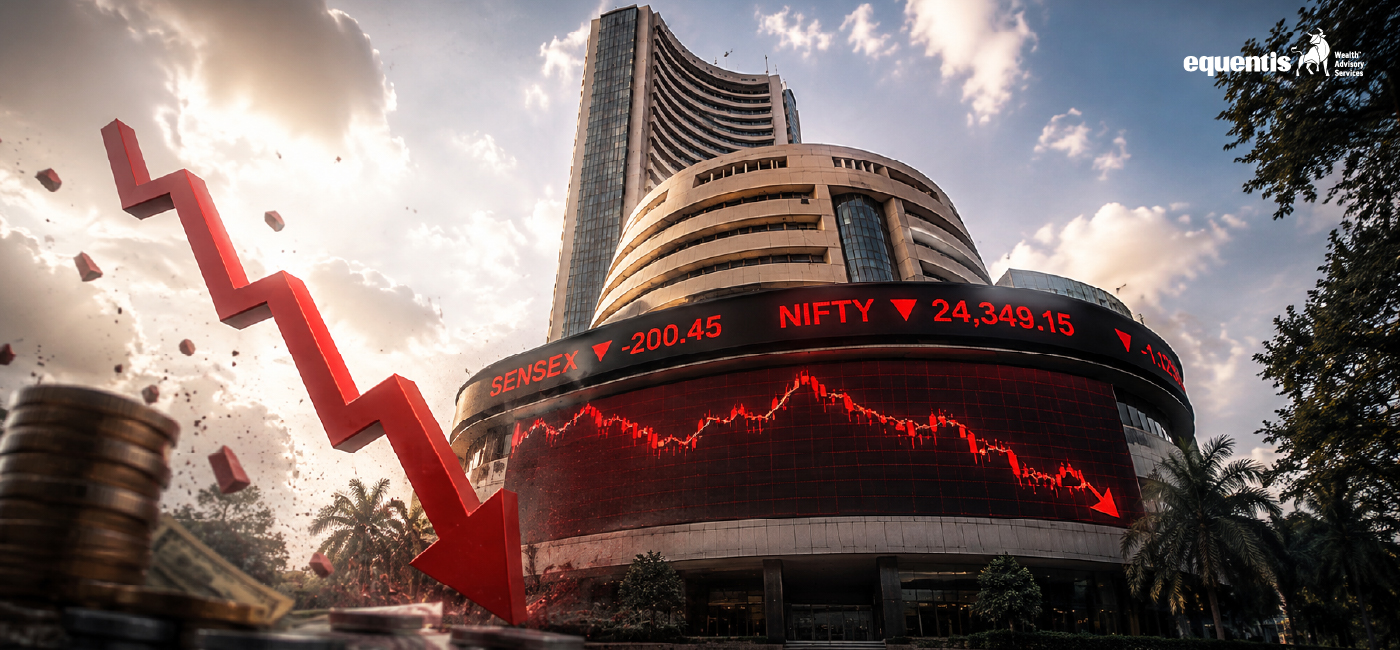

The Indian stock market remained under pressure on Monday, August 17, with the Sensex falling more than 200 points and the Nifty 50 trading below the 24,350 mark. Elevated crude oil prices, continued US-Iran tensions and cautious foreign investor sentiment are weighing on equities. The key takeaway for investors is that the market remains vulnerable to volatility, with oil prices and geopolitical developments likely to influence the next move.
Why Is the Stock Market Falling Today?
The latest decline comes after a weak week for Indian equities. The Nifty 50 had already fallen around 205 points during the previous week, while the Sensex lost roughly 500 points as investors remained cautious amid elevated energy prices and global uncertainty.
On Monday, selling pressure continued in several large sectors, particularly IT, banking and financial stocks. At the same time, some areas of the market, including metals and selected private banks, showed resilience during the session.
The market’s weakness is therefore not simply a result of one factor. Investors are balancing geopolitical risks, crude prices, global cues and the absence of a strong domestic trigger following the latest earnings season.
Crude Oil Remains the Biggest Concern
Crude oil continues to be one of the most important factors for Indian equities.
Brent crude was trading around $89 per barrel on Monday, while concerns over slower shipping through the Strait of Hormuz added to supply worries. US-Iran tensions have kept the geopolitical risk premium in oil elevated.
For India, higher crude prices matter because the country depends heavily on imported oil. More expensive crude can increase the import bill, put pressure on the rupee and potentially add to inflation.
The impact is also visible at the corporate level. Companies with high fuel or petroleum-linked input costs can face margin pressure if they are unable to pass higher costs on to customers.
Nifty 50 Below 24,350: Why Does It Matter?
The 24,350 level has emerged as an important reference point for the Nifty 50. Earlier technical analysis identified this zone as a level that could determine whether the index maintains short-term positive momentum. A sustained move below it can increase the possibility of the index testing lower support areas.
The Nifty was around 24,350 in afternoon trade on Monday after recovering from its earlier decline.
For traders, the immediate levels remain important:
- Resistance: 24,350–24,400
- Next resistance: Around 24,500
- Support: Around 24,200–24,250
- Lower support: Around 24,000
These levels should be treated as zones rather than exact turning points. A temporary move above or below a level does not necessarily confirm a breakout or breakdown.
What Is Happening With the Sensex?
The Sensex also remained under pressure, extending the cautious tone seen across Dalal Street.
At the start of trading, the index fell around 271 points, while the Nifty declined below 24,350. By 9:35 am, the Sensex was down 0.46% at 77,647 and the Nifty was lower by 0.34% at 24,282.45.
The indices later recovered some of their early losses, showing that buyers were still active at lower levels. However, the recovery has not yet changed the broader cautious market setup.
This is important because sharp intraday recoveries can sometimes indicate that investors are willing to buy on declines, even when the overall trend remains uncertain.
Which Sectors Are Under Pressure?
IT, banking and financial stocks were among the weaker areas during the early session. Meanwhile, metals, realty and some private bank stocks performed better later in the day.
The divergence between sectors suggests that investors are not selling everything indiscriminately.
Commodity-related companies can benefit from higher global commodity prices, while businesses exposed to energy costs may face greater pressure. Similarly, financial stocks are influenced by interest rates, credit growth, margins and investor expectations around economic growth.
This makes sector selection particularly important during a volatile market.
What Does FII Selling Mean for Indian Markets?
Foreign institutional investor activity remains another factor investors are monitoring.
When foreign investors sell Indian equities heavily, it can create additional pressure on benchmark indices because of the large amount of capital involved. It can also affect the rupee if foreign currency is taken out of domestic markets.
However, FII flows should not be viewed in isolation. Domestic institutional investors, mutual funds and retail investors can provide buying support, sometimes limiting the impact of foreign selling.
The broader direction of global markets and expectations around US interest rates can also influence foreign flows into emerging markets such as India.
Can Strong Earnings Support the Market?
One positive factor is that corporate earnings have remained relatively supportive.
Nifty 50 companies recorded 18% year-on-year net profit growth in Q1 FY27, according to Motilal Oswal Financial Services. However, the growth was concentrated, with five companies accounting for about 60% of the incremental earnings.
This suggests that while earnings remain a support for the market, investors may need to look beyond headline index-level profit growth and examine individual companies and sectors.
Strong earnings can help cushion the impact of geopolitical uncertainty, but they may not fully offset a sustained rise in crude prices or a sharp deterioration in global sentiment.
Opportunities and Risks for Investors
The current weakness can create opportunities for long-term investors who are researching fundamentally sound companies and have a suitable investment horizon. However, falling markets can remain volatile for longer than expected.
Key risks include:
- Further escalation in US-Iran tensions
- A sustained rise in crude oil prices
- Weakening of the rupee
- Continued foreign selling
- Global equity market weakness
- Pressure on corporate margins
Investors should therefore avoid making decisions purely because the Nifty or Sensex has fallen by a certain number of points.
What Should Investors Watch Next?
The immediate focus remains on crude oil and developments around the Strait of Hormuz. Investors should also watch global equity markets, foreign flows, the rupee and upcoming economic signals.
For the Nifty 50, the 24,200–24,250 area remains an important downside zone, while 24,350–24,400 needs to be reclaimed convincingly for the short-term setup to improve.
The Sensex will continue to take cues from heavyweight stocks, particularly banking, IT, energy and large consumer companies.
Conclusion
The Indian stock market’s decline on August 17 reflects a combination of elevated crude oil prices, geopolitical uncertainty and cautious investor sentiment. The Nifty 50’s move below 24,350 keeps the index in a sensitive zone, while the Sensex’s decline of more than 200 points highlights continued pressure on large-cap stocks.
For investors, the next move will depend less on a single day’s fall and more on whether crude prices remain elevated and whether geopolitical tensions ease. Strong corporate earnings provide some support, but sustained market recovery will likely require greater clarity on oil, global conditions and foreign flows.
Frequently Asked Questions
1. Why is the Sensex falling today?
The Sensex is under pressure mainly because of elevated crude oil prices, ongoing US-Iran tensions and cautious investor sentiment. Global uncertainty and foreign investor activity are also influencing the market. The decline follows a weak previous week, making investors more cautious about taking fresh positions.
2. Why is Nifty trading below 24,350?
Nifty is trading below 24,350 because of selling pressure linked to crude oil prices, geopolitical uncertainty and weak global cues. The 24,350 area is also an important technical level. Sustaining below this zone can keep short-term sentiment cautious, while a sustained recovery above it could improve market momentum.
3. What are the key Nifty support levels?
The 24,200–24,250 zone is an important near-term support area for Nifty, with 24,000 representing a lower level to watch. These are technical reference zones rather than guaranteed market floors. Actual price movement will depend on market breadth, global cues, crude prices and investor flows.
4. What is the immediate resistance for Nifty 50?
The 24,350–24,400 area is an important immediate resistance zone. A sustained move above this range could improve short-term sentiment and bring 24,500 into focus. However, traders generally look for confirmation through sustained price action rather than relying on a brief intraday move above resistance.
5. How are crude oil prices affecting Indian stocks?
Higher crude prices can increase India’s import costs and put pressure on inflation, the rupee and corporate margins. Industries such as aviation, logistics, paints and chemicals can be particularly sensitive to higher energy or petroleum-related costs. Oil producers can experience a different impact because their revenues are linked to crude prices.
6. What is happening with Brent crude today?
Brent crude was trading around $89 per barrel on August 17 as concerns about US-Iran tensions and slower shipping through the Strait of Hormuz continued to affect energy markets. The direction of crude remains important for India because of its high dependence on imported oil.
7. Are Indian stocks expected to remain volatile?
Volatility could remain elevated while geopolitical tensions and crude prices remain uncertain. Investors are also watching global markets, foreign flows and currency movements. However, the market’s actual direction will depend on how these factors develop rather than simply on the current level of volatility.
8. Are strong corporate earnings supporting Nifty?
Yes, corporate earnings are providing some support. Nifty 50 companies recorded 18% year-on-year net profit growth in Q1 FY27, according to Motilal Oswal Financial Services. However, earnings growth was concentrated among a small number of companies, so investors should examine individual sectors and businesses rather than relying only on index-level numbers.
9. Should investors buy stocks when the market falls?
A market decline does not automatically mean that every stock has become attractively valued. Investors should assess a company’s earnings, valuation, debt, business outlook and risk profile before investing. Long-term investors may use market corrections to research companies, but timing and portfolio allocation should match their individual financial goals.
10. What should investors watch next for the Indian stock market?
Investors should closely monitor crude oil prices, US-Iran developments, Strait of Hormuz shipping activity, foreign institutional flows, the rupee and global equity markets. For the Nifty, 24,200–24,250 is an important support area, while 24,350–24,400 remains a key zone for any short-term recovery.
Disclaimer Note: The securities quoted, if any, are for illustration only and are not recommendatory. This article is for education purposes only and shall not be considered as a recommendation or investment advice by Equentis. We will not be liable for any losses that may occur. Investments in the securities market are subject to market risks. Read all the related documents carefully before investing. Registration granted by SEBI, membership of BASL & certification from NISM in no way guarantee the performance of the intermediary or provide any assurance of returns to investors.

Jaspreet Singh Arora is the Chief Investment Officer at Equentis, where he heads a seasoned team of equity analysts and turns two decades of market experience into portfolios that consistently beat the benchmark. A go-to voice on cement, building-materials, real-estate, and construction stocks, Jaspreet previously ran research desks at leading brokerages, honing an eye for the metrics that truly move share prices. His plain-spoken analysis helps investors cut through noise and act with conviction. When he’s not deep-diving into earnings calls, you’ll find him unwinding over sports, weekend cricket or a good history podcast.