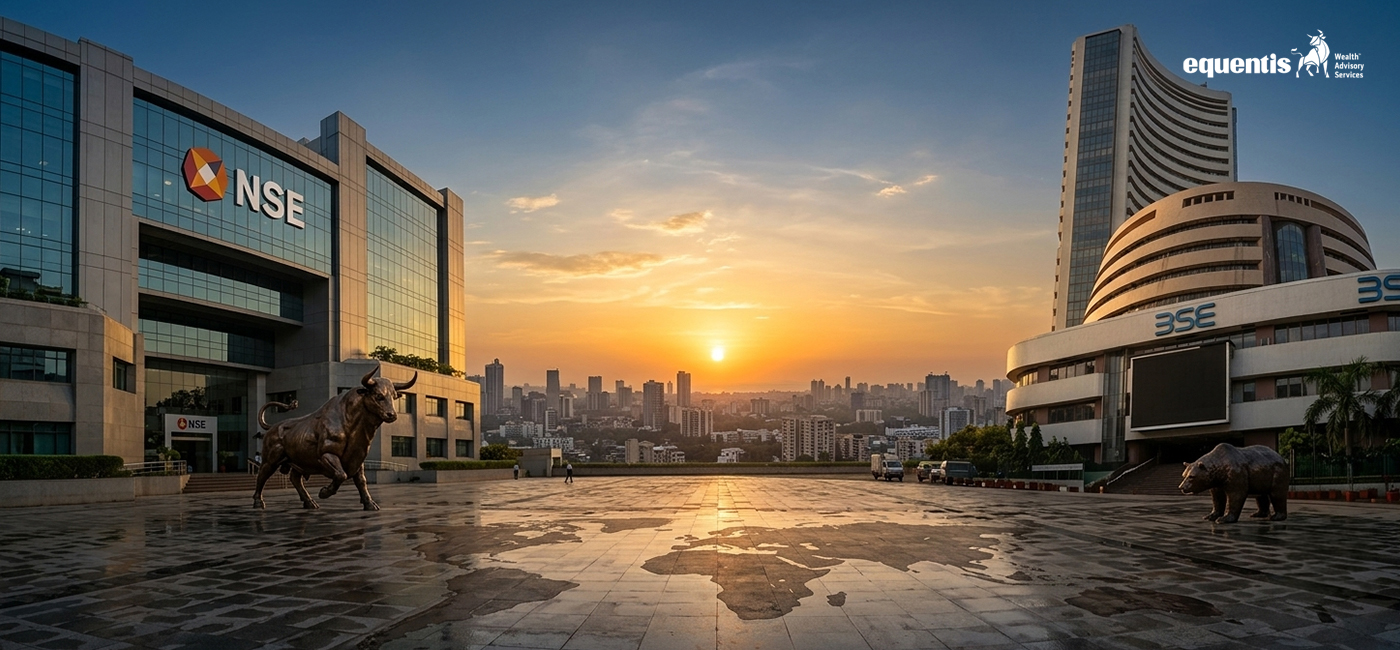

The Sensex and Nifty rebounded sharply on Thursday, August 20, after seven consecutive sessions of declines, with the Nifty moving above 24,200 and the Sensex gaining more than 600 points during the session. The recovery was driven by easing global bond yields, improved overseas cues, a firmer rupee, renewed foreign investor interest and short covering. However, investors should view the rebound in the context of the recent market weakness rather than assume that the broader correction is over.
Sensex and Nifty Today: What Changed?
The domestic market entered Thursday’s session after a difficult stretch. On August 19, the Nifty 50 closed at 24,078.30, down 76.60 points, while the Sensex ended at 76,909.68, falling 325.78 points. The Nifty had then recorded its seventh consecutive session of losses.
The sharp turnaround on August 20 therefore stands out. By the session, the Nifty had climbed above 24,200 while the Sensex was up more than 600 points at one point. The rebound was supported by buying across IT and financial stocks, with broader market indices also gaining.
Here are five factors investors should track.
1. US Bond Yields and Global Market Cues
One of the biggest triggers for the market rebound was a decline in US Treasury yields.
The US Treasury announced plans to increase buybacks of longer-duration government debt. The move helped ease pressure in global bond markets, with the US 10-year Treasury yield falling and the 30-year yield also declining. Lower yields can improve investor appetite for equities because they reduce the relative pressure from fixed-income assets and borrowing costs.
US equities also recovered after recent weakness, while Asian markets traded positively. For Indian investors, this matters because global institutional flows are influenced by movements in US yields, the dollar and overall risk appetite.
2. Rupee Strength and Crude Oil Remain Important
The Indian rupee also showed signs of stabilisation on Thursday, supported by intervention from the Reserve Bank of India and a softer US dollar. The rupee was around ₹95.61 per dollar, according to Reuters.
Currency movements matter for Indian equities because a weaker rupee can increase the cost of imported commodities, particularly crude oil. Higher oil prices can also put pressure on India’s import bill and inflation.
Crude oil therefore remains a key variable for the market. While oil prices were relatively steady during the latest session, geopolitical developments in West Asia could quickly change the outlook.
3. FII Activity Could Influence the Next Move
Foreign institutional investor activity remains another factor to watch.
Foreign flows can have a significant impact on large-cap Indian stocks and benchmark indices. After a period of selling pressure, any sustained return of foreign buying could provide additional support to the Nifty and Sensex.
However, investors should distinguish between a single day’s buying and a meaningful change in FII positioning. Global yields, currency movements, valuations and relative performance between Indian and overseas markets will continue to influence foreign investors.
The current rebound therefore needs confirmation through continued institutional participation rather than being judged only by one strong session.
4. IT and Financial Stocks Lead the Recovery
Sectoral movement is another important part of today’s market action.
IT stocks gained as investors returned to the sector following recent selling pressure. The Nifty IT index rose around 1.4%, while financial stocks also advanced. Overall, 13 of 16 key sectors gained during the session, indicating that the recovery was relatively broad rather than being concentrated in only a handful of stocks.
This matters because sector participation can provide clues about market breadth. A recovery supported by banks, financials, IT and other major sectors may have a stronger foundation than a move led by only a few heavyweight stocks.
5. Technical Levels and the Recent Losing Streak
Despite Thursday’s rebound, technical levels remain important because the market was coming off a prolonged decline.
Before the recovery, the Nifty had fallen below its 50-day moving average and closed at 24,078.30 on August 19. Analysts had identified 24,000 as an important support area, while 24,200 was being watched as an immediate resistance zone.
A sustained move above resistance could improve short-term sentiment, but another failure near higher levels could bring sellers back. Investors should therefore avoid interpreting one strong session as confirmation of a lasting trend reversal.
What Does Today’s Market Move Mean for Investors?
For long-term investors, the day’s recovery is more useful as a signal of changing sentiment than as a reason to make sudden portfolio decisions.
The market continues to face several external uncertainties, including crude oil prices, geopolitical tensions, global bond yields and foreign flows. At the same time, India’s corporate earnings backdrop has improved. Nifty 50 companies reported average profit growth of about 18% in the June 2026 quarter, the strongest pace in 10 quarters, according to Reuters.
This creates a mixed picture: domestic earnings provide support, while global risks can continue to create volatility.
Opportunities and Risks Ahead
A sustained decline in global bond yields, stable crude prices and continued foreign buying could support Indian equities. Strong corporate earnings and domestic demand could provide an additional foundation.
The risks are equally important. Higher crude prices, renewed geopolitical tensions, rising global yields or another wave of FII selling could put pressure on the indices. The recent seven-session losing streak also shows how quickly sentiment can change.
Investors should therefore focus on earnings, valuations and asset allocation rather than attempting to predict every daily movement in the Sensex or Nifty.
Conclusion
The Sensex and Nifty’s sharp recovery on August 20 was supported by five key factors: softer US bond yields, improved global cues, a more stable rupee, renewed buying interest from foreign investors and gains in IT and financial stocks.
Still, the rebound comes after seven consecutive sessions of Nifty declines. The next few sessions will be important for determining whether Thursday’s move represents a temporary recovery or the beginning of a more sustained stabilisation. For Indian investors, crude oil, global yields, FII flows, corporate earnings and key technical levels remain the main factors to watch.
Frequently Asked Questions
1. Why are Sensex and Nifty rising today?
The Sensex and Nifty rebounded on August 20 after seven consecutive sessions of declines. The recovery was supported by lower US bond yields, positive global market cues, a firmer rupee, renewed foreign investor buying and gains in IT and financial stocks. The Nifty moved above 24,200 during the session.
2. What are the five key factors affecting the stock market today?
The five major factors are US bond yields, global market sentiment, rupee movement and crude oil, foreign institutional investor flows, and sectoral performance led by IT and financial stocks. Technical levels on the Nifty are also important because the index recently experienced seven consecutive sessions of declines.
3. What was the Nifty closing level on August 19, 2026?
The Nifty 50 closed at 24,078.30 on August 19, 2026, declining 76.60 points or 0.32%. It was the index’s seventh consecutive losing session. The Sensex ended at 76,909.68, down 325.78 points or 0.42%.
4. How do US bond yields affect the Indian stock market?
US Treasury yields influence global borrowing costs and investor allocation between bonds and equities. When yields decline, pressure on risk assets can ease, potentially supporting emerging markets such as India. Lower yields can also reduce concerns around the relative attractiveness of US fixed-income investments compared with equities.
5. Why is the rupee important for Sensex and Nifty?
The rupee affects companies differently depending on their import and export exposure. A weaker rupee can increase the cost of imported commodities such as crude oil, while exporters may benefit from favourable currency conversion. Currency movements can also influence foreign investor returns when they invest in Indian assets.
6. Why are crude oil prices important for Indian markets?
India imports a significant amount of its crude oil requirement, so higher oil prices can increase the country’s import bill and create inflationary pressure. Expensive crude can also affect corporate margins, transportation costs and consumer spending. This makes oil prices particularly important for sectors such as aviation, paints, chemicals and logistics.
7. What is the important support level for Nifty today?
The 24,000 zone has been an important support area after the recent decline. The Nifty closed at 24,078.30 on August 19 before rebounding on August 20. Around 24,200 was also being watched as an immediate resistance area. Technical levels can change quickly, so investors should consider them alongside broader market conditions.
8. Are FIIs buying Indian stocks again?
Foreign investor activity is an important factor in the current market rebound. Reports on August 20 pointed to renewed foreign buying as one contributor to stronger sentiment. However, one or a few sessions of buying do not necessarily establish a long-term trend. Investors should monitor sustained FII flows along with global yields and currency movements.
9. Which sectors are supporting today’s market recovery?
IT and financial stocks were among the key contributors to the August 20 rebound. The Nifty IT index gained around 1.4%, while financials also advanced. Broader participation was visible, with 13 of 16 key sectors gaining during the session.
10. Does today’s Sensex and Nifty rebound mean the correction is over?
Not necessarily. The rebound is encouraging, but it followed seven consecutive sessions of declines in the Nifty. Investors should look for sustained buying, improving market breadth, stable global cues and a move above important technical levels before concluding that the broader trend has changed. Daily index gains alone do not confirm a lasting reversal.
Disclaimer Note: The securities quoted, if any, are for illustration only and are not recommendatory. This article is for education purposes only and shall not be considered as a recommendation or investment advice by Equentis. We will not be liable for any losses that may occur. Investments in the securities market are subject to market risks. Read all the related documents carefully before investing. Registration granted by SEBI, membership of BASL & certification from NISM in no way guarantee the performance of the intermediary or provide any assurance of returns to investors.

Jaspreet Singh Arora is the Chief Investment Officer at Equentis, where he heads a seasoned team of equity analysts and turns two decades of market experience into portfolios that consistently beat the benchmark. A go-to voice on cement, building-materials, real-estate, and construction stocks, Jaspreet previously ran research desks at leading brokerages, honing an eye for the metrics that truly move share prices. His plain-spoken analysis helps investors cut through noise and act with conviction. When he’s not deep-diving into earnings calls, you’ll find him unwinding over sports, weekend cricket or a good history podcast.