

In 2005, India’s solar industry was still in its early stages. Solar power was often seen as an expensive alternative rather than a practical source of mainstream energy. It was during this period that Vikram Solar began its journey, driven by a simple belief: India had the potential to harness the sun on a much larger scale.
Two decades later, that belief has grown into a global solar business with manufacturing capacity of 15.5 GW, a presence in 39 countries, and more than 10 GW of solar PV modules deployed worldwide.
Vikram Solar’s story is not just about manufacturing panels. It is about recognising an opportunity early, building capabilities patiently, investing in technology, and helping change the way India views clean energy.

From a bold idea to a solar business
Vikram Solar was incorporated in 2005, at a time when India’s solar capacity was only a small fraction of what it is today. The industry was still waiting for stronger policy support, better infrastructure, and wider acceptance.
Instead of waiting for the market to mature, Vikram Solar grew alongside it.
The company’s early years were focused on execution. By 2011, it had commissioned grid-connected solar projects in Chhattisgarh and Odisha. In 2013, it contributed to the solarisation of Cochin International Airport and commissioned what it describes as India’s first floating solar PV plant—a 10 kW project.
These projects helped make solar power more tangible. They showed that solar energy was not merely an idea for the future but a technology that could be used in real-world conditions.
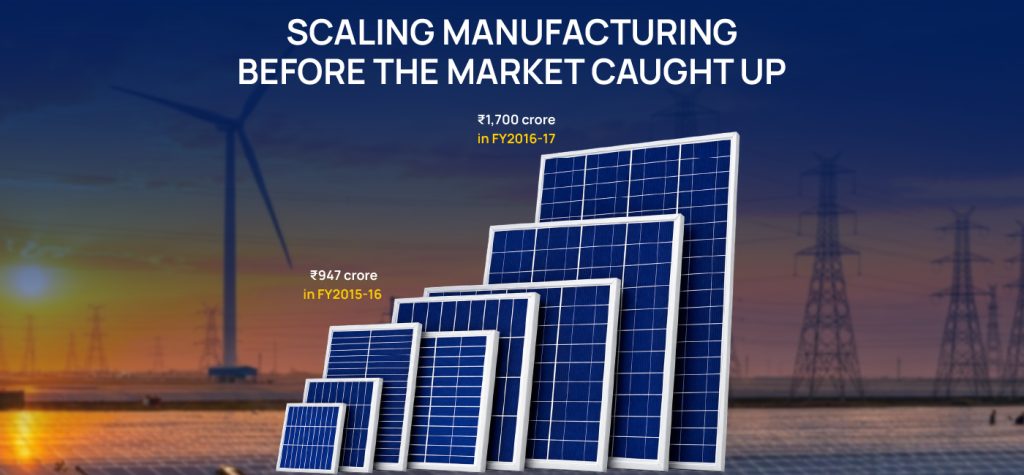
Scaling manufacturing before the market caught up
The next phase of Vikram Solar’s growth was defined by scale.
The company reached 500 MW of annual production capacity in 2015 and crossed the 1 GW mark in 2017. This came at a time when India was setting ambitious renewable energy targets and the global solar market was expanding rapidly.
The company’s financial growth reflected this progress. Revenue increased from ₹947 crore in FY2015-16 to nearly ₹1,700 crore in FY2016-17, according to company disclosures made around the time it achieved the 1 GW milestone.
Vikram Solar did not limit itself to manufacturing modules. It also built capabilities in engineering, procurement and construction (EPC), as well as operations and maintenance services. This allowed it to offer customers a more complete solar energy solution.
Today, its EPC portfolio has an aggregate capacity of approximately 1.41 GW, while its operations and maintenance portfolio exceeds 1,396 MW.

Turning technology into a brand advantage
As more companies entered the solar manufacturing business, capacity alone was no longer enough. Product reliability, efficiency, and technology became equally important.
Vikram Solar increased its manufacturing capacity to 2.5 GW in 2022 and 3.5 GW in 2023. Its research and development laboratory received NABL accreditation, and the company secured certifications for M10 and G12 cell modules under updated TÜV Rheinland standards.
It was also recognised as a BloombergNEF Tier 1 module manufacturer and became a repeat Kiwa PVEL Top Performer.
These achievements helped the company build a reputation for combining Indian manufacturing with quality and technological capability.
This positioning became especially important as solar manufacturing became closely linked with India’s broader “Make in India” ambitions. Vikram Solar was no longer just selling solar panels. It was presenting itself as an Indian clean-energy company capable of serving customers both at home and overseas.

The marketing shift: from panels to people
One of the most interesting parts of Vikram Solar’s journey has been its shift from being a traditional B2B technology company to becoming a more visible and emotionally engaging brand.
Its recent campaigns have used messages such as “Khushiyon Wali Sunshine” and “Sunshine se hoga”. These campaigns connect solar energy with homes, businesses, progress, and everyday aspirations.
In 2025, the company launched its first television advertising campaign. This marked an important change in the way it communicated with the public. Solar energy was no longer being discussed only in terms of watts, modules and production capacity. It was being linked to optimism, prosperity and a cleaner future.
The company has also used high-visibility partnerships to strengthen its brand. Its FY2024-25 annual report highlighted its association with Kolkata Knight Riders, giving the brand access to a popular cultural platform with strong regional and national appeal.

Growth through difficult market cycles
Vikram Solar’s growth has not taken place in an easy or predictable market.
Solar manufacturers face constant pressure from global supply chains, changing commodity prices, import competition, policy changes and rapid shifts in module technology. New product formats and manufacturing methods also require companies to invest continuously.
Vikram Solar’s response has been to diversify and move towards greater backward integration.
In FY2024-25, the company announced plans for cell manufacturing, increased its module manufacturing capacity to 4.5 GW and entered the energy storage market through its solid-state battery energy storage system business.
The financial performance showed the impact of this strategy. Consolidated revenue from operations rose from ₹1,730 crore in FY2021-22 to ₹2,073 crore in FY2022-23 and ₹2,511 crore in FY2023-24.
In FY2024-25, revenue increased further to ₹3,423.45 crore, representing a year-on-year growth of 36.34%. Sales volumes also more than doubled, rising from 879 MW to 1,900 MW.
This was significant because the growth came from higher sales volumes and expanded capacity, rather than depending only on price increases.

FY2025-26: another year of strong growth
Vikram Solar’s momentum continued into FY2025-26. Consolidated revenue from operations reached approximately ₹4,800 crore, while profit after tax rose to around ₹470 crore.
The company also reported strong performance in the first quarter of FY2026-27. Consolidated revenue for the April–June 2026 quarter stood at approximately ₹1,563 crore, up 38% year on year. The growth was supported by higher module shipments and continued EPC execution.
This performance suggests that the company is benefiting from both the expansion of India’s solar market and the growing demand for domestically manufactured modules.
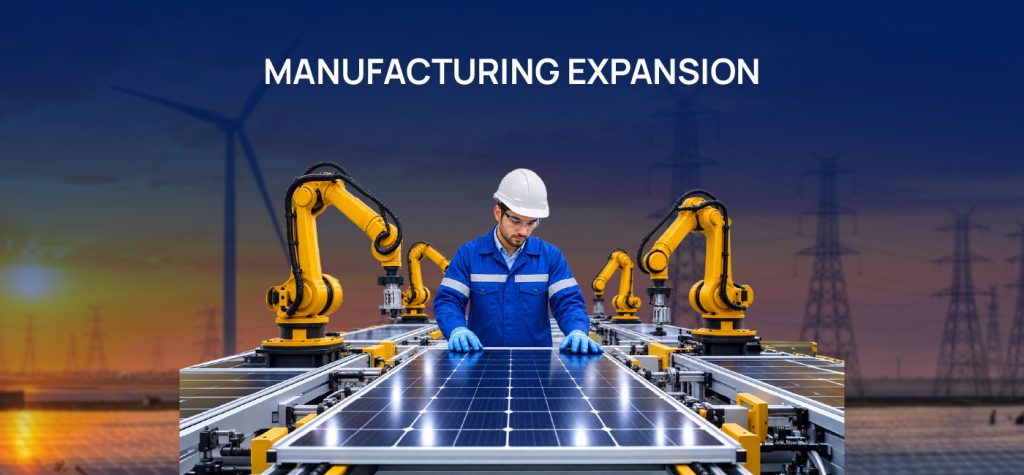
Manufacturing expansion: from 4.5 GW to 15.5 GW
Vikram Solar has made a significant jump in manufacturing capacity.
In 2026, the company inaugurated a 6 GW solar PV module manufacturing facility at Gangaikondan in Tirunelveli, Tamil Nadu. The plant increased Vikram Solar’s total module manufacturing capacity to 15.5 GW.
The 186-acre greenfield facility began production in June 2026, with its first modules rolled out during the same month.
The company is also working towards building a fully integrated manufacturing ecosystem:
- It plans to develop 9 GW of solar cell manufacturing capacity by FY2027 and increase it to 12 GW by FY2028.
- A 9 GW wafer and ingot manufacturing facility is planned at the Gangaikondan site, with commissioning targeted by FY2029.
- The company aims to build 15 GWh of battery energy storage manufacturing capacity by FY2030.
- Its solid-state battery energy storage business is expected to become an important part of its future clean-energy portfolio.
This level of integration could help Vikram Solar reduce its dependence on imports and improve its competitiveness in both domestic-content and non-domestic-content markets.

Global deployments and a stronger order book
By 2026, Vikram Solar had crossed 10 GW in cumulative global solar module deployments. The company achieved this milestone after doubling its deployments from 5 GW to 10 GW in just two years.
According to the company, its installed modules are capable of powering more than five million Indian homes.
Its order book also remained strong, standing at approximately 8.2 GW in 2026. The company has been targeting production of between 7.5 GW and 8 GW during FY2026-27, including both domestic-content and non-domestic-content modules.
This provides the company with greater visibility as it expands its manufacturing operations.

Investments and the next phase
To support its expansion, Vikram Solar has outlined a capital expenditure plan of more than ₹9,100 crore.
The planned investment includes:
- ₹5,400 crore for 12 GW of solar cell manufacturing capacity.
- ₹3,700 crore for the first phase of wafer and ingot manufacturing.
- Additional investments in battery energy storage and international market development.
The company is also expanding its presence in overseas markets. With projects and exports across 39 countries, its Tier 1 status and repeat Kiwa PVEL recognition are helping it compete in markets where product quality and long-term reliability are important purchasing factors.

From Indian manufacturer to global clean-energy brand
Vikram Solar began its journey when solar power was still a niche concept in India. Over the past 20 years, it has grown alongside the country’s renewable energy ambitions.
The company invested in manufacturing before the market reached its current scale, built credibility through projects and certifications, expanded into EPC and maintenance services, and gradually developed a more relatable brand voice.
Its journey reflects the broader transformation of India’s solar industry. What was once viewed as an expensive and specialised technology is now becoming a central part of the country’s energy future.
The company’s brand legacy rests on this transformation: it started by believing in India’s solar potential and has spent two decades helping turn that potential into a visible reality.
The next challenge will be even bigger. Vikram Solar will need to convert its manufacturing scale into continued technological leadership, customer trust and global competitiveness.
If its first two decades were about proving that an Indian solar company could grow with the market, the next chapter will be about proving how far that growth can go.

Jaspreet Singh Arora is the Chief Investment Officer at Equentis, where he heads a seasoned team of equity analysts and turns two decades of market experience into portfolios that consistently beat the benchmark. A go-to voice on cement, building-materials, real-estate, and construction stocks, Jaspreet previously ran research desks at leading brokerages, honing an eye for the metrics that truly move share prices. His plain-spoken analysis helps investors cut through noise and act with conviction. When he’s not deep-diving into earnings calls, you’ll find him unwinding over sports, weekend cricket or a good history podcast.