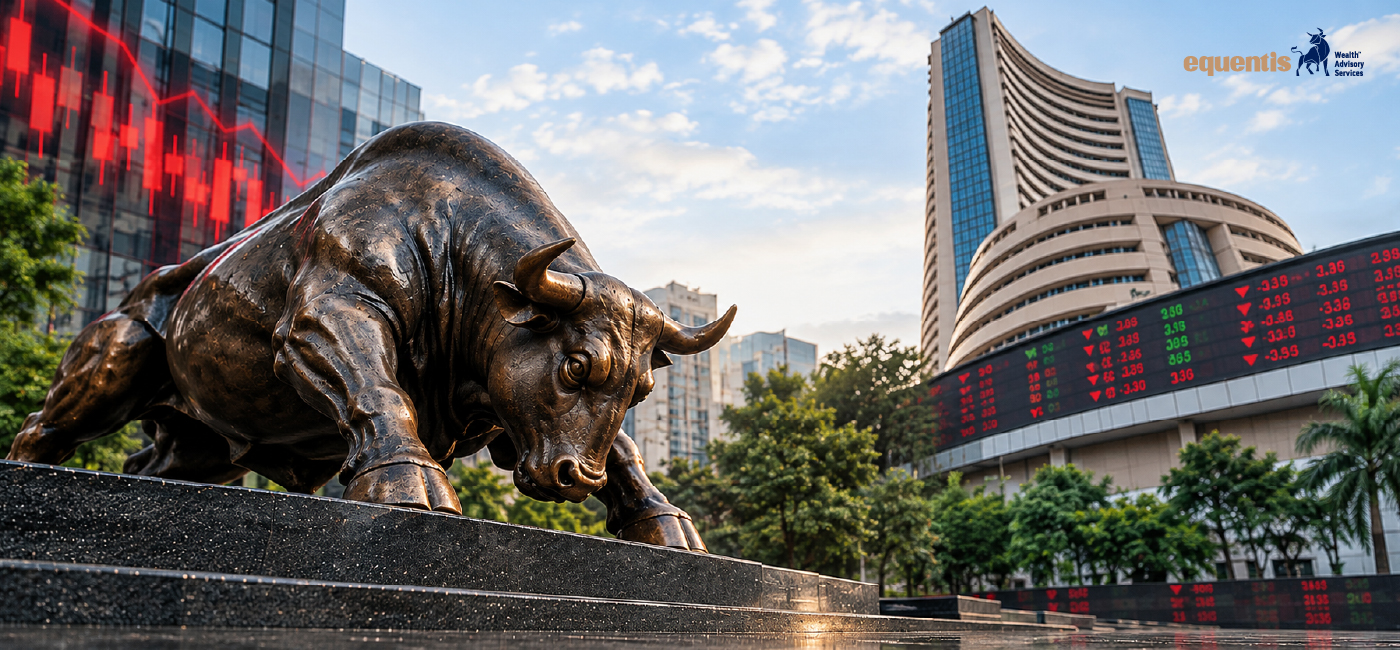

The Indian stock market opened lower on October 26, 2026, with the Sensex falling over 100 points and the Nifty 50 slipping below the 22,500 mark as information technology (IT) and public sector bank stocks led the losses. Weak global cues, elevated crude oil prices and uncertainty ahead of the US Federal Reserve’s policy meeting weighed on investor sentiment. The early decline reflected broad selling pressure, although some pharmaceutical and private banking stocks showed relative resilience.
Stock Market Today: Sensex and Nifty Key Updates
Indian equity benchmarks began Monday’s session in negative territory, extending the market’s recent weakness. The Sensex opened at 72,990.04, down 133.79 points, while the Nifty 50 fell 75.60 points to 22,524.40.
Selling intensified in early trade, with the Nifty slipping below 22,500 and the Sensex declining by more than 500 points at one stage. The weakness extended beyond large-cap stocks, with a majority of actively traded shares recording losses.
For investors, the key concern is whether the decline reflects a temporary reaction to global developments or a broader shift in market sentiment. Corporate earnings, foreign investor flows and movements in crude oil prices are likely to remain important influences on the market’s direction.
Why Is the Indian Stock Market Falling Today?
1. IT Stocks Lead the Decline
IT stocks were among the biggest drags on the market, with the Nifty IT index falling more than 2% in early trade. Infosys, HCL Technologies and other technology companies faced selling pressure as investors reassessed the sector’s growth outlook.
Infosys shares came under pressure after the company reduced its FY27 constant-currency revenue growth guidance to 1% to 2%, citing weakness in North America and pricing pressure on large contracts. The development raised concerns about the near-term earnings outlook for Indian IT services companies, which depend heavily on spending by clients in the United States and Europe.
2. PSU Bank Stocks Face Selling Pressure
Public sector bank stocks also contributed to the decline, with the Nifty PSU Bank index falling around 1.36% in early trade. Weakness across banking shares can weigh on benchmark indices because financial stocks account for a significant portion of the Indian equity market.
Investors are assessing quarterly earnings, credit growth, funding costs and asset quality across the banking sector. However, the decline in PSU bank stocks does not necessarily indicate that every public sector lender is experiencing weaker financial performance.
3. Rising Crude Oil Prices Create Inflation Concerns
Elevated crude oil prices remain another important headwind for Indian equities. Brent crude was trading around $114 per barrel during the morning session, following a recent surge driven by geopolitical tensions and concerns about supply disruptions.
India imports a substantial share of its crude oil requirements. Prolonged increases in oil prices can raise fuel and transportation costs, put pressure on inflation and affect the earnings of oil-consuming businesses.
Higher energy costs may also complicate monetary policy decisions if inflation remains elevated. This combination can make investors more cautious about stocks, particularly companies with limited pricing power.
Global Cues: Why Investors Are Watching the US Federal Reserve
Markets are also preparing for the US Federal Reserve’s October 27 to 28 policy meeting. Although interest rates are widely expected to remain unchanged, investors will look for signals about the future direction of US monetary policy.
US interest rates can influence global capital flows, bond yields and the relative attractiveness of emerging markets such as India. A more restrictive outlook could strengthen the US dollar and make foreign investors more cautious about allocating money to Indian equities.
Geopolitical developments in the Middle East are adding to uncertainty by affecting oil prices and global risk sentiment. Together, these factors have contributed to the cautious start to the trading week.
Which Sectors Are Gaining Despite the Market Fall?
Not every sector moved lower on October 26. Pharmaceutical and healthcare stocks showed relative resilience, while the Nifty Private Bank index was positive during early trading.
This difference matters because a decline in the Sensex or Nifty does not mean every listed company is falling. Sector-specific earnings, company announcements and business outlooks can produce different share price movements even when the broader market is weak.
What Should Investors Watch Next?
Investors should monitor the following developments before drawing conclusions about the market’s next move:
- Corporate earnings: Quarterly results and management guidance may influence sector-specific performance.
- Crude oil prices: A sustained rise could increase inflation concerns and pressure corporate margins.
- Foreign investor flows: Continued selling by foreign portfolio investors could weigh on large-cap stocks.
- US Federal Reserve commentary: Signals about future interest rates may affect global risk appetite.
- Market breadth: The number of advancing and declining stocks can help indicate whether selling is concentrated or widespread.
Short-term volatility can create sharp price movements in both directions. Investors should avoid making decisions based solely on a single session’s index decline.
Conclusion
The stock market today opened lower, with the Sensex falling over 100 points and the Nifty slipping below 22,500 as IT and PSU bank stocks faced selling pressure. Weakness in Infosys, elevated crude oil prices, geopolitical uncertainty and the upcoming US Federal Reserve meeting contributed to cautious sentiment.
The next direction of the Indian stock market will depend on quarterly earnings, oil price movements, global cues and investor flows. Rather than reacting to the daily decline alone, investors should focus on business fundamentals, valuations and their individual investment horizons.
Frequently Asked Questions
1. Why is the Sensex falling today?
The Sensex declined on October 26, 2026, amid selling in IT and PSU bank stocks, elevated crude oil prices and uncertainty surrounding global monetary policy. Weakness in technology shares following Infosys’ reduced revenue guidance also contributed to the cautious mood in Indian equities.
2. Why is the Nifty 50 trading below 22,500?
The Nifty 50 slipped below 22,500 during early trading as investors sold shares across several sectors. Weak global cues, pressure on IT stocks, concerns about oil prices and uncertainty ahead of the US Federal Reserve meeting contributed to the decline.
3. Which sectors are dragging the Indian stock market today?
Information technology and public sector banking stocks were among the biggest sectoral laggards in early trade. Realty, oil and gas, consumer durables and automobile stocks also faced pressure, while pharmaceutical and private banking shares showed relative resilience.
4. Why are IT stocks falling today?
IT stocks faced selling pressure after Infosys reduced its FY27 revenue growth guidance to 1% to 2%. The revised outlook raised concerns about client spending, pricing pressure and growth in North America, a key market for Indian IT services companies.
5. Why are PSU bank stocks falling today?
PSU bank stocks declined amid broader market weakness and cautious investor sentiment. Investors are monitoring quarterly earnings, loan growth, deposit costs and asset quality. Sector-wide selling does not necessarily mean that every public sector bank has reported weaker financial performance.
6. How are crude oil prices affecting the Indian stock market?
Higher crude oil prices can increase India’s import bill, raise transportation and production costs and put pressure on inflation. These factors may affect corporate profitability, consumer spending and expectations about interest rates, making investors more cautious about Indian equities.
7. What is the impact of the US Federal Reserve meeting on Indian stocks?
The Federal Reserve’s policy decision and guidance can influence global interest rates, bond yields, currency movements and foreign investment flows. A more restrictive outlook may reduce risk appetite for emerging markets, while a less restrictive outlook could support sentiment, depending on other economic conditions.
8. Which sectors are performing better despite the market decline?
Pharmaceutical and healthcare stocks showed relative resilience during early trading on October 26, 2026. The private banking index also traded positively at the time of reporting. Sector performance can change throughout the session as investors respond to company-specific news and market developments.
9. Should investors buy stocks when the Sensex and Nifty fall?
A market decline does not automatically make stocks attractive. Investors should assess company earnings, valuations, debt, growth prospects and their own risk tolerance. Long-term investors may use market corrections to review portfolios, but buying decisions should be based on fundamentals rather than short-term price movements alone.
10. What should investors watch after today’s market decline?
Investors should track quarterly earnings, crude oil prices, foreign institutional investor activity, the Federal Reserve’s policy commentary and broader market breadth. These factors can help indicate whether selling pressure is easing or continuing, although no single indicator can reliably predict the market’s next move.
Disclaimer Note: The securities quoted, if any, are for illustration only and are not recommendatory. This article is for education purposes only and shall not be considered as a recommendation or investment advice by Equentis . We will not be liable for any losses that may occur. Investments in the securities market are subject to market risks. Read all the related documents carefully before investing. Registration granted by SEBI, membership of BASL & certification from NISM in no way guarantee the performance of the intermediary or provide any assurance of returns to investors.

Jaspreet Singh Arora is the Chief Investment Officer at Equentis, where he heads a seasoned team of equity analysts and turns two decades of market experience into portfolios that consistently beat the benchmark. A go-to voice on cement, building-materials, real-estate, and construction stocks, Jaspreet previously ran research desks at leading brokerages, honing an eye for the metrics that truly move share prices. His plain-spoken analysis helps investors cut through noise and act with conviction. When he’s not deep-diving into earnings calls, you’ll find him unwinding over sports, weekend cricket or a good history podcast.