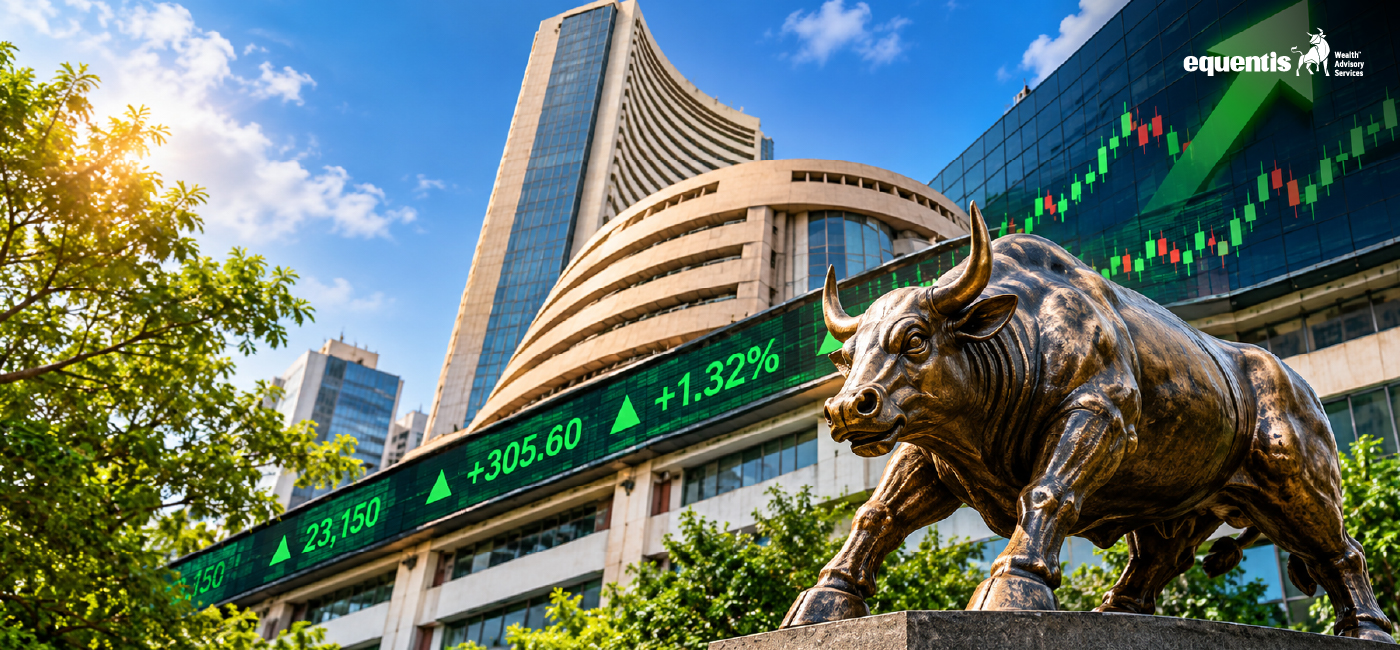

The Indian stock market staged a sharp intraday recovery on November 4, 2026, as the Nifty 50 erased an initial decline of nearly 115 points and the Sensex jumped 448 points in early trade. The turnaround highlighted renewed buying interest, supported by foreign institutional investor (FII) inflows, softer crude oil prices and improving earnings sentiment. However, the recovery also comes after a strong rally, making sustainability and profit booking important factors for investors.
Stock Market Today: How Did Nifty and Sensex Recover?
The benchmark indices opened lower on Wednesday but quickly reversed direction as buyers stepped in.
The Nifty 50 opened at 23,742.25 against its previous close of 23,810.85. It slipped to an intraday low of 23,696.15 before recovering sharply to 23,935.30 by 9:50 AM, gaining 124.45 points from the previous close.
Meanwhile, the Sensex climbed approximately 448 points to 77,365.45 during the same period.
The Nifty’s recovery of more than 239 points from its morning low demonstrated strong buying interest at lower levels. The rebound also brought the index closer to the psychologically important 24,000 mark.
Why Did the Indian Stock Market Witness a Sharp Turnaround?
1. Foreign Investor Buying Supports Sentiment
Foreign institutional investors have returned to buying Indian equities after an extended period of selling.
FII purchases can support market liquidity and help benchmark indices recover, particularly when buying is concentrated in large-cap banking and financial stocks.
Foreign investors purchased approximately ₹6,837 crore worth of shares on November 3, following purchases of around ₹3,115 crore on November 2. These two sessions brought their combined net buying close to ₹10,000 crore.
However, domestic institutional investors were net sellers on November 3, highlighting that market participation remains mixed.
2. Falling Crude Oil Prices Provide Relief
Lower crude oil prices have also supported sentiment towards Indian equities.
India imports a substantial portion of its crude oil requirements, making international energy prices important for inflation, currency stability and corporate profitability.
When crude prices decline, India’s import expenditure may reduce, potentially supporting the rupee and easing operating costs for fuel-intensive businesses.
A sustained decline in oil prices can benefit sectors such as aviation, paints, FMCG and logistics, although the actual impact depends on company-specific conditions.
3. Improving Corporate Earnings
The ongoing Q2 FY27 earnings season is another important market trigger.
Investors are assessing whether companies can maintain revenue growth and profitability despite global uncertainties. Better-than-expected results can encourage buying, particularly in companies whose valuations have become more attractive after previous corrections.
The recent recovery also reflects expectations that earnings resilience could support Indian equities over the coming quarters.
Which Sectors and Stocks Led the Market Recovery?
The early recovery was visible across banking and financial services, which helped support benchmark indices.
Early market performance on November 4, 2026
| Index | Early Movement |
|---|---|
| Nifty Bank | Up 0.43% |
| Nifty Financial Services | Up 0.92% |
| Nifty Next 50 | Up 0.70% |
Among individual stocks, Adani Ports and Apollo Hospitals were among the early gainers. However, the recovery was not uniform, with Asian Paints declining and Axis Bank showing only a marginal gain.
This distinction matters because a benchmark rally driven by a few heavyweight stocks may not reflect equally strong performance across the broader market.
What Does the Nifty Recovery Mean for Retail Investors?
The Nifty wiping out its 115-point fall is an indication that buyers were willing to enter the market after the initial weakness. Such recoveries can improve short-term sentiment, but they do not guarantee that the market will continue moving higher.
For retail investors, the development has several practical implications.
- Long-term investors: Focus on business fundamentals, earnings growth and valuations instead of reacting to every intraday movement.
- Short-term traders: Monitor price momentum, volatility and predefined risk limits.
- New investors: Avoid rushing into stocks simply because benchmark indices recover sharply.
- Existing shareholders: Review whether the companies in their portfolios remain aligned with their financial goals.
The market’s direction is influenced by institutional flows, global cues and corporate earnings, making disciplined decision-making particularly important during volatile sessions.
Nifty 24,000: What Are the Important Levels to Watch?
The Nifty’s recovery brought the index close to 24,000, making this level an important psychological reference point.
Indicative technical levels discussed by market participants
| Nifty Level | Significance |
|---|---|
| 24,000 | Psychological resistance area |
| 23,950 | Immediate intraday resistance reference |
| 23,800 | Near-term support reference |
| 23,700 | Morning low and important intraday reference |
A sustained move above 24,000 could encourage further buying interest, while failure to hold the recovery may invite profit booking.
These levels are technical references rather than guaranteed turning points. Market conditions and trading volumes can change their relevance.
Opportunities and Risks After the Market Rebound
The sharp recovery suggests that market participants are increasingly willing to buy on declines. This can be constructive when supported by improving earnings, foreign investment and stable macroeconomic conditions.
However, risks remain:
- US political developments may affect global risk appetite.
- Technology stocks could remain volatile amid concerns about artificial intelligence spending.
- Foreign investor buying may not continue consistently.
- A sharp rally can attract profit booking at higher levels.
- Crude oil prices and geopolitical developments remain uncertain.
Investors should distinguish between a temporary intraday recovery and a sustained improvement in market fundamentals.
Conclusion
The Nifty’s recovery from an initial 115-point fall and the Sensex’s 448-point jump demonstrate the strength of buying interest during early trading on November 4, 2026. Foreign investor inflows, lower crude oil prices and earnings optimism provided support to sentiment.
The next important test is whether the Nifty can sustain its recovery near 24,000. For investors, the focus should remain on earnings, valuations and risk management rather than assuming that one strong turnaround guarantees a continuing rally.
Frequently Asked Questions
1. Why did the Nifty recover after falling 115 points?
The Nifty recovered after opening lower as buying interest emerged at lower levels. Foreign institutional investor purchases, relatively softer crude oil prices and improving earnings sentiment supported the rebound. The index recovered more than 239 points from its morning low, demonstrating strong intraday buying momentum.
2. How many points did the Sensex gain on November 4, 2026?
The Sensex gained approximately 448 points during early trading on November 4, 2026, reaching around 77,365.45. The recovery followed an initially weak opening and reflected renewed buying interest across financial stocks and other heavyweight companies.
3. What caused the sudden stock market recovery today?
The recovery was supported by renewed foreign investor buying, improving corporate earnings expectations and lower crude oil prices. Banking and financial stocks also contributed to the rebound. However, global market uncertainty and US political developments continued to influence investor sentiment.
4. Can the Nifty cross 24,000 after today’s recovery?
The Nifty approached 24,000 during early trading, making this level an important resistance area. A sustained move above it could encourage further buying, while rejection near the level may trigger profit booking. Technical levels are indicators, not guarantees of future market direction.
5. How do FII inflows affect the Indian stock market?
Foreign institutional investor inflows can improve liquidity and support stock prices, particularly in large-cap companies. Their purchases may strengthen sentiment and contribute to benchmark recoveries. However, foreign investment flows can change quickly depending on valuations, global interest rates and geopolitical developments.
6. Why are falling crude oil prices positive for Indian equities?
India imports a large share of its crude oil requirements. Lower oil prices can reduce import expenditure, ease inflationary pressures and improve profitability for fuel-intensive businesses. These developments can support economic growth and corporate earnings, although the actual impact varies across industries.
7. Which sectors benefited from the Nifty recovery?
Banking and financial services were among the sectors supporting the early recovery. The Nifty Bank and Nifty Financial Services indices advanced during early trading. However, sectoral performance remained uneven, highlighting the importance of examining individual stocks rather than relying exclusively on benchmark movements.
8. What should investors do after a sharp stock market recovery?
Investors should avoid making decisions solely based on intraday market movements. Long-term investors can focus on earnings, valuations and portfolio allocation, while traders should maintain risk management discipline. A strong recovery does not automatically mean every stock has become attractive.
9. Is a market turnaround a sign of a bullish trend?
An intraday turnaround indicates that buying interest has emerged after weakness, but it does not independently establish a bullish trend. A sustained recovery generally requires continued buying participation, improving market breadth and supportive fundamentals. Investors should assess subsequent sessions before interpreting the movement as a trend reversal.
10. What are the important Nifty levels to watch after today’s recovery?
The 24,000 mark is an important psychological resistance area for the Nifty 50. On the downside, 23,800 and the morning low near 23,700 are relevant intraday reference levels. These technical levels may change as market conditions evolve and should not be treated as guaranteed support or resistance.
Disclaimer Note: The securities quoted, if any, are for illustration only and are not recommendatory. This article is for education purposes only and shall not be considered as a recommendation or investment advice by Equentis . We will not be liable for any losses that may occur. Investments in the securities market are subject to market risks. Read all the related documents carefully before investing. Registration granted by SEBI, membership of BASL & certification from NISM in no way guarantee the performance of the intermediary or provide any assurance of returns to investors.

Parvati Rai is the Vice President of the Research team at Equentis. She has over 15 years of equity-research and strategy-consulting experience. A specialist in deep-dive valuations, financial modelling, and forecasting, she has built research desks from the ground up, by steering buy-side, sell-side, and independent coverage across sectors. When she isn’t fine-tuning models, Parvati unwinds on nature treks and mentors aspiring analysts.