Economy

This section offers content on things happening in the country. Any news update on India, its GDP, plans and levels globally will be included in this section.

The current Covid-19 crisis is a significant eye-opener for most countries across the world, including India. It has shown why it’s time for India to reduce or eliminate its dependency on other countries and instead become self-reliant making full use of our domestic potential.

However, there are two aspects to this. Firstly, those things which India has no choice but to be dependent on other nations such as oil. Secondly, those areas where India can stop depending on other countries by becoming self-reliant.

First, let\’s take a look at the first aspect, i.e. oil. Covid-19 has hammered the Indian economy badly. But even in these difficult times, if there is one bright spot for India, it is low oil prices.

India is one of the largest importers of crude oil in the world, importing almost 85 per cent of its oil. According to publicly available data, India imported 4.5 mb/d of crude oil between April 2019 to January 2020 compared to the same period a year ago.

So, any significant fall in oil prices like what we are witnessing currently will be hugely beneficial to India in multiple ways such as:

Reduction in India’s current account balance and lower import bill

A fall in oil price in the range of $30 per barrel means a much lower import bill which will help in reducing India’s current account deficit by a greater extent. As per a report by Livemint, every fall in oil prices by $10 per barrel helps reduce the current account deficit by $9.2 billion, which amounts to nearly 0.43% of the GDP.

Low inflation & lower input costs for several industries

Higher oil prices mean higher transportation costs which indirectly increases the prices of all goods and services. Hence, a fall in global crude prices is highly beneficial for India in the form of low inflation.

Low oil prices are highly beneficial for the transport and aviation industry as it can help them to cut down their expenses significantly. Besides, it will also result in lower input costs for companies in which use crude oil or its by-products as raw materials.

As India faces its most significant economic challenge in the form of Covid-19, the government is doing its best to utilise global low oil prices to its advantage by building up its strategic reserves with cheap oil to the tune of over 32 million tonnes.

Now let\’s take a look at the government’s dream of making India self-reliant.

To make India self-reliant, the government under the leadership of PM Modi has announced a stimulus package of ₹20 lakh crore which includes structural reforms in areas like agriculture and manufacturing aimed at attracting investments into the country.

The primary objective of this entire campaign is to ramp up domestic production and create supply chains to meet internal demands. At the same time, PM Modi also asked people to be vocal for local, i.e. buy domestic products that would, in turn, strengthen Indian industry and give rise to strong Indian brands which could then make a mark in the international market.

To boost the MSME sector, the government has revised the definition of MSME to include the maximum number of MSMEs which can be covered under the government benefits and avail access to collateral-free automatic loans to small businesses and MSMEs. Besides this government has also introduced several other policy moves/reforms related to Ease of Doing Business, market access, debt finance, and liquidity.

Under the Self-Reliant India package, the government has created a new public sector enterprise policy, introduced commercial licensing in the coal sector and increased the FDI limit in the defence sector from 49% to 74%. Government has also opened the space sector to private investment under which private players can collaborate with the department of space in specific projects.

While India ranks among the top countries in some sectors such as pharmaceuticals, automobiles and IT/IT-enabled services, the new measures under the Self-Reliant India package will open a large part of the previously restricted economic sectors to the participation of private industry.

The government has identified 12 sectors, such as food processing; organic farming; iron; aluminium and copper; agrochemicals; electronics; industrial machinery; furniture; leather and shoes; auto parts; textiles; and coveralls, masks, sanitisers and ventilators to make India a self-reliant country as well as a global supplier.

Yes, it might take some time. However, as seen in the past, government efforts to introduce new radical reforms in various sectors have shown some wonderful results. To give you an example by opening up the market and giving farmers more choices, the government has not only changed the way agricultural commodities are now marketed in India, but it has also limited the role of intermediaries and boosted the income of farmers.

Government’s dream of a self-reliant India will not happen overnight and will take some time. But yes, with a strong government at the centre and serious intent to get things done we can expect to see some results in the coming years. And when it does India will become a global production centre.

Click here to read more about India’s fast track recovery post Covid-19.

Read more:  How Long-term investing helps create life-changing wealth – TOI.

Covid-19 has put a massive strain on our economy. While on one side, it has claimed many lives and put heavy pressure on our already fragile health care system, on the other hand, the associated lockdown has thrown the lives of many individuals out of gear. Read more about how life will change in after Covid-19 here.

Pravin Rai (name changed), a software engineer employed with an IT major in Bengaluru was not surprised when he got a pink slip in March by his employer citing revenue declines due to non-renewal of contracts by their off-shore clients.

With massive job layoffs and low recruitment across the IT industry these days, Pravin is clueless about his next move. Luckily his wife, Sneha, also employed in the IT sector, managed to escape with a minor pay cut.

Like Pravin and Sneha, there are millions of people in India today from diverse sectors including hospitality, travel, financial services and manufacturing who have either lost their jobs or facing a pay cut.

When a person loses his job, the biggest problem he faces is piling up of monthly bills for telephone, rental, electricity, grocery and school fees of children. The situation becomes worse if there are outstanding dues on credit cards, or EMI\’s for home or car loans. 

Lack of money in such turbulent times can cause arguments and fights in the family too. I sincerely hope that such situations should not happen in anyone\’s life.

Beyond the loss of income, losing a job also comes with other significant losses which are even more challenging to face, such as loss of professional identity and loss of sense of security.

According to the latest data published by the Centre for Monitoring Indian Economy, 27 million youth in the age bracket of 20-30 years lost their jobs in April 2020 following the nationwide lockdown.

Here’s what you should do if you have lost your job or facing a pay cut

#1. Don’t panic

A person with a calm and composed mind can overcome any difficulties in life. Remember a loss of job or pay cut is not the end of the world. Use this time to polish your skills, so you can rebound with a bigger force.

#2. Use your emergency savings

The golden thumb rule of financial planning is to set aside at least 3 to 6 months of your monthly expenses in the form of an emergency fund. So, in case you have an emergency fund, this is just the right time to dip into it to buy the essentials and pay off your outstanding bills. Do remember to use it wisely if you don\’t have a huge emergency fund because every bit counts.

#3. Evaluate your monthly expenses and find ways to reduce them

Once you have started using your emergency savings, your next step should be evaluating your monthly expenses and finding ways to reduce them.

Of course, nondiscretionary expenses such as rent, utilities and groceries are unavoidable. Still, you can cut down or do away with unnecessary costs like online subscriptions and ordering out.

#4. Make use of the 3-month EMI moratorium for your loans and credit card dues

RBI has offered a 3-month EMI moratorium which includes all term loans like home loans, personal loans, credit card dues etc. By using this 3-month EMI moratorium, you can skip any monthly instalments which are due from 1 March 2020 to 31 May 2020. However, if you have built enough contingency, then you may opt for timely payments as delaying your debt expenses is usually not the best practice.

#5. Sell the stuff you don’t use

Most of us have things which we bought but hardly use. It could be a bicycle, treadmill or even a guitar. Just look around your house for those things which you never use or don\’t intend to use and sell them either online or in a garage sale. The money you earn from this may not be huge, but even small amounts can add up to something meaningful over time. Besides, there is also a plus side to this in the form of a less cluttered house.

#6. Upgrade your skills

Consider this situation as an opportunity to reinvent yourself. Learn new skills which you think may supplement your existing talents and qualification, making you more employable.

To quote an example, a few decades back when computers took over from typewriters, the job openings for typist became extinct. But that did not mean that all those people employed in typist jobs were fired overnight. Majority of them upgraded themselves with the skill sets required to operate computers and re-established themselves in their new job profiles.

#7. Look for ways to earn extra cash

Make full use of your skills and hobbies to generate additional income. It could be anything ranging from conducting hobby classes to teaching a foreign language or taking tuitions.

#8. Use your credit card wisely

The built-in buy now, pay later feature of credit cards may appear very tempting during such times. However, don\’t forget that an unconstructive debt and poor management of credit cards can result in piling up of debts. If you have already have a considerable amount outstanding, keep your card aside and use it only in extreme emergencies.

#9. Don’t stop your insurance

Don’t stop paying the premium for your life or health insurance. It is a necessary expense which can save you a lot in future. If you have been depending on your health insurance policy provided by your employer, don’t forget that post job cut, the cover would also cease.

#10. Don’t touch your long-term investments

Don’t dip into your long-term investments which you have set aside for long-term goals, like retirement or child’s higher education. Instead use your short-term investments if any, along with your emergency fund. Remember the current situation is temporary, and in no way, it should impact your long-term goals.

The Bottom Line

Losing your job suddenly can be a worse experience than a pay cut. And yes, it can be a disturbing experience for most. However, the good news is that these ten simple steps can help anyone to avoid a financial mess in such testing times.

It is said that adversity brings out the best in man. Life is unpredictable, but with the right preparation, anyone can turn a potential financial tragedy into a temporary setback and better tomorrow.

Read more:  How Long-term investing helps create life-changing wealth – TOI.

Real-life experiences offer the best lessons of our life.

Do you agree with me on this?

Last week, I had written to you about how my real-life train journey to work taught me about becoming a contrarian investor in the Indian stock market. I hope you found it an interesting read. You can read it here.

Today I wish to write to you about another interesting real-life analogy with what we are currently experiencing across the stock market in India.

It was almost 25 years ago that I had a difference of opinion with my best friend, Pravin in school. The argument soon turned into a heated debate, and before either of us realised, it progressed into a physical fight.

Though Pravin was bigger than me in size, I was quicker.

I punched Pravin’s face resulting in a bleeding jaw. As other students rushed to hold us back, Pravin swore at me that he would never talk to me again in his life.

But a few weeks back, things were back to normal between us as if nothing had happened at all.

Many years have passed since, and we have had many such fights again in those years, but as usual, things would be the same again between us after a few weeks.

Isn\’t it quite similar to what we have been experiencing in the market over the last few decades, where investors stay away from the market during a bearish phase and come back to the market after some time when the tide changes as if nothing really happened?

Stock markets in India have witnessed quite a bloodbath over the last few weeks .

Let’s take a look at some of the headlines which flashed across newspapers recently

“Bears on the Prowl as Sensex crashes 3935 points.\”

Stock Market looks unenthused by RBI steps, Sensex sinks 1,400 points from highs.\”

“Sensex crashes 674 points on rising COVID-19 worries.\”

Yes, these headlines look quite scary and intimidating.

But if you ask yourself, would these headlines matter after 3, 5 or 10 years?

Honestly, the answer would be NO.

Because if you look at the history of Sensex, it is quite evident that despite several corrections it has ultimately always moved in an upward trajectory from 1000 at inception in 1979 to 42000 levels in Jan 2020 before the current crisis led correction started.

So, you see stock market investing has a lot in common with our real-life experiences.

A few years from now, when you think about your stock market investment decisions during crisis times, you will be rejoicing that you took a right step towards wealth creation by remaining invested or investing more in the stock market. 

All the pain that is currently there in the market will be forgotten just like those little fights during our childhood. 

    Click here to invest in the Best Wealth Creation Opportunities

Read more:  How Long-term investing helps create life-changing wealth – TOI

The current scenario is not too different from what we see in history. Now, why do we say so?

Currently, we are seeing:

  • Falling US bond yields
  • Falling oil prices
  • US economy entering into recession

The situation may look worrisome on prima facie, but did you know that the Indian economy never witnessed an economic recovery without the above three conditions.

Let’s go back to history, four times in the last 40 years; the US economy faced a similar situation, i.e. recession alongside falling crude oil prices and bond yield.

ity

As you can see above, in all the four situations (1985, 1992, 2002-03, and 2008-09), we saw a robust economic recovery in India.

Fast forward now to the current scenario, with Brent crude having corrected from $83 per barrel to around $30 per barrel now, U.S. Treasury bond yields now below zero and with the U.S. economy now likely to enter a recession, key prerequisites of an Indian earnings recovery are in place.

The ingredients are there to witness sustained recovery in the future:

  • Cheap money
    • Since liberalization of India, both FDI’s and FPI’s are essential to finance our growth. Why? Because most of the domestic savings went to gold and real estate. Whenever there is a fall in bond yields, capital inflows from the US accelerate in India.
    • Now, real estate as an asset class has lost its charm. Hence, domestic households are also encouraged to invest in financial markets. But having said that, India is still dependent on foreign capital, which will see a boom as we see falling bond yields.
    • Declining interest rates in the US are beneficial, as it will only encourage more foreign capital to our country when the panic cools down. Also, this will encourage RBI to reduce the rates on its savings scheme; bank will have to cut deposit rates and also lending rates. This will mean small and medium enterprises will be able to borrow more, which is a need of the hour for spurring growth.
  • Cheap oil:

All the above four phases of recovery, i.e. 1982-87, 1992-97, 2004-08, 2009-11 had a common feature – Crashing oil prices at the beginning of India’s growth along with falling bond yields. This fall was mainly triggered by a recession in the US.

With this, two key domestic reforms have also set the scene for a select few companies to benefit from the rapid formalization of the Indian economy.

  • Implementation of goods and services tax (GST)
    • 50 percent of India’s workforce is associated with the retail sector. Until GST came along, most of these people never paid taxes and hence enjoyed tax-free profit margins of 12-15 percent.
    • With the implementation of GST, the profit margins have dropped. This leads to more need for working capital to keep the businesses going, and hence put requests to the bank for borrowing. However, banks prefer organized players such as Asian Paints, Relaxo Footwear and Pidilite as compared to these laggard players. Hence, we could see growth in stock prices of Asian Paints, Relaxo and Pidilite. Now, market leaders are gaining more market share from the laggard or unorganized brands.

Read about other reforms implemented by government which will positively impact your investments here.

  • Reduction in corporate tax rate
    • In September last year not only did the government cut corporate tax rates from 35 percent to 25 percent, the Finance Minister also said that if companies committed to fresh capex in new entities, they would get a discounted corporate tax rate of 15 percent.
    • This means market leaders will spend more on capex plus increased earnings growth. Also, with more profits in the hands of market leaders (Example – Pidilite), we would see them acquiring smaller and weaker companies which would again give a boost to the formalization of the economy.

All the above four points will help India recover as well as grow once Coronavirus panic subsides.

If you ask me, this situation may look worrisome if you are only able to see the tip of an iceberg. But once you look into the past and interpret the data, it suggests that India’s recovery like in the previous four instances is all set to kickstart. But before that, this is where the wealth creation journey starts.

Start investing now

Read more:  How Long-term investing helps create life-changing wealth – TOI.

Cricket fever is still at a high in our country. After all, cricket is the most loved and played game in India. Whether you watch cricket or not, you cannot merely ignore cricket. Because you hear everybody around you talking about it, especially during IPL or World Cup tournaments. But that’s still fine.

What is worse is that everybody around is also a self-proclaimed expert on cricket and keep commenting that “XYZ should have played like this or ABC team should have batted first instead of balling.’’

Now, how many of these people do you honestly think would have even played cricket regularly?

But irrespective of their actual experience in playing cricket, everybody likes to give advice. This is precisely what happens in stock markets too.

Everybody around will give you advice on which stocks to buy or sell without knowing the actual reason behind it. It doesn\’t matter whether they are newbies or seasoned stock market investors. There is no shortage of free advice floating all around you when it comes to investing in the stock market in India.

Then there are another class of investors who believe in luck because they consider investing in stock markets are similar to gambling in casinos.

Investing in stock markets and gambling in casinos are not the same

I am sure you might have heard of the courier company FedEx. There is a very interesting story of the company and its founder, which is associated with luck. According to an article on Wikipedia, just three years after FedEx was founded, it reached the verge of bankruptcy due to rapidly rising fuel costs and failure to raise additional capital. Just three years after FedEx was founded, it reached the verge of bankruptcy due to rapidly rising fuel costs and failure to raise additional capital.

At its low point, FedEx’s founder flew to Las Vegas with the last $5000 left in the company’s funds to try his luck at the casino.  He managed to win $27000 which was just enough to keep the company running for a few days more.

This helped the founder get the crucial time of a few additional days where the company managed to get new investments and stay afloat. Today, FedEx is estimated to be worth around $25-$35 billion.

FedEx\’s founder was lucky. But then how many people do you know, who are so fortunate?

Stock markets and casinos are miles apart, but yet many people look at them with the same lens. And when they fail, they blame their luck.

One cannot be a successful stock market investor by depending on luck or tips given by others. To be a successful investor one needs a lot of patience as well as do a lot of homework in the form of research by studying financial statements of companies.

I understand that given your busy life, you may not have the time for the same. That\’s why we are here to do all the hard work for you.

Factors which sets Research & Ranking apart from other stock market advisory services in India:

In-depth research is our greatest strength

Recommendations given in our portfolio advisory service are backed by thorough research conducted by our in-house research team, which has a collective experience of several decades.

We look at a company with a perspective of owning a share in a business and hence, the level of coverage and scope is vast and most unique, unparalleled in the industry.

High levels of personalization

One size does not fit all. We understand that this is applicable in investing too.

That is why, depending on your risk profile, we offer you a highly customized portfolio of 15-20 high growth companies with the limited downside of 10-15% at the portfolio level.

Click here to invest in a Well-Diversified & Balanced Portfolio with High Growth Potential

Complete handholding for stock market investors

We take total care of your equity investments with complete handholding in the form of not just advising you on the right investment opportunities in the stock market in India, but also on the right time to exit a business as well as rebalancing your portfolio as and when required.

Meeting the stakeholders is a part of our research methodology

Apart from the financials of a company, there are some intangible qualities which are not visible on the surface. That\’s why our process to analyze a business before recommending it also includes a visit to the plant in case of manufacturing companies, talking to the management about their vision and future outlook. But that\’s not all. We also go further in assessing the ground-level reality by talking to distributors, suppliers and retailers.

Technology

Technology is continously changing our lives for the better. From communication to travel to medicine, everything is getting better with the advancement in technologies. Technology is an integral part of our entire process right from identifying the best investment opportunities for wealth creation to bringing the end product to our clients.

Our robust technology platform helps you create a ‘customized’ stock market investment portfolio with the desired investible surplus. You can also create your own portfolio and compare it 24*7*365 days with our  5×5 portfolio.

Our robust technology infrastructure offers a real-time review of portfolio holdings, including stock-specific alerts on company news, events, board announcements, quarterly reports and portfolio balancing and changes in recommendations.

You can also create monthly SIPs with a similar allocation mirroring the portfolio based on our recommended portfolio along with stock specific weights.

So you see transparency is our key element. That’s why we can proudly boast of having more than 10,000 satisfied customers who appreciate our key strengths and have chosen Research & Ranking as their trusted stock market advisory.

Get started with your investment now

Read more:  How Long-term investing helps create life-changing wealth – TOI

Coronavirus has been in the forefront of news these days. It started at Wuhan in China – spread to Hubei and now showing its signs in South Korea, Japan, Italy, Iran, Singapore, etc.

There’s a lot that the countries are doing in order to prevent it from spreading further.

Unfortunately, the number of deaths due to this virus has crossed 2,770.

From a financial markets perspective, the virus has taken its toll all across the globe over the past few days.

Sensex has plunged by around 3.5% over the past 4 trading days. The S&P 500 index has fallen by almost 7.5% over the past 5 days.

Let us try to dig a bit deeper into this.

And we will start with going into history. Do you remember the outbreak of SARS in 2002-2003 in China & Hong Kong? The outbreak started in southern China, spread to mainland China, then to Hong Kong, Taiwan, Singapore, Canada, etc. The overall death numbers were close to 800.

Talking about the impact, the stock markets globally had taken some amount of beating back then.

China, in that phase, used to contribute only around 4% of to the global GDP.

But, because fear sells better – and as soon as there’s some negative news, we all start watching TVs, go online and search about the extreme negative possibilities and more, are we missing out on some important information? Possibly yes! Sorry, definitely YES!

  • China, which used to contribute 4% back then in 2003 when there was a SARS outbreak, now contributes around 18% to the global economy.
  • We must understand that China is now much better poised to tackle the situation. As per some reports, people have again started getting back to offices and factories.
  • We’ve all heard about the 82,000+ infected cases – but have we heard about 32,000+ recovered cases?
  • India, so far has had a few countable number of cases – all of which are quarantined to prevent it from spreading and all of them seemed to have recovered as well.
  • WHO has said that as of now it doesn’t seem to be developing into a pandemic.

What’s in store for India? What’s there for us as investors?

Do we know that there are experts predicting that India may stand a good chance to divert some business its way following the impact in China?

Ignoring that, do we know that even before coronavirus, there’s been a rise in manufacturing in India? Just take a look at the positive growth in the PMI manufacturing index:

There are even some Chinese companies that have setup plants in India. Be it MG Motors or the solar panels or even the mobile companies like Realme are getting manufactured in India. This is potentially because of the far lower labour costs in India.

Here are some more facts:

  • Growth in Net FDI – Up from $21.2 billion in April-November 2019 to $24.4 billion in April-November 2020
  • Positive growth in PMI Manufacturing index – Up from 51.2 in Nov 19 to 55.3 in Jan 20
  • Growth in Net FPI – Up from $8.7 billion in April-November 2019 to $12.6 billion in April-November 2020
  • Positive growth in GST revenue collection – Up from Rs. 1.02 lakh crore in Jan 19 to Rs. 1.10 lakh crore in Jan 20
  • Positive growth in Index of Industrial Production (IIP) – From a negative growth of -4.3% in Sept 19 to a growth of 1.8% in Nov 19.

If it wasn’t for the coronavirus outbreak, with the numbers we’ve mentioned above, it doesn’t seem like the markets would have fallen down now. In our opinion, this is just a second chance provided to us for investing in fundamentally strong stocks that are available at a discount.

Think about it, the entire hulla gulla will subside over the coming few days or weeks. But if you miss out on this second chance, you may have to wait a bit too long for the next opportunity to come.

Opportunities like the one we are presented with do not come very often.

To know about how to invest during such times and create wealth.

Read more:  How Long-term investing helps create life-changing wealth – TOI

The Union Budget plays a vital role in allocating funds to sectors, where it is required the most. It is also significant for businesses and enterprises as through the budget, the government can encourage enterprises in revising their policies and contribute to the country’s economic prosperity.

The Union Budget is also important from an Indian stock market investor’s perspective as it can give a vital clue regarding the sectors which one should invest. To give an example, one of the utmost priorities of the current government has been massive infrastructure development. With this objective in mind has allocated significant resources for the same. Companies with the capability to execute large scale infrastructure projects will benefit a lot. This will ultimately reflect in the share prices of those EPC companies listed in the Indian stock market. Click here if you wish to know more about best investment opportunities for next 4-5 years.

Apart from EPC companies, this will also benefit allied industries such as cement and paint which are some of the core raw materials used in construction. So any large scale infrastructure development will also benefit some companies engaged in these businesses.

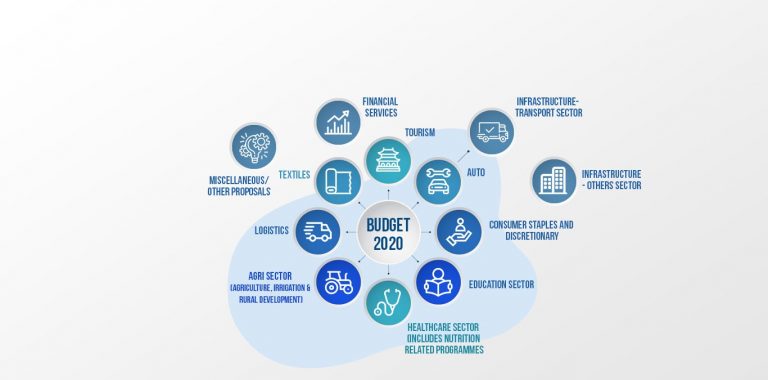
Let\’s look at the key industry specific announcements made in Budget 2020 and its impact.

Textiles

AnnouncementImpact
Proposal to set up a National Technical Textiles Mission with a 4-year implementation period from FY21 to FY24, at an outlay of Rs. 1,480cr.Will help reduce India’s annual import bill due to technical textiles worth ~$16bn. Local companies will be encouraged to set up technical textile manufacturing capacity in India

Logistics

AnnouncementImpact
National Logistics Policy to be set up soon to clarify roles of Union Government, State Government and regulators.Will create a single window e-logistics market, increasing the pace of movement of goods and setting up of warehousing infrastructure.

Agri sector (Agriculture, Irrigation & Rural Development)

AnnouncementImpact
Total Allocation for Agri Sector is Rs. 2.83 lakh crores. Out of this Rs. 2.83 lakh crores, Rs. 1.60 lakh crores to be allocated towards agriculture, allied activities, irrigation and Rs. 1.23 lakh crores to be allocated towards Rural Development.Positive for all companies deriving income from farmers – FMCG, agri inputs, irrigation, fertilizers, two-wheelers, pipes etc. 
Pradhan Mantri Kisan Urja Suraksha Evem Utthan Mahabhiyan (PM KUSUM) to be expanded to provide 20 lakh farmers for setting up standalone solar pumps.Positive for solar pump manufacturing companies. 
Scheme to enable farmers to set up solar power generation capacity on their fallow/barren lands and to sell it to the grid would be operationalized.Positive for solar equipment companies. Implementation can be an issue unless farmers are given subsidy to install solar plants.
Focus on balanced use of all kinds of fertilizers including the traditional organic and other innovative fertilizers with a view to change the prevailing incentive regime, which encourages excessive use of chemical fertilisers.Negative for select fertilizer manufacturing companies.  To build a seamless national cold supply chain for perishables, inclusive of milk, meat and fish, the Indian Railways will set up a “Kisan Rail” – through PPP arrangements. There shall be refrigerated coaches in Express and Freight trains as well.Positive for freight and logistics companies. 
Framework for development, management and conservation of marine fishery resources. The fish production to be raised to 200 lakh tonnes by 2022-23.Positive for companies engaged in business of fisheries and frozen foods.
Facilitate doubling of milk processing capacity from 53.5 million MT to 108 million MT by 2025.Negative for dairy companies as prices will decrease with the increase in supply.

Healthcare sector (includes nutrition related programmes)

AnnouncementImpact
Total allocation towards health sector is about Rs. 69,000 crores that is inclusive of Rs.  6400 crores for Prime Minister Jan Arogya Yojana (PMJAY). Mission Indradhanush has been expanded to cover 12 diseases, including five new vaccines.Positive for companies engaged in business of Hospital & Healthcare Services.
Presently, under PM Jan Arogya Yojana (PMJAY), there are more than 20,000 empanelled hospitals. Proposition of including more empanelled hospitals in Tier-2 and Tier-3 cities for poorer people under this scheme.  
Proposition to set up Viability Gap funding window for setting up hospitals in the PPP mode. In the first phase, Aspirational Districts will be covered, where presently there are no Ayushman empanelled hospitals. This would also provide large scale employment opportunities to youth.
Strengthening of TB campaign.Positive for Pharmaceutical companies.
Allocation of Rs. 35,600 crores for nutrition related programmes.Positive of Pharma, Hospital & Healthcare and Consumption sector.
Health Cess on import of medical equipment Negative for hospitals setting up new facilities or augmenting capacity

Education sector

AnnouncementImpact
Budgetary allocation of about Rs. 99,300 crores for education sector in 2020-21 and about Rs. 3,000 crores for skill development. An allocation of Rs 8,000 crore for National Mission on Quantum Computing and TechnologyPositive for companies engaged in business of Education, Training and Skill Development.
The New Education Policy to be announced soon.
Steps to enable sourcing External Commercial Borrowings and FDI so as to be able to deliver higher quality education.
About 150 higher educational institutions will start apprenticeship embedded degree/diploma courses by March 2021.  

Consumer Staples and Discretionary

AnnouncementImpact
Lowering of income tax rates to increase household savings (subject to riders)Positive for staples and discretionary items as consumption would increase due to higher disposable income in hands of individuals
Basket of announcements to boost rural income. Farmer income is expected to double by 2022
Excise duty raised on cigarettes and tobacco products (10-11% on blended basis). No change is being made in the duty rates of bidisNegative for cigarette manufacturing companies as the end product would become costly.
Increase in customs duty on imported footwear (5-10%), furniture (5%), wall fans (from 7.5% to 20%), tableware/kitchenware made of porcelain or China ceramic doubled to 20%, food processing products and many other productsPositive for domestic manufacturers as imported products will become expensive leading to higher demand for domestic products, thereby boosting domestic manufacturing 
Withdrawal of customs duty exemption on raw sugar, agro-animal based products, tuna bait, skimmed milk, certain alcoholic beverages, soya fibre and soya protein

Auto

AnnouncementImpact
Custom duty on completely built unit of electric motor vehicle increased from 25% to 40%This will provide a partial boost to domestic manufacturing of auto OEM and components 
The customs duty on completely built internal combustion engine vehicle is increased from 30% to 40%.
Tax on semi-knocked down form of electric PV and 3W has been raised from 15% to 30% and electric buses, trucks and 2W raised from 15% to 30%
Tax on completely knocked down electric buses, trucks and 2W raised from 10% to 15%

Tourism

AnnouncementImpact
Rs. 2,500cr allocated for Tourism IndustryInvestments will help in providing better infrastructure, connectivity and improved tourist experience thereby boosting the overall Tourism in India
More premium trains like Tejas express to be introduced between key tourist stations
Developing on-site museums at five archaeological sites
Rs 3,100cr kept aside for Culture Ministry

Aviation

AnnouncementImpact
100 more airports to be developed by 2025 and doubling of aircraft fleetPositive for Aviation sector as well as Tourism

Financial Services

AnnouncementsImpact
Depositor Insurance Coverage to increase from Rs. 1 lakh to Rs.5 Lakh per depositor of scheduled commercial banks.Negative for scheduled commercial banks.
Bond Market: Non-Resident Indians will be permitted to invest in certain Government Securities. FPI Investment limit in corporate bonds has been increased to 15% from 9% currently. A new debt ETF proposed consisting mainly of Government SecuritieDeepen investment in bond market
Affordable Housing: Allocation for affordable housing under the Pradhan Mantri Awas Yojana (PMAY) was higher by 9% at Rs. 275bn in FY21 vs Rs. 258bn RE in FY20. Govt extends additional Rs.1.5 lakh tax benefit on interest paid on affordable housing loans to March 2021 (from March 2020) Tax holiday is provided on the profits earned by developers of affordable housing project approved by 31st March 2020. This is extended upto March 2021.Positive for HFCs focusing on affordable housing
Debt recovery under SARFAESI: Eligibility limit for NBFCs for debt recovery under SARFAESI Act proposed to be reduced to asset size of Rs.1 bn (from Rs.5bn) or loan size of Rs.5mn (from Rs.10mn).Positive for small lenders in terms of recoveries
Liquidity improvement for NBFCs/HFCs: To address the liquidity constraints of the NBFCs/HFCs, the government formulated a Partial Credit Guarantee scheme for the NBFCs. To further this support of providing liquidity, a mechanism would be devised.Positive for NBFCs as and when final measures are taken
Lending to MSMEs: NBFCs to extend invoice financing to the MSMEs through TReDs Banks to provide subordinate debt for entrepreneurs of MSMEs, which will be counted as quasi-equity and would be fully guaranteed.Positive for MSME lenders
Divestment plans: Government will list LIC and also sell stake in IDBI Bank to private investors to meet FY21 divestment target of Rs.2.1 trillion.Negative for insurance companies
New tax regime: Removal of deductions under new tax regime discourages taxpayers to invest in ELSS and life insurance products.Negative for insurance companies and AMCs

Infrastructure- Transport Sector

AnnouncementImpact
Infrastructure allocation and funding Target of Rs 103 trillion investment in infrastructure projects reiterated. Overall 6500 projects identified across – railways, Metrorail, logistics, irrigation, healthcare, education, housing, water, etc. Rs 220bn has already been financed by Infrastructure Finance Companies such as IIFCL and its subsidiary- NIIF. Govt also proposes 100% tax concession to sovereign wealth funds to encourage them to take part in funding these projects.Positive for steel & cement companies, equipment suppliers, EPC players engaged in construction of projects in the mentioned sectors.
Railways Budgetary allocation for Railways is up by 3% at Rs 722bn in FY21 vs Rs 700bn in FY20RE. Indian Railways to set up Kisan Rail for transport of perishable goods.  Setting up large solar power capacity alongside rail tracks. To redevelop 4 stations with the help of private sector. Positive for Railways construction, Solar EPC players, wagon manufacturers and logistics players.
Roads Budgetary allocation of Rs 170bn for transport infrastructure that includes accelerated development of highways  12 lots of highway bundle spread over 6,000 kms will be monetized by FY24. Development of 2,500 kms of highways, 2000 kms of coastal roads, 9,000 kms of economic corridors. Positive for steel & cement companies Transport infrastructure players engaged in construction of roads, highways, and equipment manufacturers.
Airports Under UDAAN scheme, 100 more airports to be developed by 2024. It is expected that the air fleet number shall go up from present 600 to 1200.Positive for EPC players engaged in construction of airports and airport infrastructure, steel & cement companies, automation players.
Water treatment and management Budgetary allocation of Rs 115bn in FY21 vs Rs 100bn in FY20 RE for the Jal Jeevan Mission.  Comprehensive measures for 100 water-stressed districts.Positive for EPC players carrying out projects such as water treatment, irrigation projects, etc.

Infrastructure- Others Sector

AnnouncementImpact
Power Sector Budgetary allocation of Rs 220bn to power and renewable energy sector in FY21. New power generation companies have been extended the benefit of lower rate of 15%.Positive for EPC players engaged in the Power generation and T&D sector, cable suppliers, distribution equipment manufacturers.
Advice to all States and Union territories to replace conventional meters with smart meters in the next 3 years.Positive for companies engaged in the manufacture of smart meters.
Oil & Gas Sector Expand National Gas grid from the present 16,200 km to 27,000 kmPositive for EPC players engaged in the pipe laying companies, pipeline suppliers.
Cables Sector Budget allocation of Rs 60bn to Bharatnet programme in FY21 to provide internet connectivity in 1,00,000 gram panchayats.Positive for companies engaged in the manufacture of optical fibre cables.

Miscellaneous/Other proposals

AnnouncementImpact
Allocation of Rs 12,300 Crs towards Swach BharatThis mission now focuses towards liquid and grey water management and is committed towards ODF Plus.  Focus would also be on solid waste collection, source segregation and processing. This would further benefit sanitary ware companies.
Aiming to provide piped water supply to all households, allocated Rs 3.60 lakh crores to the Jal Jeevan Mission. This scheme also places emphasis on augmenting local water sources, recharging existing sources and will promote water harvesting and de-salination. Cities with over a million population will be encouraged to meeting this objective during the current year itself. During the year the scheme would be provided with a budget of Rs 11,500 crs.Action plan to ease India\’s water problems. Positive for pipe, water treatment pump, valve and cement companies among others.
Rs 85,000 crs allocated towards Scheduled Castes and Other Backward Classes Rs 53,700 crs allocated towards Scheduled Tribes Rs 53,700 crs allocated towards Senior Citizens and Handicapped.Furthering government’s commitment towards the welfare and development of SC, OBC, ST, Senior citizens and Handicapped.
Allocation of Rs 4,400 Crs for providing clean air in large cities having population of above one million.For ensuring cleaner air in cities having population above one million.
Increase in customs duty (from 10% to 20%) on Water heaters, Table Fans, ceiling fans, pedestal fans and scores of other electrical appliancesPositive for domestic manufacturers of these goods and the sector as it makes the fringe players exit.
Tax payment on ESOPs to be deferred by five years from the time of exercise or till employees leave the company or when employee sell their shares, whichever is earlier.These measures would provide additional support to start ups in their initial phase, thereby encouraging the start-up eco system.
Extension of turnover limit from Rs25cr to Rs. 100cr for deduction of 100% of its the profits for three consecutive assessment years out of seven years

Read more: About Research and Ranking.

As always, the budget has evoked mixed responses from the general public as well as Indian stock market investors. To help you better understand certain key announcements of the budget and its potential impact I have decided to decode it in a simplified manner.

Let me start with big picture first.

Decoding Fiscal Prudence

The government receipts for the current fiscal are expected to be approx. Rs. 20 Lakh crore and this is expected to rise to approximate Rs. 22 lakh crore for the FY20-21.

The broad break-up of this 22 lakh crore for the next year is:

  • Around Rs. 16 lakh crore as taxes
  • Rs. 4 lakh crore as income for the services it provides (Railways, telecom, etc.) and
  • Around Rs. 2 lakh crore is the disinvestment target they have set for FY20-21

With this, the annual expenses for the government are expected to be around Rs. 30 lakh crore. The broad break-up for them is:

  • Around Rs. 4 lakh crore on capital expenditures
  • Rs. 10 lakh crore on subsidies and interest
  • Around Rs. 4 lakh crore would be allocated to defence and
  • Remaining would be spent across various existing and new schemes

If you look at the numbers closely, yes, that’s a fiscal gap (receipts – expenditure) of around Rs. 8 lakh crore for the coming year.

Now before you jump to conclusions, there are 2 ways to look at reducing this gap:

  1. The government aims to improve its revenue targets
  2. The government aims to reduce its capital expenditures or reduce on expenditures on various existing or new welfare schemes announced

The government has instead gone ahead with the third option – allow extra burden of 0.5% on the fiscal deficit. 

Is This A Good Or A Bad Move?

Let us agree, as of now, a growth of even 10% in revenue collection, especially in the current scheme of things, seems an ambitious target. Coming to expenses, if the government reduces its capital expenditure, it would have a greater negative effect on the economy. In fact, the government, has spent around Rs. 3.4 lakh crore on capital expenditure this year, has decided to up its capital spending by over 17% and raise it to around Rs. 4 lakh crore.

If the government raises its capital spending especially during the times of lack of investor confidence, it would act as a confidence booster to the private investments and in turn act as a catalyst to promote higher investments.

The other positive I see here is that the government has taken a firm approach that it does not intend to go for a populist budget by increasing spends on subsidies or add newer sops.

The better way to look at it from my perspective is that the government is firm on its $5 trillion goal. And is taking all possible steps to maintain STABILITY & CONTINUITY in that direction. 

LTCG & DDT- Good or Bad for Indian Stock Market Investors?

The next on the discussion list has been LTCG. The government had set a target of Rs. 40,000 crore when it reintroduced the tax in 2018. The collection for the same is said to be much lower than its target for the current fiscal.

Neither have the Indian stock market investors really paid LTCG, nor has the government collected a significant amount as LTCG, then what is this hue & cry all about?

Thinking from a stock market investor’s perspective, speaking in the form of an example, if I am investing Rs. 10 lakh, after 3 years, if my investments have grown to say Rs. 20 lakh, I would have to pay Rs. 90,000 as LTCG (LTCG of 10% is imposed only on profits of above Rs. 1 lakh). Would I not go for stock market investments that are giving me returns that beat all other investment options by a big margin only because there is a 10% tax?

Similarly, coming to DDT, many Indian stock market investors are having negative perceptions on the decision taken. Presently, DDT is payable by the company on dividend distributed/paid to the shareholders and it is tax free income in the hands of the shareholders. With the new announcement, the company would not have to pay any tax on dividends, but it would be taxable in the hands of the shareholders.

Let me explain this with an example, currently dividend income is stated to be in the range of around 2% of the value of investments. This means if you are holding shares worth Rs. 10 lakh, you could receive dividends somewhere in the range of 2%, i.e., Rs. 20,000. Let\’s assume the company passes on the entire benefit of DDT tax savings to its shareholders; the dividend you would receive would increase to Rs. 25,000. If you fall in the income range of less than Rs. 15 lakh per annum, it is an obvious benefit to you.

1. Consider this, retail stock market investors in India hold a small number of shares, whereas the promoters/founders hold a much larger portion. Hence, the company would surely not want to affect the promoters this way. This would in turn result into them using that money to either invest in expansion of the company or even consider buyback of shares. In event of either, it would be beneficial to the shareholders.

2. Coming on to the second reason, we also need to understand that the reversal of DDT is done considering it would attract more foreign investment in India. In the current scheme of things, if a company gave dividend to its shareholders, it would deduct DDT and then give away the money to them.

3. For foreign investors, they would not get any credit for the amount deducted as DDT and the dividend income would be taxable in their country. With this announcement, the company would only have to deduct a Withholding Tax and pass on the remaining amount as dividend. And yes, they would be able to claim a credit of this in their country as well. This would give a direct boost to foreign investments in the stock markets.

4. The other confusion around this is that the companies, while paying dividends, will not pass on the DDT tax savings to the shareholders. Consider this, retail investors hold a small number of shares, whereas the promoters/founders hold a much more significant portion. Hence, the company would surely not want to affect the promoters this way. Even if they do it, it would result in them using that money to either invest in the expansion of the company or for debt repayment or even consider buyback of shares. In the event of either, it would be beneficial to the shareholders.

Confusion Around Personal Income Tax

The next on the debate list has been the personal income tax structure. I’ve heard a lot about how the government has created more confusions than before on which structure should one be going for. But, thinking deeper, the government had always stated that simplifying the tax structures would be one of the things on their agenda and this is the first step they seem to have taken in that direction.

Coming on to whether it is beneficial or not to the taxpayers, I give this move a big thumbs up, if you look at the larger picture. Or rather, I would say it will help Indian stock market investors in two major ways:

  1. In order to save tax, taxpayers were forced to invest in vehicles that would give them lesser returns. Now, by reducing the tax slabs and removing the exemptions provided, taxpayers get the liberty to save & invest according to their personal preferences. Also, this step would give tax payers a slightly bigger share of in hand income and in turn promote more consumption/expenditure at their end too.
  2. Also, a simplified tax structure will always prompt faster increase in the number of tax payers. For the current fiscal, personal income tax collection is expected to increase to the tune of around 18%. With a simplified tax structure, it is expected to ease tax payment for the newer tax payers that would get added in the years to come.

From a government perspective, they will be able to better manage the high rates of interest they are forced to pay on instruments like EPF or PPF.

Disinvestment Plan Or A Desperate Measure?

Moving ahead, disinvestment has been a big talking point. To boost revenue flows for the year and to reduce reliance on external debt, divestment targets have been increased from Rs. 65,000 crore to Rs. 2.1 lakh crore.

A large portion of this would come from stake sale in Life Insurance Corporation of India (LIC) and Industrial Development Bank of India (IDBI), reducing the chances for the government missing this target. There is no denying that listing of LIC would have a big bearing on sectorial fund allocations from domestic funds and FII’s, and thus on the trading multiples enjoyed by its peers. But this is a long pending move, with no or limited business implication on the competitors.

There are two other ways to look at it:

  1. By listing LIC on the Indian stock markets, it would make the company a lot more transparent and accountable. The total assets of LIC, that fall in the range of Rs. 35 lakh crore, would be more transparently and efficiently managed. Yes, as I said before, it would have some negative impact on other insurance players, but it would also lead to better competition in the market and provide better products to the end consumer.
  2. With the listing of LIC on the Indian stock markets, the government is looking to raise funds close to Rs. 1-1.25 lakh crore during the next fiscal. If the government is looking to raise such a high amount, one basic factor it would have to ensure is that the overall sentiments around the economy tend to be in the positive to highly positive range.

Conclusion

In my humble opinion, I think the Finance Minister has done a commendable job with regards to not deviating from the target of the Indian economy reaching the $5 trillion mark.  And it is a proven fact that stock markets in India follow the trajectory of GDP.  So you can imagine the kind of wealth one can create by investing now in those stock market investment opportunities which will grow when India grows over the next 4-5 years.

By taking an extra burden of 0.5% on the fiscal deficit targets, the government has given impetus on growth as its primary goal. Along with this, by not reducing the spending on capital expenditure (infrastructure spending), it is a great step that the government has taken to showcase that overall growth and development continue to be its primary focus.

The FM has reiterated the government\’s commitment by mentioning 6,500 projects and spend of Rs. 103 lakh crore multiple times in her speech to boost infra growth in India.

The government has also continued its quest for reforms in the financial space by easing the personal income tax structure.

And last but not the least, if the government can pull off the disinvestment plans in a systematic manner, it would give a significant boost to the overall strength of the economy.

Saying all this, yes, you may find some misses as well that could have been addressed by FM. But, considering the steps taken, I feel the government has reiterated its commitment to making India a $5 trillion economy.

Read more:  How Long-term investing helps create life-changing wealth – TOI.

In our previous article we took a look at key highlights of Budget 2020. Now let’s take a detailed look at the changes in personal income tax rates.

The Budget has proposed lower income tax rates for individuals as shown below:

    Sr. No. Income Slab Existing Regime New Regime
(without exemptions and deductions
        1 Less than Rs. 2.5L NIL               NIL
        2 Rs. 2.5L – Rs. 5L 5%               5%
        3 Rs. 5L – Rs. 7.5L 20%               10%
        4 Rs. 7.5L – Rs. 10L 20%              15%
        5 Rs. 10L – Rs. 12.5L 30%              20%
        6 Rs. 12.5L – Rs. 15L 30%              25%
       7 More than Rs. 15L 30%              30%

* This is for individuals below 60 years of age

We take a look at two cases – one where taxable income is same in new and old regime (Case A) and the other where Gross Salary is same in new and old regime

Case A – Same taxable income in new and old regime

Individuals can choose between either of the tax regimes. In case they choose the new regime with lower taxes, they will have to forego exemptions and deductions claimed in the old regime. The following is an example of tax implication in case of taxable income of Rs. 15L, assuming the person is not claiming any deductions. In this case, an individual will save Rs. 78,000 worth of tax.

Income
Slabs
Incremental
Income
Tax rate in
Existing Regime
Amount
(Rs.)
 
Tax rate in
proposed Regime
Amount
(Rs.)
  Tax
Reduction
Rs. 0L – Rs. 2.5L 250,000 0%   0%    
Rs. 2.5L – Rs. 5L 250,000 5% 12,500   5% 12,500    
Rs. 5L – Rs. 7.5L 250,000 20% 50,000   10% 25,000    
Rs. 7.5L – Rs. 10L 250,000 20% 50,000   15% 37,500    
Rs. 10L – Rs. 12.5L 250,000 30% 75,000   20% 50,000    
Rs. 12.5L – Rs. 15L 250,000 30% 75,000   25% 62,500    
  Tax implication (Rs.) 262,500     187,500    
  Health & Education
Cess @ 4% (Rs.)
10,500   H&E Cess- @4% 7,500    
  Total Tax Implication (Rs.) 273,000   Total Tax 195,000   78,000
                 
  Avg Tax Rate   18.20%     13.00%   5.20%

Summary of Income tax rates saving for different income brackets:

    Tax Implication (Rs.)  
Sr. No. Taxable Income (Rs.) Earlier Case New Case Saving (Rs.)
       1 0 – 2,50,000
       2 2,50,000 – 5,00,000
       3 5,00,000 – 7,50,000 13,000 – 65,000 13,000 – 39,000 0 – 26,000
      4 7,50,000 – 10,00,000 65,000 – 1,17,000 39,000 – 78,000 26,000 – 39,000
      5 10,00,000 – 12,50,000 1,17,000 – 1,95,000 78,000 – 1,30,000 39,000 – 65,000
      6 12,50,000 – 15,00,000 1,95,000 – 2,73,000 1,30,000 – 1,95,000 65,000 – 78,000

Case B – Same gross salary in new and old regime

The new tax regime has a catch. In case an individual chooses to use all deductions and exemptions (which most people WILL do), then he / she will end up saving tax in the old regime. There will be no incentive to switch to the new regime.

OLD Regime New Regime
  Salary Income 1,500,000     Salary Income 1,500,000  
Deductions: 80C 150,000   Deductions:    
  80D – Medicliam 25,000        
  80CCD – NPS 50,000     80CCD (2) – NPS 50,000  
  Hsg Loan int 200,000        
  Std Deduction 50,000        
  80G – Donations 50,000        
  Taxable Income 975,000     Taxable Income 1,450,000  
  <2.5L 250,000   <2.5L 250,000
  2.5L – 5L @ 5% 12,500 250,000   2.5L – 5L @ 5% 12,500 250,000
  5L – 10L @ 20% 95,000 475,000   5L – 7.5L @ 10% 25,000 250,000
          7.5L – 10L @ 15% 37,500 250,000
          10L – 12.5L @ 20% 50,000 250,000
          12.5L – 15L @ 25% 62,500 250,000
  Tax Payable 107,500          
  Cess @ 4% 4,300     Tax Payable 187,500  
  Total Tax 111,800     Cess @ 4% 7,500  
          Total Tax 195,000  

The below table summarizes tax loss incurred by adopting the new regime as against retaining old regime and availing all exemptions and deductions:

    Tax Implication (Rs.)  
Sr. No. Taxable Income (Rs.) Earlier Case New Case
Extra tax implication (Rs.)
      1 0 – 2,50,000
      2 2,50,000 – 5,00,000
      3 5,00,000 – 7,50,000 0 – 33,800 0 – 33,800
      4 7,50,000 – 10,00,000 33,800 – 70,200 33,800 – 70,200
      5 10,00,000 – 12,50,000 0 – 59,800 70,200 – 1,19,600 10,400 – 59,800
      6 12,50,000 – 15,00,000 59,800 – 1,11,800 1,19,600 – 1,95,000 59,800 – 83,200

Read more:  How Long-term investing helps create life-changing wealth – TOI.

We view the budget to have delivered on most of the parameters which would enable India gear itself for the journey towards doubling its GDP to $5tn by 2025. Central theme of this year’s budget seem to be enhancing consumer spending & farm incomes, continue impetus on infrastructure, divestments, etc, while ensuring fiscal deficit doesn’t cross the stated threshold.

In longest budget speech ever, the current FM presented the budget while trying to deliver on most set of areas, which currently needs attention. The theme of the budget revolved around ease of living supported by good governance standards and robust financial sector. The three key pillars and sub sectors which were the focus areas were:

  • ASPIRATIONAL INDIA– Agriculture, irrigation and rural development
  • ECONOMIC DEVELOPMENT– Industry, commerce and investment, infrastructure and new economy
  • CARING SOCIETY– Women & child, social welfare, culture & tourism, environment & climate change

Fiscal balance remains undisturbed even as capital expenditure budgets are raised

Budget 2020-21 reflects the Government’s firm commitment to substantially boost investment in the economy. Government proposes to increase the planned expenditure by 12% YoY to Rs. 30.42 lakh crore in FY21, while keeping the fiscal deficit target at 3.8% of the GDP. This is expected to translate in incremental investments of approx. Rs3.5 lakh crore for the year.

What gives us comfort and confidence that the stated targets are realizable are realistic growth assumptions and well calibrated estimation for revenue flows.

  1. Expenditure target is based on a nominal growth assumption of 10% for FY21, which translates in a real growth rate of 5.5-6.0% and is quite in line with the estimates provided by various reputed domestic as well as global agencies.
  2. Similarly, to boost revenue flows for the year and to reduce reliance on external debt, divestment targets have been increased from Rs 1.05 lakh crore to Rs 2.1 lakh crore. A large portion of this would come from stake sale in Life Insurance Corporation of India (LIC) and IDBI, reducing the chances for missing this target. There is no denying that listing of LIC would have a bearing on sectoral fund allocations from domestic funds and FIIs and thus on the trading multiples enjoyed by its peers, but this is a long pending move, with no or limited business implication on the competitors.

Overall therefore we see that the Government has been able to maintain the fine balance of fiscal discipline and GDP growth, amidst rising infrastructure expenditure. As stated earlier, all seem to be on track for achieving the $5tn mark in next 5 years.

Taxation anomalies across segments being ironed out

Spurring demand and rectification of anomalies seem to the common thread concerning taxation measures announced across segments in this budget. Some key announcements include:

  1. Extension of tax holiday for affordable housing segment by one more year (Mar’21). Developers have been incentivized to launch more projects in this space and individuals to purchase under affordable housing scheme.
  2. Steps initiated for personal taxation reform include rejigging tax slabs along with reduction in tax rates, even as standard deductions are removed. Here Government has given the choice to individual taxpayers to either shift to the new regime or continue under the old method, based on their preference. This has been done to simplify the tax structure and leave higher disposable income in the hands of individual taxpayers.
  3. Abolishment of Dividend Distribution Tax (DDT)- DDT has been abolished for the corporates and has been made taxable in the hands of recipients. Based on back of the envelop calculations, we expect this step to be beneficial for taxpayers below Rs 10 lakh slab of income.
  4. Cooperatives brought on same level as corporates– tax for cooperative societies has been reduced to 22% plus surcharge and cess, from 30% at present.
  5. 100% tax exemption for sovereign wealth funds for investments in priority sectors. This is likely to boost investments in the infrastructure space.

Boost to financial sector, MSME and startups to reinvigorate the slowing economy

With an aim to provide boost to financial system, and other areas of concerns, key proposals in budget are.

  1. Eligibility limit for NBFCs for debt recovery under SARFESI act reduced from asset size of Rs5 bn to Rs1 bn and loan quantum from Rs1 crore to Rs50 lakh.
  2. Proposal to ask RBI to extend the time limit for MSME restructuring to Mar’21 from Mar’20 and provide subordinated debt to MSME for working capital which will be treated as quasi equity and will be fully guaranteed
  3. Limit of FPI in corporate bonds to be increased from 9% to 15%

Raising of turnover target from Rs25 crore to Rs100 crore for startups to claim 100% deduction of profits for three consecutive years out of 7 years which is also enhanced to 10 years.

Read more:  How Long-term investing helps create life-changing wealth – TOI

Frequently asked questions

Get answers to the most pertinent questions on your mind now.

[faq_listing]
What is an Investment Advisory Firm?

An investment advisory firm is a company that helps investors make decisions about buying and selling securities (like stocks) in exchange for a fee. They can advise clients directly or provide advisory reports and other publications about specific securities, such as high growth stock recommendations. Some firms use both methods, like Research & Ranking, India’s leading stock advisory company, specializing in smart investments and long-term stocks since 2015.

An investment advisory firm is a company that helps investors make decisions about buying and selling securities (like stocks) in exchange for a fee. They can advise clients directly or provide advisory reports and other publications about specific securities, such as high growth stock recommendations. Some firms use both methods, like Research & Ranking, India’s leading stock advisory company, specializing in smart investments and long-term stocks since 2015.

An investment advisory firm is a company that helps investors make decisions about buying and selling securities (like stocks) in exchange for a fee. They can advise clients directly or provide advisory reports and other publications about specific securities, such as high growth stock recommendations. Some firms use both methods, like Research & Ranking, India’s leading stock advisory company, specializing in smart investments and long-term stocks since 2015.

An investment advisory firm is a company that helps investors make decisions about buying and selling securities (like stocks) in exchange for a fee. They can advise clients directly or provide advisory reports and other publications about specific securities, such as high growth stock recommendations. Some firms use both methods, like Research & Ranking, India’s leading stock advisory company, specializing in smart investments and long-term stocks since 2015.