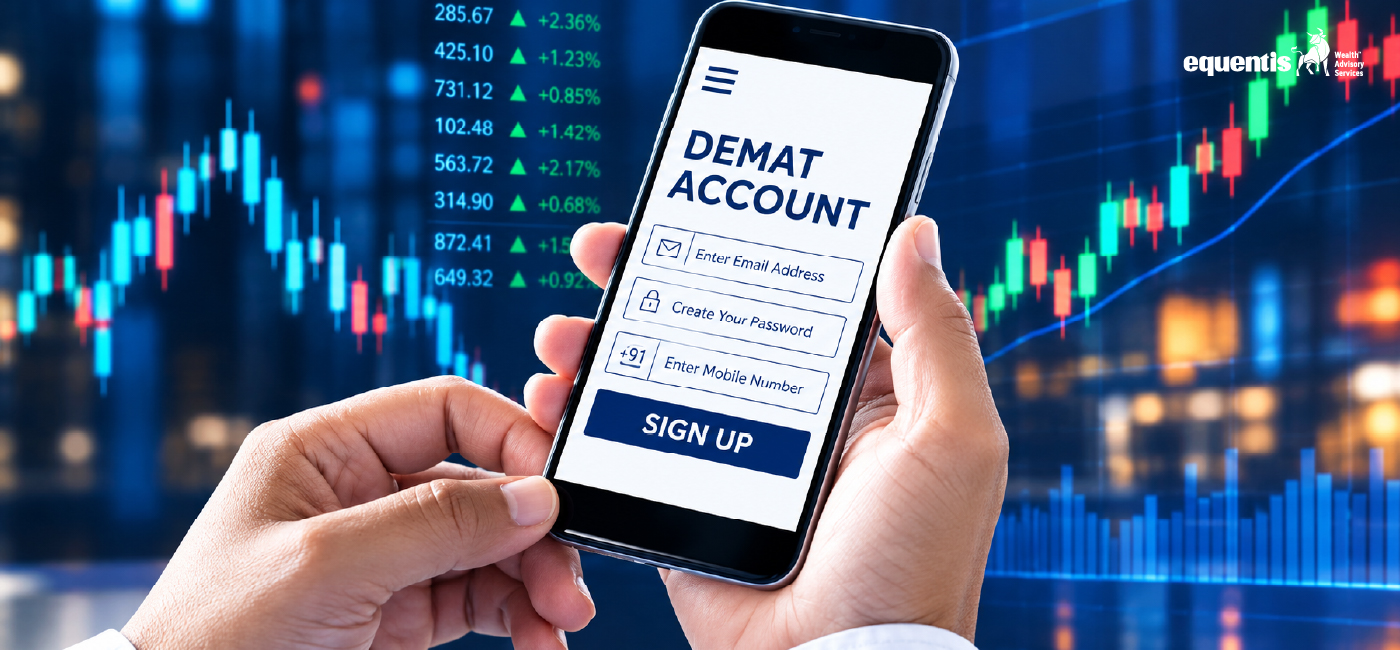

A demat account is an electronic account used to hold financial securities such as shares, bonds, ETFs and other eligible investments in digital form. For Indian investors, it is an essential part of investing in the securities market because securities purchased through exchanges are credited to the investor’s demat account. Opening one is generally a digital process, but investors should understand the different charges, account types and service terms before choosing a Depository Participant (DP).
What Is a Demat Account?
The word “demat” is short for dematerialisation, which means converting physical securities into electronic form. Instead of receiving paper share certificates, investors hold their securities digitally through a demat account.
In India, depositories such as CDSL and NSDL maintain the electronic securities infrastructure, while investors generally access these services through a Depository Participant, such as a broker or bank.
A demat account is different from a bank account. A bank account primarily holds money, while a demat account holds securities. Investors may also need a trading account to place buy and sell orders on a stock exchange.
For example, if an investor purchases 20 shares of a listed company, the securities are credited electronically to the investor’s demat account after settlement. When those shares are sold, the securities are debited from the account.
Why Is a Demat Account Important?
The shift from physical certificates to electronic holdings has made investing more convenient and reduced several operational risks associated with paper-based securities.
A demat account can offer benefits such as:
- Electronic holding: Shares and other eligible securities can be stored digitally.
- Convenience: Investors can view holdings through online platforms.
- Reduced paperwork: There is no need to maintain physical share certificates.
- Easier transactions: Securities can be credited or debited electronically.
- Portfolio visibility: Investors can track their holdings and transaction statements in one place.
- Access to corporate actions: Information relating to dividends, bonuses, rights issues and other corporate actions can be processed through the securities account.
For investors holding physical securities, dematerialisation can also make managing investments easier.
How Does a Demat Account Work?
A typical investment transaction involves three related components: the bank account, trading account and demat account.
The bank account is used to transfer or receive money. The trading account is used to place orders to buy or sell securities. The demat account is where securities are held electronically.
Suppose an investor buys shares worth ₹20,000. The money is paid through the linked banking arrangement, the purchase order is executed through the trading account, and the purchased securities are subsequently credited to the demat account after the applicable settlement process.
This separation helps investors understand why having a demat account alone does not necessarily mean they can directly place stock market orders.
What Are the Charges for a Demat Account?
Demat account charges vary by Depository Participant, so investors should check the current tariff before opening an account. Account opening charges may be nil with some providers, but other services can carry fees.
Common charges include:
Annual Maintenance Charges
Annual Maintenance Charges, or AMC, are fees charged for maintaining the demat account. The amount can vary depending on the DP, account type and applicable plans.
Transaction and Debit Charges
Some DPs charge for particular securities transactions or debit instructions. The applicable amount and structure depend on the DP’s tariff.
Dematerialisation and Rematerialisation Charges
Converting physical securities into electronic form is called dematerialisation. Converting electronic securities back into physical certificates is called rematerialisation. These services may involve charges.
Investors should also check applicable taxes, GST and other statutory or service-related charges. SEBI has historically rationalised several demat-related costs, while the actual tariff for services can differ between DPs.
What Is a BSDA?
A Basic Services Demat Account (BSDA) is a type of demat account intended for eligible individual investors with relatively smaller holdings.
Under the current framework, an eligible individual can have only one demat account where they are the sole or first holder, and the value of securities in the account must remain within the prescribed limit of ₹10 lakh. For eligible BSDA accounts, AMC is nil when holdings are up to ₹4 lakh and can be a maximum of ₹100 when holdings are above ₹4 lakh and up to ₹10 lakh.
Since September 1, 2024, eligible new demat accounts are generally opened as BSDA accounts unless the investor provides specific consent for a regular demat account.
How to Open a Demat Account in India
Opening a demat account can usually be completed online through a broker or other DP.
The general process is:
- Choose a Depository Participant: Compare the DP’s AMC, transaction charges, platform features and service terms.
- Complete the application: Enter personal and financial information.
- Provide required documents: PAN and other officially accepted identity and address documents may be required.
- Complete verification: Digital verification and video-based verification may be part of the process.
- Complete KYC: The DP verifies the information and completes the applicable KYC requirements.
- Receive account details: Once approved, the investor receives the demat account or Beneficiary Owner identification details and can access the account through the provider’s platform.
SEBI’s investor documentation recognises electronic account opening and digital verification as part of the online demat account opening process.
Benefits and Risks of Having a Demat Account
A demat account simplifies the process of holding and managing securities. Digital records can reduce the risks associated with lost, damaged or misplaced physical certificates and make portfolio monitoring more convenient.
However, investors should not assume that a low-cost or zero-opening-charge account is completely free. AMC, transaction, service and other applicable charges can still apply. Investors should also protect their login credentials, review transaction statements regularly and ensure that account details and nomination information are accurate.
A demat account also does not eliminate investment risk. The value of securities can rise or fall depending on market conditions and the performance of the underlying investment.
What Should Investors Check Before Opening a Demat Account?
Before choosing a provider, compare:
- Account opening charges
- Annual Maintenance Charges
- Securities transaction or debit charges
- Dematerialisation and rematerialisation fees
- Applicable taxes and other charges
- Trading platform and customer support
- Statement and reporting facilities
- BSDA eligibility and terms
- Nomination and account closure procedures
Reading the tariff sheet before opening an account can help avoid unexpected costs later.
Conclusion
A demat account is the digital facility through which Indian investors hold securities electronically. It works alongside a trading account and bank account to support the process of investing in market-linked securities. While opening a demat account can be straightforward, investors should compare AMC, transaction fees, service charges and BSDA eligibility before selecting a Depository Participant. Understanding these details can make the account easier to manage and help investors keep track of the actual costs associated with investing.
Frequently Asked Questions
1. What is a demat account in simple words?
A demat account is an electronic account used to hold securities such as shares, bonds and ETFs in digital form. It replaces the need to hold eligible securities through physical certificates. Investors generally access a demat account through a Depository Participant connected to CDSL or NSDL.
2. Is a demat account mandatory for buying shares in India?
For holding listed shares purchased through the normal electronic market mechanism, investors generally need a demat account because securities are credited electronically. A trading account is also generally required to place buy and sell orders through a broker, while a bank account is used for related money transfers.
3. What is the difference between a demat account and a trading account?
A demat account stores securities electronically, whereas a trading account is used to place buy and sell orders. A bank account handles money. These accounts work together when an investor purchases or sells securities through the stock market.
4. How much does it cost to open a demat account?
There is no single fixed demat account opening fee across all providers. Some DPs may offer account opening at no charge, while their other services can have fees. Investors should check the provider’s current tariff for AMC, transaction charges, dematerialisation and other applicable costs.
5. What is the annual maintenance charge for a demat account?
Annual Maintenance Charges, or AMC, are fees for maintaining a demat account. The amount varies by Depository Participant and account type. Eligible Basic Services Demat Accounts can have nil AMC up to the prescribed holding limit, subject to applicable BSDA rules.
6. Can I have more than one demat account?
Yes, an investor can have multiple demat accounts, subject to applicable rules and account structures. However, BSDA eligibility has specific conditions, including having only one demat account where the investor is the sole or first holder. Investors should check the current requirements before choosing a BSDA.
7. What documents are required to open a demat account?
Common requirements include a PAN and officially accepted identity and address information. The exact documents and verification process depend on the Depository Participant and applicable KYC requirements. Many providers allow investors to complete the process digitally.
8. What is a BSDA demat account?
BSDA stands for Basic Services Demat Account. It is designed for eligible individual investors with securities holdings within the prescribed limit. Under the current framework, AMC is nil for holdings up to ₹4 lakh and can be a maximum of ₹100 for holdings above ₹4 lakh and up to ₹10 lakh.
9. Can I close my demat account?
Yes, a demat account can generally be closed by following the DP’s account closure procedure. Before closure, investors may need to transfer or sell securities and settle outstanding obligations. Any applicable charges and refund of prepaid AMC, where relevant, depend on the DP’s terms and applicable regulations.
10. Is a demat account safe for holding shares?
A demat account provides electronic recordkeeping for securities, but investors should still follow basic account security practices. Use strong credentials, avoid sharing passwords or verification codes, review transaction and holding statements, and report unauthorised activity promptly to the relevant intermediary.
Disclaimer Note: The securities quoted, if any, are for illustration only and are not recommendatory. This article is for education purposes only and shall not be considered as a recommendation or investment advice by Equentis. We will not be liable for any losses that may occur. Investments in the securities market are subject to market risks. Read all the related documents carefully before investing. Registration granted by SEBI, membership of BASL & certification from NISM in no way guarantee the performance of the intermediary or provide any assurance of returns to investors.

Jaspreet Singh Arora is the Chief Investment Officer at Equentis, where he heads a seasoned team of equity analysts and turns two decades of market experience into portfolios that consistently beat the benchmark. A go-to voice on cement, building-materials, real-estate, and construction stocks, Jaspreet previously ran research desks at leading brokerages, honing an eye for the metrics that truly move share prices. His plain-spoken analysis helps investors cut through noise and act with conviction. When he’s not deep-diving into earnings calls, you’ll find him unwinding over sports, weekend cricket or a good history podcast.