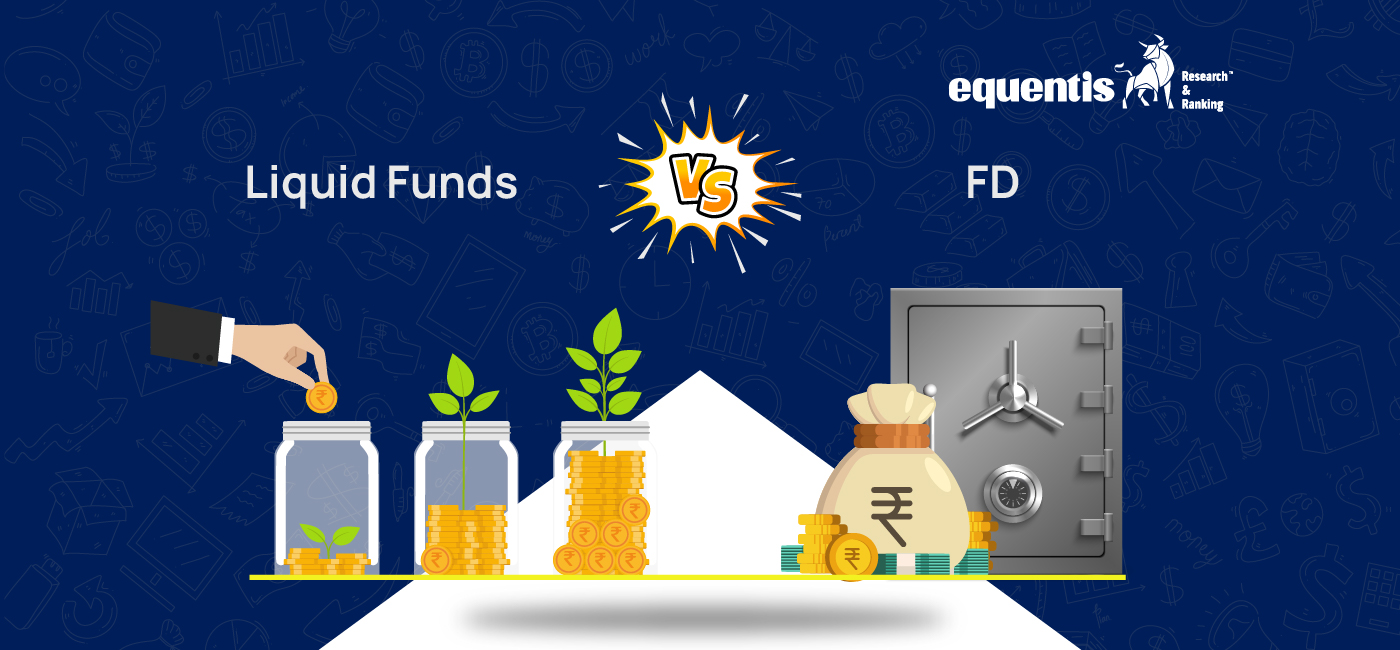

When it comes to low-risk investments in India, liquid funds and fixed deposits (FDs) are often the first choices for investors. Both aim to preserve capital while generating stable returns, yet they work very differently. Understanding liquid funds vs FD is crucial to choosing the right option based on liquidity needs, tax efficiency, inflation impact, and investment horizon.
In this blog, we break down liquid funds vs FD, compare returns, risk, taxation, and help you decide which option aligns better with your financial goals.
What Are Liquid Funds?
Liquid funds are a category of debt mutual funds that invest in short-term money market instruments such as treasury bills, commercial papers, and certificates of deposit. These instruments typically have a maturity of up to 91 days, making liquid funds one of the safest mutual fund options.
Key Features of Liquid Funds
- Low interest rate risk
- High liquidity (redemption within 24 hours)
- No lock-in period
- Suitable for short-term parking of surplus funds
Liquid funds are often recommended by a SEBI registered investment advisory for emergency funds or short-term goals.
What Is a Fixed Deposit (FD)?
A fixed deposit is a traditional investment option offered by banks and NBFCs where you invest a lump sum for a fixed tenure at a predetermined interest rate.
Key Features of Fixed Deposits
- Guaranteed returns
- Fixed tenure (7 days to 10 years)
- Premature withdrawal penalty
- Interest rate remains unchanged during tenure
FDs are preferred by conservative investors who value certainty over flexibility.
Liquid Funds vs FD: Head-to-Head Comparison
1. Returns: Liquid Funds vs FD
FD returns depend on prevailing interest rates and typically range between 5%–7% per annum (varies by bank and tenure). Liquid fund returns are market-linked but usually fall in a similar range over short periods.
Over very short durations, liquid funds can be more efficient due to daily accrual of returns.
2. Liquidity and Access to Funds
- Liquid Funds: Money is usually credited within T+1 day, making them ideal for emergencies.
- FDs: Premature withdrawals may attract penalties and loss of interest.
Winner: Liquid Funds
3. Risk Factor
- Liquid funds carry minimal credit risk, especially when invested in high-quality instruments.
- FDs are considered safe, but returns may not always beat inflation.
Both are low-risk, but liquid funds offer slightly better flexibility.
4. Taxation: Liquid Funds vs FD
Tax on FD Interest
Interest earned on FDs is fully taxable as per your income tax slab. There is no indexation benefit, and TDS applies if interest exceeds the threshold.
Taxation of Liquid Funds
- Gains are taxed as short-term capital gains if held for less than 3 years
- Tax rate = your income tax slab
- No TDS for resident individuals
From a post-tax perspective, liquid funds can be more efficient for high-income investors.
5. Impact of Inflation
FD returns often struggle to beat inflation. Using an inflation calculator, you’ll notice that real returns on FDs can turn negative over time.
Liquid funds, while not inflation-beating instruments, tend to offer better inflation-adjusted efficiency due to flexibility and compounding.
6. Investment Horizon
- Liquid Funds: Best for a few days to 6 months
- FDs: Suitable for fixed time horizons (1–5 years)
7. SIP vs FD: Which Is Better for Small Investors?
While SIPs are not typically used for liquid funds, investors often compare SIP vs FD when building disciplined savings.
- SIPs work better for long-term wealth creation
- FDs and liquid funds are better for capital preservation
Liquid Funds vs FD: Which One Should You Choose?
Choose liquid funds if:
- You want quick access to money
- You are in a higher tax bracket
- You are parking surplus cash temporarily
Choose FDs if:
- You prefer guaranteed returns
- You have a fixed investment horizon
- You are a conservative investor
A SEBI registered investment advisory can help align this choice with your broader financial plan.
Final Verdict: Liquid Funds vs FD
There is no universal winner in liquid funds vs FD. The right choice depends on your liquidity needs, tax bracket, and investment horizon. For short-term and flexible needs, liquid funds often score higher. For certainty and long-term stability, FDs remain relevant.
Disclaimer Note: The securities quoted, if any, are for illustration only and are not recommendatory. This article is for education purposes only and shall not be considered as a recommendation or investment advice by Equentis – Research & Ranking. We will not be liable for any losses that may occur. Investments in the securities market are subject to market risks. Read all the related documents carefully before investing. Registration granted by SEBI, membership of BASL & certification from NISM in no way guarantee the performance of the intermediary or provide any assurance of returns to investors.
FAQs
1. What is the main difference between liquid funds and FD?
The main difference between liquid funds vs FD is flexibility and taxation. Liquid funds invest in short-term debt instruments and offer higher liquidity, while FDs provide fixed returns for a predetermined tenure.
2. Are liquid funds safer than fixed deposits?
Both are considered low-risk. Bank FDs offer guaranteed returns, while liquid funds carry minimal market risk. When selected carefully, liquid funds recommended by a SEBI registered investment advisory are very stable.
3. Which gives better returns: liquid funds vs FD?
Returns are usually comparable over short periods. However, liquid funds may deliver slightly better post-tax returns, especially for investors in higher tax brackets.
4. Can liquid funds be used as an emergency fund?
Yes, liquid funds are ideal for emergency funds due to their high liquidity and quick redemption, typically within one working day.
5. How quickly can money be withdrawn from liquid funds?
Most liquid funds credit redemption proceeds within T+1 day, making them more liquid than FDs.
6. Is there any lock-in period in liquid funds?
No, liquid funds do not have a lock-in period. You can redeem your investment anytime without penalties.
7. How is tax on FD interest calculated?
Tax on FD interest is calculated as per your income tax slab rate. The interest earned is added to your total income and taxed accordingly.
8. Are liquid funds taxed every year?
No, liquid funds are taxed only when you redeem them. There is no annual taxation on unrealized gains.
9. Do liquid funds attract TDS?
No, liquid funds do not attract TDS for resident Indian investors, unlike FDs.
10. Which is better for short-term investment: liquid funds or FD?
For short-term investments (a few days to a few months), liquid funds are generally better due to easy liquidity and no premature withdrawal penalties.
11. Can I lose money in liquid funds?
The risk is very low, but not zero. Losses may occur in rare cases of credit defaults, which is why investing through a SEBI registered investment advisory is advisable.
12. Are liquid funds affected by interest rate changes?
Liquid funds are minimally impacted by interest rate fluctuations because they invest in very short-term instruments.
13. How does inflation impact FD returns?
FD returns often fail to beat inflation. Using an inflation calculator, you may find that real returns on FDs are sometimes negative.
14. Can an inflation calculator help compare liquid funds vs FD?
Yes, an inflation calculator helps assess the real purchasing power of returns, making it easier to compare liquid funds vs FD effectively.
15. Is SIP vs FD a valid comparison?
SIP vs FD is relevant for long-term disciplined investing. SIPs are better for wealth creation, while FDs and liquid funds are better for capital protection.
16. Who should invest in liquid funds?
Liquid funds are suitable for investors who want to park surplus cash, maintain high liquidity, or build an emergency fund.
17. Are FDs still a good investment option?
Yes, FDs remain a good choice for conservative investors who prefer guaranteed returns and have a fixed investment horizon.
18. How do SEBI registered investment advisory firms view liquid funds?
Most SEBI registered investment advisory firms recommend liquid funds for short-term needs, emergency funds, and tactical cash management.
19. Are liquid funds better than FDs for high-income earners?
Yes, liquid funds can be more tax-efficient for high-income earners since tax on FD interest is higher for those in higher tax slabs.
20. Should I choose liquid funds or FD for parking surplus cash?
For parking surplus cash temporarily, liquid funds are generally preferred due to better liquidity, flexibility, and tax efficiency compared to FDs.

Jaspreet Singh Arora is the Chief Investment Officer at Equentis, where he heads a seasoned team of equity analysts and turns two decades of market experience into portfolios that consistently beat the benchmark. A go-to voice on cement, building-materials, real-estate, and construction stocks, Jaspreet previously ran research desks at leading brokerages, honing an eye for the metrics that truly move share prices. His plain-spoken analysis helps investors cut through noise and act with conviction. When he’s not deep-diving into earnings calls, you’ll find him unwinding over sports, weekend cricket or a good history podcast.