

A couple of days ago, the Bombay Stock Exchange (BSE) celebrated its 150th birthday.
We even covered a detailed analysis showing BSE’s journey from under a Banyan tree to a powerhouse today.
While most investors focused on BSE’s 150th anniversary, one thing that went unnoticed was the sheer growth of BSE’s underlying index BSE Sensex.
The Bombay Stock Exchange created BSE Sensex on April 1, 1979. Starting from a base of 100 points back then, it touched a record level of 86,000 in 2024 and currently trades around 82,000 levels.
BSE Sensex’s Growth Trajectory
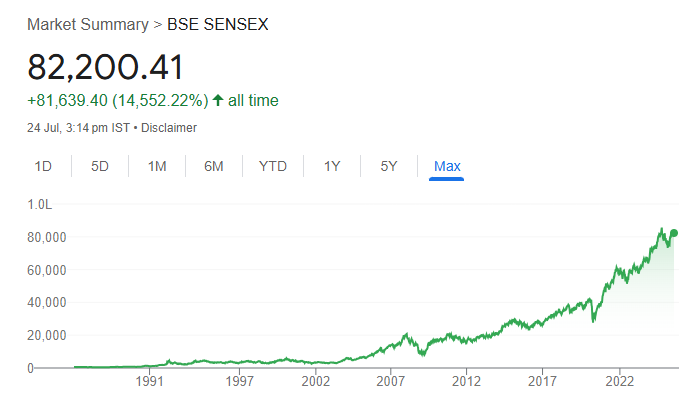
That’s an eye-popping rise of approximately 800 times. If you’d invested Rs 1 lakh in the index when it was created, it would have turned into the princely sum of over Rs 8 crore today.
The question then arises – with such amazing returns, wouldn’t it be a good idea to simply invest in the passive index?
Why try to pick individual stocks? Why bother with doing anything else at all?
Because currently, there are multiple ways one can invest in the Sensex –
Sensex Mutual Funds: These are mutual fund schemes that passively track the BSE Sensex. They invest in the exact same 30 stocks, in the same proportion as the index.
Sensex ETFs: These are traded on stock exchanges just like individual stocks. They mirror the performance of the Sensex and offer intraday liquidity.
DIY Portfolio Creation: If you’re a hands-on investor, you can even manually buy all 30 Sensex stocks in the same weights as the index. While it’s more effort, it gives full control over your holdings and dividend income. Platforms like MultiplyRR make this possible.
So, the obvious question is – with such massive returns, why not just invest in the index itself?
It’s not that simple… Here’s why.
The Two Ways to Business-like Investing
Father of value investing Benjamin Graham would say – “Investment is most intelligent when it is most businesslike.”
Yes, stocks are not mere pieces of paper. Rather, they represent underlying businesses and you have to invest in stocks like you’re buying a stake in the business.
And broadly, there’s two ways to do such business-like investing:
One, you buy a stake in the business to profit from the rise in its fair value over time. As the company increases the business it does every year, its revenues go higher. As its revenues move higher – so do its profits. And as this process continues over the years, the value of the company too increases as with greater profit making capacity comes a greater market value.
The rise in the Sensex you saw over the last 45 years is a result of this process. As the value of the companies that make up the index increased, over this period, so did its value. In this case, the rise from 100 to 86,000 over 45 years means it rose at a compounded annual rate of 16% over this time.
Which brings us to the second way in which one can go about businesslike investing. You see, while the above process takes place over the long term, it is not a smooth one way street up. In the shorter term, stock prices see massive gyrations depending on how excited or disinterested the public gets about stocks.
Due to this, stock prices sometimes go much above the underlying fair value of the company, and at times much lower.
As a result, it often becomes possible to buy a company when its stock becomes undervalued in the market, and sell it when it reaches fair value.
In this case, you are trying to profit from the market’s undervaluation of the business rather than a rise in its fair value on account of growth in revenues and profits.
This second form of businesslike investing is what most investors seek and perform. That is, to profit from undervaluation rather than increases in fair value of a business.
As to ‘Why bother?’, it’s this second way that gives one an opportunity to get returns even higher than what one could get by simply trying to ride the growth in fair values of companies over time.
In other words, if one wants to beat that 16% return that the market gave over the long term, this is the way to go!
But There’s a Catch: Most Don’t Follow Either Approach Seriously
While both these methods sound simple on paper, the real-world investor often follows neither.
Most people don’t stay invested long enough to enjoy the 16% CAGR of the index.
And most who try to find undervalued stocks lack either the research depth or the patience to hold on till value emerges.
That’s why despite 800x growth in the Sensex, equity participation in India remains shockingly low.
This is where research-backed advisory firms come in.
In a market where most investors either exit too early or enter too late, the role of a trusted advisory becomes invaluable.
Identifying fundamentally strong companies trading below fair value isn’t easy. It requires time, experience, and an unemotional lens.
And that’s exactly what a good equity research advisory helps you with — filtering noise, and bringing serious business-like investing to your portfolio.
The Final Takeaway
So yeah — you can ride the Sensex and do well over time.
Or, if you have the temperament and tools, you can do even better by identifying mispriced businesses.
The key is to pick the approach that fits your personality and stick to it with discipline.
Either way, businesslike investing — not tips, trends, or Twitter — is the real path to wealth creation.
Happy Investing.
Disclaimer Note: The securities quoted, if any, are for illustration only and are not recommendatory. This article is for education purposes only and shall not be considered as a recommendation or investment advice by Equentis – Research & Ranking. We will not be liable for any losses that may occur. Investments in the securities market are subject to market risks. Read all the related documents carefully before investing. Registration granted by SEBI, membership of BASL & the certification from NISM in no way guarantee the performance of the intermediary or provide any assurance of returns to investors.

Yash Vora is a financial writer with the Informed InvestoRR team at Equentis. He has followed the stock markets right from his early college days. So, Yash has a keen eye for the big market movers. His clear and crisp writeups offer sharp insights on market moving stocks, fund flows, economic data and IPOs. When not looking at stocks, Yash loves a game of table tennis or chess.