
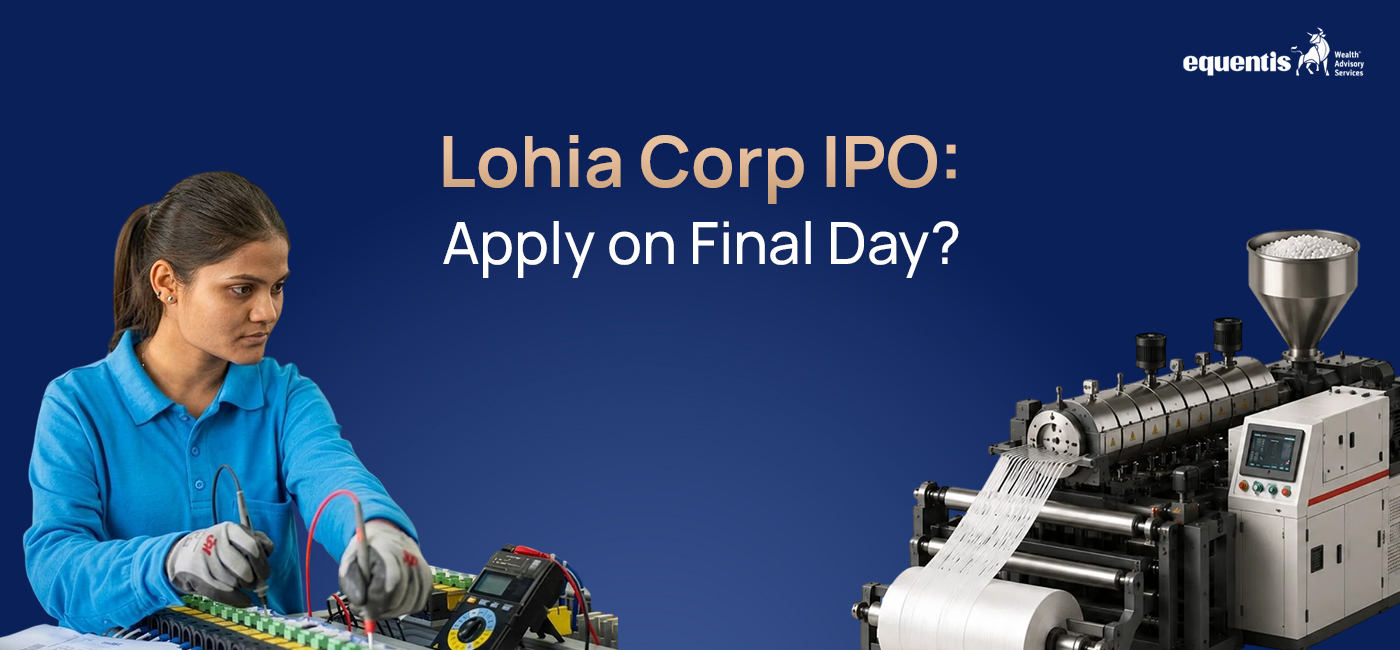

The Lohia Corp IPO has entered its final day of subscription, prompting many investors to decide whether to apply before the issue closes. While last day subscriptions often see a surge in bids, the decision should not be based solely on subscription numbers. Investors should evaluate the company’s business model, financial performance, industry outlook, valuation, and associated risks before making an investment decision. Understanding these factors can help determine whether the IPO aligns with your investment goals and risk appetite.
Lohia Corp IPO at a Glance
| Particulars | Details |
|---|---|
| IPO Size | ₹1,200 Crore |
| Fresh Issue | ₹300 Crore |
| Offer for Sale (OFS) | ₹900 Crore |
| Price Band | ₹1,250 – ₹1,325 per share |
| Lot Size | 11 Shares |
| Minimum Investment | ₹14,575 |
| IPO Closing Date | 3 August 2026 |
| Proposed Listing | BSE & NSE |
| FY26 Revenue | ₹2,046 Crore |
| FY26 Profit After Tax | ₹367 Crore |
| EBITDA Margin | 26.6% |
| Return on Net Worth (RoNW) | 24.9% |
| Debt-to-Equity Ratio | 0.04x |
| Export Presence | 100+ Countries |
| Global Circular Loom Market Share | 35%+ |
Why the Lohia Corp IPO Is in Focus
Initial Public Offerings (IPOs) continue to attract significant attention in India’s capital markets, particularly when established companies enter the public markets. Lohia Corp’s IPO has gained interest from retail and institutional investors due to the company’s presence in the industrial manufacturing sector and its role in serving global markets.
The final day of an IPO is often marked by increased participation, as investors wait to assess overall demand before submitting their applications. However, demand alone does not determine the long-term performance of a listed company. Evaluating the fundamentals remains equally important.
About Lohia Corp
Lohia Corp is engaged in manufacturing machinery and equipment used in the production of woven polypropylene (PP) and high-density polyethylene (HDPE) products. These products are widely used across industries such as packaging, agriculture, construction, and infrastructure.
Over the years, the company has built a presence in both domestic and international markets by supplying industrial machinery designed for large-scale manufacturing.
Its customer base spans multiple countries, making exports an important contributor to its business.
Key Business Statistics
- Presence in over 100 countries
- More than 35% global market share in circular looms
- Five manufacturing facilities across India
- Serves packaging, agriculture, infrastructure, and industrial sectors
- Significant contribution from exports, helping diversify revenue streams
Key Highlights of the IPO
The Lohia Corp IPO aims to raise capital through the primary market, with proceeds expected to be used for purposes such as:
- Funding expansion plans
- Investing in manufacturing capabilities
- Meeting working capital requirements
- General corporate purposes
- Strengthening the company’s financial position
As with any IPO, investors should carefully review the offer document to understand the utilization of funds and the company’s future growth strategy.
Subscription Snapshot
As of the latest available data:
| Category | Subscription |
|---|---|
| Retail Investors (RII) | 2.66x |
| Non Institutional Investors (NII) | 2.81x |
| Qualified Institutional Buyers (QIB) | 1.35x |
| Employee Portion | 1.92x |
| Overall Subscription | 2.28x |
While strong subscription numbers often indicate investor interest, they should not be viewed as a guarantee of listing gains or long-term performance.
What Should Investors Look at Before Applying?
Applying on the final day should involve more than checking subscription numbers. Several business fundamentals deserve attention.
1. Financial Performance
Reviewing the company’s revenue growth, profitability, operating margins, and cash flows can provide insights into its financial stability.
Key Financial Metrics
- FY26 Revenue: ₹2,046 Crore
- FY26 PAT: ₹367 Crore
- EBITDA Margin: 26.6%
- RoNW: 24.9%
- Debt-to-Equity: 0.04x
Key indicators include:
- Revenue growth over recent years
- Profit after tax (PAT)
- Operating margins
- Return ratios
- Debt levels
Consistent financial performance often indicates operational discipline, though past performance does not guarantee future results.
2. Industry Position
Lohia Corp operates in a niche manufacturing segment that supports packaging and industrial production.
Growth in sectors such as agriculture, food packaging, infrastructure, and exports may contribute to sustained demand for industrial machinery.
Investors should also assess how competitive the industry is and whether the company has maintained long-term customer relationships.
3. Valuation
One of the most important aspects of any IPO is pricing.
Even a financially stable company may face challenges in delivering attractive returns if the IPO valuation is significantly ahead of its earnings potential.
Comparing valuation metrics with listed peers may help investors understand whether the issue is reasonably priced.
Industry Statistics Supporting Growth
The company’s business is linked to broader manufacturing and packaging trends.
Packaging Industry Growth
- India’s packaging market is expected to reach US$ 204.8 billion by 2029.
- The sector is projected to grow at nearly 10% CAGR over the next few years.
Manufacturing Push
- Manufacturing contributes nearly 17% of India’s GDP.
- Government initiatives continue to focus on increasing domestic manufacturing capacity.
Global Demand Trends
- Global demand for woven polypropylene packaging products is expected to grow at 5–6% CAGR through 2030.
- Rising industrialization and exports continue to support machinery demand worldwide.
Understanding IPO Subscription Trends
Subscription data often receives considerable attention during the final day.
Typically, investors monitor:
- Retail investor participation
- Qualified Institutional Buyer (QIB) demand
- Non-Institutional Investor (NII) subscriptions
Strong institutional participation may indicate confidence in the company’s prospects, but subscription levels alone should not be treated as an investment recommendation.
Long-term returns depend on business execution after listing rather than subscription figures during the IPO.
Opportunities That Could Support Future Growth
Growing Demand for Packaging
Increasing consumption, organized retail, and industrial production continue to support demand for packaging materials globally.
Export Potential
The company’s international presence across more than 100 countries provides opportunities to benefit from rising global demand for industrial machinery.
Manufacturing Expansion
India’s continued focus on manufacturing and industrial development could create additional demand for capital equipment manufacturers.
Technology and Innovation
Investments in automation and advanced manufacturing technologies may help improve efficiency and strengthen competitiveness over time.
Risks Investors Should Keep in Mind
Every IPO carries risks, and investors should consider them carefully.
Dependence on Industrial Demand
Demand for machinery often depends on capital expenditure cycles. A slowdown in industrial investment could affect future orders.
Global Economic Conditions
Since exports contribute to the business, changes in global demand, trade policies, or currency movements may influence revenue.
Raw Material Costs
Fluctuations in steel and other input costs could impact manufacturing margins.
Competitive Industry
Industrial equipment manufacturing remains competitive, requiring continuous investment in product development and customer support.
Should You Apply on the Final Day?
The decision to apply should be based on your investment objectives rather than the urgency of the final subscription day.
Before applying, consider:
- Whether the company’s business model is easy to understand
- Its financial performance over multiple years
- Industry growth prospects
- IPO valuation relative to peers
- Risks associated with the business
- Your investment horizon and risk tolerance
For long-term investors, business fundamentals generally matter more than short-term listing expectations.
Conclusion
The Lohia Corp IPO has attracted attention as it reaches its final day of subscription. While strong investor participation may reflect market interest, it should not be the only factor influencing an investment decision. The company reported FY26 revenue of ₹2,046 crore, PAT of ₹367 crore, and maintains a low debt profile, while also benefiting from its presence in over 100 countries and a strong position in the global industrial machinery market.
Evaluating the company’s financial performance, industry position, growth opportunities, valuation, and business risks provides a more balanced perspective. As with any IPO, investors should read the offer documents carefully, understand the company’s long-term strategy, and ensure that the investment aligns with their financial goals and risk appetite before submitting an application.
FAQs
1. What does Lohia Corp do?
Lohia Corp manufactures machinery used for producing woven polypropylene (PP) and HDPE products used in packaging, agriculture, and industrial applications.
2. What was Lohia Corp’s FY26 revenue?
The company reported revenue of approximately ₹2,046 crore in FY26.
3. What was the company’s FY26 profit?
Lohia Corp reported a PAT of around ₹367 crore in FY26.
4. Is the last day of an IPO the best time to apply?
The last day often sees higher subscription activity, but investors should base their decision on the company’s fundamentals rather than timing alone.
5. What are the major growth drivers for Lohia Corp?
Growth may be supported by increasing demand for industrial machinery, exports, manufacturing expansion, and packaging industry growth.
6. What risks are associated with the Lohia Corp IPO?
Key risks include cyclical industrial demand, global economic conditions, raw material price fluctuations, and competitive pressures.
7. How can investors evaluate an IPO valuation?
Comparing the company’s valuation with listed peers, earnings, profitability, and growth prospects can provide useful context.
8. Does strong institutional participation guarantee good returns?
No. Institutional demand may indicate market interest, but future returns depend on the company’s execution and business performance after listing.
9. How many countries does Lohia Corp serve?
The company has a presence in more than 100 countries worldwide.
10. What documents should investors read before applying for an IPO?
Investors should review the Red Herring Prospectus (RHP), company financial statements, risk factors, valuation details, and the stated use of IPO proceeds before making a decision.
Disclaimer Note: The securities quoted, if any, are for illustration only and are not recommendatory. This article is for education purposes only and shall not be considered as a recommendation or investment advice by Equentis. We will not be liable for any losses that may occur. Investments in the securities market are subject to market risks. Read all the related documents carefully before investing. Registration granted by SEBI, membership of BASL & certification from NISM in no way guarantee the performance of the intermediary or provide any assurance of returns to investors.

Parvati Rai is the Vice President of the Research team at Equentis. She has over 15 years of equity-research and strategy-consulting experience. A specialist in deep-dive valuations, financial modelling, and forecasting, she has built research desks from the ground up, by steering buy-side, sell-side, and independent coverage across sectors. When she isn’t fine-tuning models, Parvati unwinds on nature treks and mentors aspiring analysts.










