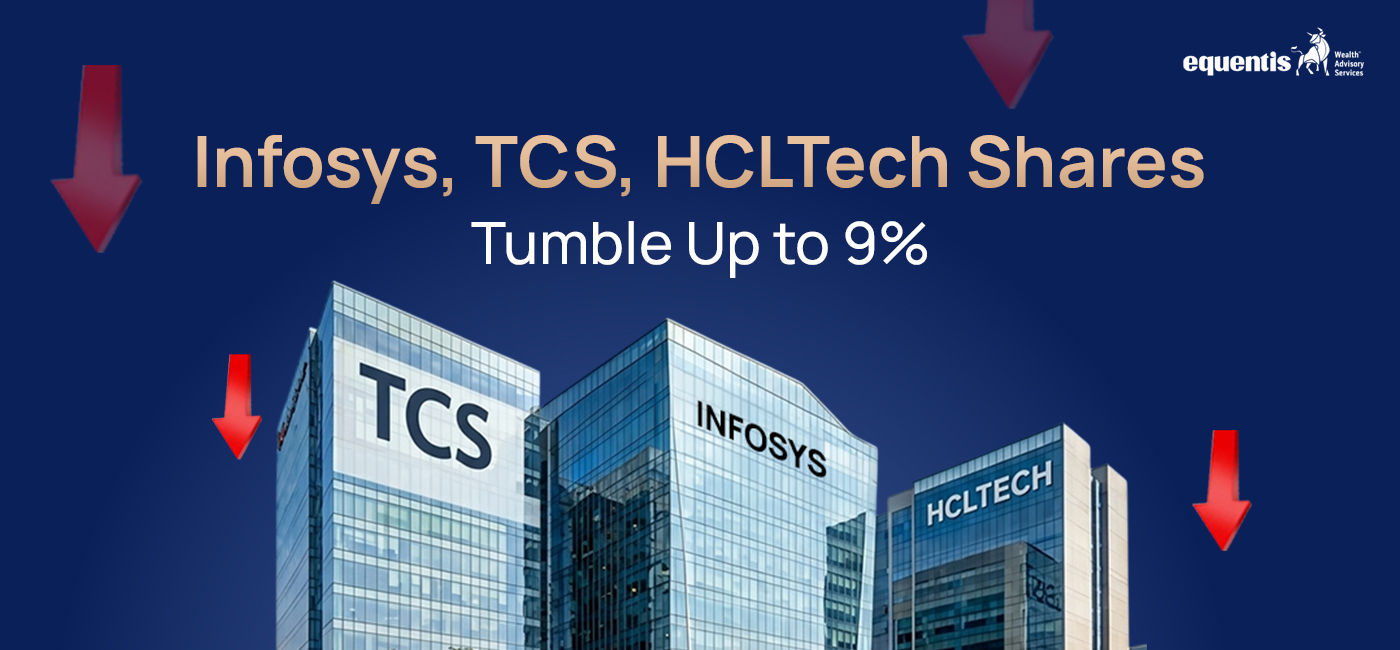

The Indian IT sector, long considered the bedrock of the country’s equity markets, recently witnessed a period of extreme volatility that has left many investors searching for answers. Shares of frontline technology giants, including Infosys, TCS, and HCLTech, experienced sharp declines, with some stocks tumbling by as much as 9% in a single session. This “bloodbath” in IT stocks saw the NIFTY IT index tanking over 10% in just two sessions, marking a significant departure from the steady growth trajectory many had come to expect.
Understanding the catalyst for such a massive sell-off requires a deep dive into macroeconomic shifts, evolving technological paradigms, and the delicate balance of global investor sentiment.
The Macro Trigger: US Economic Resilience and Interest Rate Anxiety
The primary trigger for the initial selling pressure was surprisingly strong economic data from the United States. Indian IT companies derive a massive portion of their revenue from North American clients, making them highly sensitive to the US economic climate.
Stronger-Than-Expected US Jobs Data
Latest US employment figures came in significantly stronger than market participants had anticipated. While robust employment is generally a sign of a healthy economy, for the stock market, it signaled a potential delay in interest rate cuts by the Federal Reserve.
The “Higher-for-Longer” Concern
When the US economy remains strong, the Federal Reserve has less incentive to lower interest rates. Higher interest rates for an extended period typically hurt growth sectors like IT for several reasons:
- Cost of Capital: Increased borrowing costs for corporate clients lead to tighter budget controls.
- Valuation Compression: Higher global bond yields often lead to a re-rating of IT valuations as the discount rate for future earnings increases.
- Delayed Spending: Without the relief of rate cuts, US companies often delay large-scale discretionary tech spending.
The AI Paradigm Shift: From Hype to Monetization Reality
For the past year, Artificial Intelligence (AI) was viewed as the ultimate growth catalyst for the IT sector. Every major earnings call was dominated by announcements of new AI partnerships and automation mandates. However, the narrative is shifting from “what AI can do” to “what AI is actually earning.”
Questions Around Meaningful Revenue
Investors are beginning to look past press releases and are asking tougher questions about revenue realization. There is growing concern over whether AI projects are generating meaningful revenue yet, or if they remain largely in the “pilot” and experimentation phase.
Efficiency vs. Billing Volumes
A more structural concern involves the long-term impact of AI-driven efficiency. If AI can automate tasks that previously required thousands of man-hours, could it eventually lead to a reduction in total billing volumes for traditional IT services?. This uncertainty has triggered short-term selling as the market recalibrates its long-term expectations for the sector.
Pilot Project Fatigue
While many clients are experimenting with AI, there is evidence of caution regarding large-scale transformation commitments. Clients are opting for smaller, outcome-based pilot projects rather than committing to multi-year, multi-billion dollar contracts, leading to a leaner deal pipeline for major firms.
Specific Performance and Market Indicators
The sell-off was not uniform across the board, but the heavyweights bore the brunt of the sentiment shift.
| Company | Impact Status | Key Concern |
|---|---|---|
| Infosys | Tumbled up to 9% | Revenue sensitivity to US discretionary spend |
| TCS | Tumbled up to 9% | RSI fell below 30, indicating oversold territory |
| HCLTech | Tumbled up to 9% | Recent stake acquisitions in AI firms under scrutiny |
| Tech Mahindra | Slipped up to 5% | Margin pressure from ongoing restructuring |
Technical Sell-Off
The severity of the fall was exacerbated by technical factors. For instance, TCS and several other Nifty 500 stocks saw their Relative Strength Index (RSI) drop below 30. While this technically indicates an “oversold” condition, it also reflects the intense momentum of the downward trend that forced many institutional investors to liquidate positions.
Why the Impact is Felt More in India
The deep connection between the Indian IT sector and the US economy cannot be overstated. For companies like Infosys and TCS, the US contributes a major share of total business. Consequently, any shift in US fiscal policy or corporate sentiment is felt instantly in Mumbai and Bengaluru.
- Client Dependence: When US firms face high borrowing costs, tech spending is often the first line item to be scrutinized.
- Global Sentiment: Indian IT stocks are often used by global funds as a proxy for global risk appetite. When global tech stocks react to Fed news, Indian IT stocks often follow suit regardless of domestic fundamentals.
- Currency Volatility: Movement of the Rupee against the Dollar continues to be a critical factor in margin calculations, adding another layer of complexity during periods of global macro uncertainty.
The Road Ahead: What Should Investors Watch?
While the recent fall appears to be driven more by sentiment and macro headlines than by a confirmed breakdown in business fundamentals, several key factors will determine the sector’s recovery.
- Quarterly Earnings: Actual revenue growth will be the ultimate test of the “AI monetization” thesis.
- Management Commentary: Investors will look for confident guidance regarding deal pipelines and client spending patterns.
- The India AI Impact Summit: Events like the India AI Impact Summit 2026 will be crucial for understanding how Indian firms are positioning themselves in the global AI hierarchy.
- Federal Reserve Guidance: Any clarity on the timeline for interest rate cuts could act as a significant relief trigger for the sector.
Final Thoughts
The correction in Infosys, TCS, and HCLTech shares is a reminder that the IT sector remains highly sensitive to global macroeconomic signals. For long-term investors, this phase of volatility might represent a period of consolidation where valuations become more realistic after the AI-fueled surge. However, for the short term, the sector is likely to remain under pressure until there is clear evidence that AI investments are translating into bottom-line growth and that the US economy is heading toward a “soft landing” with lower interest rates.
The next few quarters will be a defining period for Indian IT, proving whether these companies can successfully transition from traditional services to AI-first powerhouses.
Disclaimer Note: The securities quoted, if any, are for illustration only and are not recommendatory. This article is for education purposes only and shall not be considered as a recommendation or investment advice by Equentis. We will not be liable for any losses that may occur. Investments in the securities market are subject to market risks. Read all the related documents carefully before investing. Registration granted by SEBI, membership of BASL & certification from NISM in no way guarantee the performance of the intermediary or provide any assurance of returns to investors.

Jaspreet Singh Arora is the Chief Investment Officer at Equentis, where he heads a seasoned team of equity analysts and turns two decades of market experience into portfolios that consistently beat the benchmark. A go-to voice on cement, building-materials, real-estate, and construction stocks, Jaspreet previously ran research desks at leading brokerages, honing an eye for the metrics that truly move share prices. His plain-spoken analysis helps investors cut through noise and act with conviction. When he’s not deep-diving into earnings calls, you’ll find him unwinding over sports, weekend cricket or a good history podcast.