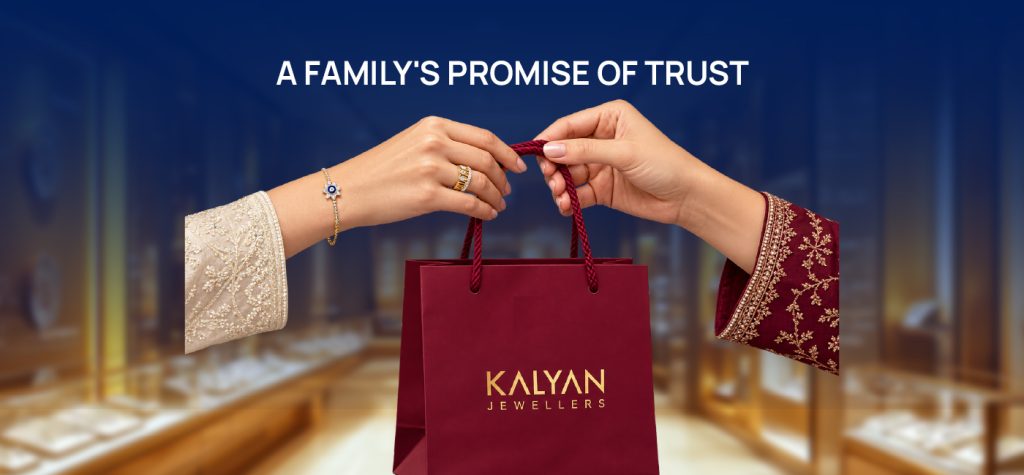
The Beginning: A Family’s Promise of Trust
Every jewellery purchase in India carries a story. It may mark a wedding, celebrate a birth, honour a relationship or represent years of savings. For Kalyan Jewellers, understanding this emotional connection became the foundation of a remarkable business journey.
Established in 1993 by T.S. Kalyanaraman in Thrissur, Kerala, Kalyan Jewellers emerged from a family business legacy dating back to 1908. The founder recognised that customers who already trusted the family’s textile business could extend that confidence to jewellery.
However, the ambition was bigger than opening another jewellery store. Kalyan wanted to change how people experienced jewellery shopping.
At a time when many traditional jewellers operated through smaller outlets and made-to-order inventory, Kalyan introduced a large-format showroom with ready-to-purchase jewellery. Customers could explore designs, compare options and make decisions with greater convenience. This retail innovation helped differentiate the brand from the beginning.
The idea was simple but powerful: make jewellery shopping more accessible, transparent and comfortable while retaining the traditional values associated with Indian jewellery.
From Kerala to a National Jewellery Brand
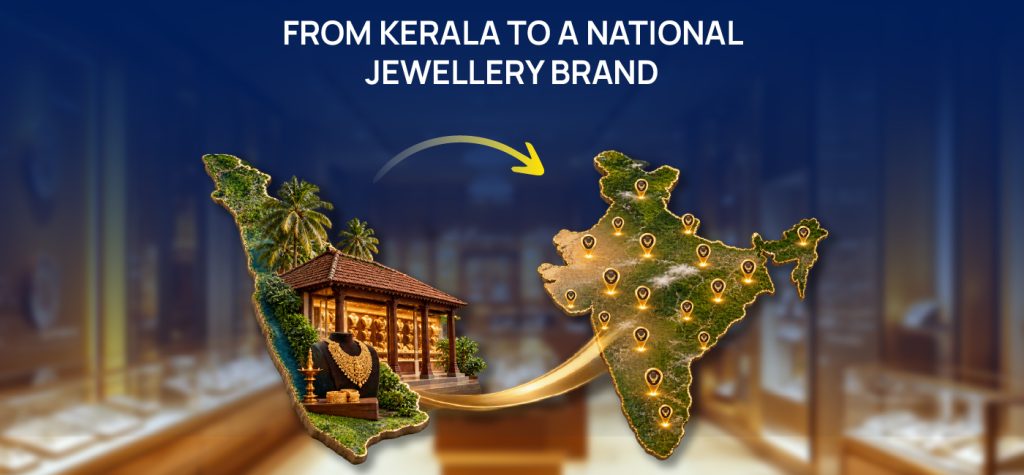
The next chapter was about expansion without losing customer trust.
In 2004, Kalyan Jewellers expanded beyond Kerala into Coimbatore. By 2010, it had entered Karnataka and Telangana, building a stronger presence across southern India. The company also introduced its My Kalyan customer outreach initiative, strengthening relationships with communities beyond its showrooms.
The journey brought an important lesson: India’s jewellery market cannot be approached with a single design philosophy.
A customer in Kerala might prefer traditional temple jewellery, while someone in Gujarat could seek different craftsmanship and bridal styles. Kalyan responded through a hyperlocal strategy, adapting inventory, designs and customer engagement to regional preferences while maintaining consistent brand values.
In 2012, the company entered Gujarat, followed by Delhi in 2014. Expansion continued into eastern, central and northeastern India, transforming Kalyan from a southern jewellery retailer into a national brand.
This geographical expansion also helped the company understand India’s diverse jewellery consumption patterns, including wedding purchases, festival shopping, gold investment preferences and changing consumer expectations.
Marketing That Turned Jewellery into an Experience
Kalyan Jewellers understood that jewellery marketing was not simply about displaying gold. It was about connecting with memories, relationships and cultural celebrations.
The company built visibility through large-scale campaigns, celebrity endorsements, regional brand ambassadors and showroom launches. Its communication combined a national identity with local relevance, allowing the brand to connect with customers across different linguistic and cultural markets.
Its campaigns frequently centred on weddings, family relationships, festivals and meaningful milestones. This approach helped position Kalyan as a participant in customers’ celebrations rather than merely a seller of ornaments.
Celebrity endorsements further strengthened brand recall, while regional campaigns helped establish familiarity among consumers who preferred communication in their own languages.
The company also introduced initiatives focused on customer education, including campaigns around jewellery purity, pricing and transparency. Price tags, customer service centres and loyalty initiatives supported its broader effort to make jewellery shopping more informed and convenient.
The strategy helped Kalyan build a brand identity around trust, customer experience and cultural understanding rather than relying exclusively on product pricing.

Challenges, Strategic Investments and Digital Expansion
Scaling a jewellery business across India presented significant challenges. Regional preferences, customer expectations, gold-price volatility and operational complexity required careful management.
Kalyan’s response was to strengthen its organisational capabilities while continuing to invest in growth.
In 2014, the company secured investment from Warburg Pincus, supporting its expansion ambitions. It subsequently broadened its business portfolio, including its investment in Candere, an online jewellery platform that expanded its engagement with digitally oriented consumers.
Candere represented an important shift in the company’s approach to jewellery retail. While traditional showrooms remained central to its business, online shopping introduced opportunities to connect with younger consumers, offer lifestyle jewellery and improve convenience.
Another defining milestone arrived in 2021, when Kalyan Jewellers India Limited listed on the NSE and BSE through its IPO. The listing marked a transition from a family-founded enterprise into a publicly traded company with greater institutional visibility.
Its franchise-led FOCO model, meaning franchisee-owned and company-operated stores, subsequently supported a more capital-efficient expansion strategy. This model allowed the company to increase its physical presence while retaining operational control over customer experience and showroom management.

The Numbers Behind Kalyan Jewellers’ Growth
The financial performance illustrates how the company’s brand-building efforts translated into business growth.
Consolidated Revenue Growth
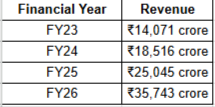
Revenue increased approximately 31.6% in FY24, 35.3% in FY25 and 42.7% in FY26.
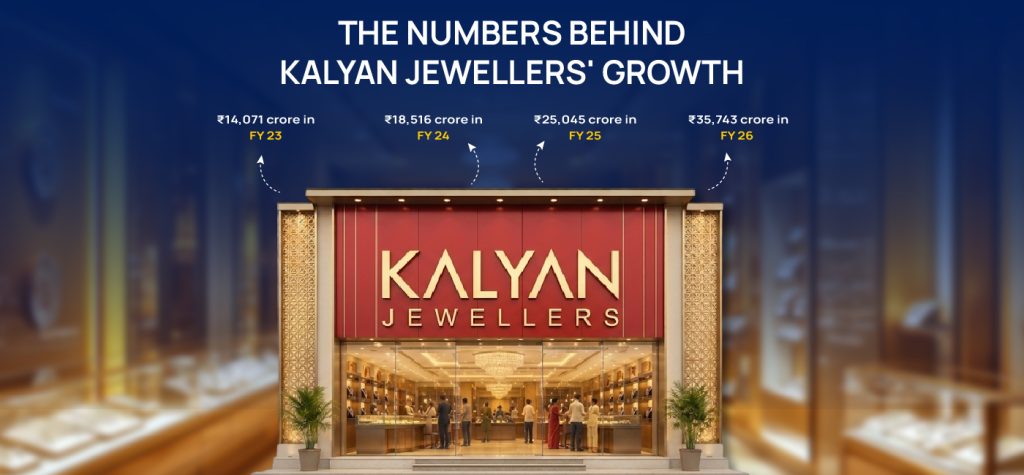
The FY26 performance marked another significant milestone, with consolidated revenue crossing ₹35,000 crore. The company continued to benefit from showroom expansion, demand across domestic markets and its growing international presence.
Profitability: Growth Beyond Revenue
Kalyan Jewellers also recorded a substantial improvement in profitability.
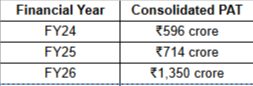
Profit after tax increased approximately 89% in FY26 compared with FY25. Consolidated EBITDA rose to approximately ₹2,491 crore from ₹1,517 crore in FY25, reflecting improved operating performance.
The improvement in profitability indicates that the company’s growth was supported not only by higher sales but also by operational efficiencies and business expansion.
However, jewellery retail remains a working-capital-intensive business. Gold prices, inventory management, financing costs and consumer demand can influence financial performance from one period to another.
FY26: A New Phase of Expansion
FY26 represented a significant year for Kalyan Jewellers in terms of revenue growth and geographical expansion.
As of March 31, 2026, the company operated 342 Kalyan Jewellers showrooms in India, 38 in the Middle East, two in the United States and one in the United Kingdom.
The entry into the United Kingdom marked another step in its international expansion strategy, extending the brand’s presence beyond its established Indian and Middle Eastern markets.
Candere also continued to expand its omnichannel presence. By the end of FY26, the platform operated 124 showrooms, compared with 73 in FY25.
Candere recorded approximately ₹425 crore in FY26 revenue and became PAT-positive during the second half of the financial year. Its expansion strengthened Kalyan’s position in lifestyle jewellery and digital-led consumer engagement.
These developments demonstrate how the company is increasingly building multiple retail formats under a broader jewellery business.
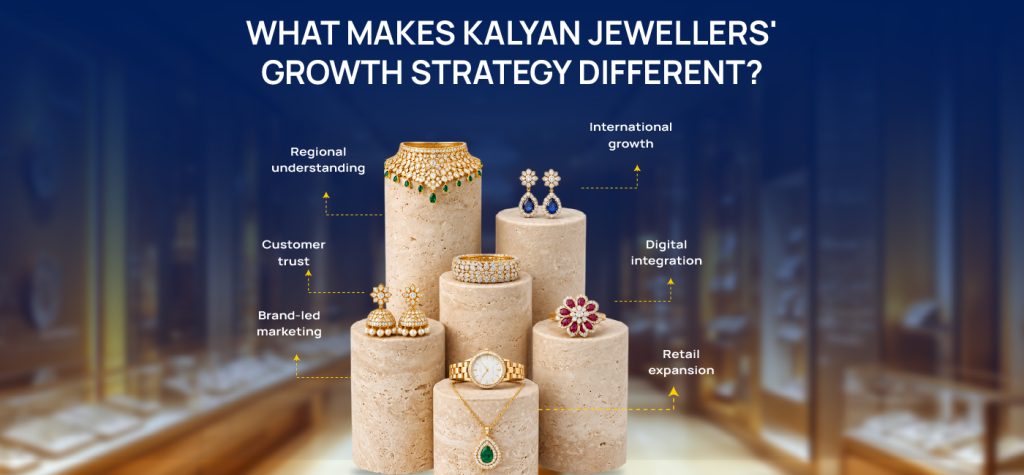
What Makes Kalyan Jewellers’ Growth Strategy Different?
Several factors explain the company’s continued expansion.
1. Regional understanding: Its hyperlocal merchandising strategy allows the company to serve different jewellery preferences across India’s diverse markets.
2. Customer trust: Transparency initiatives, customer education and consistent retail experiences have supported long-term customer relationships.
3. Brand-led marketing: Advertising built around weddings, festivals and family relationships connects the brand with important purchasing occasions.
4. Retail expansion: Large-format showrooms and the FOCO model support its expansion across established and emerging markets.
5. Digital integration: Candere provides an additional channel to reach digitally oriented consumers and diversify jewellery offerings.
6. International growth: Its Middle Eastern presence and entry into the United States and United Kingdom expand its potential customer base beyond India.
A Legacy That Continues to Shine
Kalyan Jewellers’ growth story demonstrates how trust can become a powerful competitive advantage.
From a single showroom in 1993 to ₹35,743 crore in FY26 consolidated revenue, the brand has combined cultural understanding, retail innovation, customer education and strategic expansion.
Its enduring achievement is not simply the number of showrooms it operates or the revenue it generates. It is the ability to remain relevant across generations, connecting traditional jewellery values with changing consumer expectations.
The company’s FY26 performance also highlights how a regional family business can evolve into a large organised jewellery retailer through disciplined expansion, customer engagement and investments in new business formats.
For Kalyan Jewellers, every purchase represents more than a transaction. It represents a relationship built around trust, tradition and meaningful occasions.
And that relationship continues to shape the company’s journey from a family business into one of India’s leading jewellery retail brands.

Parvati Rai is the Vice President of the Research team at Equentis. She has over 15 years of equity-research and strategy-consulting experience. A specialist in deep-dive valuations, financial modelling, and forecasting, she has built research desks from the ground up, by steering buy-side, sell-side, and independent coverage across sectors. When she isn’t fine-tuning models, Parvati unwinds on nature treks and mentors aspiring analysts.